Stablecoin regulation moved from debate to deadline on October 23, 2026, when the OCC published its final rule implementing core portions of the GENIUS Act. With an effective date of January 18, 2027, any business that holds, transacts in, or custody’s payment stablecoins — even as a non‑issuer — now faces a real compliance timeline. Here’s what the rule covers, what it leaves open, and how finance teams can prepare.
Table of Contents
- What just changed in stablecoin regulation?
- Why is the January 18, 2027 date important for my business?
- What does the OCC stablecoin rule cover?
- What does the OCC rule exclude?
- How should a non‑issuer business prepare?
- What custody activities fall under OCC supervision?
- How can I verify that my stablecoin issuer is permitted?
- What comes next after this OCC rule?
- Key Takeaways
What just changed in stablecoin regulation?
On October 23, 2026, the OCC’s final rule appeared in the Federal Register, fulfilling a statutory mandate under the GENIUS Act (signed into law July 18, 2025). The rule creates 12 CFR Part 15 and amends Parts 3, 6, 8, and 19. It sets prudential standards for permitted payment stablecoin issuers and foreign payment stablecoin issuers under OCC jurisdiction, and addresses custody activities at OCC‑supervised entities (TokenPost, October 28, 2026). This is not a blanket stablecoin regulation; it is a targeted federal framework for issuers and the banks that handle their stablecoins.
The January 18, 2027 effective date is hard‑coded in the statute: the GENIUS Act required the OCC to issue regulations within 18 months, so compliance lands on the same date enforcement begins for federally‑covered issuers. With the rule published, businesses have roughly 15 months to prepare. The OCC will announce later when it starts accepting applications for permitted issuer status. For non‑issuers, the deadline means OCC‑supervised banks must be able to show that every payment stablecoin they custody comes from a permitted issuer.
Why is the January 18, 2027 date important for my business?
If your business holds, receives, or pays with stablecoins through an OCC‑supervised bank, federal savings association, or its trust subsidiary, the rule applies. After January 18, 2027, those institutions must ensure that any payment stablecoin they custody, process, or settle is issued by a permitted payment stablecoin issuer. That means the USDC or other stablecoin you park at a bank or use for settlement must be from an OCC‑approved issuer.
For startups and DAOs reliant on digital‑dollar equivalents for payroll, vendor payments, or treasuries, this turns abstract regulation into a counterparty‑risk question: is the stablecoin I use federally compliant? Ignoring it could lead to frozen accounts, rejected transactions, or forced migration. This is not an issuer‑only problem — it cascades to anyone touching stablecoins through regulated banking rails.
Stablecoin Regulation: OCC Rule's Business Impact covers the wider business implications.
What does the OCC stablecoin rule cover?
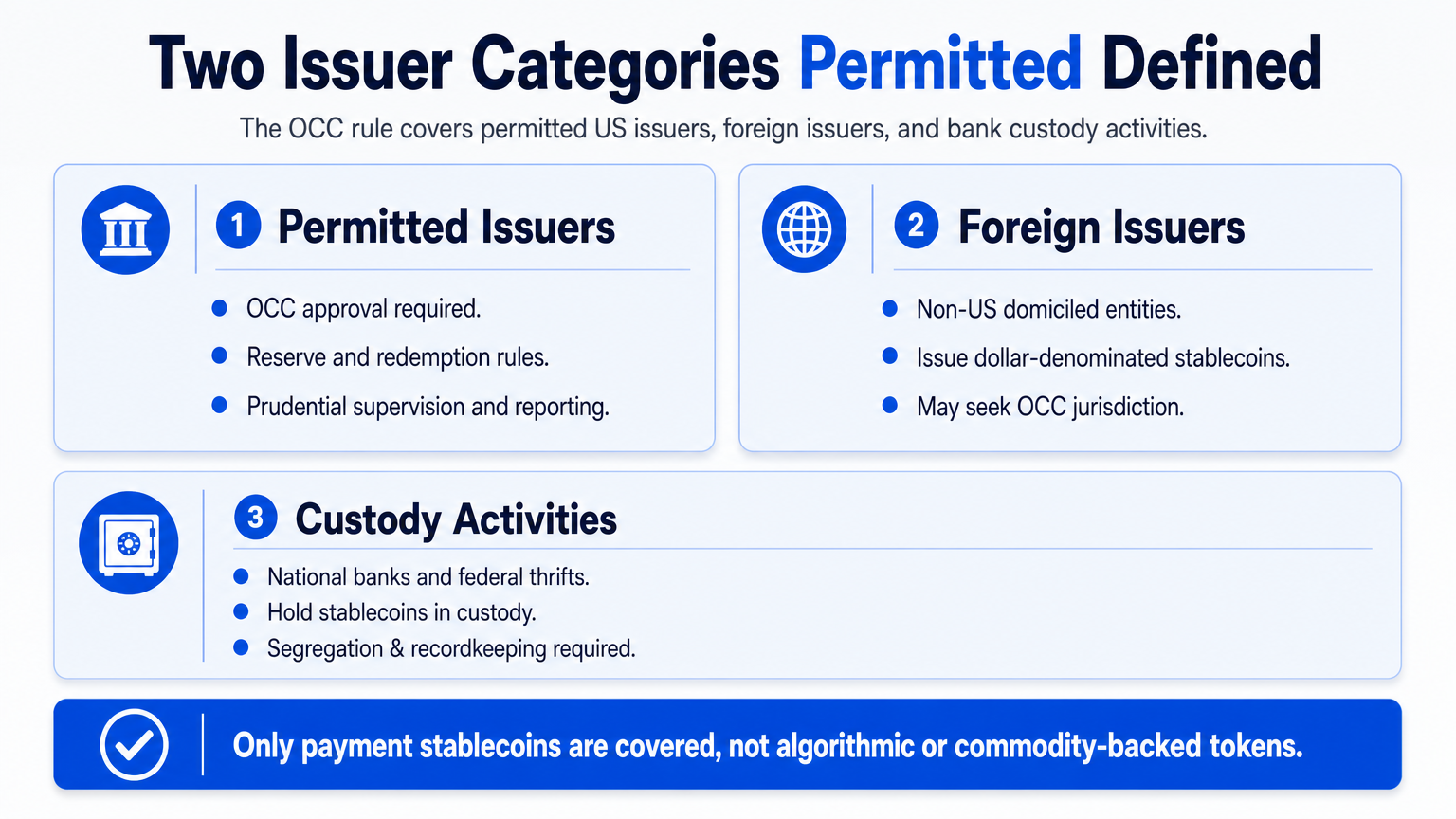
The rule defines two issuer categories:
- Permitted payment stablecoin issuers: US‑domiciled entities that receive OCC approval and are subject to prudential supervision — reserve requirements, redemption policies, and reporting.
- Foreign payment stablecoin issuers: Issuers based outside the US that offer dollar‑denominated (or otherwise US‑accessible) stablecoins and seek to operate under OCC jurisdiction.
It also addresses certain custody activities at OCC‑supervised banks and trust companies. If a national bank or federal savings association holds payment stablecoins in custody for clients, facilitates transfers, or provides safekeeping, it must meet Part 15 standards for segregation, safekeeping, and recordkeeping.
For the full legal text, see the OCC’s final rule bulletin. The rule applies only to payment stablecoins — fiat‑pegged digital assets used primarily for payments and settlement — not to algorithmic or commodity‑backed tokens.
What does the OCC rule exclude?
Crucially, the rule does not cover BSA, AML, or sanctions. The OCC carved those out and announced a separate rulemaking coordinated with Treasury will address them. So even a “permitted issuer” will still need to comply with existing and upcoming BSA/AML obligations — permission does not equal full anti‑money‑laundering clearance.
It also does not cover:
- State‑chartered issuers not under OCC oversight (e.g., New York or Wyoming trust companies) unless they voluntarily seek an OCC charter.
- Non‑bank crypto platforms that custody stablecoins outside traditional banking, unless they become OCC‑supervised or sweep in through custody arrangements with OCC banks.
- DeFi protocols without an intermediary bank — though if any on‑ramp or off‑ramp involves an OCC bank, the custody provisions could apply.
This fragmented coverage is why stablecoin regulation is a patchwork: the OCC rule is a major pillar, but it sits alongside state money‑transmitter regimes and a pending BSA/AML framework.
How should a non‑issuer business prepare?
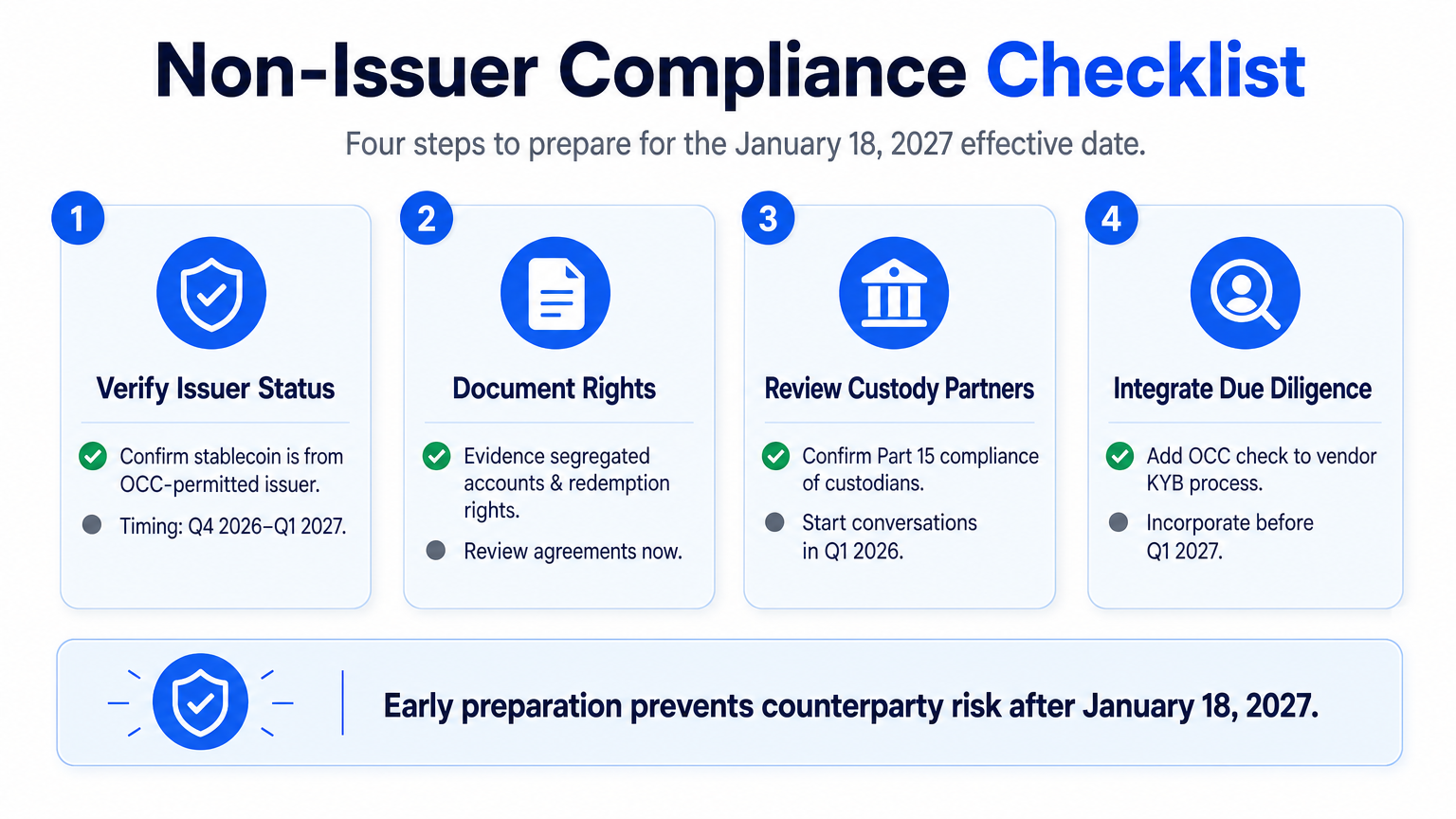
Preparation boils down to four concrete steps, summarized in this stablecoin compliance checklist:
| Action | Why it matters | Timing |
|---|---|---|
| Verify issuer status | Confirm any stablecoin you hold is from an OCC‑permitted issuer. | By Q4 2026–Q1 2027. Monitor OCC announcements once applications open. |
| Document segregation and redemption rights | Custody or banking agreements must evidence segregated accounts and enforceable par‑redemption rights. | Review existing agreements now; require before new custody relationships. |
| Review your custody partners | If you use a bank or platform that relies on an OCC‑supervised custodian, confirm they will comply with Part 15 and that your assets are structured accordingly. | Initiate conversations with partners in Q1 2026 (now). |
| Integrate issuer evaluation into vendor onboarding | Build a due‑diligence questionnaire: check OCC permission, reserve attestations, BSA/AML program. | Incorporate into KYB process before Q1 2027. |
If you use a platform like OneSafe that already provides segregated accounts, KYB checks, and Fireblocks custody, many controls are built in. Still, request written confirmation that custodial partners will align with Part 15 for payment stablecoins by the effective date.
What custody activities fall under OCC supervision?
Under 12 CFR Part 15, when an OCC‑supervised bank or federal savings association holds payment stablecoins in custody for clients, facilitates transfer or settlement, or provides safekeeping services, it must meet segregation, reporting, and operational standards. The rule likely requires a direct ownership record for each client, separation of client assets from the bank’s own, and availability of issuer redemption at all times.
These stablecoin custody requirements apply whether the bank acts as a qualified custodian, sub‑custodian, or simply maintains an omnibus wallet for settlement. For businesses, that means you can’t assume holding USDC with a traditional custodian is enough — you need to confirm the custodian’s operational posture. Ask: “Do your custody operations comply with OCC Part 15 for payment stablecoins, and can you evidence segregation and redemption rights?” This question should now be standard in any crypto treasury management due diligence.
How can I verify that my stablecoin issuer is permitted?
Until the OCC opens applications and publishes approvals, no issuer can claim OCC‑permitted status. The OCC will announce the application window (TokenPost, October 28, 2026). Once it opens, look for:
- OCC’s public registry of approved permitted payment stablecoin issuers.
- Issuer statements confirming OCC permission and specifying the approved legal entity.
- Reserve reports and attestations — many will publish monthly attestations under OCC guidelines, similar to current practices.
In the interim, evaluate an issuer’s readiness: does it hold high‑quality liquid assets at a US depository institution? Has it publicly engaged with the OCC? Does it have a path to a bank charter or a relationship with an OCC‑supervised entity? Even a major stablecoin like USDC will need to apply and be approved; Circle has signaled its intent, but no permission exists yet. Your current holdings are not yet backed by an OCC‑permitted issuer, though Circle’s timeline will likely align with the January 2027 date.
What comes next after this OCC rule?
The OCC explicitly flagged that the BSA/AML/sanctions gap must be filled. A separate rulemaking coordinated with FinCEN will establish program requirements, suspicious‑activity reporting, and sanctions compliance for stablecoin issuers. That could impose additional obligations on issuers and, indirectly, on businesses transacting with them.
Open questions to watch:
- Application window: when will the OCC start accepting applications? A logical window would be early 2026.
- State‑chartered issuers: many large stablecoin issuers are state trust companies. They may need to convert to a national charter or obtain a federal permit.
- DeFi and non‑custodial wallets: the rule focuses on custodial bank activity, but any fiat on/off‑ramp through a bank will trigger compliance.
- Broader stablecoin regulation: yield‑bearing or algorithmic stablecoins may face SEC scrutiny, but that is outside this OCC rule.
For now, the immediate priority is operational readiness: issuer verification, custody documentation, and segregated‑account structures. The OCC rule turns stablecoin regulation from a policy discussion into a concrete calendar event, with January 18, 2027 as the date the first federal oversight layer becomes enforceable.
For businesses that want to keep pace with such regulatory shifts, Joyrise: your blog, written and published every day plans, writes and publishes illustrated SEO articles to your Webflow blog every day. Read your first article before you pay at Joyrise.
Key Takeaways
- The OCC’s final stablecoin rule takes effect January 18, 2027, covering permitted issuers and custody at OCC‑supervised entities.
- Non‑issuer businesses must verify that any stablecoin they hold comes from an OCC‑permitted issuer; ignoring it creates direct counterparty risk.
- Custody of payment stablecoins at national banks and federal savings associations now requires segregation and recordkeeping under 12 CFR Part 15.
- The rule excludes BSA/AML/sanctions — a separate rulemaking is coming, so “permitted” does not mean “fully compliant.”
- Use the stablecoin compliance checklist to audit issuer status, custody arrangements, and redemption rights well before the effective date.
Start preparing your stablecoin operations today with a platform that bridges fiat and crypto finance — sign up for OneSafe.