On November 1, 2026, Ripple secured final U.S. banking approval—a development that redefines what “bank-integrated” means for crypto treasury management. The approval, reported by CryptoRank that same day, marks the first time a major crypto-native company gained official status to operate banking services in the United States. XRP ended October down 16%, but the signal isn’t about price. It’s a practical reset in how startups and DAOs should think about holding, moving, and deploying digital assets when a counterparty can now be a regulated bank.
Table of Contents
- What just happened: Ripple’s bank approval changes the treasury conversation
- Why this matters now
- Does treasury management require support for crypto assets?
- What is a crypto treasury?
- What is crypto treasury management?
- How is it different from traditional treasury management?
- What does secure treasury management look like?
- How should DAOs structure treasury operations after this shift?
- What can a founder do this week?
- What to watch after November 1
- The bottom line
- Key Takeaways
What just happened: Ripple’s bank approval changes the treasury conversation
According to a CryptoRank report on November 1, 2026, Ripple received final U.S. banking approval, capping what it described as one of its strongest months for institutional expansion. A crypto payments firm can now interface with the traditional financial system as a regulated bank—not just as a vendor or token issuer.
This is distinct from a trust charter or partner-bank arrangement. For a corporate treasurer, holding assets with or settling through Ripple now carries a different risk profile. It signals that the line between crypto-native companies and traditional banks is blurring fast, and crypto treasury management in 2026 must reflect that reality.
Before this, treasury management largely focused on securing assets in non-bank custody and using separate fiat accounts. Ripple’s new status points to a future where a single regulated entity can custody digital assets, move funds on-chain, and connect to ACH or wire rails under its own license. The treasury conversation shifts from where do I park my crypto? to how do I build a unified, bank-grade operational flow?
Why this matters now
Many Web3 startups and DAOs assumed a treasury could be entirely on-chain. A U.S.-approved bank counterparty introduces the possibility that the most efficient payment rails and lowest counterparty risk might come from regulated entities that natively handle crypto. That doesn’t mean abandoning decentralization, but it means being pragmatic about where custody ends and banking begins.
When a crypto company becomes a bank, treasuries can potentially hold stablecoins and fiat in the same institution, use that bank’s ACH and wire capabilities, and rely on bank-grade compliance. The friction of a dual-fiat-and-crypto world drops when one counterparty can do both.
Treasuries that cling to a custody-only model may find themselves locked out of bank-grade services. As shown in a 2026 analysis of Uber’s tokenized deposit pilot, enterprise treasurers are already testing programmable fiat on private blockchains—a reminder that the future isn’t fully crypto or fully traditional, but a fluid combination. Ignoring the Ripple bank approval treasury shift leaves liquidity fragmented.
Does treasury management require support for crypto assets?
Yes, but not as an isolated asset class. The Ripple approval confirms that stablecoins are becoming payment instruments that regulated banks will handle. A treasury that treats crypto as a separate, exotic holding misses the point: the future is about managing fiat and crypto on the same operational layer, with identical compliance and liquidity controls.
What is a crypto treasury?
A crypto treasury is a balance sheet that includes digital assets—stablecoins, protocol tokens, or native chain tokens—alongside fiat. The term refers to asset composition, not the absence of banks. It’s defined by the presence of digital assets that require secure custody, liquidity management, and accounting just like cash.
What is crypto treasury management?
It’s the discipline of overseeing digital assets with the same rigor applied to fiat: ensuring operational liquidity, mitigating risks, and producing auditable reporting. It spans the full lifecycle—on-ramping fiat to USDC, cross-border supplier payments in stablecoins, contributor payouts, and converting surplus back to fiat. As Ripple’s treasury guide notes, modern infrastructure must handle settlement, accounting, and compliance for digital assets, not just vault them.
How is it different from traditional treasury management?

Traditional treasury assumes fiat rails, bank SLAs, and fixed settlement windows. Crypto treasury management operates on 24/7 blockchains with near-instant settlement, but finality and reversibility differ by chain. Key differences:
- Settlement speed: near-instant on-chain, but fiat ramps reintroduce delays.
- Volatility management: for non-stablecoin assets, treasuries must actively manage FX-like risk.
- Custody risks: irreversible key loss or smart-contract bugs demand institutional-grade MPC and HSMs.
- Regulatory ambiguity: the legal status of stablecoins varies by jurisdiction, requiring dynamic compliance.
The core challenge: crypto treasury management demands both the security of a custodian and the payment functionality of a bank—a gap that many tools still struggle to bridge.
What does secure treasury management look like?
It means combining bank-grade custody with operational payment rails in a single, auditable environment. Custody-only providers solve one half: securely storing keys via MPC infrastructure. But they don’t offer USD accounts, ACH, wires, or corporate cards. The operational gap isn’t about vaulting; it’s about the entire flow from crypto to fiat treasury operations and back.
A hybrid neo-banking platform like OneSafe—which partners with banks to deliver fiat and crypto services—illustrates what crypto neo-banking for businesses looks like in 2026. A typical monthly workflow:
- Receive revenue in USDC from a protocol contract.
- Convert a portion to USD at a transparent FX rate (0.25%) into a segregated business account.
- Pay team salaries via ACH (0.15% fee) or domestic wires ($25).
- Fund contributor invoices in stablecoins with no deposit/withdrawal fees.
- Issue virtual corporate cards topped up in multiple tokens.
Everything runs under role-based permissions, mandatory MFA, and Fireblocks-secured custody, with a clean audit trail. That’s the operational reality: not a wallet or spreadsheet, but a single, permissioned platform.
How should DAOs structure treasury operations after this shift?
DAOs must manage contributor payroll in stablecoins, reimburse expenses in fiat, and allocate capital—while maintaining governance and transparency. The Ripple approval changes the crypto treasury for DAOs counterparty risk landscape. If a DAO uses a now-regulated bank service, it can offload some compliance burdens without sacrificing trustlessness.
The missing piece has never been custody alone. The real gap is fiat-compatible operations with on-chain-aligned permissions. After November 1, 2026, every DAO should:
- Refresh counterparty assessments: a bank-approved entity brings new protections but also concentration risk. Diversify.
- Implement role-based controls: a platform with customizable roles lets a DAO enforce multi-sig governance for crypto outflows while enabling fiat vendor payments without fragmenting the treasury.
- Move stablecoin payroll onto bank-integrated rails: pay contributors in USDC from a wallet natively linked to a fiat account, simplifying tax reporting and token accounting.
What can a founder do this week?
Use this four-step framework to move from reactive to proactive. For deeper guidance on staying current, services like Joyrise keep your educational content fresh—Joyrise plans, writes and publishes illustrated SEO articles to your Webflow blog daily, so your team always has relevant insights.
Step 1: Classify your fiat-to-crypto mix
Are you 90% stablecoins or 50% ETH? Frequent conversions demand instant on/off-ramps and competitive FX. If fiat needs are minimal, pure custody might suffice—but be honest about payroll and vendor touches.
Step 2: Decide your custody and rails architecture
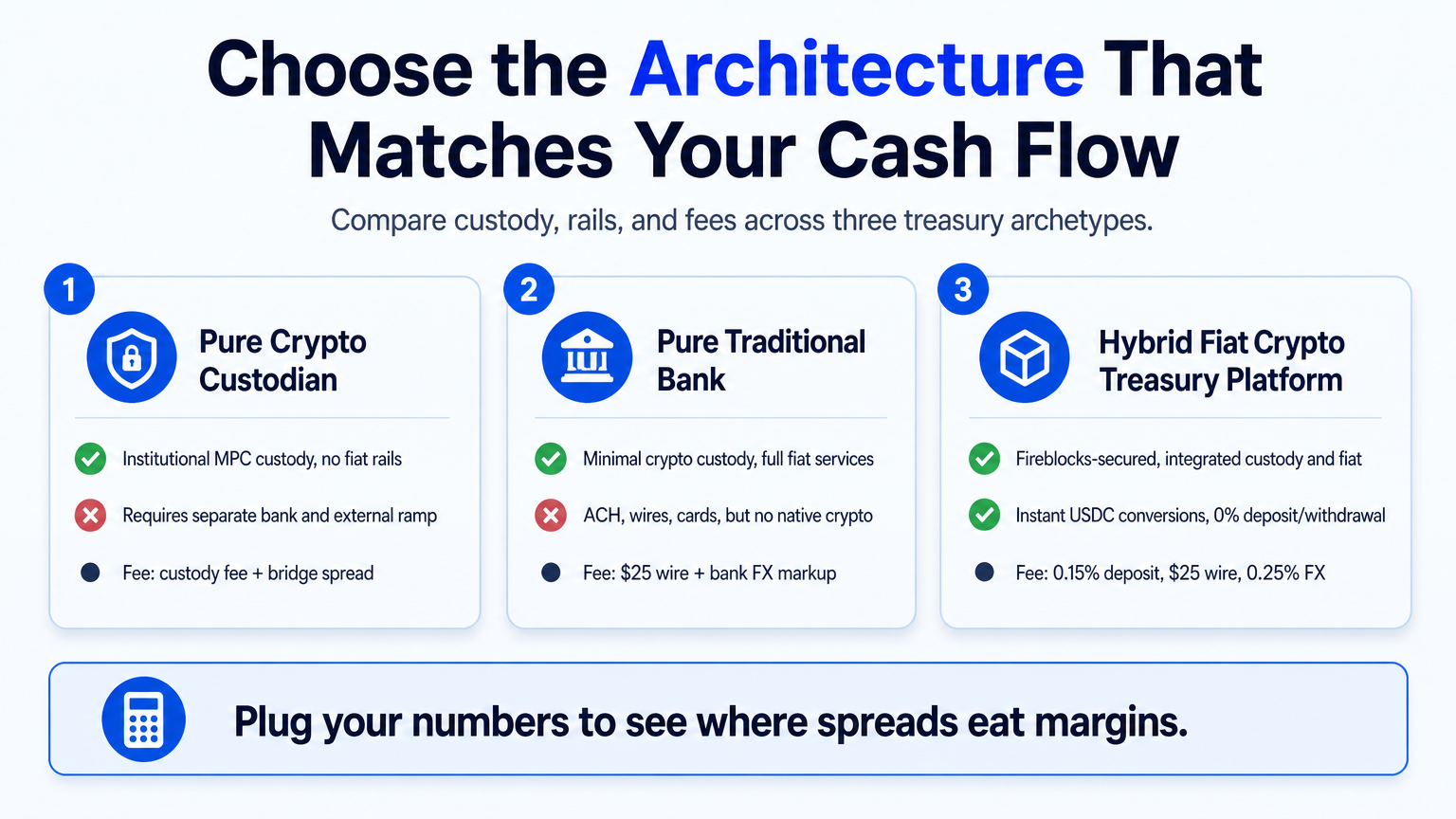
| Archetype | Custody | Fiat rails | Crypto on/off-ramp | DAO-ready features | Fee example (USDC to USD wire) |
|---|---|---|---|---|---|
| Pure crypto custodian | Institutional MPC | None; separate bank needed | External third-party | Multi-sig wallets only | Custody fee + bridge spread |
| Pure traditional bank | Minimal | ACH, wires, cards | No native crypto | Standard business banking | $25 wire + bank FX markup |
| Hybrid fiat crypto treasury platform | Fireblocks-secured, integrated | Full ACH, wires, cards | Instant USDC conversions, 0% deposit/withdrawal fee | Custom roles, automated payroll, invoicing | 0.15% fiat deposit, $25 wire, 0.25% FX |
OneSafe falls into the third archetype, with transparent fees that give a concrete benchmark for crypto treasury fees comparison. Choose the architecture that matches your cash flow, not ideology.
Step 3: Pressure-test fees with real numbers
Take last month’s volume. If you moved $100,000 from USDC to fiat and paid 10 domestic wires, a hybrid platform might cost $150 in ACH fees (0.15%) plus wire fees. Plug your own numbers to see where spreads eat margins.
Step 4: Set review triggers for regulatory events
Ripple’s approval is a trigger. Schedule quarterly reviews against similar milestones (e.g., stablecoin legal tender status, CBDC support). Each trigger prompts a re-evaluation of counterparty risk, fees, and operational gaps.
What to watch after November 1
Will other crypto companies follow Ripple’s path? If Circle pursues a banking license, the stablecoin treasury landscape upends again. The Stablecoin Regulation: Bank Disintermediation Is Here analysis suggests the trend is already in motion.
Does bank approval lead to interest-bearing stablecoin accounts? That would blur the line between treasury and earning asset—watch closely.
How will regulators treat hybrid neo-banks that partner with banks? Services like OneSafe aren’t banks themselves. If Ripple’s approval ramps scrutiny, know-your-provider due diligence becomes critical.
The bottom line
Ripple’s November 1, 2026 bank approval closes the chapter on crypto treasury custody vs banking as a custody-only problem. The new playbook integrates bank-grade payment rails directly into the crypto treasury stack. For founders and DAO leads, the immediate step is to audit whether your setup handles the full fiat-crypto loop—custody plus banking—without fragmented tools and opaque fees.
Key Takeaways
- Ripple’s U.S. banking approval signals that a crypto company can be a regulated bank counterparty, changing treasury risk assumptions.
- Crypto treasury management in 2026 requires both institutional custody and bank-integrated payment rails—a hybrid platform, not a custodian alone.
- DAOs should reassess counterparty risk and adopt role-based, fiat-compatible workflows for stablecoin payroll and reimbursements.
- A 4-step framework—classify mix, choose architecture, test fees, set review triggers—lets any founder act this week.
- The next regulatory event will reset the conversation; quarterly reviews are essential.
To explore a hybrid fiat crypto treasury platform that integrates Fireblocks-secured custody, fiat accounts, and role-based DAO controls in one interface, sign up for OneSafe today.