The UK government plans to give the Bank of England a new innovation mandate that directly targets stablecoin regulation and digital payment infrastructure, according to a Bloomberg report on August 26, 2026. If you run a global business, DAO, or Web3 startup, this isn't just another policy headline—it's a signal that compliant stablecoin usage is about to become a structural advantage, not a regulatory risk you tolerate.
Table of Contents
- The UK Just Bet on Innovation-Led Stablecoin Regulation
- Why the BOE Mandate Matters for Your Business
- Stablecoin Regulation Today: What You Need to Know
- Rethinking Your Finance Stack for the Stablecoin Era
- What to Watch Next
- What just happened with UK stablecoin regulation?
- Why does the Bank of England innovation mandate matter for my business?
- How does this fit with global stablecoin regulation trends?
- What is a 'payment stablecoin' and how are they regulated?
- What should I do now to prepare my finance operations for stablecoin integration?
- How can a neo-bank like OneSafe help with compliant stablecoin usage?
- Key Takeaways
- Sources
The UK Just Bet on Innovation-Led Stablecoin Regulation
What the Treasury announced on August 26
On August 26, 2026, the UK Treasury revealed plans to add "promoting innovation" as a secondary objective to the Bank of England's (BOE) regulation of payment systems, as reported by Bloomberg via bloomingbit. The BOE's primary objective—financial stability—remains untouched. But the secondary mandate explicitly supports stablecoins, tokenization, and distributed ledger technology (DLT)-based payment infrastructure.
Emma Reynolds, the UK's Economic Secretary to the Treasury, stated that financial stability would stay the BOE's top priority, while the new objective would help "drive innovation in payments and digital finance" and support the UK's position as a global leader in financial services. The government is paying particular attention to tokenization and DLT, which Reynolds said "have the potential to reshape global financial markets."
This isn't a standalone move. The UK and the US previously formed a joint task force to promote stablecoin adoption, and the BOE is already developing a joint regulatory framework with the Financial Conduct Authority (FCA) for systemic stablecoin issuers. What's new is the formal embedding of innovation into the central bank's statutory duties—a competitive signal aimed at firms deciding where to build compliant stablecoin operations. For anyone tracking fintech news, this lands as one of the more consequential policy shifts of 2026.
How this fits into the global regulatory patchwork
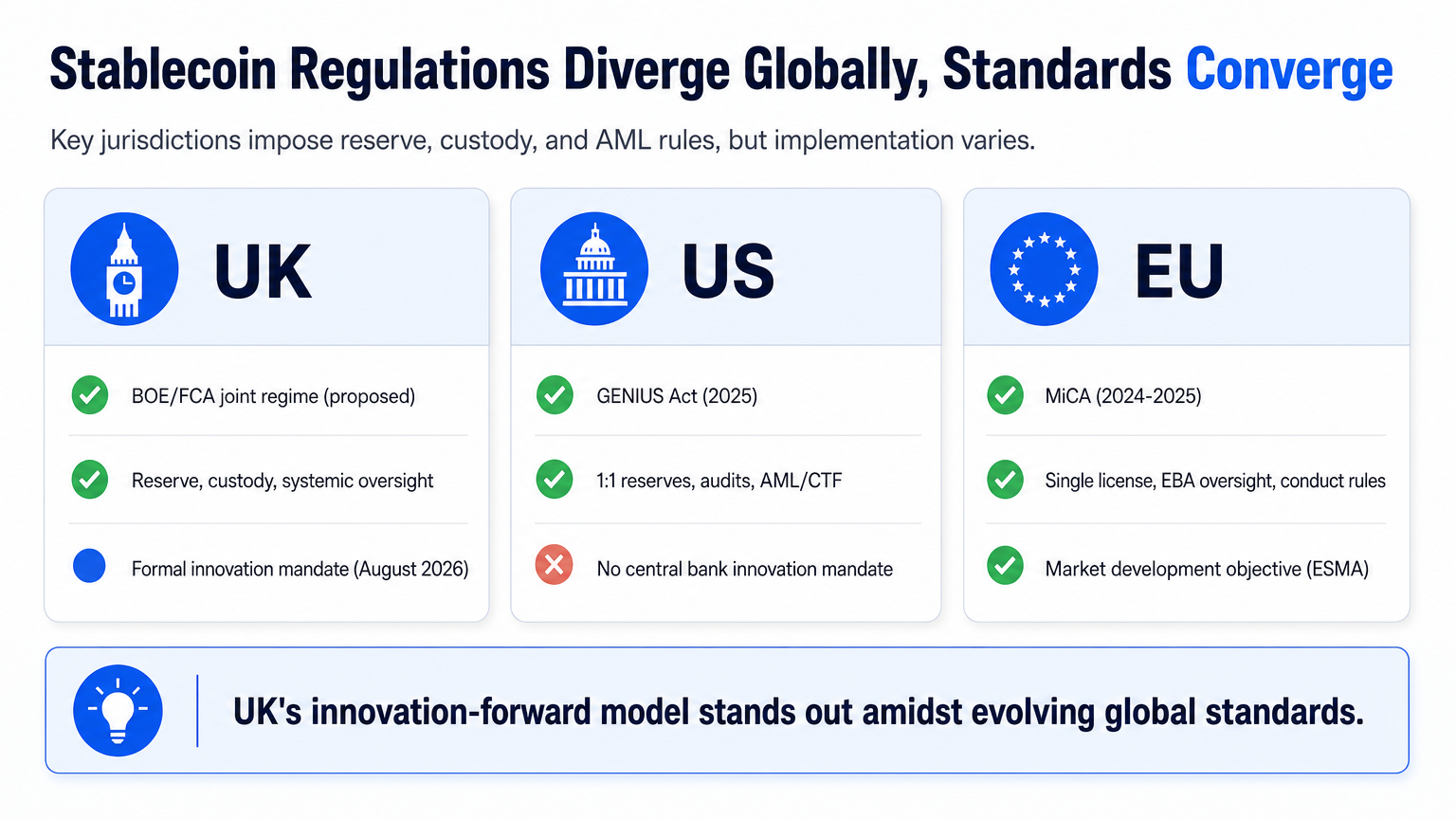
The UK's innovation mandate lands in a fast-forming global patchwork. The EU's Markets in Crypto-Assets (MiCA) framework is already live, creating a comprehensive licensing regime for stablecoin issuers across the bloc. The US has the GENIUS Act, which established a federal-state dual-path for payment stablecoin issuers in 2025 with requirements for 1:1 reserves and regulatory oversight. Other jurisdictions—Singapore, Hong Kong, the UAE—are advancing their own frameworks, creating a complex, multi-speed environment for digital asset regulation that businesses must navigate strategically.
The UK's move stands out because it integrates innovation directly into the mandate of the central bank rather than treating stablecoin regulation as a standalone securities or payments question. For businesses operating across jurisdictions, the difference between "permissioned compliance" and "innovation-forward compliance" is starting to matter.
Why the BOE Mandate Matters for Your Business
Stablecoins move from speculative to systemic
The BOE innovation mandate isn't about making life easier for crypto speculators. It's about stablecoins becoming systemic payment infrastructure. When a G7 central bank is told to actively promote innovation in digital money, the asset class graduates from "experimental" to "expected." This shifts the risk calculus for businesses. A year ago, holding USDC for operational payments might have looked like an aggressive move. Today, with the UK actively encouraging stablecoin infrastructure, not having a plan for compliant stablecoin usage is becoming the riskier position. This is the core of what stablecoin compliance will demand going forward.
The mandate also signals a regulatory environment that wants to compete for digital asset business. That matters for international firms choosing where to incorporate, where to hold reserves, and which banking partners to trust. Jurisdictions that embed innovation into their central banking framework are effectively telling the market: we want your stablecoin business here, and we'll build the rails to support it.
The ripple effect on payment infrastructure and tokenization
The Treasury's explicit focus on tokenization and DLT means the mandate extends beyond stablecoins themselves. The underlying message is that the UK wants the infrastructure that supports tokenized assets—custody, settlement, cross-border rails—to be built under its regulatory umbrella. For businesses, this creates a clearer path to using stablecoins not just for payments but as part of a broader tokenized treasury strategy.
This is where stablecoin payments start intersecting with operational reality. When a G7 jurisdiction signals it wants innovation built into payment regulation, the downstream effects hit the banking layer that global business banking depends on every day.
Stablecoin Regulation Today: What You Need to Know
The US GENIUS Act and the dual-path issuer model
The GENIUS Act, enacted in 2025, created a federal-state dual-path model for payment stablecoin issuers in the US. Under the Act, issuers can choose to operate under a federal framework or a state-level regime that meets federal standards. Key requirements include:
- Full 1:1 reserve backing for all outstanding stablecoins
- Regular attestation of reserves by an independent auditor
- Compliance with anti-money laundering (AML) and counter-terrorism financing (CTF) rules
- Clear redemption rights for holders
The dual-path model has drawn both praise and criticism. Proponents argue it preserves regulatory flexibility; critics worry it creates inconsistent standards across states. For businesses holding or transacting in stablecoins, the practical takeaway is that the US regulatory landscape is now more structured but still fragmented—and the choice of issuer matters for compliance certainty.
EU's MiCA and other international approaches
The European Union's MiCA framework, which took effect in 2024-2025, takes a more harmonized approach. It creates a single licensing regime for stablecoin issuers across all 27 member states, with the European Banking Authority (EBA) overseeing significant stablecoins. MiCA imposes strict reserve requirements, redemption rights, and conduct-of-business rules.
The UK's approach sits between the fragmented US model and the harmonized EU model—it's national but actively innovation-forward, with the BOE and FCA jointly regulating systemic stablecoin issuers. The FCA's Consultation Paper 25/14 outlines proposed rules for stablecoin issuance and cryptoasset custody, signaling a comprehensive framework is taking shape.
Jurisdictions like the UAE and Singapore have developed their own models. The result is a patchwork where businesses must track multiple, evolving standards—especially for KYC/AML obligations and reserve transparency. For firms tracking stablecoin regulation UK developments specifically, the BOE/FCA joint regime is the one to watch.
What is a 'payment stablecoin' anyway?
A payment stablecoin is a digital asset designed to maintain a stable value relative to a fiat currency—typically the US dollar—and intended primarily for use as a means of payment rather than investment. The regulatory distinction matters: payment stablecoins are increasingly regulated like payment systems, not securities. This is the category the GENIUS Act addresses, and it's the category the UK's innovation mandate is designed to support.
Below is a summary of the key regulatory approaches across major jurisdictions:
| Jurisdiction | Key Framework | Issuer Requirements | Innovation Mandate |
|---|---|---|---|
| UK | BOE/FCA joint regime (proposed) | Reserve requirements, custody rules, systemic oversight | Yes — secondary BOE objective (August 2026) |
| US | GENIUS Act (2025) | 1:1 reserves, audits, AML/CTF compliance | No explicit central bank mandate |
| EU | MiCA (2024-2025) | Single license, EBA oversight, conduct rules | Market development is an ESMA objective |
| UAE | VARA/FSRA frameworks | Varies by emirate; reserve and custody rules apply | Varies |
| Singapore | Payment Services Act | MAS licensing, reserve and redemption requirements | Fintech regulatory sandbox approach |
Rethinking Your Finance Stack for the Stablecoin Era
Compliance without compromise: why your bank matters
For Web3 startups, DAOs, and global businesses, the choice of banking partner is no longer just about fees and features. It's a regulatory strategy decision. If your bank doesn't handle fiat and crypto natively, you're forced to maintain fragmented relationships—a traditional bank for payroll and vendor payments, a separate crypto custodian, and manual reconciliation between the two. That's not just inconvenient; it's a compliance risk when stablecoin regulation tightens and you need a single, auditable record of all treasury activity.
The BOE innovation mandate makes this dynamic more acute. When a central bank is actively promoting stablecoin infrastructure, the banking layer needs to keep pace. For many firms, a neo-bank stablecoin approach—using a platform that offers native stablecoin support, automated compliance reporting, and integrated on/off-ramp functionality—becomes the infrastructure that compliant businesses run on, not just a "nice-to-have."
Practical steps for founders and finance leads
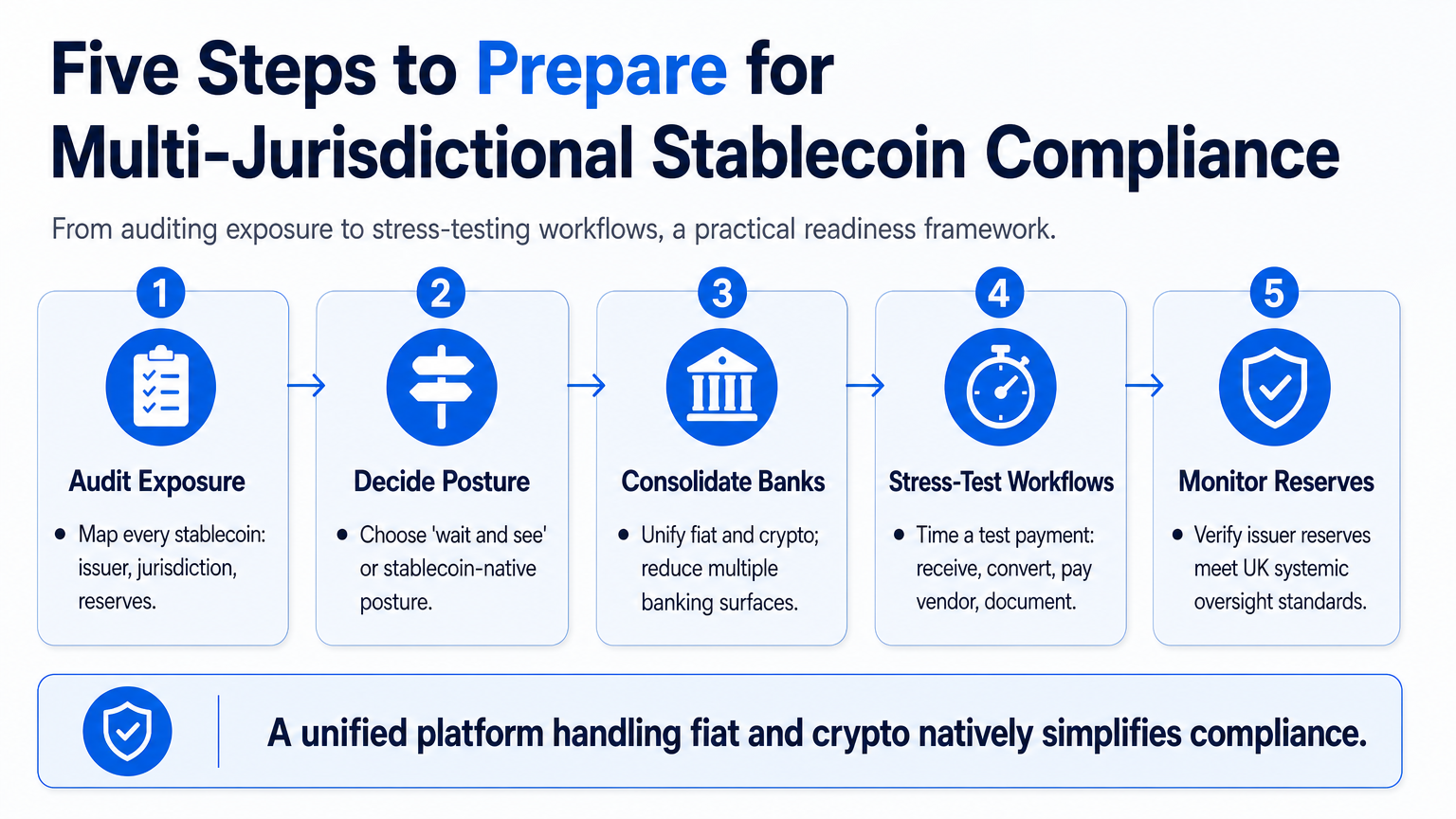
Here's a practical framework for preparing your finance operations for multi-jurisdictional stablecoin regulation:
1. Audit your current stablecoin exposure Map every stablecoin you hold, transact in, or receive. For each: which issuer, which jurisdiction, what reserve composition, and what redemption rights. If you can't answer these questions for a given stablecoin position, treat that as a risk item.
2. Align on regulatory posture Decide whether your business is taking a "wait and see" approach or actively positioning for stablecoin-native operations. The UK innovation mandate suggests the window for "wait and see" is closing faster than expected for firms with UK or cross-border exposure.
3. Consolidate banking relationships Multiple banking relationships create multiple compliance surfaces. Evaluate whether a single platform that handles fiat and crypto natively can reduce your audit burden and improve treasury visibility. This is especially relevant if you're a DAO managing treasury across multiple signers and jurisdictions—the reconciliation overhead alone can be a material operational cost.
4. Stress-test compliance workflows Run a test transaction through your current banking stack: receive a stablecoin payment, convert to fiat, and pay a vendor. Time it. Document every step required for audit. If the process takes days or generates fragmented reporting, your stack isn't ready for the compliance demands coming from frameworks like the UK's.
5. Watch reserve transparency rules Both MiCA and the GENIUS Act mandate reserve attestation and transparency. If you're holding stablecoins as part of working capital, you need to be confident that the issuer's reserve practices would survive a UK-style systemic oversight review. Regulation doesn't just affect issuers—it affects every business holding the asset.
What to Watch Next
Interoperability standards and cross-border coordination
The UK-US joint task force on stablecoin adoption, combined with the BOE's new innovation mandate, points toward a focus on cross-border interoperability. The technical and regulatory standards that allow a US-issued stablecoin to settle seamlessly in a UK-regulated payment system aren't built yet. Watch for coordination between the BOE, the Federal Reserve, and bodies like the Financial Stability Board on standards for cross-border stablecoin settlement. The comparison of UK and US approaches highlights areas where divergence could create friction—particularly around custody rules and resolution frameworks for failed issuers.
The unanswered questions for DAOs and Web3 startups
Several questions remain open for decentralized organizations and startups:
- Will the UK and other jurisdictions recognize DAO legal structures for stablecoin-related licensing? The innovation mandate suggests openness, but legal personality questions remain unresolved for truly decentralized entities.
- How will the BOE's mandate affect banking access for crypto-native businesses? An innovation-forward regulator doesn't guarantee innovation-forward banking partners. The gap between regulatory intent and banking reality is where most founders feel the friction.
- What does compliance look like when a DAO holds stablecoins across multiple jurisdictions? Multi-jurisdictional stablecoin regulation doesn't yet have clear guidance for entities without a single legal domicile.
What just happened with UK stablecoin regulation?
On August 26, 2026, the UK Treasury announced plans to add "promoting innovation" as a secondary objective to the Bank of England's regulation of payment systems, directly supporting stablecoins, tokenization, and digital payment infrastructure while keeping financial stability as the BOE's primary mandate.
Why does the Bank of England innovation mandate matter for my business?
The mandate signals that stablecoins are being treated as systemic payment infrastructure by a G7 central bank, which shifts the risk calculus: not planning for compliant stablecoin usage is becoming riskier than adopting it, especially for firms with UK or cross-border operations. It also signals a regulatory environment that wants to compete for digital asset business, affecting decisions about incorporation, reserves, and banking partners.
How does this fit with global stablecoin regulation trends?
The UK mandate joins the EU's MiCA framework, the US GENIUS Act, and emerging frameworks in Singapore, Hong Kong, and the UAE in a global patchwork that is moving from experimental to structural. The UK's approach stands out for embedding innovation directly into the central bank's duties, creating an "innovation-forward compliance" posture that businesses can factor into jurisdictional strategy.
What is a 'payment stablecoin' and how are they regulated?
A payment stablecoin is a digital asset pegged to a fiat currency and intended primarily for use as a means of payment. Regulation is increasingly treating them like payment systems rather than securities, with requirements for 1:1 reserve backing, independent attestation, AML/CTF compliance, and redemption rights—though specific requirements vary by jurisdiction under frameworks like MiCA, the GENIUS Act, and the UK's proposed BOE/FCA regime.
What should I do now to prepare my finance operations for stablecoin integration?
Audit your current stablecoin exposure, align on a regulatory posture, consolidate fragmented banking relationships into platforms that handle fiat and crypto natively, stress-test compliance workflows with real transactions, and track reserve transparency rules across jurisdictions that affect the stablecoins you hold.
How can a neo-bank like OneSafe help with compliant stablecoin usage?
OneSafe provides a unified platform where businesses can manage fiat accounts, multi-currency operations, and USDC transactions with integrated on/off-ramp functionality, on-chain custody via Fireblocks, and automated compliance reporting—reducing the reconciliation overhead and fragmented audit trails that come from maintaining separate banking and crypto relationships. For global businesses navigating multi-jurisdictional stablecoin regulation, a platform that bridges fiat and crypto natively simplifies the compliance surface while supporting the stablecoin payments and treasury operations that frameworks like the UK's innovation mandate are designed to enable.
Key Takeaways
- The UK's new BOE innovation mandate, announced August 26, 2026, makes stablecoins a systemic priority for a G7 central bank—shifting the risk calculus for businesses from "should we use stablecoins?" to "how do we use them compliantly?"
- The global regulatory patchwork is hardening: the GENIUS Act in the US, MiCA in the EU, and the UK's BOE/FCA framework create distinct compliance surfaces that multi-jurisdictional businesses must track strategically.
- Your choice of banking partner is now a regulatory decision—platforms that natively handle fiat and crypto reduce the audit burden and reconciliation overhead that fragmented relationships create.
- Practical next steps include auditing stablecoin exposure, consolidating banking relationships, stress-testing compliance workflows, and tracking reserve transparency rules across the jurisdictions where you operate.
- Unanswered questions about DAO legal recognition, banking access for crypto-native firms, and cross-jurisdictional compliance for decentralized treasuries remain the frontier to watch.
Start building your global finance stack for the stablecoin era—sign up for OneSafe and manage fiat and crypto from a single platform.
Sources