A sweep account is an automated cash-management service that moves money from a primary operating account into a secondary account once a preset balance is reached. It keeps idle cash working in the background while still leaving funds available for next-day payments and operations.
You know the feeling if your team runs cash across USD, EUR, or even stablecoins. Funds pile up in one place, payroll is due in another, and someone on finance ends up manually moving balances just to keep the business liquid. That's where a sweep account earns its keep, especially when you're trying to run lean treasury operations while watching rates, settlement timing, and cross-border friction. If you're also thinking about how bank and crypto rails can live side by side, this bank accounts crypto integration guide is a useful companion.
Table of Contents
Putting Your Idle Business Cash to Work
A founder closes the books on Friday and sees healthy balances sitting in several accounts, but the cash isn't really helping the business. One account holds USD for vendors, another holds EUR for a European contractor payout, and a third holds leftover proceeds that just sit there until Monday. By the time someone remembers to move funds, the opportunity has already passed, or the transfer has created a new reconciliation headache.
That's the practical problem a sweep account solves. It turns idle balances into a rules-based cash-management system, so money above a preset level can move automatically into a secondary vehicle and then move back when operating cash gets tight. JPMorgan describes sweep accounts as an automated structure that shifts balances above a target balance into another vehicle, usually overnight, while preserving next-day liquidity for payments and working capital needs, which is the part most founders care about in day-to-day operations. See also how economist predicts Fed rate hike month can change the way teams think about idle cash and timing.
For a fast-growing company, the value isn't just yield. It's the removal of manual cash shuffling, the reduction of non-interest-bearing balances, and the ability to keep one clean operating view while the money does its work behind the scenes. That's especially relevant when your finance stack has to span bank accounts, payment rails, and digital asset workflows without turning treasury into a full-time spreadsheet exercise.
What Is a Sweep Account
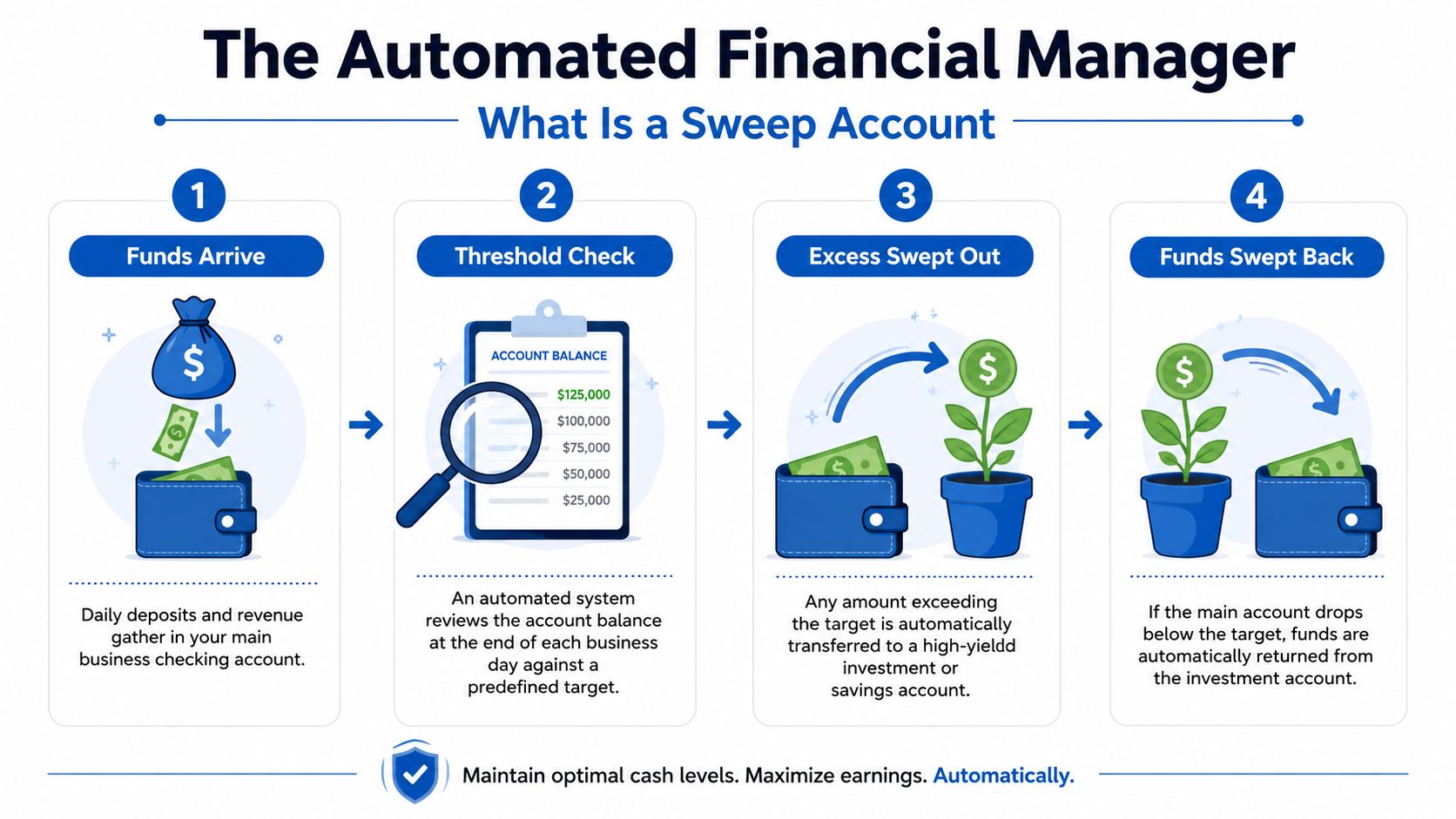
A sweep account definition is simple once you strip away the banking jargon. It's an automated cash-management setup that watches a primary account, compares the balance to a preset target, and moves excess money into a second place where it can serve a different purpose.
The three moving parts
Think of it as a bucket system with rules.
- Primary operating account. It is the initial destination for customer receipts, sales proceeds, and incoming transfers.
- Target balance. This represents the minimum amount treasury wants to leave available for payments, payroll, and settlement.
- Secondary vehicle. Excess cash is directed to this, for instance, a money market fund, repurchase agreement, or another instrument chosen by the bank or platform.
JPMorgan's description is the cleanest technical version of that flow, because it captures both directions of movement. Excess cash is swept out, and if the operating account falls below the target, funds can be moved back to restore liquidity and support payments or check clearing. That back-and-forth is what makes sweeps more than a savings feature. They're a liquidity buffer with automation built in.
Practical rule: If your business can't tell finance what “safe to deploy” cash looks like, your sweep threshold is probably too blunt to be useful.
Why the definition matters
People often describe sweep accounts as “interest on idle cash,” but that's too narrow. The more useful framing is automated cash positioning. Federal Reserve guidance describes corporate sweep programs as overnight cash-management tools, not just retail-style yield features, which matters because the design has to match settlement timing and cash volatility, not just a marketing promise of better returns.
That's why treasury teams tune sweep logic around real operations. A company with daily card settlements, supplier payouts, and multi-currency inflows needs a different rule set than a simple checking account holder. If the target balance is too low, you risk shortfalls. If it's too high, you leave money stranded in the operating account and miss the point of the automation.
A quick video can help anchor the mechanics before you compare providers.
Types of Sweep Accounts Explained
Not every sweep does the same job. The phrase covers a few distinct structures, and picking the wrong one can make treasury feel more complicated than it needs to be. A founder might want yield, another might want account simplification, and a third might want to move balances across entities or currencies without creating reconciliation chaos.
Common structures and what they're for
| Sweep Type | Primary Goal | Destination Account / Vehicle | Best For |
|---|---|---|---|
| Overnight sweep | Put idle cash to work while keeping it accessible on a regular cycle | A higher-yield or collateralized vehicle, often overnight | Companies that need liquidity every day but don't want idle balances |
| Investment sweep | Move excess cash into an investment instrument | Money market fund, repurchase agreement, or similar instrument | Treasury teams balancing yield and access |
| Zero-balance account, or ZBA | Concentrate cash and simplify control across operating accounts | A master concentration account that funds subsidiary accounts as needed | Groups that want tighter cash control and cleaner reconciliation |
That table hides an important truth. A sweep account isn't always about investing more aggressively. Sometimes it's about cash concentration, so subsidiaries or wallets can operate with less clutter while a central account keeps the funding logic tight. In larger businesses, that can reduce manual transfers and make reporting easier, especially when multiple entities or regions are involved.
How the differences show up in practice
An overnight sweep is usually the closest fit for a founder who wants the money to move automatically, then come back by the next cycle if operating balances need support. An investment sweep pushes a little further out on the risk-return spectrum, because the destination instrument may have different liquidity or credit characteristics. A ZBA feels different again, because the point is control and concentration more than earning more.
Good treasury design starts with the question “What problem are we solving?” not “Which sweep product sounds most advanced?”
For modern operators, especially those running globally or through platforms that combine banking and digital asset workflows, the right structure depends on the payment calendar, settlement windows, and the number of currencies you have to manage. If you're building a treasury stack that spans fiat and crypto workflows, a platform such as global treasury management can fit into that conversation, but the sweep logic still has to be tuned to the actual cash pattern, not the platform headline.
Key Benefits and Potential Risks
The best reason to use a sweep account is simple. It lets cash do more without demanding more of your team. That matters when treasury is already juggling vendor payments, customer receipts, bank reporting, and currency conversion across several rails.
Where sweeps help most
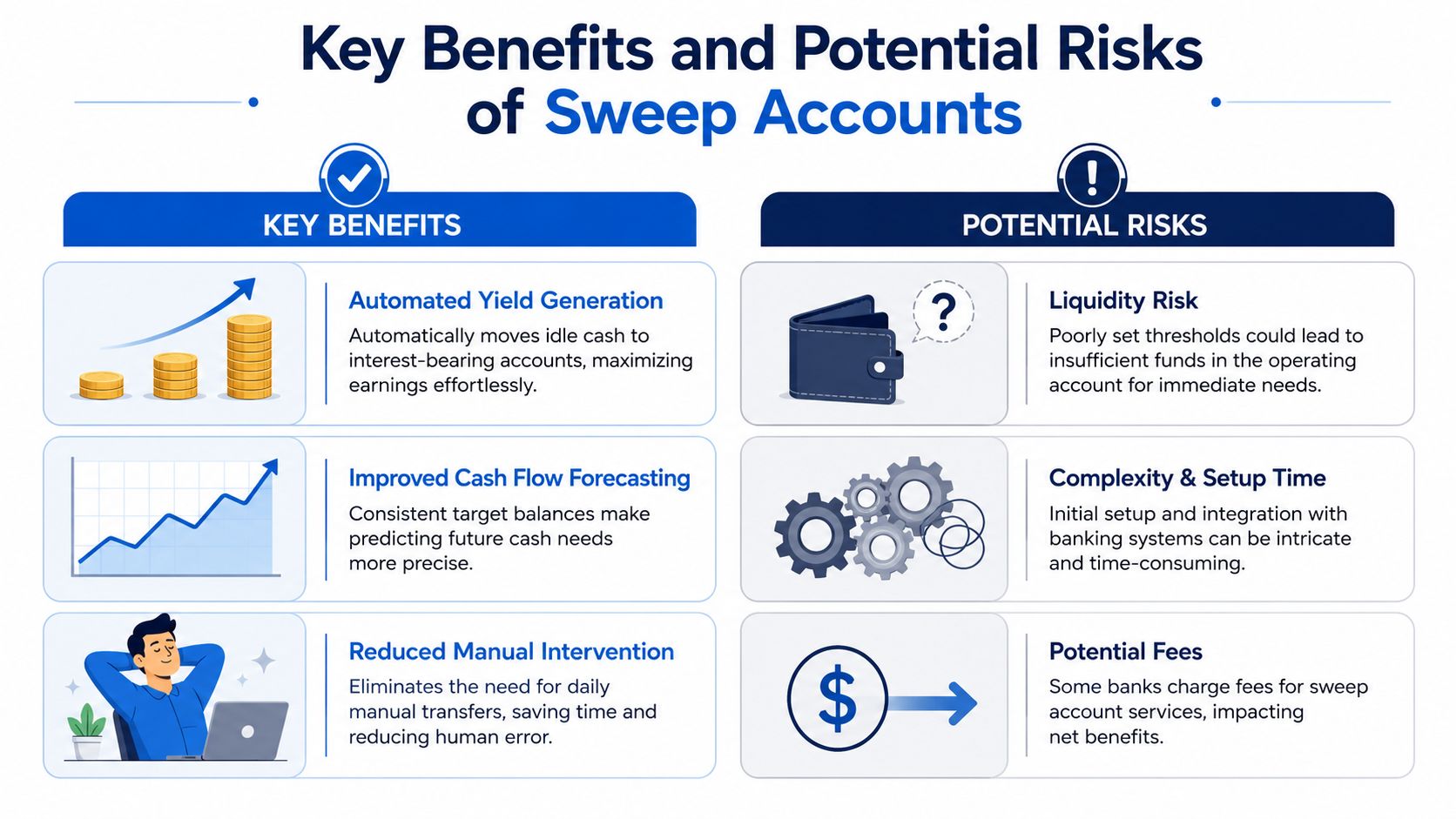
The first benefit is automatic positioning of idle cash. Instead of leaving surplus balances untouched in a non-interest-bearing operating account, the sweep moves them into a secondary vehicle chosen by the bank or platform. That creates a cleaner separation between money you need right now and money you can deploy for a little longer.
A second benefit is operational. Treasury staff don't have to remember every transfer or create ad hoc movement rules daily. That lowers manual workload and reduces the chance of a missed transfer or an overfunded account sitting unchanged for days. For finance leaders, the value is often in the consistency, not just the yield.
A third benefit is policy discipline. Once the target balance is set correctly, forecasting becomes more predictable because the operating account is designed to hold a defined working level. Treasury can model liquidity more cleanly when the sweep is doing the routine balancing.
The risks you can't ignore
The main risk is liquidity timing. If the threshold is set poorly, money may move out too aggressively and leave the operating account short when a payment hits. The reverse can happen too, where too much cash sits in the primary account and the sweep isn't doing enough work.
FDIC disclosure rules add another layer. The FDIC says sweep-account disclosures must tell customers whether swept funds count as deposits under federal law, and if not, what creditor status they would have in a bank failure. That distinction depends on the destination vehicle, which is why the legal treatment matters as much as the yield story.
The destination vehicle matters more than the marketing label. A sweep is only as safe and useful as the structure behind it.
Fees also matter. Even when the sweep itself feels automatic, maintenance, transaction, or program charges can eat into the net benefit. That's why treasury teams need to look at the full cost stack, not just the headline rate or the promise of better cash yield.
Sweep Account Use Cases for Modern Businesses
An international ecommerce company often has money arriving in more than one currency. EUR sales land during the day, GBP payouts are due later, and the finance lead wants USD liquidity available for a parent entity or consolidated expense base. A sweep strategy can keep those balances organized by moving excess funds into a designated account or instrument while still leaving enough money available in each operating wallet for settlements and refunds.
A web3 startup faces a different problem. Revenue may arrive in USDC, but payroll, contractors, and cloud bills still need fiat. In that case, the sweep logic may sit inside a broader treasury workflow that automatically converts excess digital assets into operating currency at the right point in the cycle. The point isn't to speculate, it's to avoid leaving payroll exposed to unnecessary volatility while still keeping a defined reserve in the original asset.
DAOs and on-chain treasuries often need a similar discipline, just with different tools. Idle stablecoins parked in a hot wallet can be swept into a more structured vehicle, then brought back when proposals, grants, or operational expenses need funding. The treasury question is the same across all three cases, which balances should stay liquid, which can be moved, and how quickly must they return.
For teams operating across fiat and crypto rails, the key advantage is not that the sweep looks familiar to traditional treasury. It's that the logic can be adapted to multi-currency and digital asset flows without forcing every movement to be manual. That's why these structures matter to platform-first companies as much as to legacy finance departments.
A sweep works best when it mirrors how money actually moves in your business, not how a bank brochure says it should move.
Practical Considerations for Implementation
Before you switch on a sweep, ask for the mechanics in plain language. The product name matters less than the rules underneath it.
A checklist that keeps surprises down
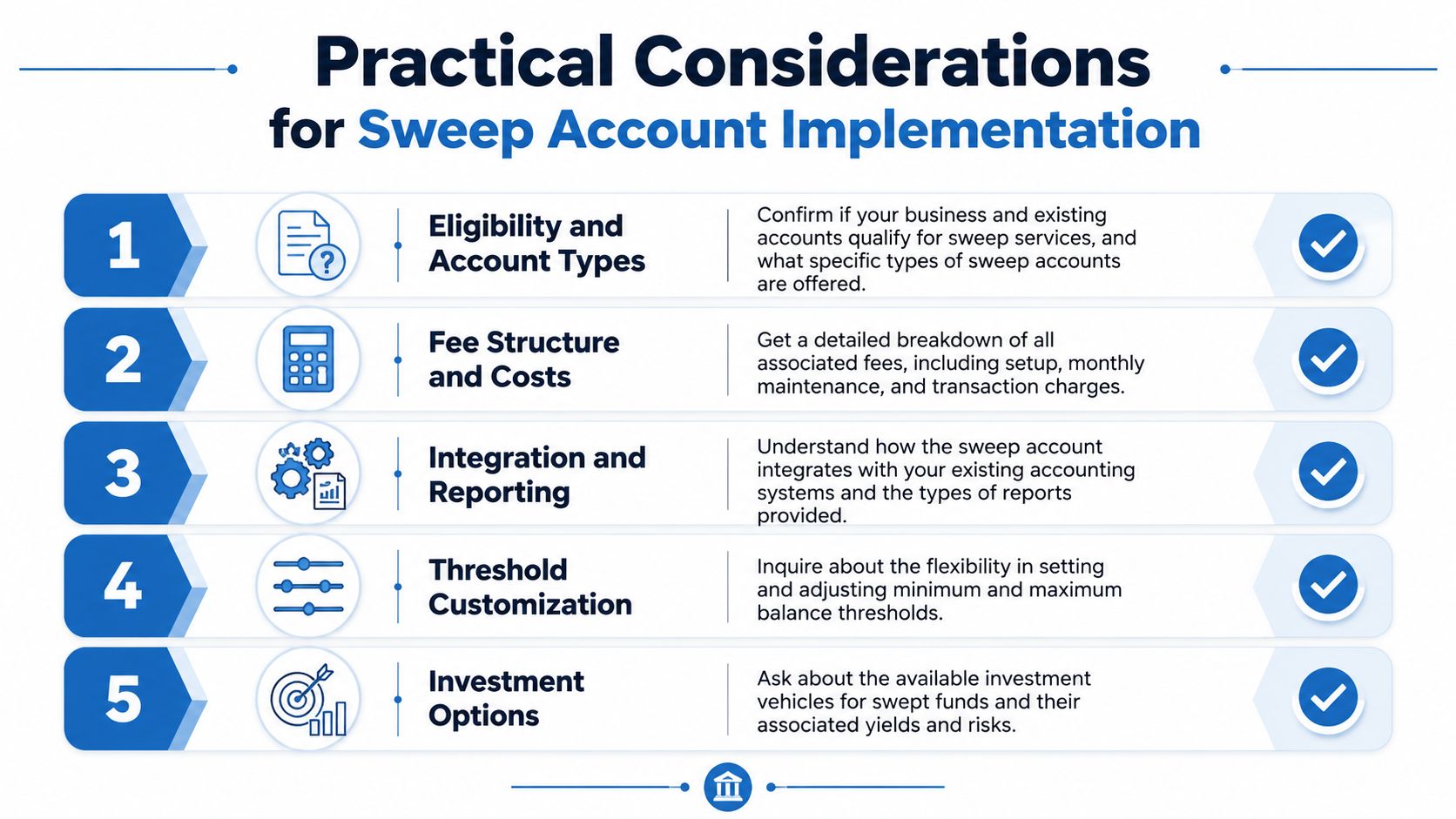
- Fee structure. Ask about setup, maintenance, transaction, and management fees, then compare them against the benefit of moving idle balances.
- Cutoff times. Confirm when the sweep runs and when funds can move back, because those windows determine whether you have same-day liquidity.
- Threshold design. Pick a target balance that reflects your cash volatility, not a round number that looks tidy on paper.
- Eligible vehicles. Verify where swept funds go, since the destination determines liquidity, yield, and legal treatment.
- Reporting and integration. Make sure the sweep feeds into your accounting and treasury workflow cleanly, especially if you reconcile across currencies or entities.
Federal Reserve guidance is useful here because it frames corporate sweeps as overnight cash-management tools whose value depends on tuning thresholds and timing to expected cash volatility. In a higher-rate environment, that balance gets more important, because the spread between doing nothing and running a tight sweep policy can feel meaningful even when the operational friction is modest.
If your business touches crypto as well as fiat, ask how the sweep fits into the rest of the treasury stack. A platform like best practices crypto treasury management can be part of that design conversation, but only if the sweep logic, custody model, and accounting flow are clear from the start.
The hidden question is governance. Who can change thresholds, who approves destination vehicles, and who reviews exceptions when a payment fails or a settlement runs late? If those controls aren't documented, the sweep can become another source of ambiguity instead of a control point.
Automating Your Treasury for Strategic Growth
A sweep account is useful because it turns routine cash movement into a rule, not a task. That frees finance teams to spend less time pushing balances around and more time on forecasting, working capital decisions, and exception handling.
For modern companies, especially those operating across borders or mixing fiat with digital assets, that shift matters. Treasury gets easier when the business has one source of truth for liquidity, one policy for thresholds, and one automated path for excess cash. If you're also trying to automate internal reporting and decision support, this piece on automating business intelligence is a good complement to the treasury automation mindset.
The smartest way to think about idle cash is as an active resource with a job. A sweep account gives that cash a job without adding another manual process to your team's list.
If you're ready to make treasury less manual and more disciplined, review how OneSafe can help you manage multi-currency balances, crypto flows, and operating cash in one place, then decide whether sweep-style cash positioning fits your treasury policy.