You've approved an invoice for an overseas vendor, entered the beneficiary's bank details, and now the payment screen asks for a SWIFT or BIC code, an intermediary bank, a fee option, and a purpose of payment. The transfer looks simple from your side, yet a single missing address line or incorrect account identifier can send it into a repair queue.
That's why understanding an international wire transfer through SWIFT matters. SWIFT is still a core rail for businesses paying suppliers, contractors, partners, and treasury accounts across borders, including finance teams at web3 companies that need to connect fiat banking with digital-asset operations. The important distinction is that SWIFT moves payment instructions between banks. It doesn't independently move the funds or guarantee that the beneficiary bank will post them immediately.
The practical result is straightforward. A fast SWIFT message can still lead to a slow customer experience if compliance teams, intermediary banks, cut-off times, or the beneficiary bank create friction after the message leaves the network. Once you understand those handoffs, you can choose the right payment rail, prepare better data, and troubleshoot a delayed transfer without guessing.
Table of Contents
Introduction to International Wire Transfers and Why SWIFT Still Matters
A founder paying an overseas contractor usually cares about three outcomes: the right amount leaves the business account, the recipient receives the expected currency, and the payment arrives when promised. The payment method matters because international banking relationships, currencies, local regulations, and intermediary institutions all affect those outcomes.
SWIFT remains relevant because it gives financial institutions a shared way to exchange payment instructions across borders. Newer rails can be faster or cheaper in specific corridors, but they don't replace the need for a broadly interoperable bank-to-bank messaging standard when a business must pay outside a single domestic or regional system.
The network began on 3 May 1973, when 239 banks in 15 countries created it to replace the older telex-based approach to international financial messaging. By 2015, SWIFT connected more than 11,000 financial institutions in over 200 countries and territories, handling an average of more than 32 million messages per day, according to the SWIFT history summary. That evolution explains why the term “SWIFT transfer” is so common even though the network itself is a messaging layer rather than a bank account.
Who needs to understand the rail
This guide is designed for:
- Founders and finance leads paying international vendors or contractors.
- Operations teams managing recurring cross-border settlements.
- Web3 businesses and DAOs coordinating fiat payments alongside crypto treasury activity.
- Newly incorporated companies preparing their first business wire and compliance review.
The central operating lesson is simple: don't treat SWIFT as a direct pipe from your account to the recipient's account. Treat it as a controlled relay. Your bank creates and sends instructions, correspondent banks may route or settle the payment, and the beneficiary bank performs its own checks before crediting the account.
That model makes the confusing parts easier to predict. The rest of the process comes down to accurate beneficiary information, appropriate routing, clear payment purpose, known fee handling, and a realistic view of where the final delay can occur.
What SWIFT Is and How It Differs From Moving Money
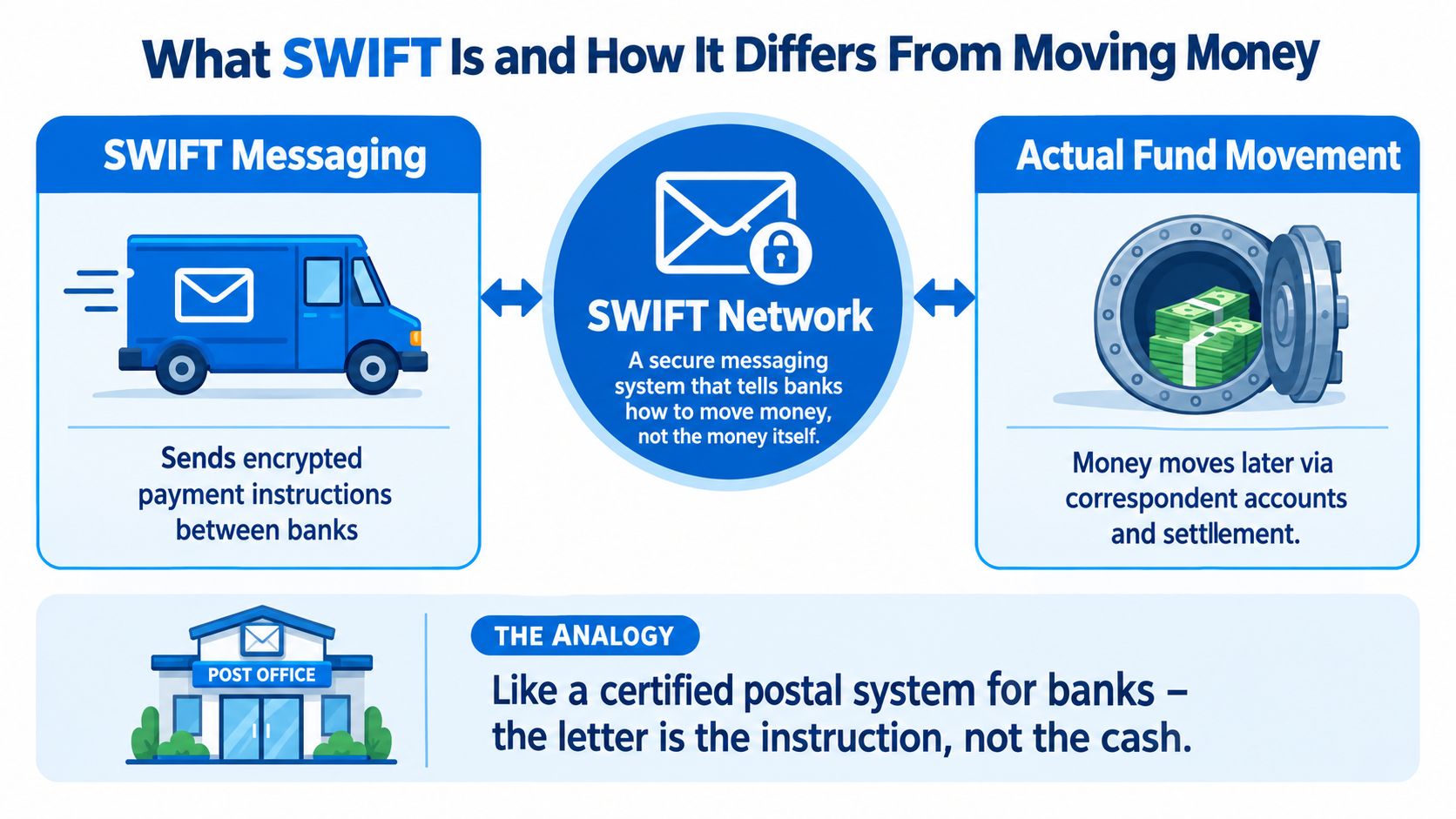
Think of SWIFT as a secure postal system for banks. Your bank prepares a certified letter containing payment instructions. SWIFT transports that message to the relevant financial institution, but the letter itself isn't the cash. Banks settle the underlying value through accounts and banking relationships that sit behind the message.
Three terms that people often mix up
SWIFT is the messaging network used by financial institutions to exchange structured financial instructions. It helps banks communicate in a common format and identify where a payment should go.
A BIC, often called a SWIFT code, identifies a bank or financial institution for routing. Your bank may ask for an eight-character or eleven-character code, depending on the institution and branch details required.
A wire transfer is the movement and settlement of funds between accounts. A SWIFT wire uses the SWIFT messaging layer to communicate the instruction, while the actual value may pass through correspondent accounts maintained between banks.
Practical rule: A SWIFT confirmation proves that a message was sent or accepted. It doesn't automatically prove that the beneficiary has been credited.
This distinction matters when you troubleshoot. If your bank says the SWIFT message was transmitted, the next question isn't necessarily “Why hasn't SWIFT delivered the money?” It may be “Which bank currently has the payment, and what action is required before the beneficiary bank posts it?”
Why banks need a shared language
Cross-border banks may use different domestic payment systems, account formats, currencies, and compliance procedures. A common messaging framework reduces ambiguity in fields such as the debtor, creditor, amount, purpose, and regulatory information.
SWIFT has fully moved international payment instructions between financial institutions onto ISO 20022 standards, replacing legacy MT formats for those interbank instructions, as described on the SWIFT homepage. ISO 20022 carries richer structured data than older wire formats, which can help automation and screening systems interpret a payment more consistently.
For individual customer transfers, many explanations still refer to the MT103 structure. It represents the customer wire instruction and includes information such as amount, sender, beneficiary, intermediaries, and remittance details. The format reinforces the key point: the message describes how banks should handle the payment, while routing and settlement determine when the recipient receives usable funds.
How a SWIFT International Wire Transfer Works Step by Step
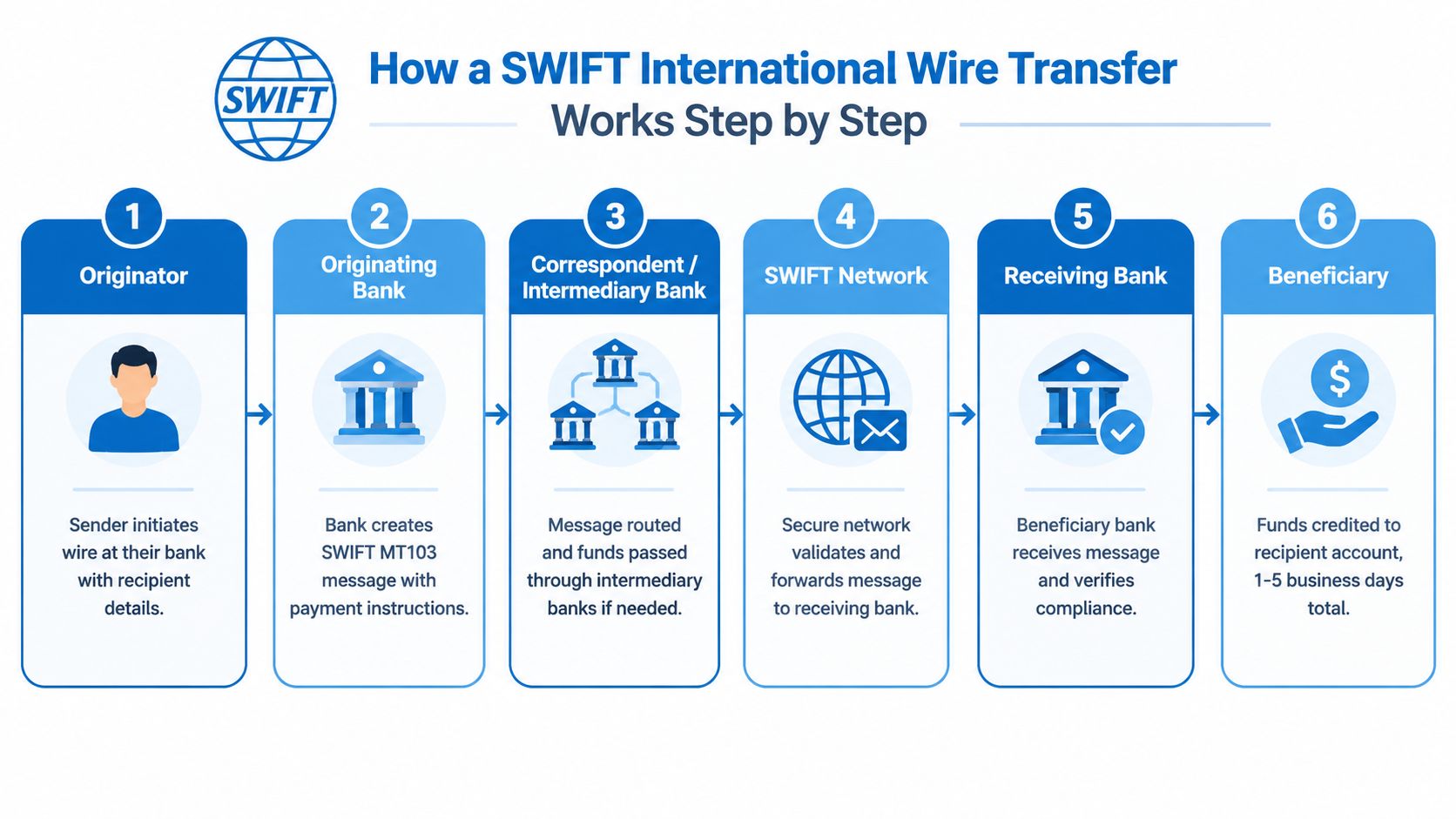
A SWIFT wire behaves more like a relay than a direct tunnel. Each participant handles a different responsibility, and a payment can slow down when one participant needs clarification or completes a review.
The six handoffs
Originator. You submit the payment through your business bank or payment platform. You provide the beneficiary's identity, bank details, amount, currency, and payment purpose.
Originating bank. Your bank validates the instruction, checks available funds and account permissions, and prepares the relevant bank-to-bank message. Older explanations may describe an MT103, while current interbank instructions use ISO 20022 standards.
Correspondent or intermediary bank. If your bank doesn't maintain a direct settlement relationship with the beneficiary bank, one or more correspondent institutions may participate. They help pass value through established accounts and can apply their own review or fee processes.
SWIFT network. SWIFT securely transmits the financial message to the next institution. It provides the communication layer, not the final beneficiary posting.
Receiving bank. The beneficiary bank receives the instruction, checks the message and account details, and performs sanctions, regulatory, fraud, and internal risk reviews where required.
Beneficiary. After the receiving bank accepts the payment and completes its processing, it credits the recipient's account. The recipient may see a pending status before the funds become available.
Why complete data supports straight-through processing
Straight-through processing, or STP, means a payment can move through the workflow without manual repair. Structured and complete information gives automated systems a better chance of matching the beneficiary, validating the route, and completing screening without sending the payment to an operations queue.
Poor data creates the opposite result. A misspelled legal name, incomplete address, unsupported purpose, or incorrect intermediary detail can force a bank employee to investigate. That investigation can happen at the originating bank, a correspondent bank, or the beneficiary bank, so your bank may not be able to resolve it instantly.
The SWIFT 2024 annual review reports that 90% of cross-border payments sent over the network reached beneficiary banks within an hour. That figure describes delivery to the beneficiary bank, not necessarily final credit to the customer account. The distinction is central to understanding real-world timing.
A payment can therefore be visible at the receiving bank while still awaiting compliance approval, repair, currency handling, or local posting. When a transfer stalls, ask the bank to identify the last confirmed participant and whether the issue concerns message delivery, settlement, compliance, or beneficiary posting.
What You Need to Send a SWIFT Transfer Without Delays
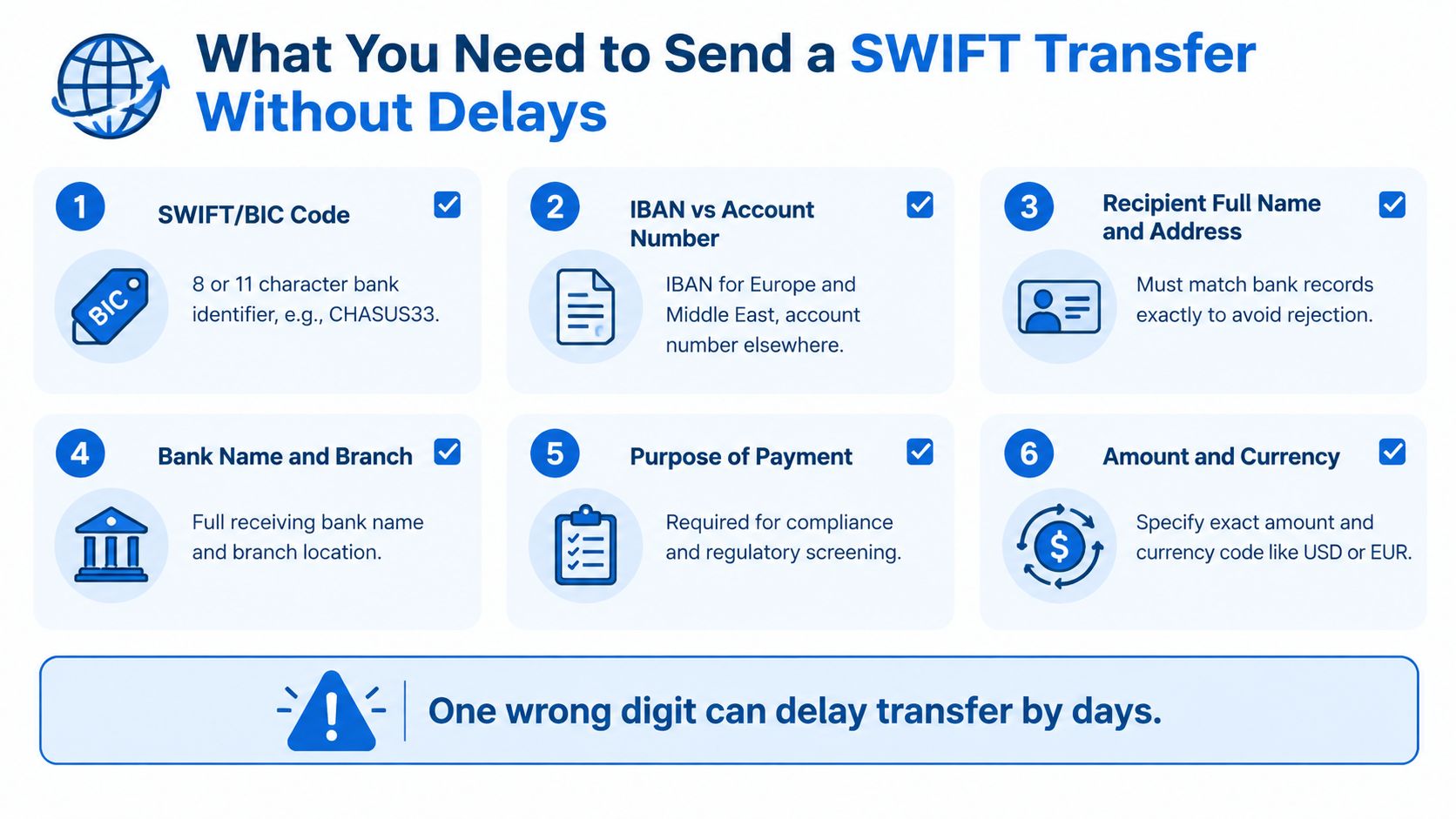
The fastest payment is usually the one that doesn't need a human to correct it. Before submitting an international wire, compare every field against the beneficiary's official banking instructions, not a copied email fragment or an old invoice.
The payment details to verify
SWIFT or BIC code. Confirm the receiving institution's identifier and whether the bank requires branch-specific information. Don't substitute a similar-looking code from a search result.
IBAN or account number. Use an IBAN where the destination banking system expects one. Elsewhere, the bank may use a domestic account number or another local identifier. Ask the beneficiary's bank for the correct format rather than assuming an IBAN applies everywhere.
Legal beneficiary name and address. Enter the name exactly as the receiving bank holds it. A trading name, abbreviated company name, or outdated address can create a mismatch during screening or account validation.
Receiving bank and branch. Include the bank's full legal name and location when requested. If the beneficiary supplied intermediary details, preserve those details in the designated intermediary fields instead of placing them in the beneficiary bank field.
Purpose and remittance information. Write a clear business reason, such as an invoice payment, contractor payment, capital contribution, or software subscription. The description should match the supporting document and the actual commercial activity.
Amount and currency. Specify the exact amount and currency code. Confirm whether the beneficiary expects the sent currency or a local conversion, because conversion and receiving-bank policies can affect the final credited amount.
Prepare for business compliance review
Banks may ask for incorporation documents, ownership information, invoices, contracts, source-of-funds evidence, or an explanation of the business relationship. This can be particularly relevant for newly formed companies and web3 organizations, where the bank may need a clearer view of the entity, controllers, counterparties, and transaction purpose.
Keep the supporting record together with the payment approval. A finance operator who can quickly provide an invoice and explain the beneficiary relationship gives the bank a cleaner review path than a payment submitted with a vague description and no documentation.
Before you click send: Read the beneficiary name, bank identifier, account identifier, currency, amount, purpose, and intermediary fields aloud against the source document. This catches transcription errors that a visual scan often misses.
Use dual approval for material payments, especially where the account details arrived through email. Confirm changes through a trusted channel, and save the payment reference after submission. Those controls won't eliminate every bank-side review, but they reduce preventable repairs and make an investigation easier to manage.
Fees Timelines and Why SWIFT Transfers Still Take Days
The cost of a SWIFT wire has more than one layer. Your originating bank may charge for sending it, an intermediary may deduct a handling fee, the beneficiary bank may charge for receiving it, and currency conversion may include an exchange-rate margin.
Fee instructions often determine who absorbs those deductions. Under OUR, the sender pays the applicable charges. Under SHA, sender and recipient share charges according to the banks' arrangements. Under BEN, the recipient bears the fees. Your provider may expose these choices differently, so read the payment confirmation rather than assuming a “free” wire has no downstream cost.
For a practical discussion of international payment pricing and fee visibility, see OneSafe's guide to B2B cross-border payments. Its published example lists a SWIFT fee of 0.35% plus $50, but pricing can depend on the provider, account plan, currency, and payment route. Treat any displayed fee as one part of the total cost and check whether intermediary or receiving-bank deductions remain possible.
Where SWIFT time and cost actually go
| Stage | Typical cost driver | Typical time impact |
|---|---|---|
| Originating bank | Outgoing wire fee, currency conversion, internal review | Account approval, cut-off time, and data validation |
| Correspondent bank | Routing, settlement handling, and possible deductions | Queueing, compliance review, and handoff timing |
| SWIFT messaging | Messaging and instruction transmission | Often a small part of total end-to-end latency |
| Beneficiary bank | Receiving fee, local processing, conversion, and posting | Compliance checks, repair, local cut-off, and account credit |
| Recipient account | Final posting and availability rules | The point at which the recipient can actually use the funds |
The last mile explains the apparent contradiction
SWIFT's October 2024 speed report says 90% of cross-border payments processed on its network reach the beneficiary bank within an hour. The same report places that performance ahead of the G20 target of 75% reaching the end customer's account within one hour by 2027.
Those measures aren't contradictory. The first concerns the network journey to the beneficiary bank. The second concerns the customer's account. After the message arrives, the receiving bank may still need to repair data, complete screening, wait for a local processing window, convert funds, or post the credit.
That's why an international wire can still take 1 to 5 business days, as reflected in the provided SWIFT process material, even when network transit is fast. To improve the outcome, submit complete data before the bank's cut-off, choose the correct currency route, clarify fee responsibility, and ask for the bank's payment trace if the beneficiary hasn't received the credit.
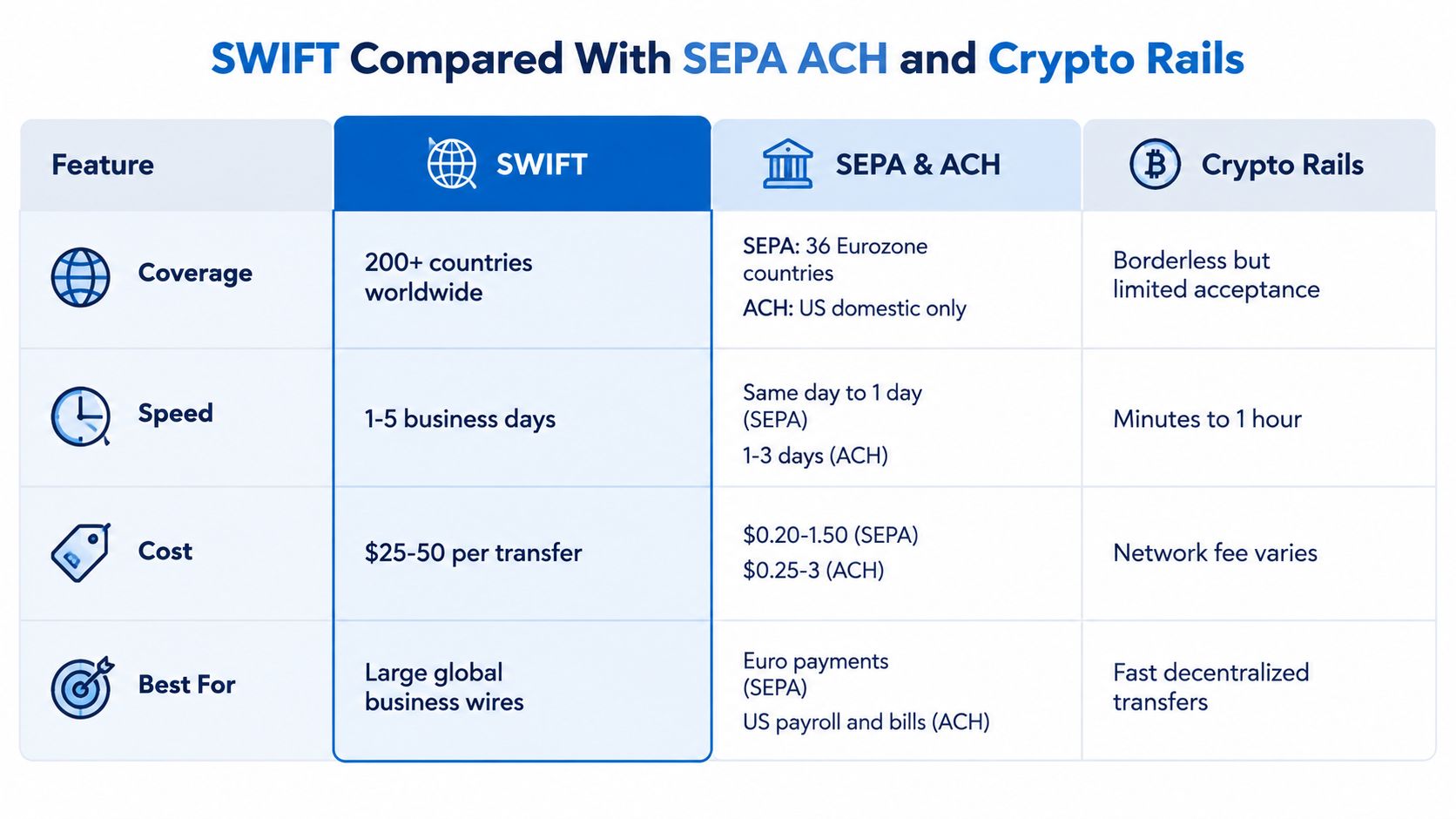
SWIFT Compared With SEPA ACH and Crypto Rails
SWIFT isn't automatically the right choice for every cross-border payment. The best rail depends on the destination, currency, recipient's acceptance requirements, compliance context, and whether the recipient needs bank money or digital assets.
SEPA is generally suited to euro payments within the Single Euro Payments Area. ACH is designed for US domestic account-to-account payments, making it useful for payroll, recurring bills, and domestic vendors. Crypto rails can provide a direct digital-asset transfer, but the recipient must accept the asset and manage custody, conversion, and compliance requirements.
Choose by payment context
| Payment need | More suitable starting point | Why |
|---|---|---|
| Global bank payment outside a regional scheme | SWIFT | Broad bank connectivity and established cross-border messaging |
| Euro payment within a SEPA-accessible route | SEPA | Regional design and simpler euro settlement |
| US domestic payroll or vendor payment | ACH | Built for domestic US account transfers |
| Web3 treasury movement where both sides accept digital assets | Crypto rail | Direct digital-asset settlement and flexible treasury workflows |
| Fiat payment after converting digital assets | Platform supporting both rails | Can connect crypto conversion with a bank payout |
For a deeper operational contrast between domestic ACH and international SWIFT wires, review OneSafe's ACH versus SWIFT comparison. The useful question isn't “Which rail is fastest?” in isolation. It's “Which rail reaches this recipient in the required form, with the fewest handoffs and the clearest compliance path?”
Trade-offs to keep visible
SWIFT offers the broadest bank-oriented reach, but it can involve correspondents, variable fees, and last-mile processing. SEPA and ACH can be more efficient when the payment stays within their supported regions, yet they aren't universal substitutes for a global bank wire.
Crypto rails can reduce dependence on correspondent-bank routing, but they introduce different operational responsibilities. The sender and recipient must agree on the asset and network, wallet details must be correct, and the business may still need to convert into fiat before paying a traditional vendor.
For a founder, the decision can be practical:
- Confirm the recipient's required form of payment. A supplier asking for a bank account usually needs a bank rail.
- Check corridor fit. Use a regional rail when both parties and currencies qualify.
- Assess the compliance path. Choose the route your financial institution can support and document.
- Compare total cost. Include conversion, intermediary deductions, receiving fees, and operational effort.
Simplifying SWIFT Transfers for Your Business With OneSafe
A reliable SWIFT workflow starts before the payment screen. Store verified beneficiary records, require a second approver for sensitive changes, attach the invoice or contract, and define who pays fees. Then schedule the transfer with the beneficiary's local banking hours and your provider's cut-off times in mind.
For teams that use several rails, fragmentation creates another source of risk. A finance operator may need one system for USD operations, another for EUR payments, a separate account for CAD settlement, and a crypto platform for USDC conversion. A unified workflow can make it easier to select the appropriate rail while keeping approvals, records, and treasury visibility in one operating environment.
OneSafe's business account for international payments supports multi-currency business accounts and payment workflows that include ACH, domestic wires, international wires, and SWIFT. Its stated capabilities also include USD, EUR, and CAD accounts, crypto-to-fiat and fiat-to-crypto conversions, team controls, corporate cards, and KYB support for businesses operating across fiat and web3 environments. Review the applicable plan, eligibility, corridor availability, and fees before relying on any specific route.
Use this pre-send routine:
- Validate the beneficiary. Match the legal name, address, account identifier, and bank code to current documentation.
- Validate the route. Confirm whether an intermediary bank is required and whether its details belong in a separate field.
- Validate the economics. Check currency conversion, fee allocation, and the amount the beneficiary should receive.
- Validate the evidence. Attach the invoice or business rationale and retain the payment reference.
- Validate the fallback. Know whom to contact if the payment reaches the beneficiary bank but isn't posted.
The central lesson is operational rather than technical. SWIFT can transmit a payment instruction quickly, but your team controls much of the information that determines whether banks can process it without repair.
OneSafe brings multi-currency accounts, SWIFT and ACH payment workflows, and crypto-to-fiat conversion into one business finance environment, with team controls and KYB support for eligible companies. Visit OneSafe to review the available account and payment options, then match the workflow to your next international wire.