Stablecoin regulation is at a crossroads, and nowhere is that clearer than in Africa, where businesses are adopting digital dollars faster than lawmakers can write the rules. On September 5, 2026, THISDAYLIVE reported that stablecoins are gaining traction across the continent as a practical payment rail—not speculative assets—used to bypass broken fiat systems, expensive remittance corridors, and chronic foreign-exchange shortages. The development exposes a widening gap: real-world usage races ahead of US-centric frameworks never designed for African market realities.
Table of Contents
- What Just Happened in Africa’s Payments Landscape
- Why This Development Matters for Global Stablecoin Regulation
- Background: Stablecoin Regulation Today
- Implications for Businesses and Neo-banks
- What to Watch Next and Open Questions
- Key Takeaways
What Just Happened in Africa’s Payments Landscape
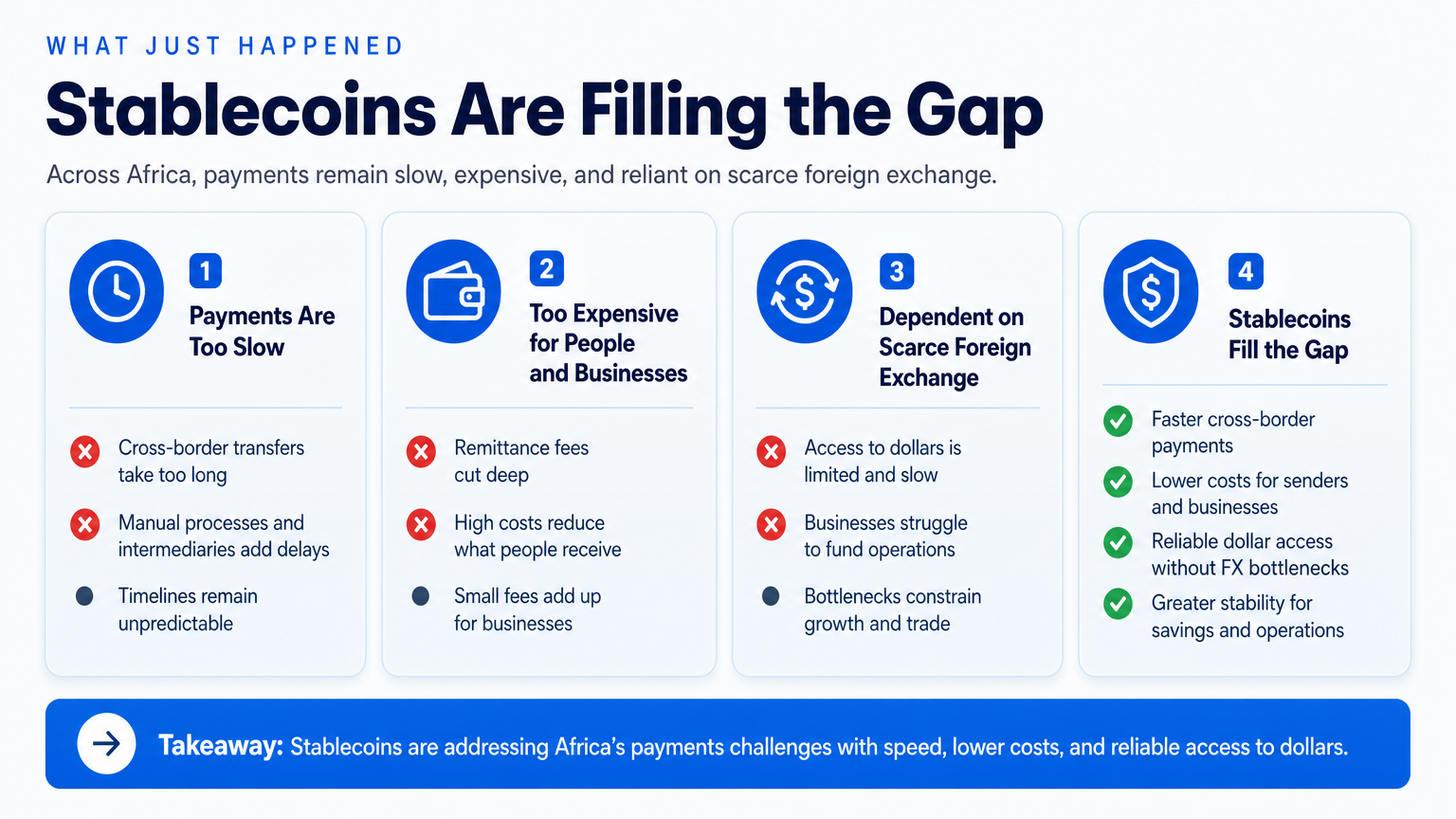
Across Africa, sending money remains too slow, too expensive, and too dependent on scarce foreign exchange. Currency swings wipe out savings, remittance fees cut deep, and many businesses struggle to access dollars for basic operations. Stablecoins are beginning to fill this gap.
The stablecoin lifeline in Africa
The THISDAYLIVE piece quotes fintech executive Osaro Jackson, who describes stablecoins as digital dollars used for everyday payments. Importers in Nigeria use USDC to settle invoices with Chinese suppliers without touching naira or waiting weeks for dollar allocations. Freelancers in Kenya receive USDT from overseas clients and convert only what they need. Cross-border traders in Ghana move value instantly to partners in Togo at near-zero cost.
These are real-world payments, not speculation. Volume isn’t driven by leverage trading or yield farming; it’s driven by businesses that just need a functioning payment rail when the traditional one breaks down.
Real-world adoption, not speculation
In developed markets, stablecoin adoption is often framed around trading efficiency and DeFi. In Africa, it’s about survival: importers facing 18-month dollar queues, diaspora workers paying 8–12% in remittance fees, and SMEs locked out of SWIFT. Stablecoins solve these failures directly.
Why This Development Matters for Global Stablecoin Regulation

Regulators in Washington, Brussels, and London are debating frameworks built on assumptions that don’t match African reality. The stablecoin regulation 2026 conversation has been dominated by reserve requirements, redemption rights, and prudential oversight—all important, but none of which answer the fundamental question: who writes the rules for a dollar-denominated payment instrument used primarily outside American borders?
The current US-centric regulatory approach
The US framework, anchored by the GENIUS Act, is built around a “payment stablecoin” issued by regulated entities with dollar-backed reserves. Proposed rules published in the Federal Register on March 2, 2026 establish a dual federal-state regime: federally chartered institutions can issue under OCC supervision, while state-level frameworks remain available under certain conditions. The OCC issued its Notice of Proposed Rulemaking that same month, and the Treasury Department proposed rules defining stablecoin issuance and sales.
This is rational for domestic financial stability, but it presumes the primary risk vector is the US banking system—not the Nigerian SME using USDC on a smartphone to pay a Kenyan supplier because no correspondent bank will touch the transaction.
A growing gap between law and on-the-ground need
Stablecoin payments Africa represent a regulatory blind spot. The Federal Reserve’s March 2026 research note acknowledges the cross-border benefits and implications for monetary policy but stops short of the jurisdictional question: when a stablecoin circulates as a parallel currency in markets with restricted dollar access, whose consumer protection and financial stability mandate applies?
African businesses aren’t waiting. They’re routing around the problem, creating an environment where the only viable path is unregulated—because the regulated path doesn’t exist in their market.
Background: Stablecoin Regulation Today
Stablecoins are cryptocurrency tokens pegged to a reference asset, typically the US dollar, maintained through reserves of cash, Treasury bills, or other liquid assets. USDC and USDT dominate. In emerging markets, stablecoin remittances are the killer app: faster and cheaper than traditional money transfer operators, with settlement in seconds.
US regulation: The GENIUS Act proposes a dual federal-state framework. Federally regulated issuers must hold one-to-one reserves in high-quality liquid assets, meet redemption requirements, and undergo regular examinations. The Treasury’s March 2026 proposal clarifies issuance and sales definitions, distinguishing true “payment stablecoins” from other tokenized instruments. Abroad: The EU’s MiCA offers a comprehensive cross-border framework, while the UK and UAE are advancing their own. Most African central banks have yet to issue formal stablecoin frameworks—the vacuum that makes the adoption wave both inevitable and legally ambiguous.
Risks and benefits: Benefits include near-instant settlement, minimal costs, 24/7 availability, and access for the unbanked. Risks include run risk, consumer protection gaps, and potential undermining of local monetary sovereignty. In markets like Nigeria, the absence of a legal framework means users have no recourse if an issuer fails or funds are frozen.
A “payment stablecoin,” per the GENIUS Act and Treasury rules, is a fiat-pegged digital asset issued by a regulated entity, intended primarily for payments and settlement—not investment. The classification determines which rules apply.
Implications for Businesses and Neo-banks
What it means for companies using stablecoins for cross-border payments
The African story signals two things: demand is real and growing, and the regulatory gap creates genuine compliance risk. A US business paying a Nigerian supplier in USDC operates in a gray zone—the issuer is regulated, but the end-user transaction occurs in a jurisdiction with no framework.
Stablecoin compliance for businesses requires:
- Jurisdiction mapping: document counterparty locations and local restrictions.
- Transaction monitoring: treat stablecoin flows with the same rigor as wire transfers.
- Banking partner alignment: ensure your platform supports stablecoin transactions compliantly with clean fiat ramps.
- Record-keeping: maintain audit trails demonstrating the business purpose of every payment.
Compliance without sacrificing speed: The role of platforms like OneSafe
Compliance often means slower payments, but a stablecoin neo-bank can bridge the gap. OneSafe is a financial technology company—not a bank—that provides a unified platform for fiat and cryptocurrency transactions. Banking services are provided by its partners. It supports ACH, wires, bill payments, and instant crypto-to-fiat conversion, with multi-currency accounts in USD, Euro, and CAD.
A typical workflow: convert fiat to USDC on-platform, send to the supplier’s wallet, and let the supplier convert locally. The platform’s compliance infrastructure handles KYB and transaction monitoring, while the business retains speed and cost advantages. Onboarding typically completes within a week.
| Factor | Traditional Banking | Stablecoin + Neo-bank |
|---|---|---|
| Cross-border settlement time | 2–5 business days | Seconds to minutes |
| Average remittance cost to Africa | 8–12% | Near-zero on-chain; FX conversion varies |
| Dollar access for African SMEs | Queue-based, often months | Immediate on-chain |
| Regulatory clarity for US business | Established | Emerging; issuer-level regulation exists, end-user framework incomplete |
| Compliance burden | Known, manageable | Requires active jurisdiction monitoring |
What to Watch Next and Open Questions
When will US regulators catch up?
The GENIUS Act rulemaking is underway, but current drafts are silent on extraterritorial use. The Fed’s March 2026 note acknowledges cross-border benefits without proposing a supervisory framework for those flows. If African usage volumes trigger systemic risk assessments, US regulators may be forced to engage—or bilateral agreements, like those pursued in UAE stablecoin regulation, could provide a template.
How African central banks may respond
African regulators face a tough choice: resist stablecoins and lose visibility, issue CBDCs (which have struggled globally to gain adoption), or build regulatory sandboxes that treat stablecoins as a legitimate payment rail with protections. Nigeria’s eNaira saw limited uptake, suggesting a domestic digital currency won’t solve the dollar-access problem.
The Banking Industry and Regulation ARM of the Federal Reserve has noted that payment stablecoins and cross-border payments are linked in ways monetary policy frameworks haven’t yet integrated. For African central banks, stablecoin adoption Africa is not a future scenario—it’s current reality.
Businesses should also watch how the 21 banks issuing stablecoins impacts the landscape. When major institutions enter, they bring compliance infrastructure but also the same correspondent banking limitations stablecoins were designed to circumvent. Stablecoin payments in B2B settings are already being piloted elsewhere; in Africa, they’re production-grade rails moving real value. The regulation has no choice but to follow.
For businesses, the near-term strategy is clear: maintain compliance through platforms that bridge fiat and crypto natively while documenting every counterparty and jurisdiction. The regulatory landscape will shift, but the operational need for fast, low-cost cross-border payments will not.
Key Takeaways
- Stablecoins are being adopted in Africa as a primary payment rail, driven by failed fiat infrastructure and scarce dollar access.
- US-centric stablecoin regulation, including the GENIUS Act rulemaking, does not address extraterritorial use in markets like Nigeria and Kenya.
- Businesses must implement jurisdiction-aware compliance now, even where local frameworks haven’t caught up.
- Neobanking platforms combining fiat, stablecoin transactions, and built-in compliance reduce operational risk in legally ambiguous corridors.
- African central banks face an urgent choice: build frameworks that acknowledge stablecoins as legitimate infrastructure, or lose visibility over a growing parallel system.
Open an account with OneSafe to manage fiat and stablecoin transactions on a single, compliance-ready platform built for the global businesses shaping the future of cross-border payments.