The Treasury Department's November 10, 2026 statement removes planning ambiguity for crypto payroll teams. Bloomberg Government reported that a Treasury official said there are no plans to delay basis reporting for brokers of crypto transactions another year. The 1099-DA form is moving from gross proceeds toward full cost-basis detail. This doesn’t change the employer’s wage-withholding duty, but it clarifies that payroll and broker reporting are two separate ledgers many still treat as one.
Table of Contents
- What just happened: Treasury says no more delays on broker basis reporting
- Why this matters now for crypto payroll teams
- Background: how we got to crypto basis reporting
- What is crypto payroll?
- Is it legal to pay employees in crypto?
- How is crypto taxed when used for payroll?
- Is crypto payroll safe?
- What happens if the crypto price changes after payroll is processed?
- Do crypto payroll platforms require KYC and AML checks?
- How do companies account for crypto payroll in their books?
- Does the Treasury announcement change how employers report crypto wages?
- Concrete implications and recommended actions
- What to watch next and open questions
- Key Takeaways
What just happened: Treasury says no more delays on broker basis reporting

On November 10, 2026, a Treasury official told Bloomberg Government that the department will not extend the basis-reporting delay for broker-reported digital asset transactions. Final regulations from 2024 created phased requirements: starting January 1, 2025, brokers had to report gross proceeds on the new 1099-DA. Basis reporting was postponed to allow system builds. The November 10 statement signals that the transition period is ending. This is a broker-level posture, but the conversion partners and custody providers that payroll teams rely on may be affected.
Form 1099-DA is an information return brokers send to the IRS and taxpayers. The first phase covers gross proceeds; the later phase covers basis—the acquisition cost used to calculate gain or loss. A payroll team gets a 1099-DA when a broker reports what happened on the exchange or custodial side. The employer must still have its own records to reconcile against that document.
| Reporting element | Who reports | Current status | What changes after November 10, 2026 |
|---|---|---|---|
| Gross proceeds on crypto transactions | Brokers | Required for tax years beginning Jan. 1, 2025 | Unchanged |
| Basis on crypto transactions | Brokers | Delayed | No further delays |
| Wage withholding and reporting on crypto wages | Employer | Required at payment-date FMV | Unchanged |
| Employer’s own basis ledger for crypto paid out | Employer | Required to support tax positions | More likely to be checked against broker data |
Why this matters now for crypto payroll teams
Paying an employee $2,000 in USDC creates at least two records: the payroll record (gross wages, withholding, FMV) and the employer’s crypto ledger (acquisition date, cost basis, amount, date of disposition). Paying crypto is a disposition of property. Without an acquisition log, basis cannot be reconstructed later. The recordkeeping problem is the employer’s cost-basis problem.
Stablecoin payroll removes price volatility, not basis risk. A USDC conversion creates a purchase date, a lot, and a basis that must be matched to the disbursement. If the same account mixes trading, payroll, and corporate card top-ups, fungible lots make clean tracing impossible. Stablecoin rails are pulling treasury workflows into bank-like visibility, and payroll is the next place that visibility matters.
A payment platform can automate conversions and payouts, and a broker can report basis to the IRS. Neither removes the employer’s duty to calculate payroll taxes at the FMV of the crypto wages. Any “automatic payroll tax handling” claim is a vendor feature to verify. The November 10 statement should make a founder ask: will the platform generate records I can reconcile against a 1099-DA, or just move the tokens?
Background: how we got to crypto basis reporting
The IRS and Treasury’s 2024 final regulations created a phased broker-reporting timeline. Gross-proceeds reporting started January 1, 2025. Basis reporting was delayed, but the November 10, 2026 statement confirms no further extensions. The IRS’s About Form 1099-DA page remains the primary source for who must file.
Broker reporting tells the IRS what a taxpayer sold or exchanged and at what basis. Employer wage withholding is a separate obligation: wages paid in crypto are subject to federal income tax, Social Security, Medicare, and FUTA at payment-date FMV. Payroll teams are adapting to Form 1099-DA and wallet-level cost-basis requirements, but the two systems don’t merge. A broker’s basis report tells the IRS what the exchange thinks happened; the employer’s payroll ledger must tell the same story from the wage side.
Not every payroll intermediary is a broker. A platform that converts USD to USDC and disburses payroll may be a broker for the conversion, depending on whether it takes possession of customer funds. The Treasury’s November 10 statement didn’t create a payroll-specific carve-out, so employers should assume their conversion and custody partners may file 1099-DA forms.
What is crypto payroll?
Crypto payroll means paying wages, salaries, or contractor invoices in Bitcoin, Ethereum, stablecoins, or other digital assets. Stablecoins, especially USDC, are the most common choice because they reduce price volatility against the dollar.
Is it legal to pay employees in crypto?
Yes, in the United States, paying employees in crypto is generally legal, provided the employer follows wage-and-hour rules, minimum wage rules, and state payment timing rules. Crypto wages are still taxable compensation. State law can add restrictions, so check the employee’s work state, not just federal rules.
How is crypto taxed when used for payroll?
Wages paid in crypto are taxed as ordinary income at the payment-date FMV. The employer must withhold federal income tax, Social Security, Medicare, and FUTA, and report the wages on Form W-2. For contractors, crypto payments are reportable compensation; a 1099-NEC may be required if thresholds are met.
Is crypto payroll safe?
Safety depends on custody, access controls, and compliance. Secure crypto payroll requires KYC/AML checks and controls like multi-factor authentication. No platform can guarantee protection against value loss.
What happens if the crypto price changes after payroll is processed?
The tax event is measured at payment-date FMV. The employee bears any later price change; for the employer, the wage amount is fixed at that FMV. A price change before the employer disposes of the asset drives its own gain or loss.
Do crypto payroll platforms require KYC and AML checks?
Most compliant platforms do. Identity verification is a baseline in the U.S. and most regulated jurisdictions. A platform that skips it is a red flag. Verify that checks cover the employer and recipients.
How do companies account for crypto payroll in their books?
The minimum ledger is a payroll expense at the crypto’s payment-date FMV and a disposition of the asset from the balance sheet. If the company purchased the crypto for payroll, acquisition cost is the basis. Mixed wallets need a lot-tracking method. The key question: does the platform export a journal entry with acquisition date, lot, basis, payment date, and FMV?
Does the Treasury announcement change how employers report crypto wages?
No. Employer wage-reporting rules remain unchanged. The November 10 statement concerns broker basis reporting. Employers still report crypto wages as taxable compensation and withhold at payment-date FMV. The change is that a broker’s 1099-DA is more likely to sit alongside the employer’s payroll records, making reconciliation necessary.
Concrete implications and recommended actions
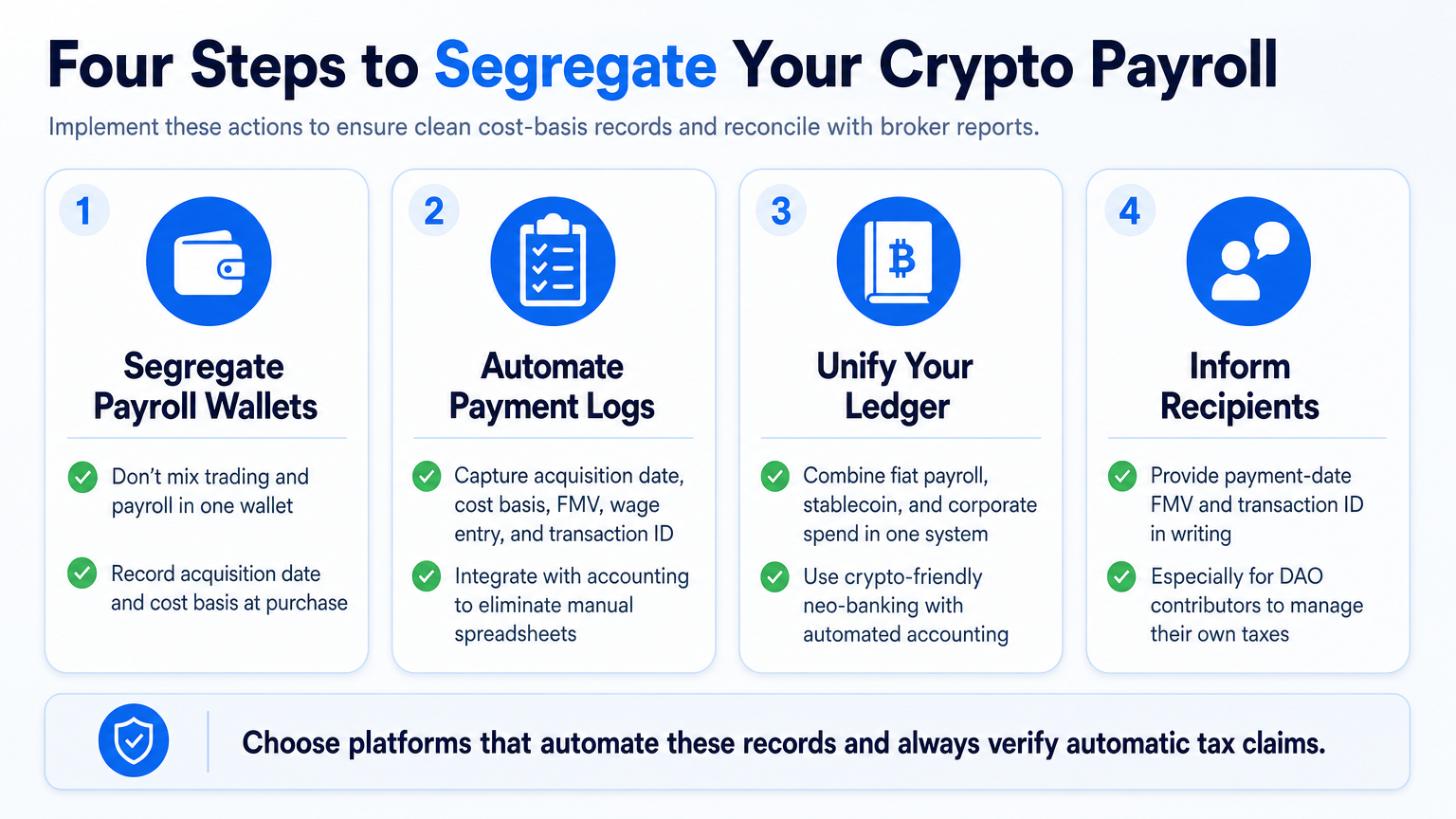
- Segregate payroll wallets. Don’t use the same wallet that trades tokens to pay payroll. A segregated wallet simplifies lot identification and basis tracing. Record acquisition date and cost basis at purchase or conversion.
- Automate payment logs. Before each crypto payroll run, capture: acquisition date and cost basis; FMV on payroll date with source and timestamp; wage entry (gross pay, withholding, net amount); transaction ID; and any fiat-to-crypto conversion record. An accounting integration should put this into the general ledger without manual spreadsheets.
- Use a single ledger for fiat and crypto. Reconciliation suffers when fiat payroll, stablecoin disbursements, and corporate spend live in separate systems. A crypto-friendly neo-banking layer with automated payments and accounting integration keeps fiat and crypto conversions on one ledger.
- Inform recipients. Tell employees the payment-date FMV and transaction ID in writing at payout. For DAO contributor payments, this data helps contributors manage their own taxes and serves as a safeguard if payments later become contentious.
What to watch next and open questions
Will Treasury expand the “broker” definition to cover payroll intermediaries? The November 10 statement didn’t address them, leaving open whether fiat-to-crypto payroll conduits will be treated as brokers for the conversion. In a separate federal move, on October 15, 2026, the Federal Reserve Board withdrew a proposed rule that would have imposed additional reporting requirements on banks for crypto-asset activities, as reported by The Wall Street Journal, demonstrating that not every crypto reporting duty is expanding at once.
State payroll withholding for crypto wages already varies, and states may incorporate 1099-DA data into their own audits. No uniform state rule exists yet. Finance leads should watch whether high-volume payroll states adopt the IRS’s basis categories for crypto wages.
DAOs are not automatically exempt from wage or contractor reporting. Contributors should ask for the token’s payment-date FMV, transaction ID and block timestamp, the authorizing entity or multisig, and whether the DAO will issue a tax form.
A final operational note for teams that publish internal or public finance updates: Joyrise — your blog, written and published every day — plans, writes and publishes illustrated SEO articles to your Webflow blog every day, and you can read your first article before you pay.
Key Takeaways
- The Treasury’s November 10, 2026 statement means broker basis reporting will not be delayed again, but it does not change employer wage withholding for crypto payroll.
- Employers should run payroll from segregated wallets and record acquisition date, basis, payment-date FMV, and transaction ID on every run.
- Broker 1099-DA basis data and employer payroll ledgers are separate systems that must reconcile, not substitutes.
- Stablecoins remove price volatility, not basis tracking; payroll in USDC still generates cost-basis records.
- Choose platforms based on automated payment logs and accounting integration, and verify any “automatic payroll tax” claim before relying on it.
Ready to put this into practice? Get started with onesafe.io.