Meta Description: Senate probe into Tether conflict of interest and USDT sanctions evasion reshapes stablecoin regulation. Learn immediate compliance steps for businesses.
Senate's Tether Probe Shifts Stablecoin Regulation Focus
Table of Contents
- What Just Happened: Senate Opens New Front in Stablecoin Scrutiny
- Why It Matters Now for Businesses Holding or Transacting in USDT
- The Background: Stablecoin Regulation Before the Probe
- How the Tether Probe Reshapes Compliance
- Concrete Steps for DAOs and Web3 Startups
- What to Watch Next
- How does the Senate Tether probe change stablecoin regulation?
- What risks do businesses face if they hold USDT right now?
- How are stablecoins regulated in the US, and why is this investigation different?
- What should DAOs and Web3 startups do to protect operations amid regulatory uncertainty?
- How does a crypto-fiat neo banking platform like OneSafe help?
- Key Takeaways
What Just Happened: Senate Opens New Front in Stablecoin Scrutiny
On October 22, 2026, the US Senate opened a new chapter in stablecoin regulation—one that moves beyond legislative drafts and into direct enforcement. Senator Richard Blumenthal sent formal letters to Tether and consulting firm Nxum Group, demanding explanations about payments Tether made to a company co-owned by Beau Hines while Hines served as a White House crypto adviser, according to a CoinDesk report published the same day (Bloomingbit, October 22, 2026).
The Blumenthal stablecoin probe doesn’t stop at conflict-of-interest claims. It expands to USDT’s role in Iranian sanctions‑evasion financial networks and Tether’s ties with Cantor Fitzgerald. The letters request the business relationship, payment circumstances, and the extent to which USDT has facilitated transactions that circumvent US sanctions—making this a conflict of interest crypto and sanctions evasion stablecoin inquiry rolled into one.
What distinguishes this investigation is the target: a specific stablecoin issuer facing allegations that combine personal conflicts with national‑security concerns. The probe isn’t about whether stablecoins should be regulated—it’s whether the largest one has already been used in ways that violate existing law.
The International Consortium of Investigative Journalists previously documented that Tether promised careful customer vetting while some early users were later implicated in financial crimes (ICIJ investigation). In September 2026, prosecutors seized bank accounts of a Montana firm with reported ties to Tether (Reuters, September 25, 2026). The Senate action builds on escalating scrutiny—Blumenthal’s letters demand Tether and Nxum Group explain the payments and USDT’s Iran role.
Why It Matters Now for Businesses Holding or Transacting in USDT
Any business holding USDT—as a treasury asset, payment rail, or DeFi collateral—now faces a counterparty risk that is no longer theoretical. An active Senate investigation creates pressure points: potential enforcement actions, custodian de‑risking, exchange delistings, and liquidity fragmentation. Even without charges, the probe signals elevated compliance risk to banks and institutional counterparties.
The Iran dimension changes the calculus. US sanctions enforced by OFAC carry strict liability. If the investigation substantiates that USDT has been systematically used to evade Iran sanctions, every US-based firm transacting in USDT confronts a question it likely hasn’t asked: has any USDT we’ve touched been involved in a sanctions-violating flow? The Department of Justice has already pursued civil forfeiture to recover cryptocurrency tied to illicit networks (US Attorney’s Office, District of Massachusetts). The Tether probe raises the stakes from individual bad actors to possible systemic contamination—directly threatening USDT regulation and business exposure.
The conflict‑of‑interest allegations involving Beau Hines add political vulnerability. When a stablecoin issuer’s relationships become the subject of Senate demands, the company’s ability to shape policy weakens. The question shifts from “should stablecoins face oversight?” to “who at the highest levels of government may have benefited?”—accelerating regulatory timelines and making selective enforcement more likely.
The Background: Stablecoin Regulation Before the Probe
The Legislative Slow Lane: Genius Act and the Fragmented Framework
Before October 22, US stablecoin regulation centered on the Genius Act, which the OCC had begun implementing through final rules defining redemption requirements and operational standards (OCC final rules, October 2026). But federal legislation moved slowly; in the interim, most oversight depended on state money‑transmitter licenses—a patchwork the Tether probe now exposes as insufficient for cross‑border sanctions concerns. The OCC’s recent final rule established a 2‑day redemption window (OCC 2‑day redemption rule), but that addresses prudential risk, not sanctions and conflicts.
International Patchwork: MiCA, Japan’s PSA, and the Gaps Elsewhere
The EU’s Markets in Crypto-Assets (MiCA) framework and Japan’s Payment Services Act require reserve transparency, redemption guarantees, and supervision. Yet neither directly tackles the geopolitical dimension of a dominant dollar‑pegged stablecoin allegedly facilitating transactions for a sanctioned state. These MiCA stablecoin rules assume stablecoins are neutral infrastructure; the Senate probe treats USDT as a specific actor whose business relationships merit investigation.
The Brokerage Model vs. the Issuer Model: Where Oversight Sits
A persistent confusion is the distinction between the issuer and intermediaries. State money‑transmitter regulation covers intermediaries; federal sanctions enforcement reaches both. The Tether probe blurs this boundary by examining issuer payments to a consulting firm—bringing corporate conduct into the regulatory frame. Brookings framed stablecoin regulation primarily as a legislative conversation about systemic risk, while Ripple’s published guidance emphasized state‑level oversight already producing “regulated” stablecoins. The Tether investigation fits neither framework; it is a targeted enforcement action implying that even state‑licensed issuers can face federal scrutiny for sanctions and political conflicts—the gap neither approach captures.
How the Tether Probe Reshapes Compliance
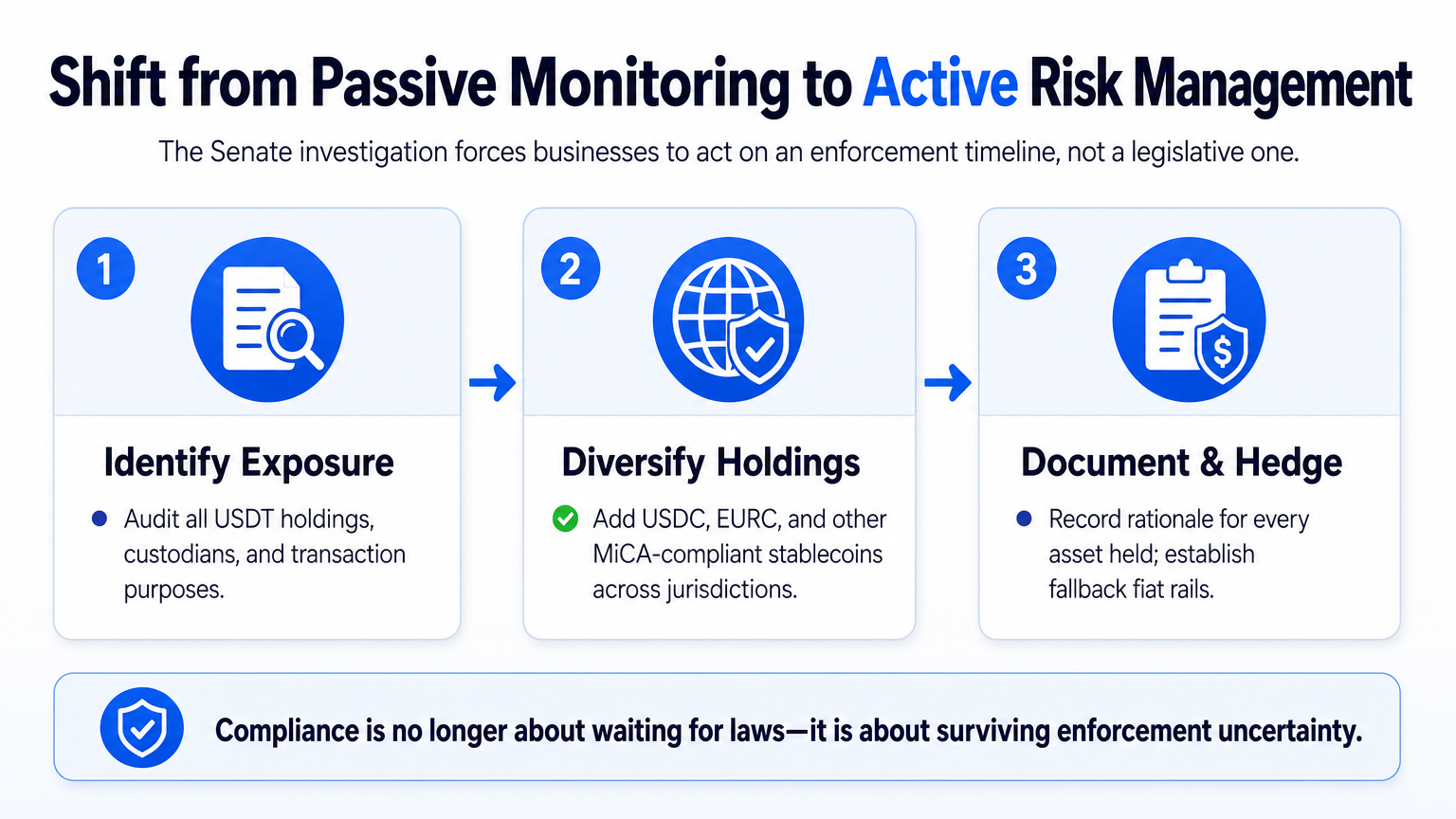
For two years, many Web3 businesses assumed stablecoin regulation would arrive slowly through legislation. The Senate investigation invalidates that. A business holding USDT must act on the enforcement timeline, not a legislative one. The shift is from passive monitoring to active risk management: identify exposure, stress‑test operational alternatives, and document the rationale for every stablecoin held.
Diversify stablecoin holdings across multiple issuers and jurisdictions. USDC—issued by Circle with regular attestations—offers one alternative. Euro Coin (EURC) and other MiCA‑compliant stablecoins provide jurisdictional diversification. Full divestment may cause operational friction, but reducing concentration and establishing fallback rails for mission‑critical flows is prudent.
When a dominant stablecoin faces active investigation, platforms that natively bridge fiat and crypto serve as an operational hedge. OneSafe, a crypto-fiat neo banking platform, supports multi‑currency accounts, ACH and wire capabilities, and on/off‑ramp functionality without concentrating treasury in a single stablecoin. This agility becomes strategically significant when enforcement uncertainty attaches to one asset.
Concrete Steps for DAOs and Web3 Startups
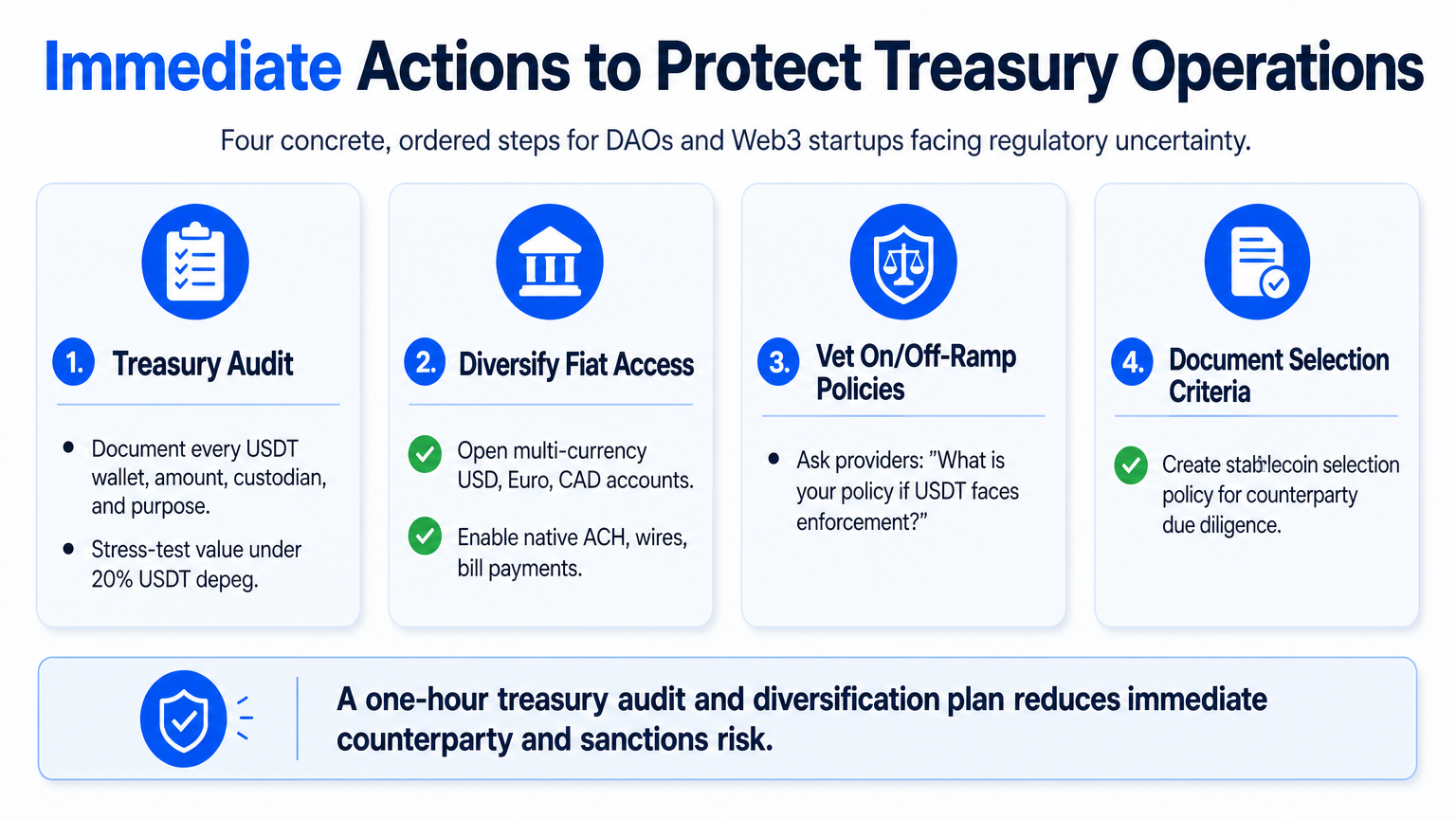
Start with a one‑hour treasury audit: document every wallet and custodial arrangement holding USDT, its amount, custodian jurisdiction, and purpose (payroll, liquidity, vendor payments). Categorize each as operational or strategic, check whether custodians have issued statements about USDT risk exposure, and stress‑test treasury value under a 20% USDT depeg scenario.
Maintain multiple fiat on‑ and off‑ramp accounts in different currencies and jurisdictions. Platforms offering multi‑currency USD, Euro, and CAD accounts alongside crypto capabilities let businesses route around single points of failure. Native ACH, wires, and bill payments mean normal operations can continue even if stablecoin holdings are temporarily reduced.
Reassess on/off‑ramp relationships: ask each provider what its policy is if a supported stablecoin becomes the subject of a federal enforcement action. As the Web3 payments consolidation shows, infrastructure providers are anticipating exactly this kind of regulatory sorting event.
What to Watch Next
The Senate probe could trigger subpoenas, DOJ referrals, or accelerated Genius Act implementation with sanctions‑compliance provisions (OCC finalizes stablecoin regulation). The Cantor Fitzgerald angle signals the investigation touches mainstream financial infrastructure. If the Iran sanctions‑evasion claims are substantiated, implications extend to any US institution that facilitated USDT‑related flows. A Wall Street Journal report found “rampant use” of Tether’s stablecoin by the Iranian regime (WSJ), and Inca Digital documented Tether’s growing role in illegal activities (Inca Digital).
The probe rarely stays confined to one issuer; other less‑transparent stablecoins should expect scrutiny. The Mastercard stablecoin security API already screens for sanctions, showing payments infrastructure is building for a world where stablecoin flows face the same controls as fiat wires.
How does the Senate Tether probe change stablecoin regulation?
It shifts the center of gravity from legislative deliberation to enforcement. The Blumenthal stablecoin investigation creates immediate counterparty risk and establishes a precedent for federal sanctions enforcement reaching into issuer operations.
What risks do businesses face if they hold USDT right now?
Custodial/liquidity risk (exchanges may restrict USDT support), sanctions exposure (OFAC strict liability if USDT has been used to facilitate sanctioned transactions), and operational disruption (bank partners may pause fiat rails connected to USDT).
How are stablecoins regulated in the US, and why is this investigation different?
State money‑transmitter licensing and emerging OCC prudential standards don’t address the conduct alleged—issuer payments to a politically connected consulting firm and USDT’s role in circumventing Iranian sanctions. The probe treats Tether as an entity whose corporate behavior is subject to federal inquiry.
What should DAOs and Web3 startups do to protect operations amid regulatory uncertainty?
Audit treasury USDT exposure, diversify holdings across transparent issuers, open multi‑currency fiat accounts for continuity, and demand each custodian’s written stablecoin‑enforcement policy. DAO treasury compliance now requires documented stablecoin selection criteria that withstand counterparty due diligence.
How does a crypto-fiat neo banking platform like OneSafe help?
It combines multi‑currency fiat accounts with crypto on/off‑ramps and custody, letting businesses reduce dependence on any single stablecoin without fragmenting operations. The platform’s Fireblocks‑based custody, mandatory MFA, and automated payment workflows also address DeFi compliance requirements drawing regulator attention.
Key Takeaways
- The Senate’s October 22 Tether investigation shifts stablecoin regulation from slow‑moving legislation to immediate enforcement risk, with sanctions‑compliance and conflict‑of‑interest allegations at the center.
- Businesses holding USDT face counterparty, sanctions, and operational disruption risks—demanding a treasury audit and a documented diversification plan.
- Neither the wait‑for‑Congress approach nor reliance on state‑level licensing fully captures the October 2026 reality: federal enforcement has arrived ahead of comprehensive legislation.
- DAOs and Web3 startups should diversify stablecoin holdings, maintain multi‑currency fiat accounts, and pressure custodians for clear policies on stablecoin enforcement scenarios.
For global businesses and DAOs that need to bridge fiat and crypto without concentrating risk in any single asset under investigation, sign up for a OneSafe account to access multi-currency accounts, secure crypto custody, and compliant on/off-ramps in one platform.