
On October 22, 2026, Standard Chartered signed an agreement to acquire Zodia Custody outright, marking a pivotal moment for institutional crypto custody and the broader crypto banking landscape. While the headlines focus on Wall Street’s infrastructure race, the real story for operating businesses and DAOs is that secure custody alone doesn’t solve the fiat-crypto operational gap. This analysis explains what the acquisition changes—and what it doesn’t—for startups, Web3 teams, and global companies that need a usable banking layer today.
Table of Contents
- What Just Happened
- What Does Standard Chartered’s Acquisition Mean for Crypto Banking?
- How Does Crypto Banking Actually Work for My Business Today?
- Can Startups and DAOs Get the Same Secure Custody as Big Institutions?
- What’s the Difference Between a Crypto Custody Provider and an Operations Platform?
- How Fast Can I Actually Open an Account That Handles Both Fiat and Crypto?
- What Fees and Transparency Should I Expect from a Modern Crypto-Friendly Platform?
- What to Watch Next
- Key Takeaways
What Just Happened
Standard Chartered Acquires Zodia Custody Outright
According to CryptoSlate’s October 22 report, Standard Chartered’s subsidiary will acquire 100% of Zodia Custody, bringing regulated cryptocurrency custody operations under direct banking ownership. Zodia Custody, previously a Standard Chartered-backed venture with Northern Trust and SBI Holdings, will now become an internal division of the bank. The move signals that the London-based financial giant sees digital asset custody as a core banking service, not a separate experiment.
The Deal Structure: Banking Integration and a Tech Spin-off
The transaction splits Zodia’s custody business into Standard Chartered’s banking operations, while its technology arm separates into Zodia Solutions, providing custody technology to other financial institutions. This mirrors how Fiserv and Fireblocks partnered to embed crypto financial services into conventional banking rails without forcing every bank to build its own.
Regulatory Clearance Still Pending
Completion depends on regulatory clearances. No timeline was provided. Even post-approval, integrating Zodia into Standard Chartered’s compliance and treasury systems will take additional months. The agreement was signed on October 21, 2026, and announced the next day.
What Does Standard Chartered’s Acquisition Mean for Crypto Banking?
The acquisition confirms that the largest banks are moving beyond cautious pilots and into permanent infrastructure. Kraken’s 2026 purchase of a US bank charter showed crypto-native companies seeking regulated banking licenses, while this move shows a traditional bank absorbing a crypto-native custody provider internally. Together, they mark a maturation of crypto banking from a niche service to an integrated line of business.
For institutions—pension funds, asset managers, corporate treasuries—the news means a trusted global bank will soon offer custody that meets their compliance, audit, and insurance requirements under one roof. Standard Chartered can bundle custody with its existing prime brokerage, FX, and lending services.
However, for startups, scale-ups, DAOs, and international e-commerce operations, the acquisition does not create a fiat-crypto bank account they can open next week. Zodia has historically catered to institutional clients with high minimums, lengthy due diligence, and a custody-only remit. Bringing it in-house doesn’t build a multi-currency current account, payment rails, corporate cards, or permissioned team workflows.
This asymmetry is the core tension: the custody race secures assets for large funds; operating businesses need a platform that turns custody into everyday treasury operations.
How Does Crypto Banking Actually Work for My Business Today?

Crypto Banking Is Two Different Things Right Now
The term crypto banking means two distinct offerings:
- Institutional digital asset custody, where a regulated entity holds private keys, provides insurance or segregated accounts, and meets audit standards. This is what Zodia, BitGo, and now Standard Chartered provide.
- Operational fiat-crypto platforms that combine traditional banking services (accounts, payments, cards, FX) with crypto on- and off-ramps, stablecoin support, and multi-user treasury tools. These are what businesses use to pay vendors, manage payroll in stablecoins, convert revenue, and handle day-to-day finances.
A large institution might use Zodia to hold a billion-dollar Bitcoin allocation but still rely on separate banking partners for cash management. A startup or DAO needs a single interface handling both fiat and crypto flows, with custody as a safety net, not the whole product.
Institutions Build for Themselves; Operating Businesses Need a Platform
Banks building crypto custody optimize for existing institutional clients: segregated cold storage, SOC-2 compliance, insurance wrap, and integration with traditional market infrastructure. They rarely offer multi-currency wallets, instant stablecoin settlement, or developer-friendly APIs. As PwC notes in its crypto custody primer, institutional solutions prioritize safekeeping over operational utility.
A business paying contributors in USDC across time zones needs fiat-crypto conversions, automated payouts, and role-based access—none of which a custody-only provider delivers.
How Hybrid Platforms Actually Work for Global Teams
A modern crypto banking platform bridges this gap by partnering with regulated banks for fiat accounts and using institutional-grade custody technology for digital assets, all within a single application. OneSafe, for instance, provides multi-currency accounts in USD, EUR, and CAD, corporate cards, ACH and wire payments, and instant USDC conversions—while securing digital assets on Fireblocks. This lets a DAO treasury manage stablecoin reserves and operational cash without maintaining five separate banking relationships.
Can Startups and DAOs Get the Same Secure Custody as Big Institutions?
Yes—through the technology layer, not through the bank’s front door. Most startups and DAOs cannot clear institutional custody providers' minimums and legal reviews. However, the same secure custody infrastructure—Fireblocks’ multi-party computation (MPC) technology or qualified hardware security modules—can be accessed via platforms that integrate it as a service. OneSafe, a financial technology company, uses Fireblocks for digital asset custody, giving its business clients the same underlying security architecture without the vetting hurdles.
This is not FDIC insurance (crypto assets are not FDIC-insured), but it aligns with industry-standard security practices that US Bank describes for its institutional custody clients. For a business, digital assets sit in a similar vault—accessed through a cleaner interface with operational capabilities a pure custody provider never built.
What’s the Difference Between a Crypto Custody Provider and an Operations Platform?
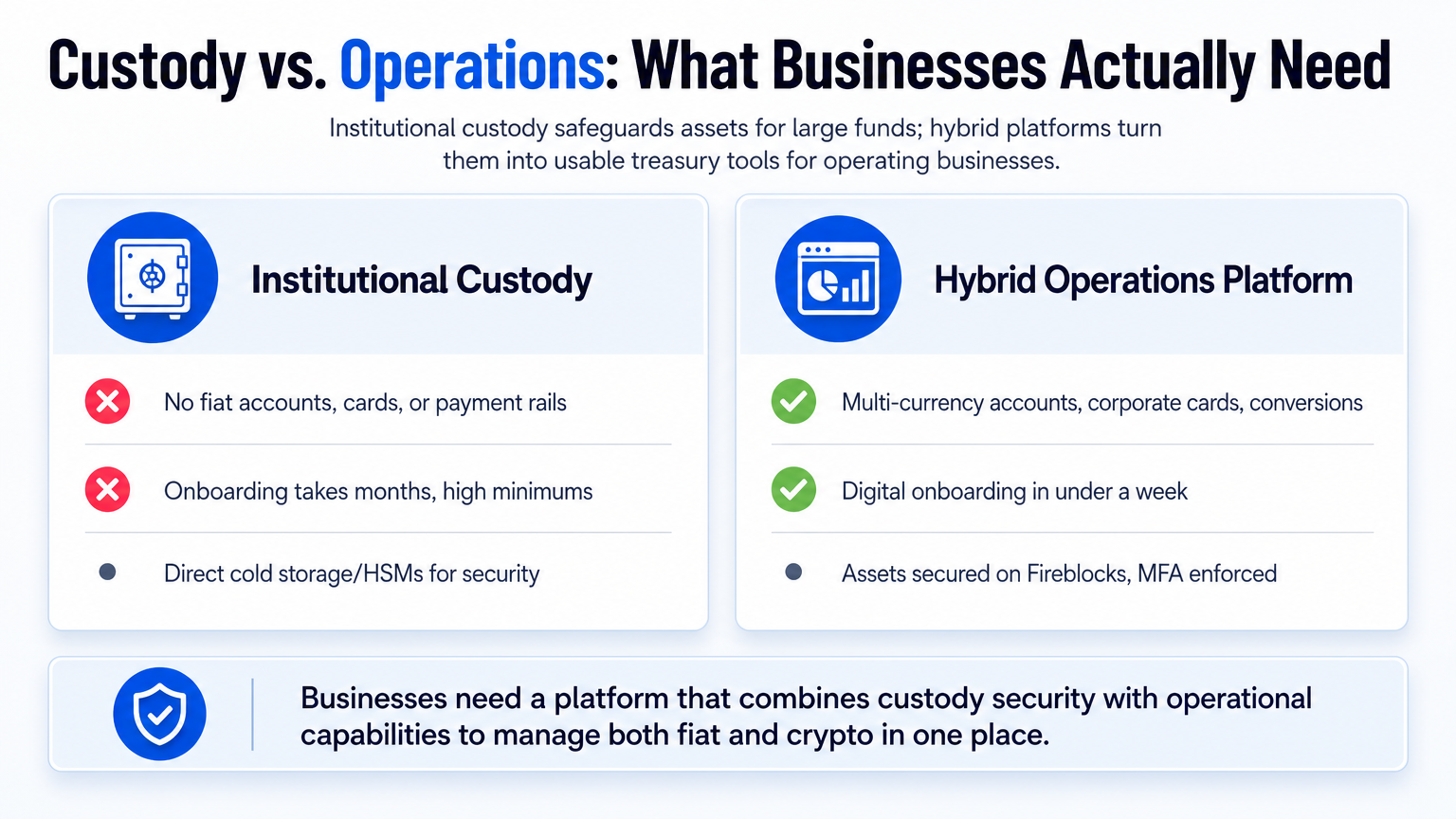
The distinction is between a safe and a banking operations center. A custody provider holds assets securely, provides reporting, and may support staking or governance. An operations platform lets you use those assets alongside fiat: pay a vendor in EUR, receive a customer’s USDC, convert it to USD, and issue a corporate card with spend limits.
| Feature | Institutional Custody (e.g., Standard Chartered's Zodia) | Hybrid Operations Platform (e.g., OneSafe) |
|---|---|---|
| Primary function | Safeguard digital assets for large entities | Unify fiat and crypto treasury operations |
| Typical clients | Asset managers, hedge funds, exchanges | Startups, DAOs, global SMEs, Web3 companies |
| Fiat account (multi-currency) | No | Yes — segregated accounts via bank partners |
| Crypto on/off ramp | No direct payment rails | Yes — instant fiat-crypto conversions |
| Corporate cards | No | Yes — virtual/physical cards, spend controls |
| Multi-user permissions | Limited to admin roles | Yes — customizable roles and permissions |
| Onboarding time | Months, extensive KYC/AML | Days to a week, fully digital KYB |
| Crypto security model | Direct cold storage/HSMs | Assets secured on Fireblocks, MFA enforced |
| Regulatory basis | Bank or trust license | Technology company; banking via licensed partners |
Custody plus operations makes secure digital asset custody usable for daily business. A DAO can keep stablecoin reserves on a platform supporting multi-sig transactions, role-based access, and one-click payroll—features absent from pure custody products.
How Fast Can I Actually Open an Account That Handles Both Fiat and Crypto?
With traditional banks, onboarding still takes months. The Standard Chartered-Zodia integration is unlikely to change that for smaller businesses; it remains an institutional offering.
Digital-first platforms built for crypto-native businesses can complete onboarding in under a week. OneSafe requires business formation documents, a government-issued photo ID, and (for US companies) an EIN. The process is fully digital, with many businesses applying in 10 minutes or less and operating within days while maintaining robust KYB standards. This speed reflects a purpose-built onboarding flow, not cut corners.
For a startup needing to receive a wire and a USDC payment by Friday, that agility matters more than a bank-branded vault coming “soon.”
What Fees and Transparency Should I Expect from a Modern Crypto-Friendly Platform?
Legacy institutional custody often has layered fees: setup costs, safekeeping fees based on assets under custody, transaction fees, and opaque minimum balance requirements. A Chainlink analysis of institutional custody notes that fee structures vary widely.
Modern fiat-crypto platforms publish their fee schedules clearly. Expect:
- Fiat deposit/withdrawal fees around 0.15%–0.35%.
- Crypto transfers in stablecoins like USDC often free.
- FX conversion around 0.25%, potentially lower on volume.
- Monthly account fees from $0 to $29+/month for premium features.
- Corporate card FX around 3% and SWIFT transfer charges.
OneSafe’s published pricing (October 2026) includes free USDC deposits/withdrawals, 0.15% fiat transaction fees, $25 wire withdrawal fees, and FX at 0.25%. Transparent, line-item pricing lets a business budget accurately.
What to Watch Next
Regulatory Decisions Will Set the Pace
The Standard Chartered deal still needs regulatory approval. On October 3, 2026, the OCC finalized the GENIUS Act stablecoin rule, setting two-day redemption requirements for stablecoin issuers. That creates a clearer path for stablecoin banking, and we may see banks offering deposit accounts interacting directly with regulated stablecoins. Combined with Kraken’s bank purchase, the trend suggests more hybrid models where a banking charter and crypto infrastructure sit under one roof—though the timeline for extending services to non-institutional clients is uncertain.
Whether Banks Open Access to Smaller Businesses
Standard Chartered’s move follows the institutional playbook; there is no indication Zodia’s custody product will become accessible to startups or DAOs. If other banks follow suit, the market could bifurcate: large institutions get bundled banking-plus-custody, while smaller businesses rely on independent platforms serving crypto banking for businesses. The question is whether competitive pressure eventually lowers client thresholds, or whether banks leave the broad business market to the neobank for startups segment and fintech players.
How DAO-Specific Financial Tools Evolve Outside Traditional Banking
DAOs need multi-sig governance over treasury moves, programmable permissions, automated stablecoin payouts, and transparent on-chain reporting. The recent consolidation in Web3 payments infrastructure suggests dedicated tools for DAO treasury management are being built outside traditional banking. As stablecoin usage for cross-border payments grows, expect platforms to offer more DAO-centric features: customizable role-based access, on-chain attestations, and integrated governance mechanisms bridging multisig wallets and fiat operations. Crypto financial services 2026 are increasingly defined by these operational layers, not just custody milestones.
Key Takeaways
- Standard Chartered’s acquisition of Zodia Custody accelerates institutional crypto custody but does not create an accessible fiat-crypto banking solution for startups and DAOs.
- Businesses that need both fiat and crypto operations should seek a hybrid platform—not a custody-only provider—so they can pay, convert, and manage funds without fragmented infrastructure.
- Startups and DAOs can achieve institutional-grade digital asset security through platforms that integrate custody technology like Fireblocks, without the high minimums and months-long onboarding of traditional banks.
- Modern fiat-crypto platforms offer transparent pricing, days-not-months onboarding, and multi-user permissions—capabilities that custody-first banks rarely provide.
- Regulatory clarity is arriving, but the gap between Wall Street’s infrastructure build-out and the everyday needs of operating businesses will widen before it closes.
For teams ready to manage fiat and crypto from a single platform with transparent fees and institutional-grade custody, open an account with OneSafe.



