SEPA payments are euro-denominated bank transfers across 36 European countries designed to work as smoothly as domestic transfers. SEPA is an umbrella term, though, because it covers credit transfers, direct debits, and instant credit transfers, and they don't settle at the same speed.
You've probably just incorporated in the EU, opened a business account, and now you need to pay a contractor in Portugal, a SaaS vendor in Germany, and maybe collect monthly fees from customers without turning every payment into a manual operations task. That's where SEPA enters the picture, and where a lot of founders get tripped up, because “SEPA” sounds like one thing but behaves like three different payment tools.
Table of Contents
- Timing, currency, and use case are the first filters
- Payment rail comparison for cross-border transfers
Understanding SEPA Payments Beyond the Basic Definition
A web3 startup incorporated in Estonia can send a SEPA payment to a freelance developer in Portugal and a SaaS vendor in Germany, and the workflow may still feel more complicated than the dashboard suggests. The missing piece is that SEPA is a framework, not a single payment type, so the result depends on whether you are sending a transfer, collecting funds, or using an instant scheme.
A common rail, with different schemes on top
The Single Euro Payments Area was created so euro payments could move across borders with the same basic processing expectations as domestic transfers, and it now covers 36 European countries. The European Payments Council says more than 529 million citizens benefit from SEPA and that they make about 146 billion electronic payments every year; its 2022 infographic also describes SEPA-related activity as handling more than 21 billion SEPA credit transfers and over 21 billion SEPA direct debits annually. That scale explains why SEPA sits at the center of euro-denominated retail payments across much of Europe. European Payments Council SEPA infographic
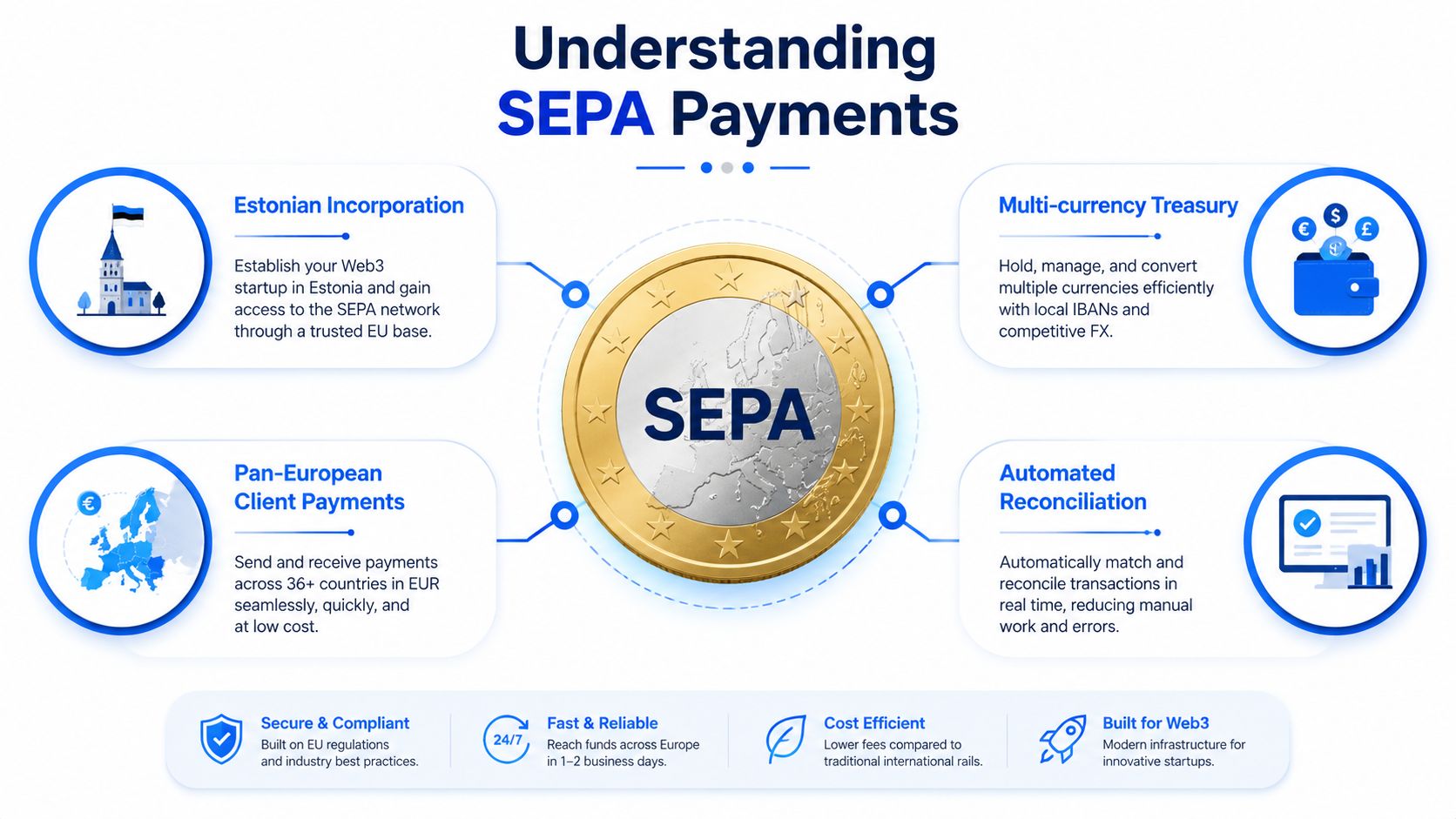
For operators, the key point is simple. SEPA standardizes the payment rail, but it does not make every payment behave the same way. A supplier payout, a subscription collection, and an urgent treasury transfer each rely on different SEPA schemes, so finance teams need to identify whether they are using SEPA Credit Transfer, SEPA Direct Debit, or SEPA Instant Credit Transfer before they plan cash flow.
Practical rule: if your team says “we use SEPA,” ask which scheme they mean. Settlement timing, collection mechanics, and treasury handling all change with the scheme.
What SEPA does, and what it leaves untouched
SEPA payments are euro-denominated, so a business that earns or holds funds in another currency still meets FX conversion at the edge, even if the payment itself feels local. That is where hidden friction appears for non-euro companies. The transfer can be standardized and efficient while the currency conversion still adds cost, timing risk, and treasury work. SEPA helps with routing and reach across the area, but it does not remove currency exposure.
The cleanest way to describe it is this. SEPA is the plumbing, not the water. It sets the pipes and the rules that let euros move through them in a consistent way, but the speed and purpose of the payment still depend on the scheme you choose. That distinction matters for a founder deciding whether to pay contractors, collect customer funds, or move money between accounts without delay.
For a broader view of how these rails fit into cross-border operations, this guide to international business payments is a useful companion. The same operational logic also shows up in what is payment processing in 2026, where routing, settlement, and reconciliation sit behind the payment itself.
How SEPA Payment Mechanics Work
SEPA can look simple from the dashboard. You enter an IBAN, maybe a name, maybe a reference, and hit send. Under the hood, the transfer depends on strict message formats, standardized identifiers, and rules that let banks and payment service providers process it without manual repair.
The identifiers and message format behind the transfer
At the account level, SEPA credit transfers generally rely on IBAN-based identification for both the debtor and creditor accounts, and standard SEPA rules typically restrict the charge option to SHA. Each side usually covers its own bank's charges rather than one party absorbing the full fee burden. For operations teams, that matters because fee handling is part of payment planning, not an afterthought. Alpha Mass Payments technical and operational specifications
SEPA messages are built on the European Payments Council's rulebooks and implementation guidelines, with XML formats based on ISO 20022. That standardization lets payment service providers and payment infrastructures interoperate and support automated settlement across the SEPA area. The practical upside is fewer manual repairs, better straight-through processing, and fewer failed files coming back to ops for cleanup. Bundesbank technical standard in SEPA
A good way to understand it is to treat SEPA as a shared grammar. The structure of the message stays fixed, but the outcome still depends on the payment details you send, the scheme you choose, and whether the receiving bank supports the flow you expect.
The three schemes and where each one fits
SEPA Credit Transfer is the workhorse for routine euro payments. It suits payroll, supplier invoices, and one-off business payments when instant delivery is not required. SEPA Direct Debit is the pull-based scheme, which is why it fits recurring collections like subscriptions and B2B billing. SEPA Instant Credit Transfer is the time-sensitive option, and it can move funds in real or near-real time, with a €100,000 per-transfer cap between participating PSPs.
The operational gap shows up fast. Standard SEPA is usually fine when treasury can wait for normal processing windows. SEPA Instant helps when the payment itself is time-sensitive, but only if both sides sit inside participating infrastructure and your payout flow is ready for immediate settlement.
That distinction matters even more for non-euro businesses. SEPA still moves euros, so if your operating account is in another currency, the FX conversion happens at the edge. That can add cost, create timing risk, and force treasury to manage balances more actively. For a closer look at how ACH differs on the operational side, see ACH payment processing explained. The broader mechanics behind routing and reconciliation are also covered in what is payment processing in 2026.
SEPA Instant vs Standard SEPA vs SWIFT and ACH
A lot of teams assume SEPA means “instant euro payments.” It doesn't. The primary operational decision is whether you need standard SEPA, SEPA Instant, or an alternative rail like SWIFT or ACH.
Timing, currency, and use case are the first filters
The European Payments Council says SEPA Instant Credit Transfer can move funds in less than 10 seconds, 24/7/365, with a €100,000 transfer cap. Standard SEPA credit transfers, by contrast, are commonly used for planned payments where next-business-day timing is acceptable. The ECB's payment statistics also show how large the euro payment ecosystem is overall, with 77.7 billion non-cash payments in the first half of 2025, a total value of €116.0 trillion, and 57% of volume from card payments, 22% from credit transfers, and 14% from direct debits. ECB payment statistics first half 2025
Here's the part founders usually miss. SEPA doesn't remove FX exposure for a non-euro business, because the rail itself is still euro-denominated. If your operating account is in another currency, the conversion happens at the edge, which is where treasury cost and timing risk can sneak back in.
Payment rail comparison for cross-border transfers
| Rail | Settlement Time | Currency | Typical Cost | Best For |
|---|---|---|---|---|
| SEPA Credit Transfer | Usually next business day | EUR | Low, bank-dependent | Routine euro supplier payments and payroll |
| SEPA Instant Credit Transfer | Less than 10 seconds when supported | EUR | Low, bank-dependent | Urgent euro payments and treasury moves |
| SWIFT wire | Often 1 to 5 business days | Multi-currency | Usually higher, with intermediary fees | Global transfers outside SEPA |
| ACH | Typically 1 to 2 business days | USD | Usually low | US domestic collections and disbursements |
The key distinction is not just speed, it's operational fit. SWIFT is still the better fit for non-euro destinations and currencies outside SEPA, while ACH is the familiar domestic rail in the US. SEPA sits in the middle, efficient for euro flows inside the SEPA zone, but not a universal replacement for everything else.
If you're comparing payment rails more broadly, this ACH processing guide gives useful context for domestic transfer mechanics. For tax handling on cross-border flows, managing international transaction taxes is worth reading before you bake payment rails into your finance workflow.
Real Business Use Cases for SEPA Payments
SEPA becomes useful when it stops being a definition and starts being a workflow choice. The best rail depends on who you pay, how often you pay them, and whether you need control over cash timing.
Web3 teams, DAOs, and recurring vendor flows
A web3 startup with a contractor in Portugal and a SaaS vendor in Germany usually wants standard SEPA for planned payments, because the workflow is predictable and the rail is designed for euro-denominated business activity. A DAO managing contributor payouts across Europe can use the same logic, but the treasury team has to think about batching, reconciliation, and whether a payment must land immediately or can wait until the next cycle.
Recurring billing is where SEPA Direct Debit stands out. If a business is collecting the same customer amount on a fixed cadence, direct debit reduces manual chasing and makes the cash collection side cleaner than repeated card invoicing. That's especially relevant for B2B subscription models where invoice follow-up eats ops time.
Operational insight: if the payment is predictable, use the scheme that matches the cadence. If the payment is urgent, use the scheme that matches the deadline.
Non-euro businesses and the FX question
The hidden friction for non-euro businesses is that SEPA doesn't make currency conversion disappear. A company can operate across the SEPA zone and still have FX exposure if its accounting currency, treasury currency, or client billing currency isn't EUR. HSBC's SEPA explanation is useful here because it underscores that SEPA is a euro-based system and that both sides need SEPA accounts. HSBC on SEPA
That's why the operational benefit isn't just lower fees. It's the combination of standardized IBAN/BIC-based routing, cleaner payment files, and less friction than traditional international wires. For a finance lead, that means fewer exceptions, faster reconciliation, and less time spent hand-holding bank transfers across multiple jurisdictions.
Compliance Requirements and Common Payment Pitfalls
SEPA payments fail for boring reasons, and boring reasons cost time. Bad identifiers, missing fields, and mismatched records create the kind of delay that shows up on a Friday afternoon and turns into a weekend cash-flow problem.
The most common reasons payments get rejected
An incorrect IBAN is the fastest way to create a failed transfer. A wrong BIC, missing mandatory XML fields, or beneficiary details that don't line up with what the bank expects can also trigger rejection or manual review. For instant transfers, exceeding the €100,000 cap is another obvious blocker.
Name, account identifier, and payment reference have to line up. If they don't, someone in ops usually ends up fixing it.
The controls around payee verification are getting stricter across Europe, which means payment initiation can now fail earlier in the flow if the account data doesn't look right. That's good for fraud prevention and bad for teams that still treat payment setup as a one-time admin task.
A practical checklist that keeps the transfer moving
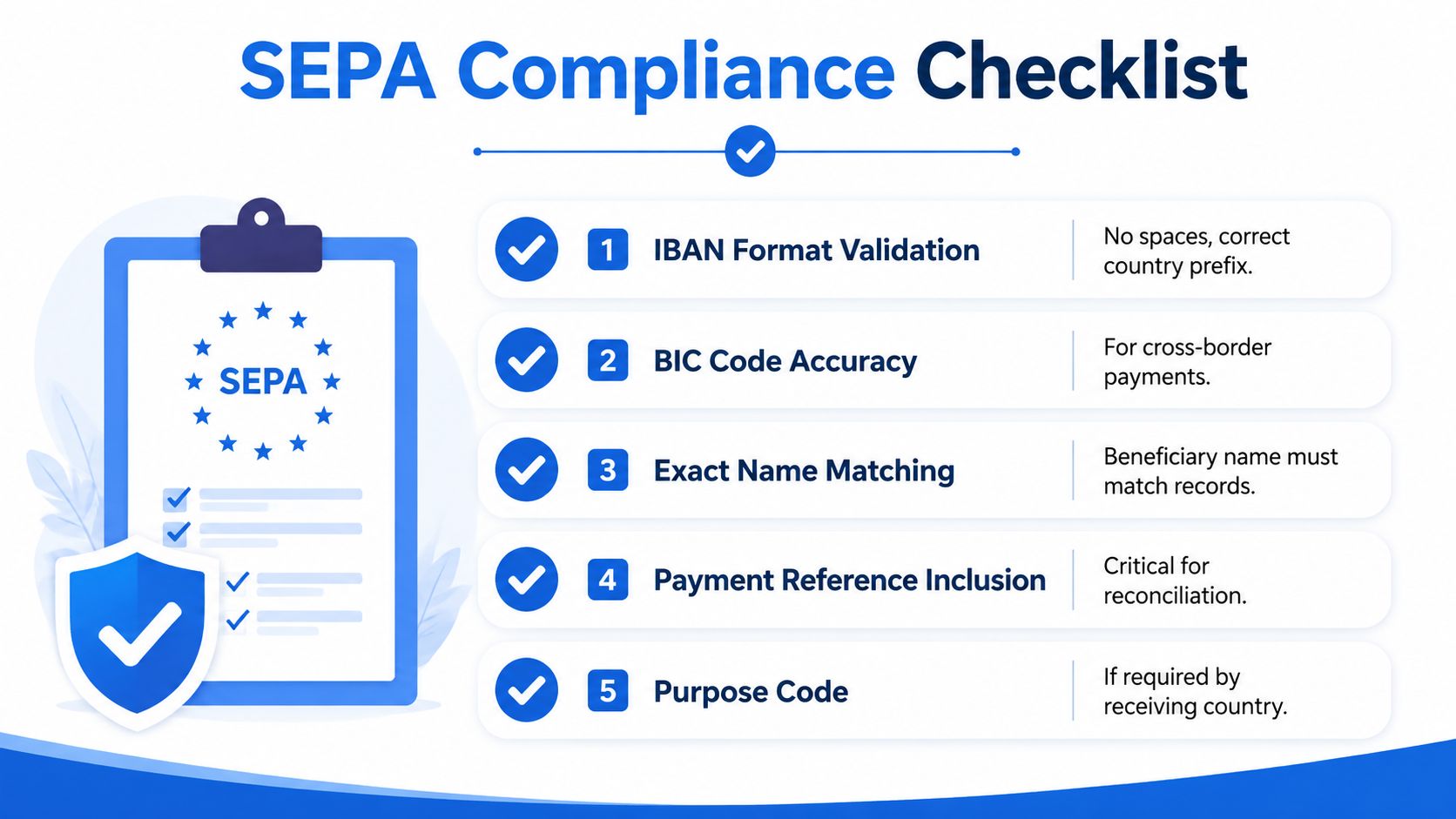
- Validate the IBAN first. Don't wait until the payment is already approved in finance.
- Check the beneficiary name carefully. Matching matters more as bank verification gets stricter.
- Use structured remittance data. Reconciliation is much easier when references are consistent.
- Confirm the scheme fit. Instant transfers need different handling from standard SCT flows.
- Watch cut-off times. A standard transfer submitted too late can slide into the next business day.
SEPA also sits inside the wider EU payments rule set, including PSD2, which brings strong customer authentication into the picture for many payment initiation flows. That means the operational design has to assume extra checks, not just bank routing. For a finance team, the safest move is to validate before submission, not after rejection.
How OneSafe Simplifies SEPA for Global and Web3 Companies
A lot of global teams don't need a lecture on SEPA, they need one place to move between fiat rails and crypto workflows without splitting treasury across five tools. That's where platforms like OneSafe fit into the conversation, because they're built to handle euro payments alongside broader cross-border operations.
A single interface for fiat and crypto-linked workflows
OneSafe provides multi-currency business accounts and supports payments across fiat rails, including SEPA, ACH, wires, and SWIFT, in one operational layer. For a web3 company, that matters because the treasury doesn't live only in EUR or USD, it often moves between stablecoins, fiat balances, and vendor obligations that still need to settle on traditional rails. OneSafe web3 invoicing
That kind of setup is useful when a team wants to invoice in crypto or fiat, settle euro obligations through SEPA, and still keep oversight with corporate cards, spend limits, merchant controls, and policy-based approvals. It's the bridge between a crypto-native operating model and the fact that many contractors, vendors, and payroll recipients still want bank transfers.
Why this matters for founders in practice
Newly incorporated companies in places like the Cayman Islands, BVI, or Panama often run into the same issue, they need access to European payment rails without rebuilding their finance stack around legacy banking friction. A platform that supports USDC deposits and withdrawals, fiat conversion, and SEPA-linked euro flows can reduce the number of handoffs between treasury, operations, and accounts payable.
Security also matters. OneSafe states that it uses Fireblocks-based custody and mandatory MFA, which is relevant for teams handling both digital assets and bank-linked payouts. For founders, the value isn't a flashy feature set, it's less fragmentation when money has to move from one format to another without breaking the workflow.
Making the Right Payment Rail Decision for Your Business
SEPA is powerful because it standardizes euro payments across a large part of Europe, but it only works well if you choose the right scheme for the job. SEPA Instant fits urgent transfers under €100,000 when speed matters, standard SCT fits routine payments where next-day timing is fine, and SDD fits recurring collections. The rest of the decision depends on whether you're sending or collecting, and whether the payment is in euros.
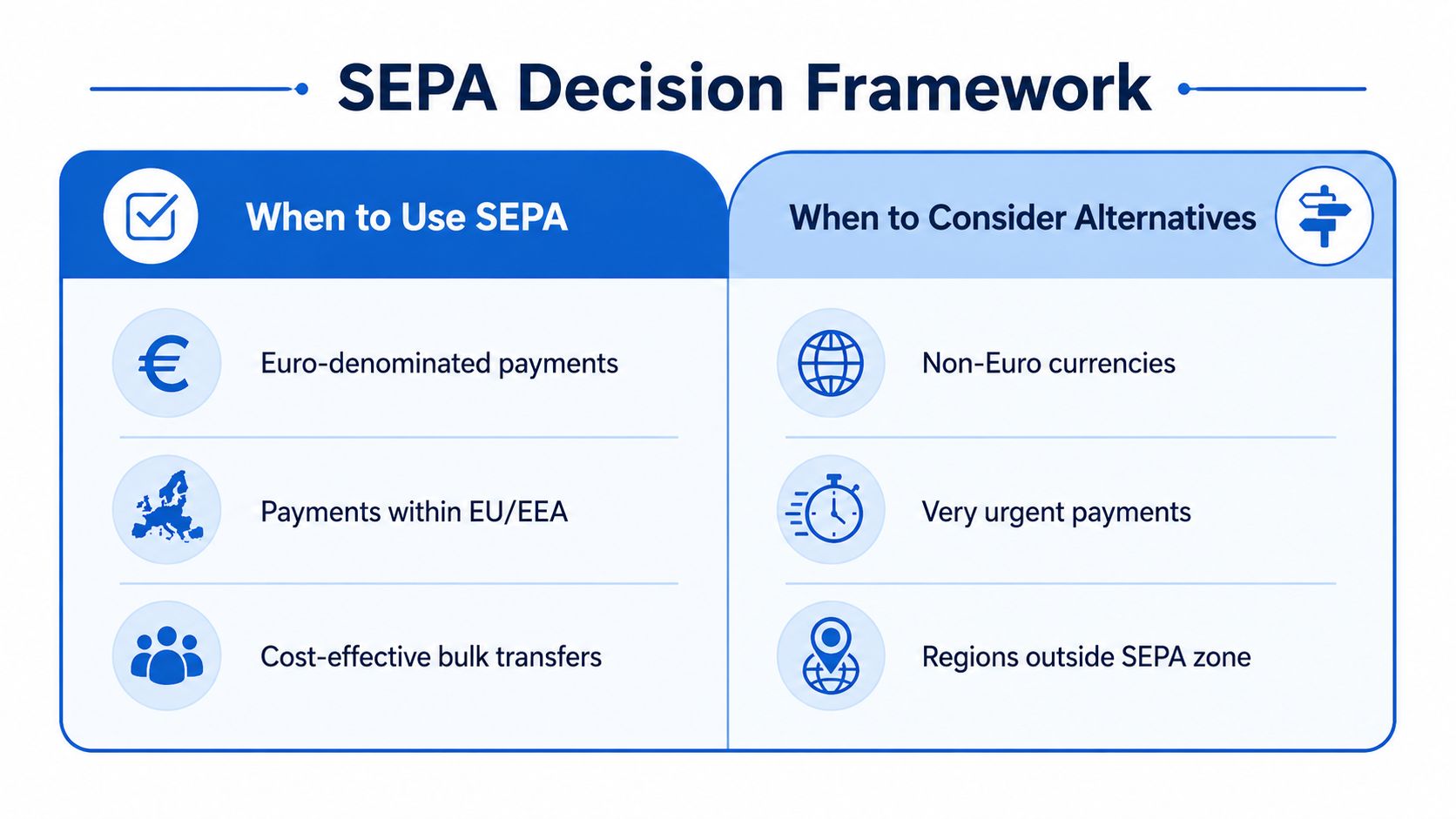
The cleanest decision tree is simple. Use SEPA for euro-denominated payments inside the SEPA zone, use SEPA Instant when the money has to arrive fast, and look beyond SEPA for non-euro currencies or destinations outside the zone. Don't let the “one rail” label hide the trade-off, because FX cost, reconciliation effort, and settlement timing all matter as much as the transfer fee.
If you're building a finance stack for a global or web3 business, take a hard look at how your accounts, payment rails, and currency conversion connect. OneSafe offers multi-currency business accounts and SEPA-capable workflows for companies that need to move between crypto and fiat without juggling separate systems.