
ACH direct deposit is the electronic transfer of money into a bank account through the Automated Clearing House network. In U.S. payroll, 94% of employees receive pay this way, which is why direct deposit has become the default way most businesses move recurring wages and benefits. (Direct deposit overview, U.S. payroll summary)
For a new finance manager, that sounds simple until payroll has to run. Questions are operational, not conceptual, because ACH lives in batch files, settlement windows, return codes, and bank cutoffs that decide whether money lands on time or gets stuck in review.
Table of Contents
Understanding ACH Direct Deposit Fundamentals
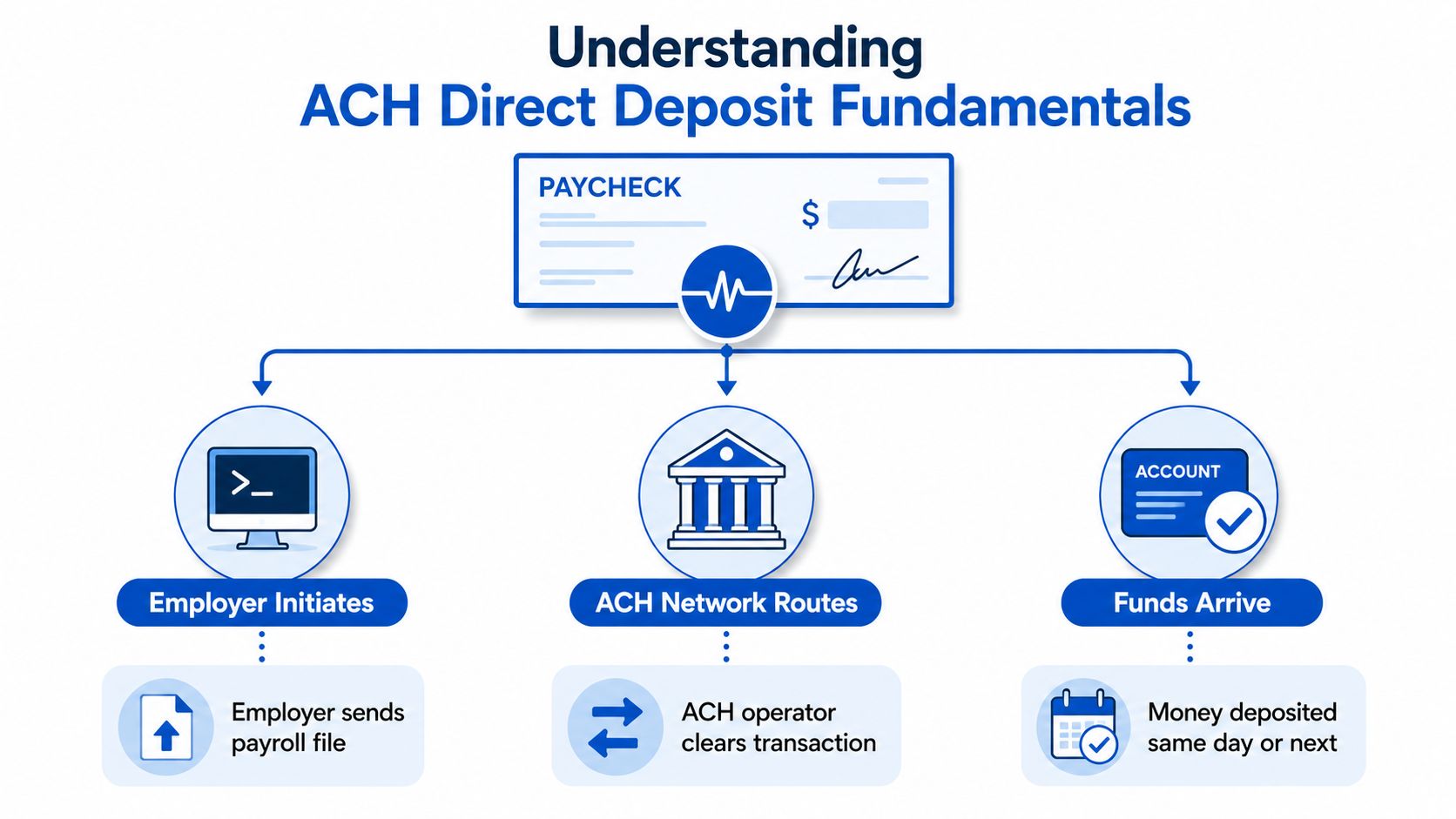
ACH direct deposit is the electronic transfer of funds into a bank account through the Automated Clearing House network. That network handles direct deposits, bill payments, and other online transactions in the United States, and it turns a paper-heavy process into a standardized bank-to-bank flow. (Nacha ACH basics)
At a basic level, ACH direct deposit works like a digital mail route for money. The sender supplies routing and account information, the payment travels through the ACH rails, and the recipient's bank credits the account after the entry clears. Banks use this rail for payroll, tax refunds, pensions, and government benefits because it fits recurring payments that do not need instant movement. (Citizens Bank direct deposit guide)
Why businesses adopted it so widely
The operational case is easy to see. Paper checks require printing, signing, mailing, and manual deposit handling, while ACH direct deposit needs bank details and authorization. Payroll teams adopted it first, then extended it to reimbursements, contractor payouts, and recurring vendor payments because the workflow is simpler to manage across repeat pay cycles.
Practical rule: if a payment repeats on a schedule and the recipient has a U.S. bank account, ACH direct deposit usually deserves to be your default option.
Setup is also straightforward, but finance teams still need to collect the right fields. In practice, that means a routing number, an account number, and sometimes a voided check to confirm the account details before the first payment goes out. For recurring wage and benefit payments, that file-based setup is part of why ACH became core infrastructure instead of a one-off transfer method. (Citizens Bank direct deposit guide)
Where the confusion usually starts
ACH direct deposit is often grouped together with cards or wires, but the processing model is different. It is an ACH credit, so the rules, timing, and return handling do not match card authorization or wire settlement. (Nacha ACH basics)
For a finance leader, the practical takeaway is simple. ACH is the plumbing underneath recurring domestic payroll, and it works because banks, processors, and employers all exchange structured files rather than treating every payout as a manual transfer.
How Payments Move Through the ACH Network
A payroll run begins when the employer, or its payroll platform, assembles a batch of payment instructions. That batch goes to the Originating Depository Financial Institution, often called the ODFI, which sends it into the ACH network for routing. On the other side, the Receiving Depository Financial Institution, or RDFI, posts the credit to the employee's account after the entry clears.
A simple example helps. A startup paying five U.S. contractors on Friday does not send five card-like authorizations. It sends one structured batch, and each recipient entry is routed, matched, and settled through the network. That batch format is a major reason ACH fits payroll and vendor payouts, even when the individual payments are small and recurring.
The network runs on batch processing, not real-time transfer. That is by design. The ACH operator clears entries in cycles, which gives banks time to reconcile, manage risk, and process large volumes without treating every payroll deposit like an urgent wire. The operating schedule and settlement windows described by the Federal Reserve explain why timing can shift based on when a file is submitted. (Federal Reserve ACH timing and operations)
Operational insight: if payroll misses a cutoff, the payment did not fail, it entered the next processing window.
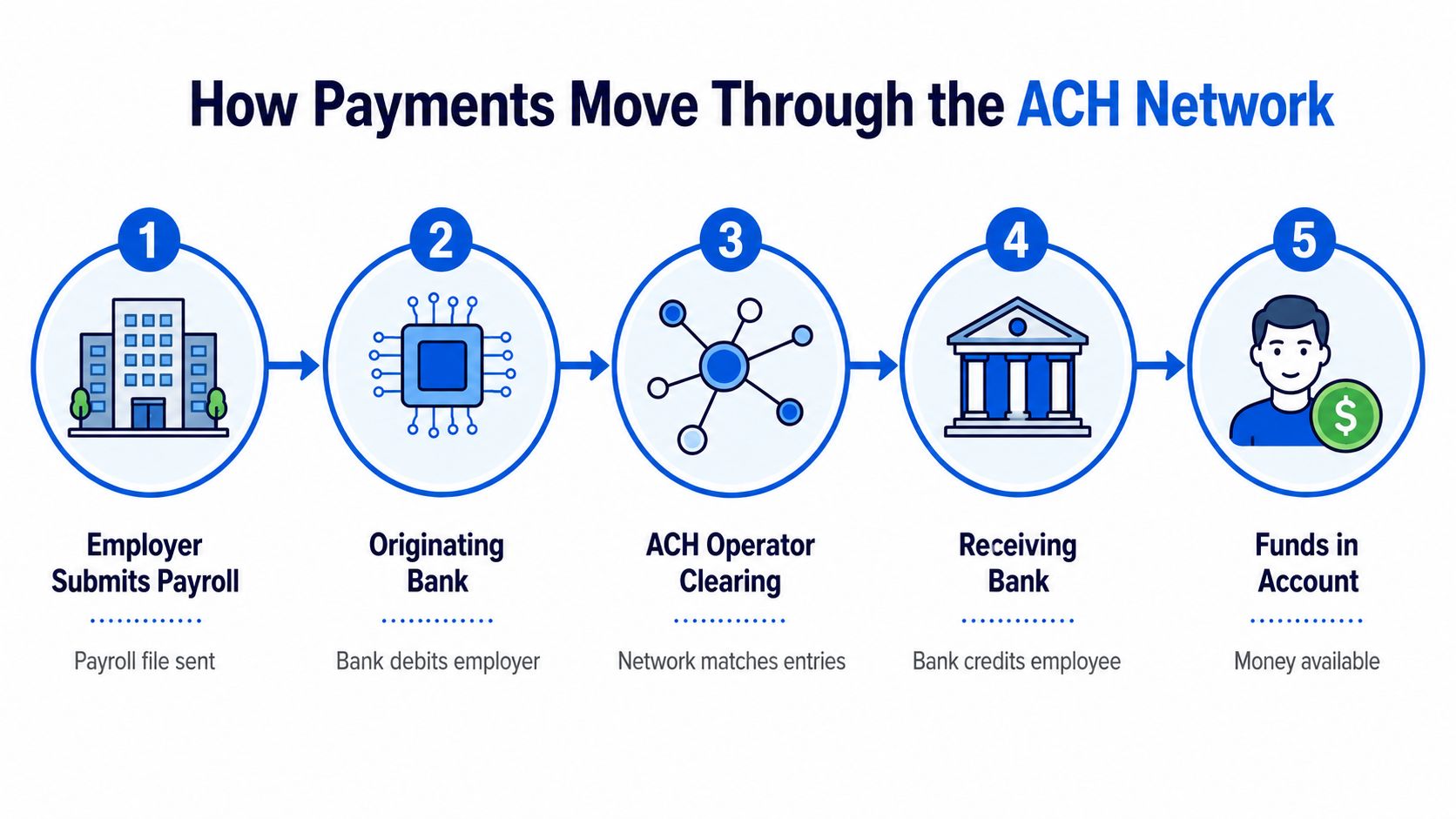
A useful mental model is mail, not messaging. The originator prepares the envelope, the bank routes it, the network sorts it, and the recipient bank delivers it to the account. If the routing details are wrong, the envelope comes back. If the details are correct but the account cannot accept the funds, the return happens later, after processing has already moved forward.
For a practical walkthrough of the file flow, cutoff points, and how entries move through an ACH processor, this ACH payment processing guide is helpful.
Settlement Timing and Operating Windows
ACH timing is where finance teams usually get caught off guard. The CFPB explains that ACH transactions can settle quickly, sometimes the same business day, but timing can also stretch over a few days because the system includes controls for fraud and money laundering. Banks may also set transfer limits and fees, and ACH payments can still return if the sender account does not have enough funds. (CFPB on ACH transactions)
The operating window matters just as much. The ACH network runs in multiple settlement windows on business days, and timing changes depending on when a file enters the queue. A file sent early in the day has a different path from one sent late in the afternoon, and weekends or holidays can push settlement to the next available window.
Why cutoffs matter more than most teams expect
If payroll reaches the bank before the cutoff, the deposit may settle the same day or the next business day, depending on the file and the receiving bank. If it arrives after cutoff, it usually waits for the next window. Two payroll runs submitted on the same calendar date can therefore settle on different schedules.
A practical rule helps. Treat ACH like a scheduled rail with checkpoints, not like a button that instantly moves money. A Monday morning submission and a Monday evening submission can look the same in your dashboard, but the network does not treat them the same way.
Planning around delay points
Finance teams should build slack into payroll calendars, especially when contractors, reimbursements, or vendor payouts depend on a hard arrival date.
That slack matters even more when a bank applies its own review rules or transfer limits. As noted earlier, those limits can affect larger payroll runs or concentrated vendor disbursements, so the file can clear in the network while the receiving institution still slows the final credit.
For a crypto-native company, the timing problem gets more complex because treasury activity often spans several rails. A fiat payout may follow ACH timing, while a stablecoin transfer may settle on a different schedule entirely. If your finance team does not map those rails separately, it becomes easy to misread when funds are actually available.
ACH Direct Deposit Costs Compared to Alternatives
ACH direct deposit usually has the lowest operating cost for recurring domestic payments. A U.S. payroll summary reports that employers pay about $0.35 per direct-deposit transaction versus $3.15 for a paper check, which it describes as roughly 89% lower transaction cost. The same summary says direct deposit also removes printing, mailing, and manual check-cashing work.
That difference is more than an accounting note. Paper checks create process drag, someone has to issue them, track them, mail them, replace lost ones, and reconcile the exceptions. ACH replaces that chain with a batch file and bank-to-bank settlement, so the cost profile shifts from manual handling to file discipline and payment timing.
Payment method comparison
| Payment Method | Cost Per Transaction | Settlement Speed | Best Use Case |
|---|---|---|---|
| ACH Direct Deposit | About $0.35 | Same day, next day, or up to two business days depending on timing | Recurring domestic payroll and vendor payments |
| Paper Check | About $3.15 | Slower, depends on printing, mailing, and deposit timing | Rare fallback when bank details are unavailable |
| Wire Transfer | Higher, varies by bank and corridor | Fast, often used when urgency matters | Urgent or high-value payments |
The wire comparison matters because wires solve a different problem. They justify the added fee when speed, payment certainty, or corridor requirements matter, especially for urgent, high-value, or international transfers. ACH is the cleaner choice for repetitive domestic payouts where predictability matters more than immediate movement. For a broader fee comparison across rails, the wire transfer fees versus crypto costs guide is useful context.
A practical procurement question keeps the decision honest. Is this payment recurring and domestic, or is it urgent and exceptional? If it is recurring and domestic, ACH usually belongs in the default slot.
Setting Up ACH Direct Deposit for Your Business
ACH setup starts with clean recipient data. You need the person's bank routing number, account number, account type, and authorization to debit or credit the account. If any of those inputs are wrong, the payment may be delayed or returned, and you'll waste time cleaning up something that should've been right at onboarding.
The underlying file is more rigid than most non-finance teams realize. A valid ACH file is built on fixed-width 94-character records and uses six record types, with headers and controls that support reconciliation and error checking. The file header also carries fields such as the immediate destination, immediate origin, creation date, and a file ID modifier that changes when multiple files are generated the same day. (ACH file specifications)
What your payroll system is really doing
When your payroll platform “sends direct deposit,” it's usually generating that structured NACHA-style file in the background. Finance doesn't need to handcraft the file, but the team does need to know what's inside it because that's where reconciliation and exception handling begin.
Useful habit: keep a mapping sheet that ties each payment run back to the source employee or contractor record. When a return lands, you'll need that trace fast.
For teams that operate globally, ACH often sits alongside a broader banking stack rather than replacing it. OneSafe, for example, offers business accounts that connect fiat payment rails, including ACH, with multi-currency workflows and crypto-compatible operations. Its business bank account setup and fiat-crypto integration guide is a relevant reference for teams building that kind of stack.
Setup checklist that prevents avoidable errors
- Verify account ownership: collect authorization before the first live payment.
- Double-check routing data: one wrong digit can send the file into returns.
- Match account type carefully: personal and business accounts don't always behave the same way.
- Test before scale: send a small pilot payment before a full payroll run.
- Document approvals: keep the approval trail with the payment file and employee record.
For a payroll-funding angle that sits adjacent to ACH operations, the OilGasFactoring.com payroll funding guide is a useful operational read, especially for teams balancing cash timing against payroll deadlines.
When ACH Payments Fail and How to Handle Returns
A direct deposit file is not finished work once it leaves your system. ACH entries can still come back after submission, and finance teams need a clear process for handling those returns before they turn into payroll delays or AP exceptions.
The most common return reasons are operational, not mysterious. The account can be closed, the routing number or account number can be wrong, the account may not have enough funds, or the authorization may be missing or invalid. ACH systems also include fraud and money-laundering controls, so a legitimate payment can still be slowed down or flagged while the bank reviews it.
What a return means operationally
A return does not mean the payment never entered the network. It means the bank processed the entry, then sent it back with a reason code so the originator can fix the problem. Payroll or AP still has to investigate, correct the record, and decide whether to retry the payment.
That investigation needs clear ownership. Payroll should own employee data, AP should own vendor bank changes, and treasury should own cash timing, so there is no confusion about who reissues the payment or updates the file.
The file structure matters here too. If your payment run does not tie cleanly back to the source employee, contractor, or vendor record, a return turns into a scavenger hunt instead of a routine exception. For a finance manager at a web3 startup, that usually means the ACH trail needs to sit beside the crypto payout trail, not buried in a separate spreadsheet.
Controls that reduce avoidable pain
- Keep recipient data clean: revalidate account details before the first live payment and after any bank change.
- Build alerting: route failed-payment notices to the people who can fix them.
- Hold buffer cash: do not run payroll so tight that one rejected entry creates a cascade of delays.
- Separate approval from execution: reduce the chance of accidental or unauthorized entries.
- Track the reason code: every return should be logged with the specific cause, the owner, and the next action.
Returned entries are easier to handle when the team treats them as part of normal operations. A small return can still create a support ticket, a trust issue, and a manual correction loop if nobody owns the follow-up. In a web3 company, the mess grows when the same person is also paid in crypto for other work, because finance then has to reconcile two settlement paths and two record-keeping trails without mixing them together.
Integrating ACH with Multi-Currency and Web3 Operations
ACH still matters in a finance stack that also uses stablecoins, wires, and corporate cards. The reason is simple, U.S.-based payroll, contractor payouts, and reimbursements still need a reliable domestic bank rail, even if treasury sits partly in crypto. ACH handles that domestic lane while other rails handle the rest.
For a web3 startup, the cleanest operating pattern is usually split by payment type. Use ACH for U.S. employees and contractors, use wires for urgent international payments, and use crypto rails for fast cross-border transfers where that makes operational sense. That mix keeps finance from forcing every payment into one system that wasn't built for every use case.
OneSafe fits into that model as one option for teams that want ACH, multi-currency accounts, crypto-compatible workflows, and corporate cards in one interface. The value isn't that one rail replaces the others, it's that finance can see the movement of funds across rails without bouncing between separate tools.
How the rails work together
A treasury team might hold operating funds in one currency, pay a U.S. contractor through ACH, settle a vendor invoice by wire, and move surplus value through crypto-to-fiat conversion when timing allows. That's not overengineering, it's normal for companies whose revenue, vendors, and team members don't all live in one currency lane.
Corporate cards add another layer of control for spend that doesn't belong in payroll at all. They help operations teams separate recurring disbursements from everyday expense flow, which makes reconciliation easier at month-end and reduces confusion when card spend and payroll are mixed in the same ledger.
The long-term point is broader. ACH isn't disappearing because blockchain settlement exists. It remains one of the basic domestic rails that modern finance teams still need to run reliably, and the smartest stacks combine ACH with other payment systems instead of pretending one rail can do everything.
If you're building payroll, contractor payouts, or treasury workflows across fiat and crypto, visit OneSafe to see how ACH, multi-currency accounts, and crypto-friendly operations can live in one finance stack. It's a practical way to keep domestic payouts, cross-border transfers, and treasury controls aligned without stitching together a half-dozen disconnected tools.