You're staring at a checkout stack that seemed simple last year and now feels stitched together with exceptions. One PSP handles cards, another covers a region you just entered, a BNPL provider sits in a separate integration, and finance keeps asking why the same payment shows up differently in three dashboards. That mess is where payment orchestration starts to matter.
Payment orchestration is the control layer that sits above multiple payment providers and payment methods, normalizes their different data shapes, and decides where each transaction goes, what happens if the first route fails, and how the result gets reconciled later. It doesn't replace your gateways or processors, it makes them work as one system.
If you run payments for a growing business, the hard part usually isn't “can we take a card?” It's “can we route this transaction intelligently, recover soft failures, keep reporting clean, and avoid turning every new market into a new engineering project?”
Table of Contents
- The Real Problem Payment Orchestration Solves
- Gateway abstraction and normalization
- Routing engine, retries, and failover
- Vault, webhooks, and the internal ledger
The Real Problem Payment Orchestration Solves
Your checkout stack gets messy the moment you add a second provider. A regional acquirer helps in one market, a local APM helps in another, and a BNPL provider adds another set of APIs, status codes, and settlement files. Finance wants one answer about what cleared, product wants one flow at checkout, and engineering ends up translating four provider dialects into one app.
Payment orchestration emerged because merchants didn't want more isolated integrations. They wanted one control layer that can manage provider choice, retries, failover, and reporting across a fragmented payment stack. That's the core problem, not the buzzword.
The category exists because larger merchants increasingly want access to multiple payment processors instead of relying on one provider. In 2025, 451 Research, as cited by Forbes, found that 64% of U.S. merchants whose online sales account for half or more of revenue prefer to work with multiple payment processors, and the market data in the brief shows the category is now a recognized global software layer rather than a niche idea. Forbes coverage of the merchant preference for multiple processors
A useful working definition is simple. Orchestration normalizes each payment into a common internal model, then routes it based on transaction attributes like currency, BIN, issuer country, or customer location. That lets a business centralize acceptance logic instead of hard-coding provider-specific rules into checkout.
Practical rule: if your team can't answer which provider should handle a payment without opening three dashboards or reading application code, you're already living in orchestration territory.
| Layer | Primary Job | Typical User | Example |
|---|---|---|---|
| Checkout or application layer | Collect the payment request | Product, frontend, app engineering | Customer clicks Pay |
| Payment orchestration | Decide route, retries, provider choice, and reconciliation flow | Payments, finance, platform teams | One layer that manages multiple PSPs |
| Gateway | Connect the merchant to a payment endpoint | Engineering | A single gateway connection |
| Processor or acquirer | Move the payment through card infrastructure | Payments operations | The provider that authorizes and settles the transaction |
Inside the Orchestration Layer and Its Core Components
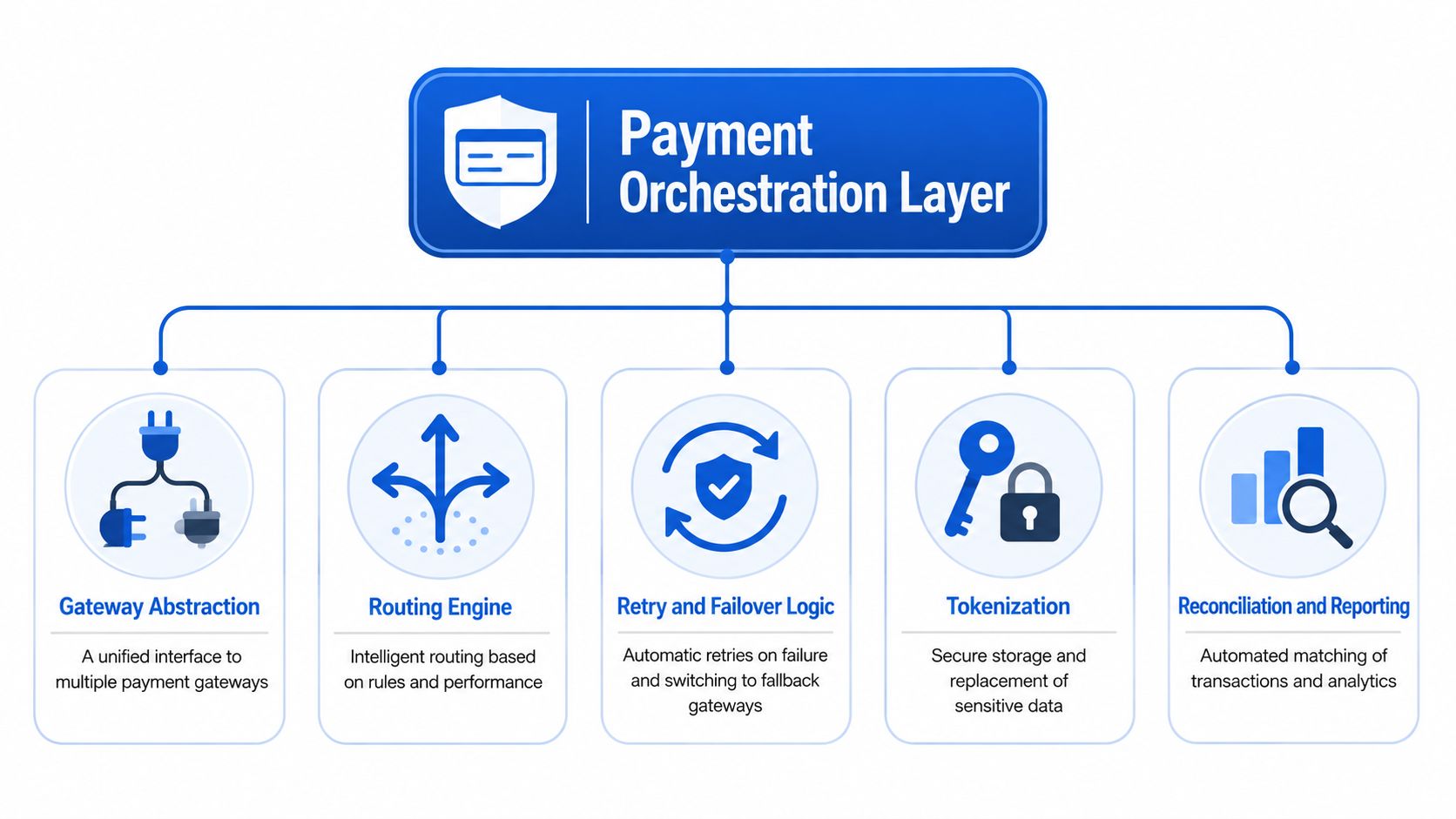
A mature orchestration layer isn't one feature. It's a set of tightly connected components that hide provider differences and keep every transaction traceable. The unglamorous part is normalization, the process of converting each PSP's request and response into one internal model so the rest of your stack doesn't have to care whether a provider calls a field transaction_id, pspReference, or something else. Technical architecture of payment orchestration
Gateway abstraction and normalization
Gateway abstraction gives your product one interface to many providers. Instead of wiring every checkout flow directly to each PSP, the orchestrator accepts one request shape, maps it into the right provider format, and translates the response back into the same internal model.
That matters because provider APIs aren't just different names for the same thing. They often differ in authentication, webhook format, settlement files, and error semantics. If your team handles those differences inside the core app, every new provider becomes a mini replatforming project.
Routing engine, retries, and failover
The routing engine decides which provider gets a payment first. It can weigh transaction attributes like amount, geography, issuer country, or card network, then pick the path most likely to succeed or cost less. The brief notes that architecture references describe routing decisions in roughly 20 to 50 ms, which is why caching and fast lookup patterns matter, and fraud screening can add about 10 to 50 ms more to the latency budget. Architecture notes on orchestration timing and resilience
Retries and failover are separate from initial routing. Retry logic handles soft declines or uncertain outcomes, while failover moves the transaction to a backup path if the first provider is degraded. That's also where idempotency becomes critical, because a timeout without duplicate protection can turn a recoverable blip into a double charge.
Vault, webhooks, and the internal ledger
A tokenization vault is more than a storage bin for card data. It protects sensitive payment details, returns tokens your systems can safely use, and helps keep PCI exposure down because the raw data stays isolated. Webhook fan-in matters because provider updates arrive asynchronously, and those callbacks need to land in one place so finance doesn't reconcile against conflicting versions of reality.
The internal ledger is what keeps orchestration auditable. Every authorization, capture, refund, and settlement needs a record that matches external provider events, or you end up with a routed payment that “worked” in the checkout flow but can't be tied cleanly to cash movement later. That's the operational value of a mature orchestration stack.
Routing is the visible part. Reconciliation is the part that keeps the visible part trustworthy.
A good mental model is a control plane with three jobs. First, it converts provider chaos into one internal language. Second, it decides what happens to each transaction. Third, it proves later that the money went where the system said it went.
How Orchestration Differs From Gateways, Processors, and Smart Routers
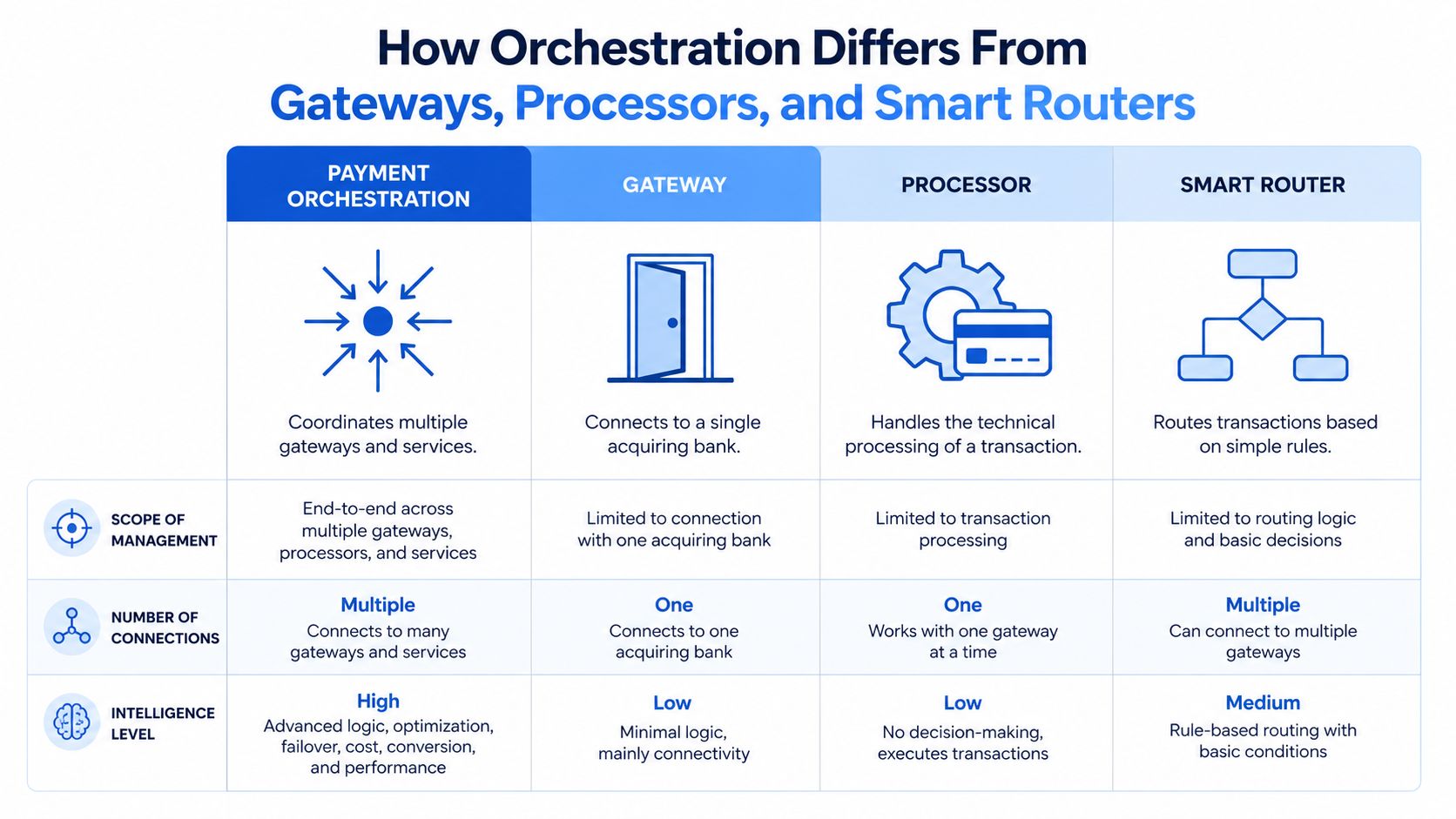
Buyers often collapse these categories into one another, then discover too late that they bought a narrower tool than they needed. S&P Global notes that payment orchestration is often confused with payment optimization, and the broader stack-level foundation matters because optimization only works well once orchestration exists. S&P Global primer on payments orchestration
The clean line between the categories
A gateway connects checkout to a payment endpoint and forwards the transaction. A processor moves the payment through card infrastructure and handles the technical processing side. A smart router chooses among options inside a narrower decision layer, usually with a rules engine or simple performance logic.
Payment orchestration sits above them and governs the whole multi-provider setup end to end. It owns the control plane, the provider connections, the routing rules, the retries, and the operational record of what happened. A smart router can be one capability inside orchestration, but it isn't the whole category.
What buyers usually ask in procurement
The question isn't always “do we need orchestration?” Sometimes it's “do we need orchestration, a smart router, or both?” If you only need to optimize one decision inside one existing stack, a router may be enough. If you're managing multiple PSPs, multiple acquirers, and region-specific payment methods, you're buying a wider operating layer.
That distinction matters in vendor meetings. A tool that improves routing isn't automatically solving reconciliation, failover governance, or provider normalization. Those are orchestration jobs, and they don't disappear just because the checkout path looks cleaner.
For a separate look at a related payment-integration problem, see ACH payment processing in practice.
| Category | Owns the relationship with multiple providers | Controls routing policy | Reconciles across providers |
|---|---|---|---|
| Gateway | No | No | No |
| Processor | No | No | Limited |
| Smart router | Sometimes | Yes, within a narrower scope | Usually no |
| Payment orchestration | Yes | Yes | Yes |
Buyer rule: if the vendor can't explain failover semantics and reconciliation together, you're probably looking at a router, not orchestration.
Walking a Single Transaction Through the Stack
A cardholder in Mexico places a USD 120 order on a US merchant's site. The checkout page sends the request to the orchestration layer, not to a single hard-coded PSP. The orchestrator looks at the transaction attributes, like currency, issuer country, card network, BIN, and customer location, then chooses the first provider to try.
From click to decision
The customer clicks Pay. The orchestration layer receives the payment request, normalizes it, and applies routing rules. Maybe the first route is a US-based processor, maybe a regional acquirer, maybe a backup provider with stronger performance for that corridor. The point is that the choice happens in the control plane, not in scattered application logic.
If the first attempt soft-declines or times out, the orchestrator can retry or cascade to a backup provider. That fallback needs to stay idempotent, because the system has to know whether the first provider processed the payment or just never returned a clean answer. Without that guardrail, retries create duplicate risk.
From provider response to finance record
Once a provider authorizes the transaction, the capture and settlement events still have to come back through the same orchestration layer. Webhook fan-in gathers those asynchronous updates, then the internal ledger matches them against the original request and later settlement records. That's how finance gets one coherent view even when the underlying PSPs send events at different times.
The practical advantage is visible in day-to-day operations. Product sees one payment flow. Operations sees one place to monitor provider health. Finance sees one set of records to reconcile against the bank or acquirer output.
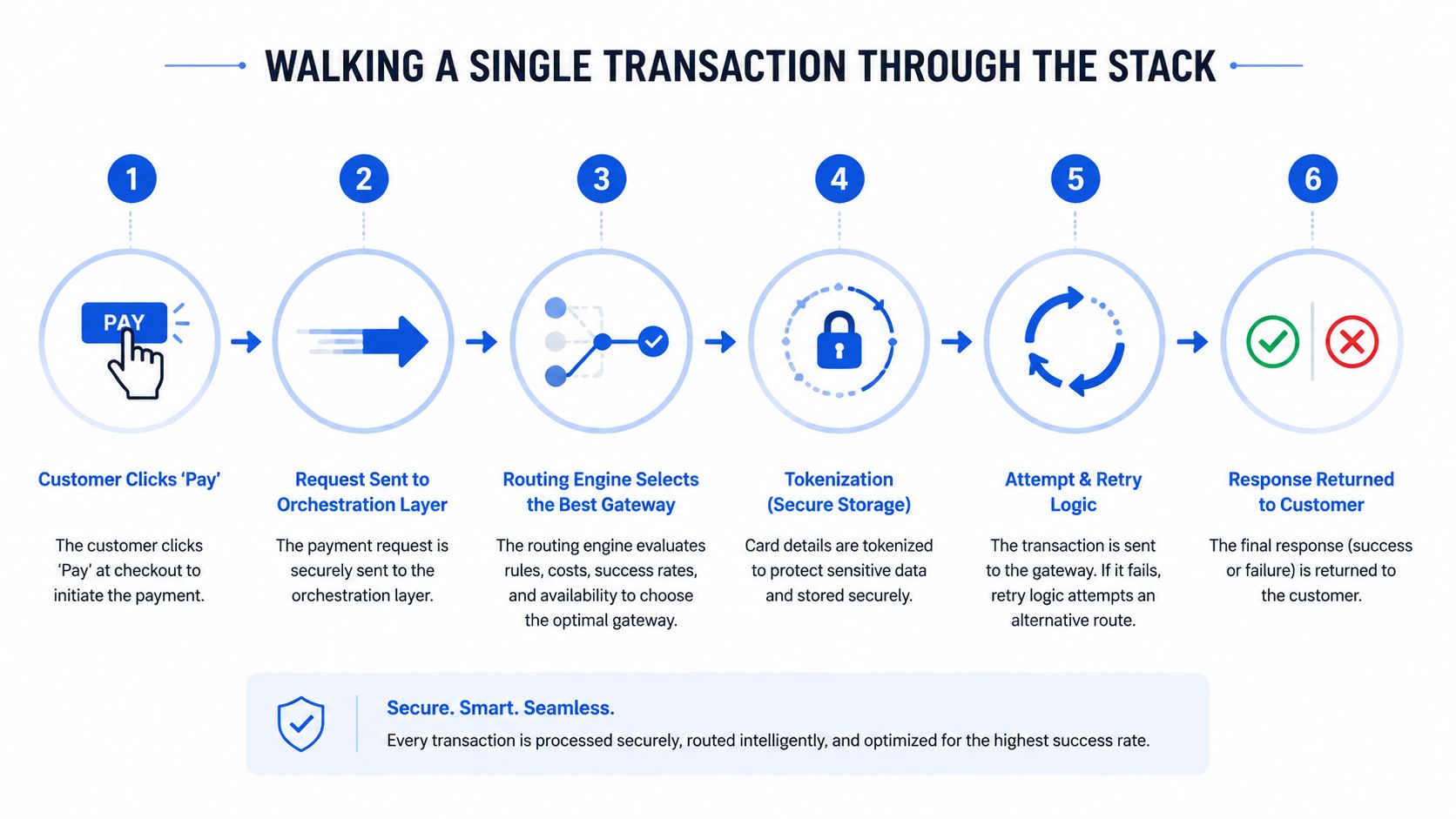
The main lesson is simple. Orchestration doesn't just choose a route once. It keeps the transaction legible after the first decision, across retries, captures, settlement, and reporting.
Benefits and the Hidden Operational Costs
The obvious upside is control. You can route by market, provider health, payment method, or cost, and you can keep working even if one provider has a bad day. The brief also notes that merchants want multiple processors for resilience and coverage, and market estimates show this category has become a mainstream infrastructure choice rather than a niche experiment. Market overview with merchant and category data
What gets better first
Higher acceptance is usually the first thing teams notice. If a provider performs better in one corridor than another, orchestration gives you a place to use that signal instead of treating every transaction the same. Regional coverage gets easier too, because local methods and local acquirers can be layered into the same decision engine.
Centralized reporting is another real gain. When settlements, refunds, chargebacks, and fees no longer live in separate PSP portals, finance can work from one operational view instead of stitching together exports. That reduces the time spent answering basic questions like which provider cleared which payment.
The costs people underestimate
Integration effort is the first hidden cost. Every provider still has to be connected, tested, and monitored, even if the orchestrator hides the complexity from the checkout app. Governance is the second. Someone has to own routing rules, failover policies, provider reviews, and exception handling, or the platform turns into another layer of drift.
Reconciliation gets more complex before it gets simpler. A multi-PSP setup creates more moving parts, not fewer, and the benefit comes from centralizing that complexity rather than pretending it goes away. If your business is single-country, single-provider, and low complexity, the overhead may outweigh the gain.
Good fit: orchestration usually makes sense when provider choice, geography, or reconciliation pain has become a real operating cost.
Weak fit: if one PSP already covers your markets and payment methods, an orchestration layer can become expensive plumbing.
The honest trade-off is this. Orchestration doesn't remove payment operations, it concentrates them. That's valuable when the concentration gives you better control, and wasteful when it just adds another system to manage.
Real-World Use Cases From E-Commerce to Web3
A global e-commerce merchant uses orchestration to route by region. A customer in one market might go to one provider, while a customer in another corridor goes somewhere else because the local path performs better. The merchant doesn't need three checkout stacks, just a decision layer that understands geography and provider behavior.
A B2B cross-border payer has a different problem. Invoices move across entities, currencies, and rails, so the hard part becomes reconciliation rather than checkout conversion. Orchestration helps centralize routing and records when money moves through wires, card rails, or other payment methods, which is why platforms that handle cross-border finance often care as much about back-office clarity as front-end acceptance. For a related treasury and crypto-acceptance resource, see best practices for accepting crypto payments.
Where web3 fits and where it doesn't
A crypto-native DAO or web3 company can use orchestration concepts for hybrid treasury flows. Stablecoin holdings, fiat contractor payouts, and invoice settlement in either currency all benefit from the same ideas, routing, retries, and an auditable ledger. But on-chain settlement, self-custody mechanics, and gas management are not classic orchestration problems, they're crypto-native infrastructure problems.
That distinction matters. Orchestration can sit above fiat and crypto workflows where the business needs one control plane. It can't replace a chain, a wallet, or the mechanics of a treasury stack that lives partly on-chain.
Integration, Migration, Security, and Compliance Realities
The safest migration path is usually phased. Teams often start with shadow traffic, then move to failover-only routing, then enable active routing once the provider behavior and reporting line up. That lowers the risk of discovering a mismatch only after live volume is flowing.
Security and compliance don't disappear when you add orchestration. Tokenization can reduce how much sensitive data touches your own systems, but you still need KYB, sanctions screening, entity-level controls, and the right operational policies. PCI scope may get simpler, but not zero.
A good orchestrator should also fit your regional data and custody requirements. Some teams care about where payment data is stored, others care about how approvals are controlled, and web3-heavy businesses may need custody and conversion features in the same operating model. For teams that bridge bank rails and digital assets, OneSafe's bank and crypto integration guide is a useful reference point.
Migration rule: move the flow in stages, not all at once. If your first live test is full traffic, you're making the hardest version of the mistake.
Businesses that need to coordinate payments across many operational contexts can also look at platform examples that centralize transfers and approvals, including resources like streamline restaurant payments. The common thread is the same, fewer isolated payment paths and more control over how money moves.
Evaluating Orchestration Vendors and a Buyer Decision Checklist
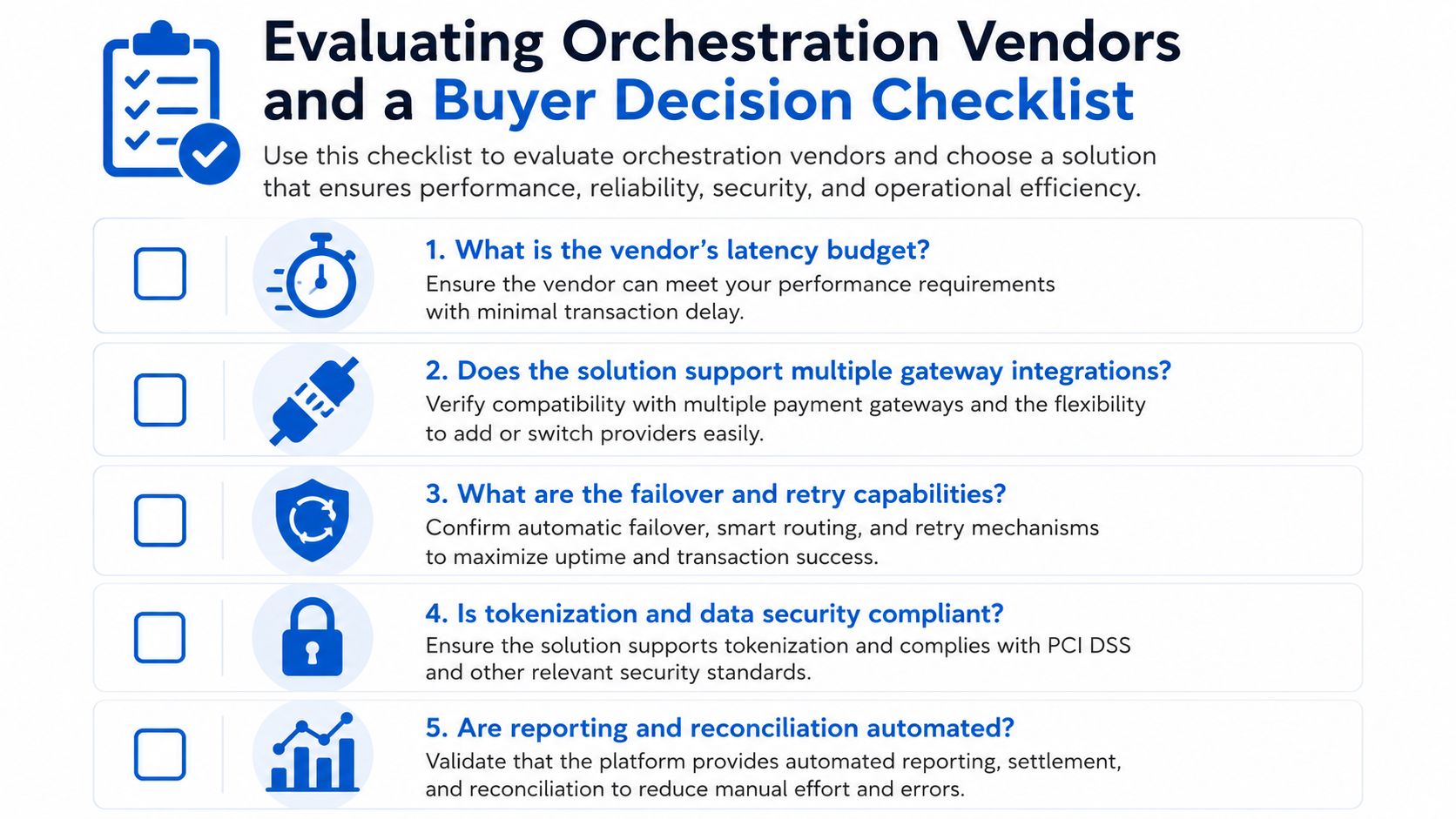
Use a shortlist, not a vibe. Ask each vendor what their latency budget looks like, how many gateway or PSP integrations they support, how failover and retry are handled, whether tokenization and data security are compliant for your stack, and how reporting and reconciliation are automated.
If the vendor only improves route selection, you may just need a smart router. If the vendor governs multiple providers, retries, reporting, and ledger-level traceability, you're looking at orchestration. If your operation also includes cross-border treasury or crypto payouts, make sure the platform can fit that complexity without forcing you into manual workarounds.
A practical decision rule is straightforward. Choose orchestration when you have multiple providers, multiple regions, or multi-entity reconciliation pressure. Choose a smart router when the only problem is one decision inside one payment path. Choose both when routing is only part of the problem and operations still need a real control plane.
If your team is already juggling multi-PSP payments, cross-border flows, and treasury movement across fiat and crypto, a platform like OneSafe can be part of the broader stack because it combines multi-currency accounts, global payments, card controls, and crypto-compatible workflows in one interface.
If your payment stack is already split across providers, regions, or treasury workflows, visit OneSafe and compare how a single platform for multi-currency accounts, global payments, and crypto-compatible operations could fit into your flow. The right next step isn't another isolated integration, it's a clearer control plane for how money moves and how your team reconciles it.