You're staring at a clean trial balance, and one line looks fine on its own, Accounts Receivable. Then a customer asks why their invoice still shows open, another asks about a credit memo, and a third says they already paid. The single balance in the general ledger doesn't tell you who owes what, which invoice is late, or where the mismatch started.
That's where a subsidiary ledger comes in. It's the detail book behind a summarized control account, the place where finance keeps the transaction-level story that the general ledger intentionally leaves out. If the general ledger is the dashboard, the subsidiary ledger is the logbook underneath it.
Table of Contents
- The Idea Behind a Subsidiary Ledger
- Why the summary layer stays small
- Why this structure prevents confusion
The Idea Behind a Subsidiary Ledger
A controller can open the trial balance and see one Accounts Receivable number, but that total does not explain who owes the money, which invoices are still unpaid, or whether a cash receipt was posted to the right customer. The summary is useful, yet it does not give enough detail to manage the account with confidence.

A subsidiary ledger, or subledger, is the detailed record behind that summary. In accounts receivable, it tracks each customer's credit sales, invoice dates and numbers, payments, discounts, returns, and allowances, while the total still has to agree with the Accounts Receivable balance in the general ledger. That is the basic idea behind what is subsidiary ledger, it is the detail layer that supports one summarized balance, as described in the accounts receivable ledger overview from Investopedia.
A hotel folio works the same way. The guest sees one checkout total, but that number is built from minibar charges, parking, late checkout, and tax. The bill is the summary, and the subledger is the itemized record that explains it line by line.
Practical rule: if you cannot trace the total back to the individual entries, you do not really have control over the account yet.
That is why finance teams rely on subledgers for accounts with a lot of detail. The general ledger stays clean enough for reporting, while the subsidiary ledger keeps the transaction history ready for a customer question, a vendor dispute, an audit, or a manager review. The same structure also helps in cloud ERP setups, where multi-currency postings, intercompany activity, and even crypto or web3 treasury workflows need a clear trail behind the summarized balance, especially in cases like church accounting ledger differences.
How the Subsidiary Ledger Connects to the General Ledger
A junior accountant can usually spot the relationship by following one customer balance from start to finish. The subsidiary ledger records the line-by-line activity, while the general ledger carries the single summarized amount that appears in the financial statements. The link between them is the control account, the summary account in the general ledger that should match the total of the related subledger balances.

A simple example helps. If a company posts several customer invoices, partial payments, and credit memos in the accounts receivable subledger, those details should roll up to one Accounts Receivable balance in the general ledger. If the totals do not agree, something in the posting flow needs attention. That mismatch can come from timing, a misclassified entry, or an incomplete update, which is why reconciliation is treated as a roll-up check in OpenDue's subsidiary ledger glossary.
Why the summary layer stays small
The general ledger is meant to stay compact. It feeds the balance sheet, income statement, and other reports, so it should not carry every invoice number, customer name, payment application, or item-level adjustment. The subsidiary ledger keeps that detail available without crowding the main reporting record.
A useful comparison appears in church accounting ledger differences, where the same separation shows up in a smaller operating setting. The setup is the same, detail stays below, summary stays above. That structure makes it easier for finance teams to answer operational questions without turning the general ledger into a pile of transaction lines.
Why this structure prevents confusion
Once transactions are entered in the subsidiary ledger, they are summarized and posted to the general ledger. The subledger supports the daily work, and the general ledger supports reporting and review, a distinction described in O'Reilly's financial accounting reference. For a finance team, that means one place for detailed tracing and another place for the summarized balance.
The practical benefit shows up at month end. If a balance looks off, the team can inspect the subledger instead of searching through every account in the chart of accounts. That matters in cloud ERP systems, where postings may come from multiple entities, currencies, or treasury workflows, including crypto and web3 activity that still has to tie back to a clean control account.
Common Types of Subsidiary Ledgers
Finance teams typically encounter four classic subledgers first, and each one answers a different operational question. A customer balance, a vendor bill, a stock item, or a long-lived asset all need their own detail record. The pattern stays the same, detail below, summary above. What changes is the type of information each ledger stores.
| Subledger Type | Detail Captured | Control Account |
|---|---|---|
| Accounts Receivable | Customer invoices, payments, credits, returns, allowances | Accounts Receivable |
| Accounts Payable | Vendor bills, payment status, due dates, discounts | Accounts Payable |
| Inventory | SKU quantities, item movement, cost detail | Inventory |
| Fixed Assets | Asset purchase data, depreciation detail, disposals | Fixed Assets |
Accounts Receivable
The AR subledger tracks what each customer owes. A single line might show customer name, invoice number, invoice date, payment applied, and remaining balance. The control account in the general ledger holds the total of all those customer balances.
A junior accountant can picture it like a customer file cabinet. The general ledger gives the total drawer label, while the AR subledger holds the individual folders inside the drawer.
This ledger answers the questions that come up in collections and cash application. Who is late, which invoice did that payment hit, and what is still open. The general ledger cannot answer those questions on its own, because it only shows the summary balance.
Accounts Payable
The AP subledger is the mirror image. It stores each vendor bill, due date, discount term, and payment status. The control account shows the total liability owed to suppliers.
A month-end AP review becomes much easier when the details sit outside the general ledger. You can see which bills need approval, which ones are scheduled, and which vendors are waiting on payment. For a practical example of how those details matter during an audit, see this accounts payable audit guide.
That detail also matters in cloud ERP systems, where invoices may enter from different approval paths, currencies, or entities. The AP subledger keeps the bill-level trail intact, while the control account gives finance a clean summary for reporting.
Inventory
Inventory subledgers support businesses that sell physical products or hold stock. One line may reflect a SKU, quantity on hand, cost basis, and movement in or out of storage.
That detail matters because a single summarized inventory balance does not help a warehouse team reorder a fast-moving item or identify a slow seller. It also does not show which location received the goods, which lot moved, or how cost changed after a transfer. In a cloud ERP, those item-level records help operations and accounting stay aligned without forcing the general ledger to carry every stock movement.
Fixed Assets
Fixed asset subledgers track long-lived items, like equipment, vehicles, or computer hardware. A line usually includes the acquisition record, asset category, and depreciation support.
If you are trying to understand whether a truck is still on the books or whether a machine has been disposed of, the fixed asset subledger is where you look. It works like the asset register behind the balance sheet, giving accountants a place to trace purchases, depreciation, and disposals without cluttering the general ledger summary.
Reconciling a Subsidiary Ledger Step by Step
A reconciliation starts when the balance on the control account looks right at a glance, but you still need proof from the detail. That proof matters in a cloud ERP, a spreadsheet export, or a treasury workflow that spans currencies and entities. The goal is simple, tie the summary balance back to the transactions that created it.
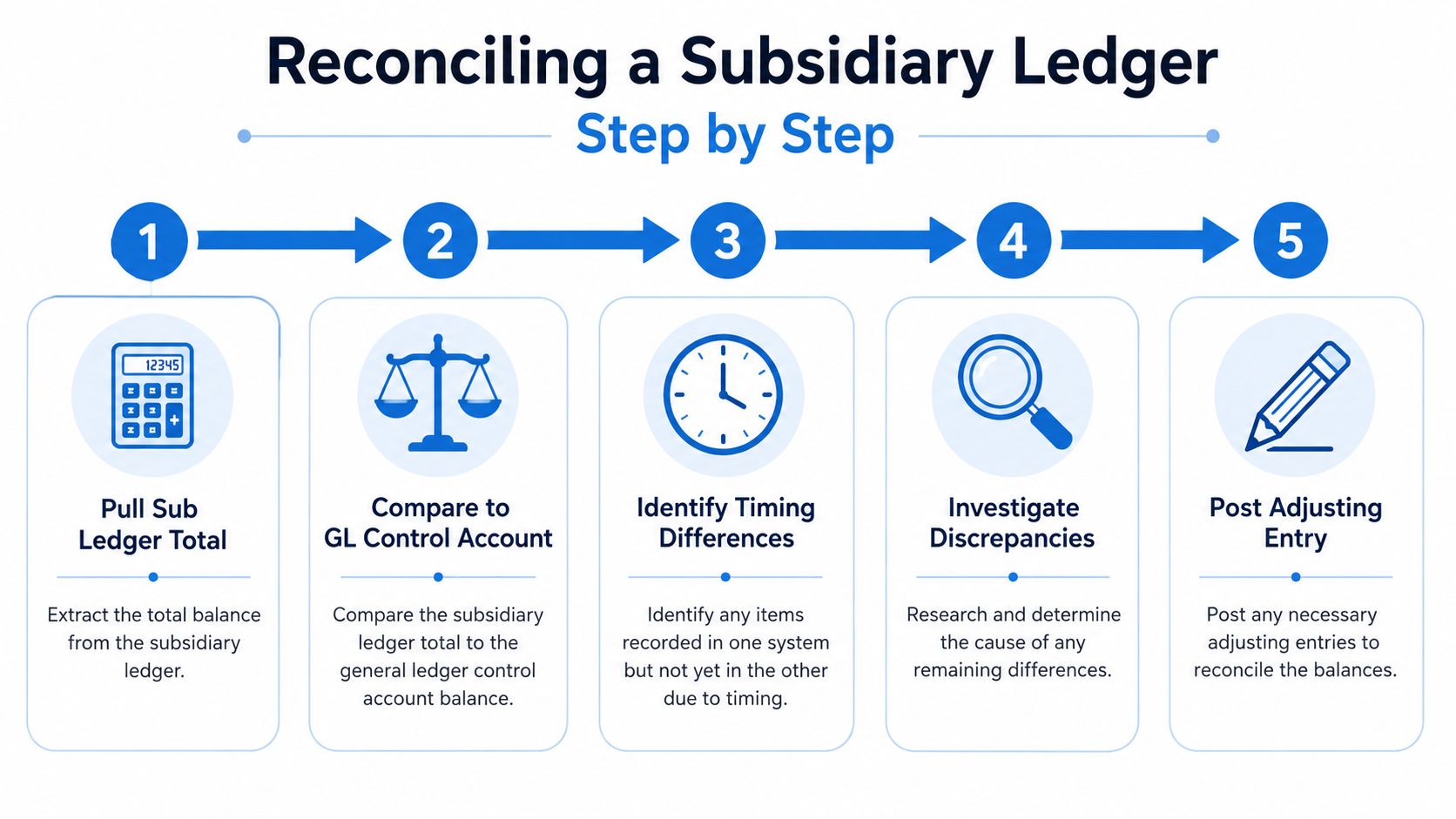
Here's a practical way to walk a junior accountant through it.
- Pull the subledger total. Start with the detailed ledger, not the summary account. You want the customer, vendor, asset, or item-level balance first, because that is the evidence you will test.
- Compare it to the control account. Match the detailed total against the related balance in the general ledger. The control account should reflect the same underlying activity in summary form.
- Check for timing gaps. A payment, invoice, inventory move, or asset posting may have landed in one system view before the other, especially in cloud ERPs that sync modules on different schedules.
- Trace the difference line by line. Look for duplicate postings, missing entries, misapplied cash, currency translation issues, or a transaction pushed to the wrong entity or account.
- Fix the source and document the close. Post the correction where the error started, then keep a note of what changed and why so the next review is easier to follow.
A mismatch usually means the trail is incomplete, not that the whole ledger is broken.
The point is to make the detail support the summary, the way a stack of receipts supports a monthly card total. In a manual system, that may mean ticking through journal entries one by one. In a cloud ERP, the same logic applies, but the review often includes posting rules, interface logs, and exception reports rather than handwritten totals. That is why the control account can stay clean for reporting while the subsidiary ledger holds the transaction-level story.
A simple AR example makes the process easier to see. If the subledger shows three open invoices and two payments, the remaining balance should match the control account once every posting has cleared. If it does not, the difference may come from a late update, a reversed payment, or an entry applied to the wrong customer. Finance teams often use the same habit when they audit related payables balances, because the method is the same even when the account type changes.
For fixed assets, the same line-by-line discipline helps teams keep track of additions, depreciation, and disposals. If you need a place to find fixed asset accounting tools, the software still needs one thing from you, accurate source data and a clean reconciliation habit.
How Modern ERPs and Fintech Platforms Handle Subledgers
In cloud systems, the old image of a separate paper ledger book doesn't fit anymore. AP, AR, inventory, and fixed-asset modules often behave like database-driven subledgers that feed the general ledger continuously. The control-account rule still applies, but the mechanics are much less manual.
High-volume environments use subledgers specifically to keep the general ledger from becoming operationally unmanageable. AR and AP subledgers can hold line-item transactions with invoice dates, settlement dates, discounts, and counterparty details, while the general ledger records only the ending control balance, as noted by Modern Treasury. That separation is what keeps the reporting layer readable when transaction volume spikes.
What changes inside software
In a cloud ERP, the subledger may post detail and summary entries automatically. That means finance doesn't always “manually summarize” the ledger the way older textbooks describe it. Instead, the reconciliation task shifts toward reviewing the system's posting logic, exception reports, and audit trail.
That shift matters because ownership changes too. A finance ops team might own the subledger module, while accounting owns the control account and the monthly close sign-off. If the platform posts both sides, someone still has to verify that the rule holds.
A good place to start when comparing accounting tooling is fixed asset accounting tools, especially if you're evaluating how asset detail is maintained outside the main ledger.
Why the modern stack needs closer supervision
Automation reduces manual entry, but it doesn't remove the need for review. If invoices sync from a billing platform into AR and then into the general ledger, the team still has to confirm the sync happened completely and in the right period. The same logic applies when a fixed asset module calculates depreciation or when AP posts bills automatically.
For teams building a fiat and crypto operations stack, the bank and payment layer can also influence how subledger detail is captured. One useful reference is bank account setup business fiat crypto integration, because the ledger design often has to match how money moves.
Multi-Currency, Multi-Entity, and Web3 Treasury
Cross-border finance makes the subledger idea more useful, not less. When a business pays vendors in several currencies, or when a group manages several legal entities, one summary balance isn't enough to explain the underlying movement. The subledger has to carry the detail that makes the roll-up meaningful.
Standard content often stops at receivables, payables, inventory, and fixed assets, but that leaves unanswered questions about on-chain assets, stablecoin flows, wallet-level balances, and DAO treasury segmentation when one control balance maps to many wallets, chains, or legal entities, as noted in eCapital's subsidiary ledger overview. That's the gap modern finance teams run into first.
Where the ledger structure stretches
In a multi-entity business, each entity may need its own subledger mapping so the control account stays clean at the legal-entity level. In a multi-currency workflow, the subledger may need to preserve original currency, settlement currency, and FX translation support. In a web3 treasury, the detail may need to track wallet, chain, and asset type as separate dimensions.
The key point is traceability. Finance still wants one balanced control account, but operations need to know which wallet received funds, which chain moved first, and which entity owns the obligation.
For teams balancing cash across transport or logistics operations, the French guide on conseils trésorerie pour transporteurs is a practical complement because it shows how cash visibility affects day-to-day operating decisions.
Why crypto workflows need ledger discipline
A web3 treasury can't afford duplicate records or vague ownership. If a stablecoin moves from one wallet to another, someone needs to know whether that movement is a treasury transfer, an internal rebalance, or a settlement event. The subledger gives that movement context without forcing the general ledger to carry every operational nuance.
OneSafe's crypto treasury management best practices are relevant here because treasury operations need a clean bridge between fiat and digital assets, not a separate bookkeeping universe. The ledger principle stays the same, but the data model has to be broader.
Internal Controls and Best Practices for Subledgers
A subledger only works if people trust it. That trust comes from controls, not from software alone. The detail can be rich and fast, but if approvals, posting, and documentation are sloppy, the control account stops meaning much.
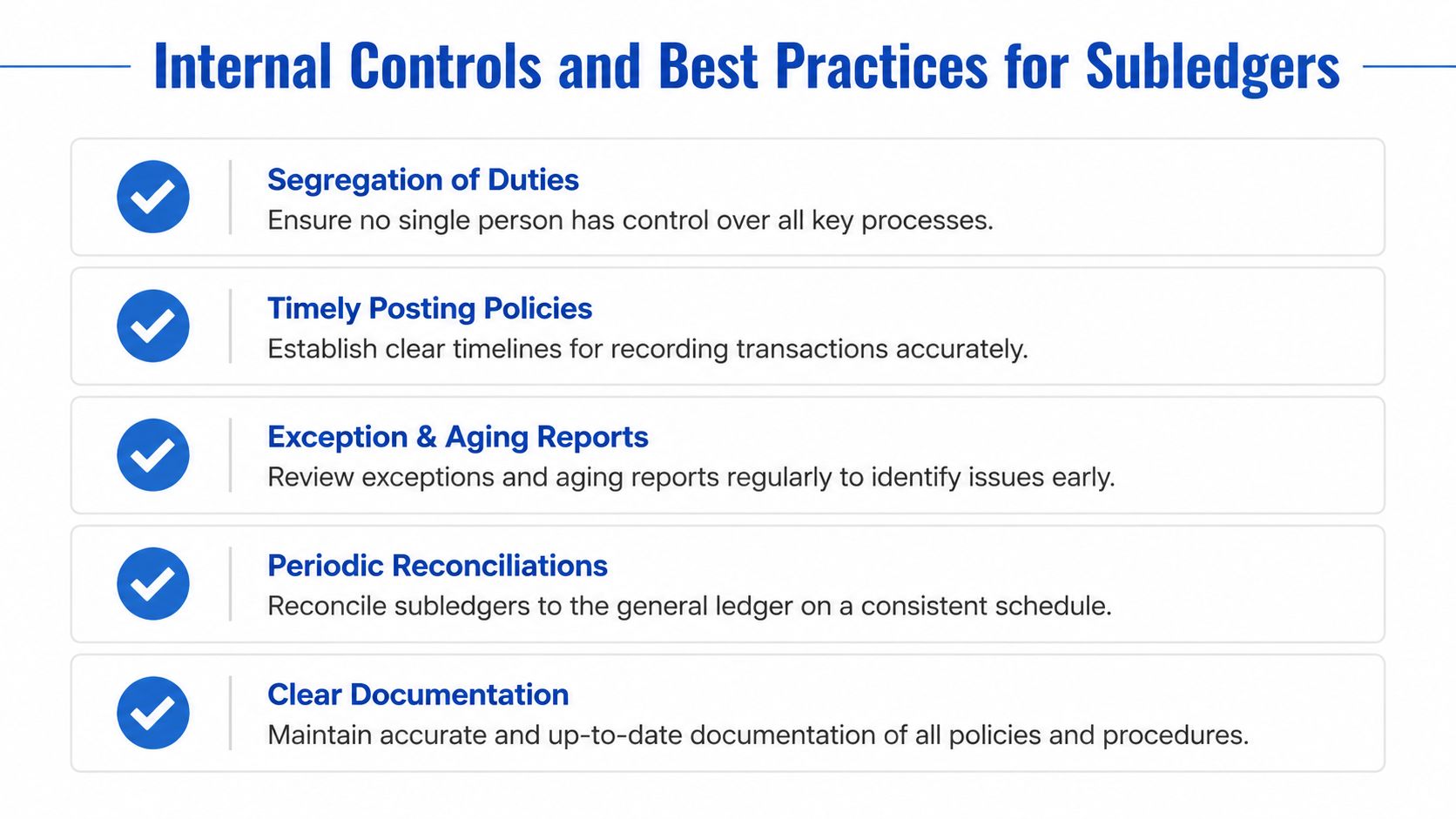
A useful control framework starts with five habits:
- Segregation of duties. The person entering transactions shouldn't be the only person approving them.
- Timely posting policies. Detail should reach the ledger quickly enough to keep the summary account current.
- Exception and aging reports. Review overdue items, unusual entries, and unapplied balances on a routine basis.
- Periodic reconciliations. Match subledger totals to the control account on a set cadence, not only when something looks wrong.
- Clear documentation. Keep support attached to the transaction history so an auditor or reviewer can follow the trail.
If the evidence sits in someone's inbox, the ledger isn't really controlled yet.
A strong subledger process also needs clear ownership. Someone should own AR, someone should own AP, and someone should own the reconciliation sign-off. That ownership should be visible enough that the team knows who resolves exceptions and who approves adjustments.
The best systems make this easier, but the rule stays human. Software can post the entries, yet finance still has to define who checks the work, who keeps the support, and who signs off when the numbers agree.
Key Takeaways for Finance Teams
A subsidiary ledger gives the detail behind a control account, while the general ledger carries the summarized balance used for reporting. Both sides have to match. That is the basic discipline, whether the detail sits in accounts receivable, inventory, fixed assets, or a cloud ERP module that posts across multiple entities and currencies.
A simple example helps. If the general ledger says customers owe one amount, the accounts receivable subledger should show how that total breaks down by customer, invoice, currency, and status. The same idea applies in modern treasury workflows too. A crypto or web3 balance may need separate detail for wallets, tokens, or counterparties so the summary account does not hide what is happening underneath.
The most common mistake is treating the subledger like a hidden feature inside the system instead of a controlled accounting record. If no one owns the module, no one checks the detail, and no one ties it back to the control account, the summary figure stops being trustworthy. Errors tend to sit in plain sight in high-volume automation, especially when postings move quickly across payment rails, inventory feeds, or platform integrations.
The fix is steady and practical. Assign each subledger to a clear control account, set a reconciliation schedule, and name the person who reviews exceptions and signs off on adjustments. Keep the support close to the entry, so a reviewer can trace the transaction from source document to subledger to general ledger without guessing. If your team can explain the balance, match the detail, and resolve differences quickly, the process is working.
If you're building finance operations across fiat, cards, and crypto, OneSafe gives you a place to manage those flows without losing visibility. Visit OneSafe to see how multi-currency accounts, payments, and treasury controls can support cleaner reconciliation and stronger ledger discipline.