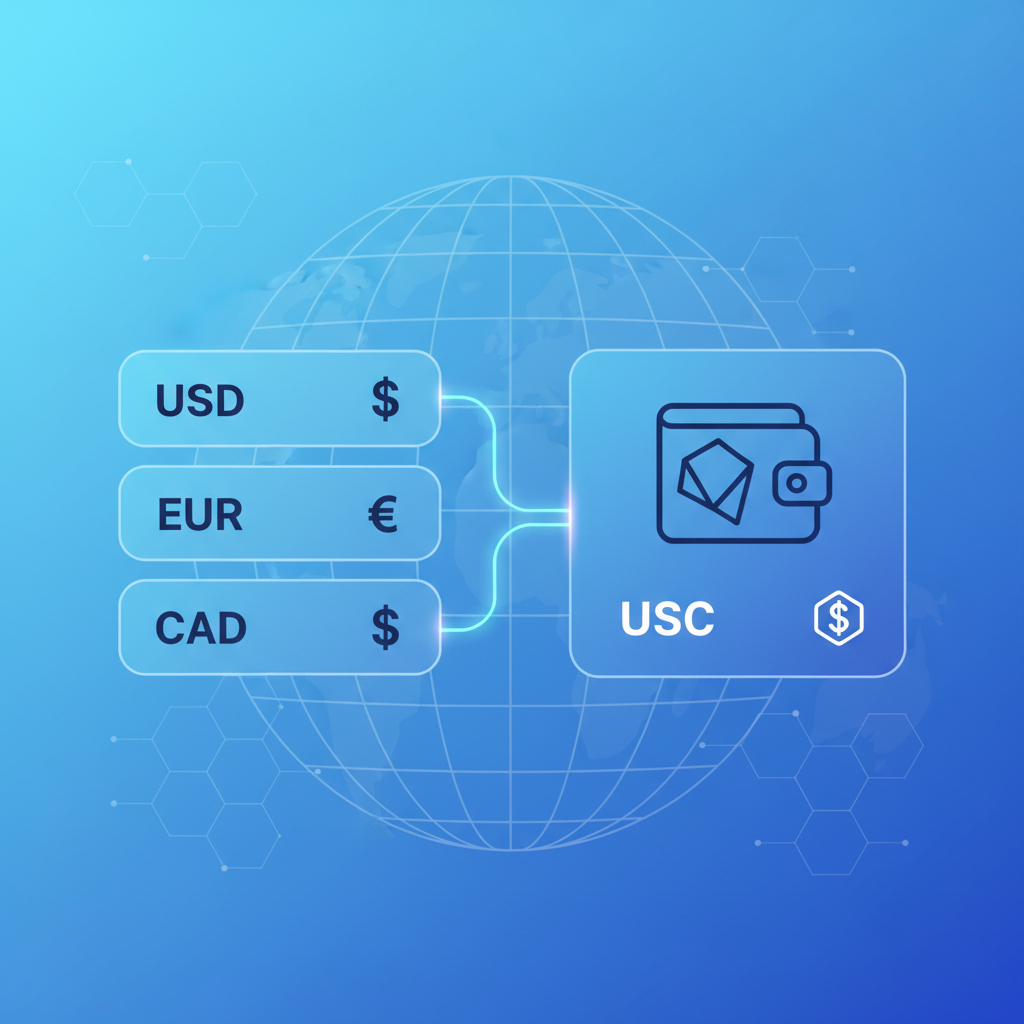
The question "What is the best global bank account?" produces different answers for an expat versus a founder. If you’re moving cross-border vendor payments, paying remote staff, and managing a treasury that may include stablecoins, the best international bank account for business is often a purpose-built neo-banking platform rather than a traditional chartered bank.
This guide filters options for globally distributed businesses that need multi-currency accounts, corporate card controls, remote onboarding, and crypto-native treasury management.
What is a global bank account — and who really needs one?
Consumer definitions focus on low FX markups and international ATM access. A business needs something different: a financial operating system that can receive, hold, convert, and send funds across borders without losing 3% on each conversion or waiting days for SWIFT.
Three criteria matter more than bank status:
- Multi-currency with local payment rails. Can you hold USD, Euro, and CAD in named accounts and send payments via local clearing networks instead of only SWIFT?
- Cross-border speed. Do transfers settle in hours via stablecoin rails or crawl through SWIFT over three to five business days?
- Treasury flexibility. Can the account natively manage fiat and crypto without separate bank accounts, OTC desks, and manual reconciliation?
A platform that checks all three boxes does the job of a global account better than most banks.
Traditional international banks: the old guard
HSBC, Citi, and Barclays offer physical presence and deep fiat infrastructure. That still matters for credit lines, trade finance, or in-person cash services.
The friction starts quickly: branch visits, minimum balances that can reach six figures, and onboarding that stretches past three weeks. Layered fees—maintenance charges, $15–$45 wires plus correspondent deductions, and 2–4% FX markups—are consistently flagged in guides on overseas business bank accounts.
For startups holding crypto, traditional banks are worse. Many freeze or close accounts when they detect transfers to or from crypto exchanges, which is an unacceptable operational risk for any Web3 company.
Forbes released its 2026 World’s Best Banks list on April 8, 2026. It is useful for consumer retail banking quality, but it measures satisfaction, not remote onboarding, stablecoin support, or multi-currency business rails. Use it for high-street banking, not for choosing a global business account.
The neo-banking alternative: OneSafe for global business
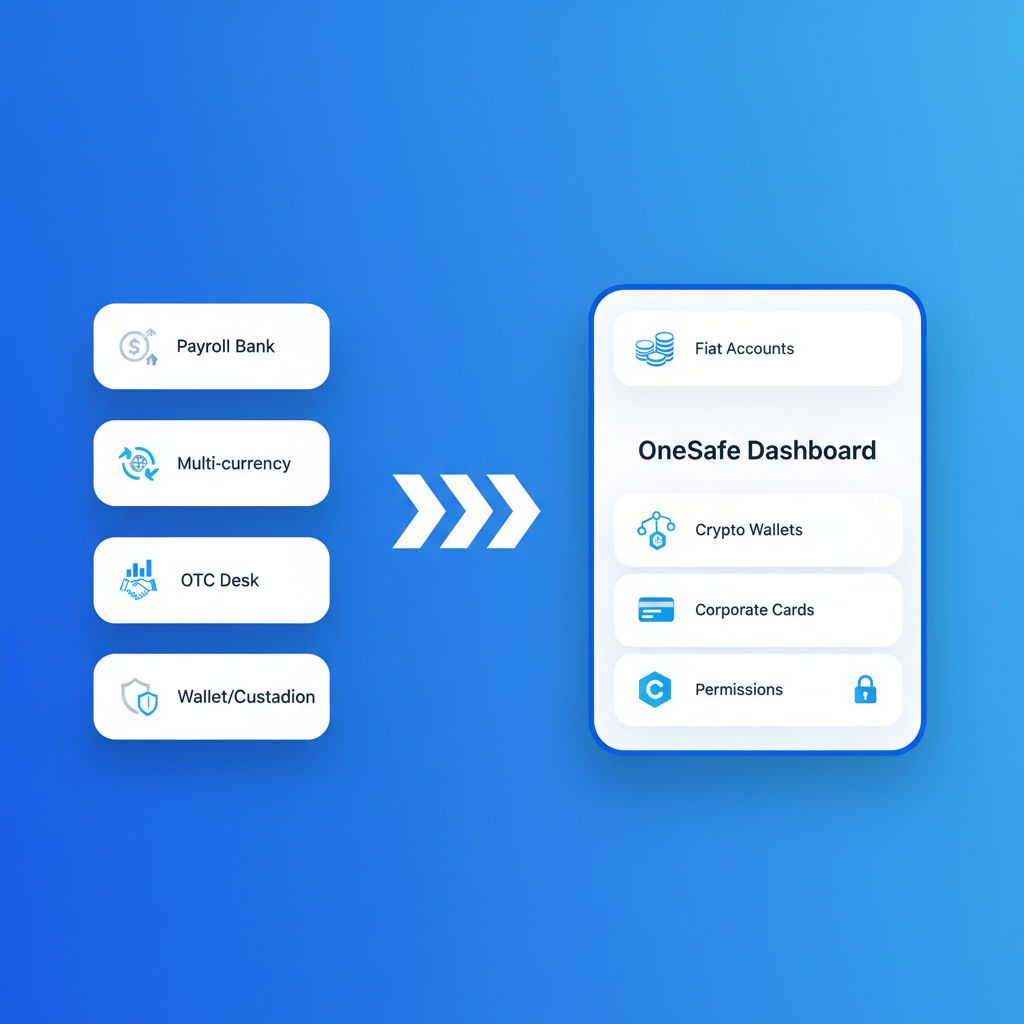
OneSafe exists because a single legacy system cannot serve companies operating on both SWIFT and stablecoin rails. It supports ACH, domestic and international wires, bill payments, and crypto-to-fiat conversions in one interface. This is a global account for Web3 companies as well as fiat-first distributed teams.
A typical Web3 startup may maintain four relationships: a bank for payroll, a multi-currency account for EUR/GBP, an OTC desk for crypto, and a wallet/custodian. OneSafe collapses that into one dashboard: fiat accounts, crypto wallets, corporate cards, and role-based permissions.
Security is digital-first rather than branch-based. Digital assets are held in Fireblocks MPC-based custody, and all users must enable Multi-Factor Authentication. Encryption and compliance protocols apply across transactions.
Features that define the best account for modern business
Global business account multi-currency. A global business account multi-currency setup should let you receive payments as if local. OneSafe supports named accounts in USD, Euro, and CAD, with more currencies planned. Local rails such as SEPA avoid the $15–$50 correspondent fee on incoming wires. Providers like OFX and Airwallex offer similar fiat functions, but they stop at fiat.
Corporate cards with controls. Virtual cards issued instantly with per-card spend limits, merchant restrictions, and real-time visibility beat sharing one card across a distributed team.
Crypto on/off-ramps and stablecoin treasury. No major traditional bank lets you hold USDC in the business account and convert it to USD in one click. For a Web3 startup receiving revenue in stablecoins, this is the difference between a 10-minute treasury operation and a full-day manual process. OneSafe processes USDC deposits and withdrawals with zero network-to-platform fees.
Role-based access and payment workflows. DAOs and distributed teams need treasury managers, reviewers, and auditors with separate permissions, plus multi-party approval workflows. OneSafe encodes this natively, making it one of the few practical DAO treasury management tools for fiat and crypto.
How to open business account remotely
You can open business account remotely with OneSafe. The online application takes about 10 minutes. KYB review typically completes within one week. There is no branch visit, mailed paperwork, or notarization.
Required documents are standard:
- Business formation documents
- Government-issued photo ID for beneficial owners
- EIN confirmation letter for US companies
Coverage is worldwide except OFAC-sanctioned countries and certain US states. For unclear jurisdictions, support@onesafe.io can provide pre-application clarity.
Fee transparency: international wire fees vs crypto
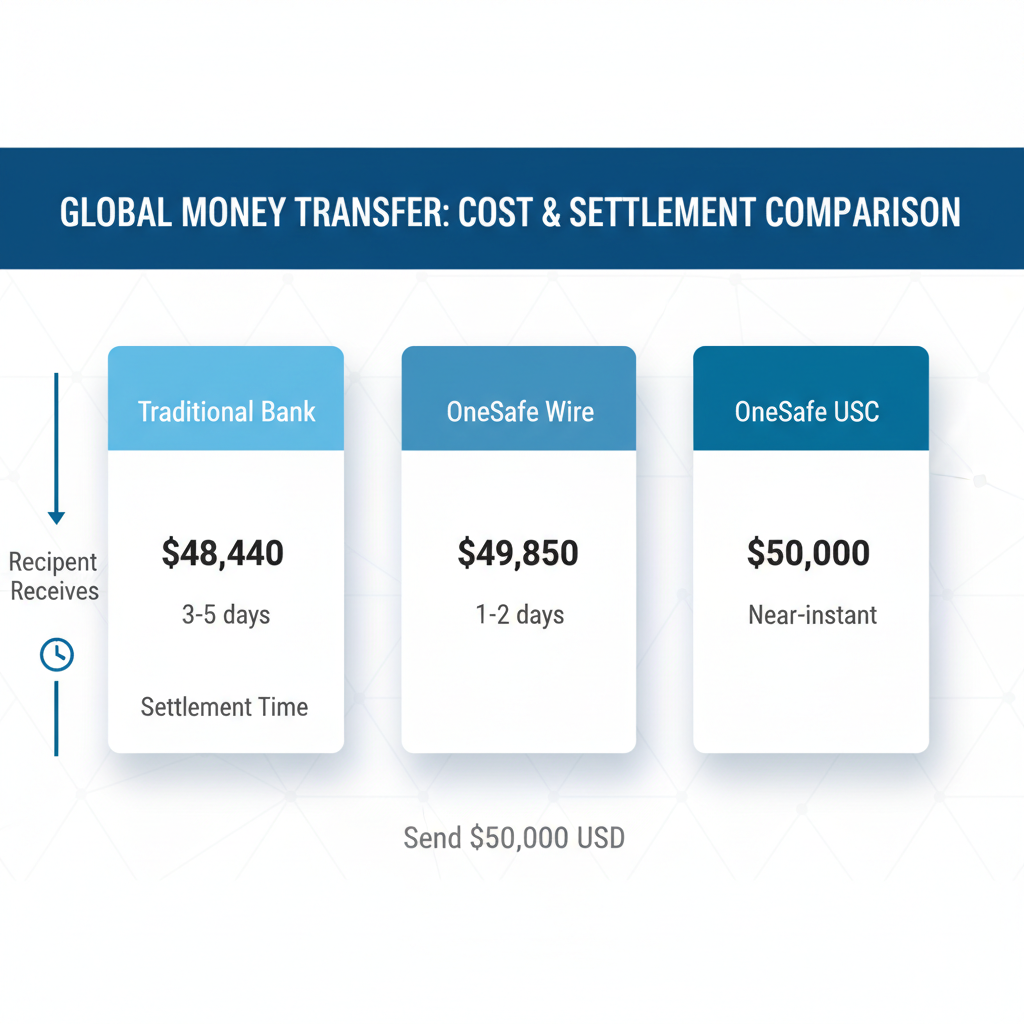
Traditional international wires layer three costs: sending bank fee ($15–$45), embedded FX markup often 2–4%, and correspondent bank deductions. As British Business Bank guidance notes, the final amount can be $200–$400 lighter than expected on a $10,000 transfer.
A $50,000 example:
| Traditional Bank | OneSafe wire | OneSafe USDC | |
|---|---|---|---|
| Sending fee | $35 | $25 | $0 |
| FX conversion | 3% embedded ($1,500) | 0.25% ($125) | N/A |
| Correspondent charge | ~$25 | $0 | $0 |
| Recipient receives | ~$48,440 | $49,850 | ~$50,000 minus <$2 gas |
| Settlement time | 3–5 business days | 1–2 business days | Near-instant |
When both parties transact in USDC, international wire fees vs crypto are stark: gas fees under $2 on Ethereum L2s versus SWIFT charges and FX spreads. For more, see the stablecoin payments for startups guide.
Is a neo-banking platform safer than a traditional bank?
A bank charter mainly provides deposit insurance; it doesn’t guarantee better cybersecurity or crypto custody. OneSafe customer fiat balances are held in segregated partner bank accounts, and digital assets are protected by Fireblocks MPC custody, mandatory MFA, and encryption. This is built for digital threats, not check fraud.
The honest trade-off: funds are not FDIC insured. If OneSafe itself became insolvent, segregated fiat should not be part of its operating estate, but you lack direct statutory protection against partner bank failure. For businesses prioritizing daily operational security, crypto custody integrity, and fast settlement, that trade-off is rational. Cash-heavy fiat-only businesses may still prefer deposit insurance.
Which best global bank account wins — and for whom?
For expat personal accounts, in-person needs, or credit products, a highly rated traditional bank from the Forbes list remains sensible.
For a globally distributed business that wants to onboard remotely, manage both fiat and crypto, and run lean operations, the best international bank account for business is not a traditional bank. It’s a neo-banking platform like OneSafe that combines multi-currency accounts, corporate card controls, and stablecoin on/off-ramps. When matched against the actual requirements of a digital-first company, traditional banks don’t compete in the same category.
FAQ: short answers
What is the best global bank account for a business holding fiat and crypto?
There is no traditional bank account that handles both natively without freeze risks. A crypto-friendly business account like OneSafe provides integrated fiat accounts, crypto wallets, and on/off-ramps in one dashboard.
Can a non-bank be a better bank account than a traditional bank?
Yes, for businesses managing fiat and crypto. Non-banks avoid crypto-hostile policies, provide faster digital onboarding, and consolidate multiple relationships. The trade-off is no FDIC insurance, but segregated accounts and Fireblocks custody mitigate risk. The biggest neobanks in 2026 and Global Finance’s 2026 Best Consumer Digital Banks awards reflect the growing institutional recognition of this model.
How do corporate card controls, multi-user roles, and crypto treasury affect choice?
If you issue cards or hold crypto, standard banking checklists miss the point. You need virtual cards with per-card limits, role-based access for treasury managers and reviewers, and native stablecoin support. Traditional banks don’t offer all three; platforms like OneSafe do, including DAO treasury management.
What does onboarding look like?
The process is fully digital: apply online, upload formation documents and ID, complete KYB. Typical completion is within one week—no branch visit or notarization. This remote process is central to the neo-banking for startups trend.
What are the real fee trade-offs between wire and crypto transfers?
A $50,000 bank wire can incur a 3% FX spread ($1,500), a $35 wire fee, and $25 in correspondent charges, delivering about $48,440 after days. The same amount via USDC costs roughly $1–2 in network fees and settles near-instantly; if conversion to fiat is needed, OneSafe’s 0.25% FX fee costs about $125. See the stablecoin payments for startups guide.
Is a neo-banking platform safe for business funds?
It depends on threat model. Against institutional insolvency, FDIC insurance wins for cash deposits. Against cybersecurity and crypto custody threats, Fireblocks MPC custody, mandatory MFA, and segregated accounts are stronger than legacy bank security. Choose based on your asset mix, not the assumed safety of a charter.