Treasury management is the corporate finance function that plans, controls, and reports on a company's cash, payments, liquidity, FX, and financial risk. It decides where money sits, when it moves, and how the business protects its ability to operate.
You may be looking at several bank accounts, a payment queue, foreign-currency invoices, corporate cards, and perhaps crypto wallets, while accounting is asking for clean reconciliations. The confusion is understandable. Accounting records what happened. Treasury makes sure the business has the right money, in the right place, at the right time, with the right controls before and after it moves.
Table of Contents
Why Treasury Management Exists and Who Owns It
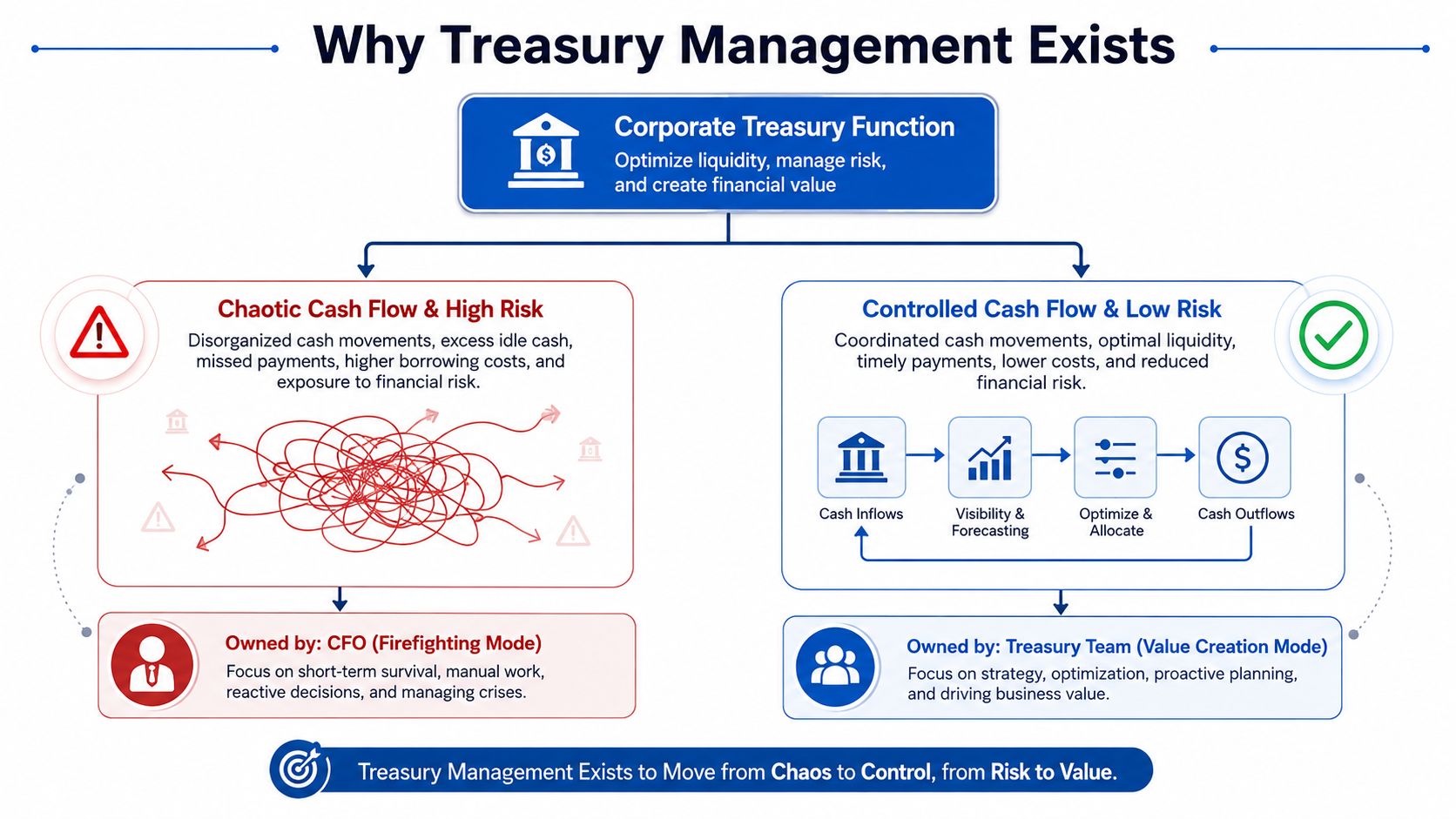
Treasury management exists because a profitable company can still run into trouble if cash is poorly positioned or financial risks go unmanaged. The function decides when cash moves, where it sits, how payments are released, and which exposures the company accepts.
Consider a mid-market company where the CFO's office manages several bank logins informally. A late customer payment creates uncertainty around payroll, a supplier batch waits for manual approval, and nobody has a consolidated view of balances in different currencies. The accounting ledger may be accurate, but it doesn't answer the urgent treasury question: Can the company meet every obligation as it falls due?
A peer company handles the same pressure differently. Its treasurer publishes a recurring liquidity dashboard, checks expected inflows and outflows, confirms funding needs, and pre-funds approved payments across its operating currencies. The difference isn't better software alone. It's clear ownership, a repeatable operating rhythm, and policies that turn financial information into decisions.
Who is responsible for treasury
In a larger company, the treasurer usually owns the overall framework. A treasury analyst may prepare cash positions, monitor bank balances, and support payment or FX activity. The controller typically owns the accounting close and reconciliation process, although treasury and controllership must exchange data constantly.
The CFO sets the risk appetite and approves major policies, such as banking concentration, borrowing, hedging, and investment limits. Treasury manages execution within those boundaries. In a web3 company, ownership may sit with an operations lead, finance lead, or treasury guild, with wallet permissions and governance approvals replacing some traditional management processes.
Practical rule: Accounting should be able to explain the recorded balance. Treasury should be able to explain whether that balance is available, usable, exposed, and sufficient for upcoming obligations.
The discipline became more formalized in the early 1970s, when bank-processing automation helped establish the first treasury management services in the United States. That shift moved companies from manual cash handling toward cash visibility, payment control, and bank connectivity, as described in the history of treasury management in the United States. Treasury is now a core finance function because it protects runway and turns fragmented financial activity into controlled value creation.
The Four Pillars of Treasury Management
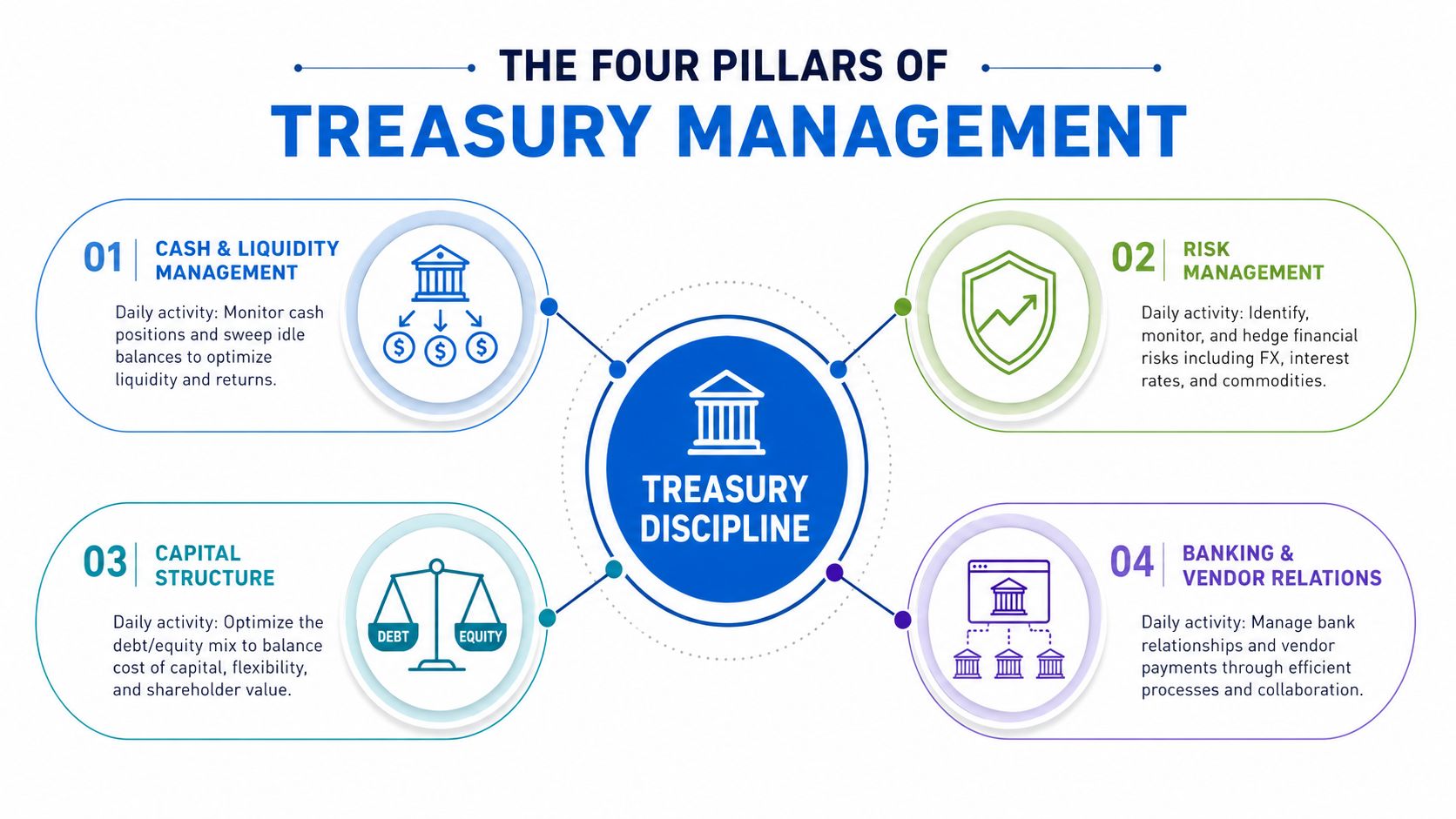
A useful answer to what is treasury management starts with four operating pillars: cash and liquidity, payments, foreign exchange, and risk. They overlap, but each answers a different daily question.
Cash and liquidity
Cash management tracks what the company has today. Treasury checks opening balances, expected receipts, scheduled payments, and idle funds across accounts. Liquidity management looks ahead, asking whether the company can cover payroll, suppliers, taxes, debt service, and other commitments over the forecast horizon.
The practical work may include sweeping idle balances, moving funds into the account that will fund payroll, or keeping a buffer in a liquid account rather than investing it for a higher return.
Payments
Payments management controls how money leaves the business. It includes payment factories, vendor master data, batch runs, bank files, approval matrices, and confirmation of successful settlement. A payment process isn't complete when someone clicks “send.” Treasury also needs evidence that the beneficiary was approved, the payment cleared, and the transaction was reconciled.
Foreign exchange
FX management handles the risk created when receipts, costs, assets, or liabilities use different currencies. Treasury may net intercompany invoices, use multi-currency accounts, or execute spot and forward transactions under an approved policy. Stablecoins can also become part of the operating toolkit for relevant web3 businesses, but they introduce custody, conversion, and counterparty questions rather than eliminating risk.
Financial risk
Risk management connects the other pillars. Treasury monitors bank and custodian exposure, interest-rate sensitivity on debt, currency movements, fraud risk, and operational weaknesses in payment workflows.
A treasurer's week might follow a recurring rhythm:
- Monday, cash position: Confirm balances, inflows, outflows, and funding gaps.
- Tuesday, FX review: Identify exposures and decide whether to convert, net, or hedge.
- Wednesday, payment run: Validate files, approvals, beneficiaries, and cut-off times.
- Thursday, reconciliation: Match bank activity with the ERP and investigate exceptions.
- Friday, policy review: Review limits, counterparty exposure, incidents, and upcoming decisions.
The pillars work as a cadence, not a static checklist. Treasury creates value when the same information reaches the same decision-makers before the same risks become urgent.
Core Tools and Techniques Treasurers Use Every Day
Treasury policy only matters when it changes daily actions. The practical toolkit connects bank accounts, forecasts, payment workflows, cards, FX execution, and reporting.
Cash pooling lets a group concentrate or coordinate balances across subsidiaries. A company with surplus cash in one entity may redeploy it internally instead of borrowing externally, although EY's guidance on managing cash pools highlights credit and liquidity risks that treasury must control. Notional pooling can provide coordinated visibility without physically moving every balance, subject to banking, legal, tax, and regulatory conditions.
Corporate cards and spend controls bring policy closer to the point of purchase. A virtual card can pay for a recurring software subscription while applying a merchant category, user limit, and receipt requirement. That's easier to monitor than allowing employees to pay personally and submit reimbursements later.
Forecasting models combine sales expectations, accounts receivable, supplier commitments, payroll dates, taxes, and debt service into a forward-looking liquidity view. The model doesn't predict the future perfectly. It gives the treasurer a disciplined basis for deciding whether to retain cash, move it between currencies, or arrange funding.
Bank connectivity and payment factories replace scattered logins with structured data and centralized workflows. APIs and host-to-host files can feed balances and transactions into a treasury management system, while a payment factory standardizes beneficiary records and approval routes.
FX techniques reduce unnecessary conversion volume. Treasury may net EUR and USD intercompany flows, layer hedges around known exposures, or hold operating balances in the currencies needed for local payments. A unified approach to business bank account setup and fiat-crypto integration can be relevant when a company must coordinate conventional accounts with digital-asset activity.
| Tool or Technique | Primary Use Case | Typical Owner |
|---|---|---|
| Cash pooling | Concentrate or coordinate subsidiary liquidity | Treasurer |
| Corporate cards | Control employee, vendor, and subscription spend | Treasury and operations |
| Rolling cash forecast | Anticipate funding needs and surplus cash | Treasury analyst |
| Payment factory | Centralize files, beneficiaries, and approvals | Treasury operations |
| FX netting | Reduce avoidable intercompany conversions | Treasurer and tax |
| Bank connectivity | Import balances and transactions automatically | Treasury systems lead |
The right tool depends on the company's structure. A small business may begin with account controls and a reliable forecast. A multinational or crypto-native organization needs stronger connectivity, permissioning, custody, and cross-rail reporting.
Key Metrics and a Typical Treasury Workflow
Treasury metrics should lead to action. A daily report might show opening balances by account and currency, expected same-day inflows, scheduled outflows, and available liquidity after committed payments. The purpose isn't to create another dashboard. It's to decide whether money must be moved before a bank cut-off.
The weekly forecast adds forward visibility. A rolling 13-week cash forecast combines accounts receivable, accounts payable, payroll, tax, debt service, and planned investment. The 13-week cash flow modeling guide provides a useful reference for organizing that operating view.
Metrics that matter
| Metric | Cadence | Formula or Definition | Decision It Informs |
|---|---|---|---|
| Cash position | Daily | Opening balances plus expected inflows minus expected outflows | Whether to fund, sweep, or retain cash |
| Liquidity forecast | Weekly | Projected cash movements across the forecast horizon | Whether to arrange funding or defer discretionary spend |
| Days cash on hand | Monthly | Available cash divided by average daily cash requirements | Whether the operating buffer is appropriate |
| Cash conversion cycle | Monthly | Days inventory outstanding plus days sales outstanding minus days payable outstanding | Whether working capital needs intervention |
| Idle cash yield | Monthly | Return earned on surplus cash relative to the balance held | Whether surplus funds are positioned efficiently |
| FX hedge ratio | Monthly | Hedged exposure divided by identified exposure | Whether policy coverage is adequate |
| Counterparty exposure | Monthly or event-driven | Amount exposed to each bank, custodian, or financial counterparty | Whether concentration limits need adjustment |
A month in motion
Each morning, treasury publishes the position report and investigates unexpected movements. Around a scheduled payment run, the team verifies approvals and beneficiary data before releasing the batch. If the company expects a known USD invoice while holding another currency, treasury compares a spot conversion with its approved hedge strategy and records the decision.
At quarter-end, the team may net intercompany balances to reduce unnecessary transfers. At month-end, treasury reconciles bank activity against the general ledger, while the treasury committee reviews exposure, liquidity, and policy exceptions.
Three early-warning indicators deserve close attention: forecasting accuracy, payment success rate, and FX slippage. A forecast that repeatedly misses receipts can distort funding decisions. Failed payments reveal data or process problems. FX slippage shows whether execution differs materially from the approved rate or strategy.
Treasury Management in Action for Global and Multi-Currency Teams
A Series B software company sells in the United States, European Union, and United Kingdom. It collects USD from US customers, EUR under EU contracts, and GBP from UK resellers. Its engineers in India are paid in USD, the Berlin office needs EUR, and a London agency invoices in GBP.
The treasury team starts by separating collection needs from surplus-cash decisions. Local accounts may make customer receipts faster and simplify domestic payments. Concentration accounts can improve visibility and allow the group to redeploy funds, but they also create dependency on transfer timing, bank cut-offs, and the concentration structure.
Decisions behind the balances
Suppose Berlin payroll is due soon, but most available cash sits in USD. Treasury must decide when to convert, how much to convert, and whether the exposure is predictable enough for a forward contract. If the company expects EUR receipts but has a USD cost base, the team may evaluate whether the receivable provides a natural hedge or whether additional protection is needed.
The company also has four bank portals. Each portal may use different formats, approval rules, and settlement windows. A missed cut-off can delay a payment even when the group has enough cash. Treasury therefore needs a consolidated view that includes balance, currency, payment status, expected settlement, and responsible approver.
Treasury's job isn't to choose the cheapest transaction in isolation. It's to balance timing, visibility, control, cost, and risk across the whole operating cycle.
A banking partner may offer strong local collection and FX services. A unified treasury platform may provide a clearer operating view across accounts, cards, and payment workflows. The choice depends on the company's risk appetite, geographic footprint, integration needs, and control environment. Global treasury management is especially relevant to teams coordinating multi-currency operations across banking and digital-asset workflows.
The same decisions look different in a holding company with subsidiaries. That structure may require intercompany funding, cash pooling, transfer-pricing documentation, and formal counterparty limits. A flat, remote-first team may have fewer legal entities but still face currency conversion, contractor payments, card controls, and multiple banking relationships. Treasury complexity follows the number of flows, currencies, entities, and risks, not the number of employees.
Governance, Controls, and Security in Modern Treasury
Treasury becomes a bottleneck when every payment requires an informal approval. It becomes dangerous when nobody can prove who initiated, reviewed, released, and reconciled a transaction. Good governance separates those responsibilities without making routine work impossible.
A practical policy stack includes:
- Segregation of duties: The person who creates a payment shouldn't be the only person who approves and releases it.
- Dual control: Higher-risk payments require two authorized reviewers, with the applicable limit defined in policy.
- Beneficiary controls: Approved vendor lists and change verification reduce exposure to altered bank details.
- Maker-checker workflows: The treasury system records preparation, review, release, and exceptions.
- Reconciliation: Daily matching identifies duplicate, failed, or unauthorized movements quickly.
- Exception reporting: Payments outside policy receive a documented explanation and escalation.
Security must follow the money
Modern treasury tooling should support SSO and SCIM, strong authentication, device checks, and an immutable audit trail. For digital assets, operational wallets should be separated from long-term or cold-storage custody. Multi-signature approval can reduce dependence on one key holder, but it still requires clear signer roles, recovery procedures, and transaction monitoring.
The escalation matrix should answer practical questions before an emergency arrives. Who approves a routine vendor batch? Who reviews a large intercompany loan? Who can authorize a new banking relationship? Each answer should produce an audit trail that supports finance review, internal audit, and incident investigation.
Teams translating operational risk principles into trading or FX procedures may also find this resource on how to translate ISO risk rules to trading useful for structuring controls and documented limits.
A spreadsheet can document a control. A system can enforce it, timestamp it, and make the evidence searchable.
Small teams often begin with spreadsheets, shared drives, and chat approvals. That can work while flows remain simple. As accounts, currencies, wallets, and approvers multiply, governance must move into controlled workflows. The cost of that transition is usually lower before a missed wire, leaked credential, or poorly documented exposure forces a forensic reconstruction.
How Treasury Management Differs for Web3 Companies and DAOs
Web3 treasury management uses the same core discipline as corporate treasury, but the assets, rails, and counterparties differ. A conventional company may manage bank accounts, ACH, wires, SWIFT transfers, and ERP integrations. A crypto-native company may add custody wallets, multi-signature wallets, smart-contract permissions, stablecoin settlements, and on-chain reporting.
The shared questions remain straightforward:
- Visibility: What assets exist, where are they held, and are they available for use?
- Controls: Who can propose, approve, sign, or execute a transaction?
- Forecasting: What must be paid, in which currency or token, and when?
- Risk: What could impair value, access, settlement, or continuity?
A protocol might hold part of its runway in USDC, then convert only what it needs for payroll, vendors, or operating expenses. A DAO may allocate grants across several chains through governance proposals. The treasury team must track the proposal, vote, execution transaction, recipient, chain, asset, and resulting balance.
Governance changes the workflow
A company's treasury decision may begin with a management memo and finish with a bank approval. A DAO may begin with a public proposal, proceed through a governance vote, and execute through a multi-signature wallet or smart contract. That process can make the record more transparent, but it also raises the importance of role-based permissions, quorum rules, signer availability, and real-time monitoring.
A web3 company might pay global contractors in stablecoins to reduce dependence on correspondent banking timing. It still needs contractor verification, payment approvals, sanctions screening where applicable, wallet-address controls, tax documentation, and reconciliation back to the accounting system.
The unified operating model is the important connection. Treasury teams shouldn't treat on-chain activity as an ungoverned side ledger. They need one control framework that connects bank balances, cards, fiat payments, stablecoins, wallets, conversion activity, and reporting.
The video below offers additional context on treasury workflows across traditional and decentralized operating environments.
Best Practices and How a Unified Platform Supports Treasury Work
A dependable treasury function starts with habits before it starts with software. Keep one trusted view of cash, define who can initiate and approve payments, forecast liquidity on a rolling basis, review FX exposure regularly, and write policies in language that operators can follow during a busy payment run.
Use this checklist as a practical baseline:
- Maintain a single cash truth: Reconcile bank, card, and wallet balances so decision-makers aren't comparing conflicting spreadsheets.
- Separate initiation from approval: Give each role a clear permission and escalation path.
- Apply dual control: Require multiple authorized people for sensitive or high-value movements.
- Forecast continuously: Update expected receipts, supplier payments, payroll, tax, and debt service as assumptions change.
- Review FX exposure: Identify currency mismatches before invoices and payroll become urgent.
- Document recurring flows: Record standing instructions, beneficiaries, timing, owners, and exception handling.
- Connect fiat and crypto reporting: Use consistent labels for accounts, wallets, assets, counterparties, and transactions.
A platform such as OneSafe can bring multi-currency accounts, global payments, corporate cards, spend controls, approval workflows, digital-asset custody, multi-signature processes, stablecoin payouts, and consolidated reporting into one operating workspace. The value of that arrangement is operational consistency. Treasury, finance, and operations teams can apply the same approval logic and reporting discipline across banking rails and on-chain workflows instead of maintaining disconnected systems.
Instant settlement, richer payment data, and expanding automation also raise the standard for treasury design. ISO 20022 supports structured payment information that can improve automation, reconciliation, and forecasting, while industry guidance notes that corporate-to-bank migration hasn't been universally mandatory before 2025 in the cited context, as outlined in CFONB's ISO 20022 migration material. Treasury teams should therefore design data fields, approval rules, and exception handling before a payment rail makes them unavoidable.
Market forecasts also show why this operating model is attracting investment. One estimate projects the treasury management market from USD 7.52 billion in 2026 to USD 18.83 billion by 2033, a 14.0% CAGR, while another projects USD 6.6 billion in 2025 to USD 16.31 billion by 2032, a 13.8% CAGR. The same market research estimates that software could represent about 65% of the market and North America about 35% of global share in 2025, according to Coherent Market Insights' treasury management market analysis. These are projections, not guarantees, but they reflect the shift from manual cash control toward integrated treasury infrastructure.
OneSafe gives global and web3 companies a single workspace for multi-currency accounts, payments, corporate cards, spend controls, and crypto-compatible treasury workflows. Visit OneSafe to connect fiat and on-chain operations with clearer approvals, visibility, and reporting.