For businesses that need real-time crypto banking infrastructure, a “blockchain strategy” slide deck no longer counts. On October 1, 2026, PYMNTS reported that major banks have split into two camps: those moving regulated money on‑chain in production, and those still running proof‑of‑concept sandboxes. The dividing line is production, not pilots.
Table of Contents
- What just happened: the production vs. pilot divide
- Why this matters now for global businesses
- The spectrum of institutional crypto banking
- Interoperability: the test that will rewrite the rules
- What production‑grade crypto banking means for DAOs and Web3 startups
- Actions to take in a split market
- What to watch next
- What are cryptocurrencies?
- Are cryptocurrencies regulated?
- How does tokenized money differ from holding stablecoins on an exchange?
- Is my business’s digital cash protected with production‑grade block chain solutions?
- Key Takeaways
What just happened: the production vs. pilot divide
PYMNTS report confirms J.P. Morgan, Citi, HSBC are live with tokenized money
PYMNTS’s October 1, 2026 analysis shows banks now range from experimental labs to production‑grade tokenized deposits that settle 24/7. J.P. Morgan, Citi, and HSBC already use blockchain infrastructure for institutional payments, liquidity, and asset transfer — moving real value, not simulated transactions. Many other banks remain stuck in pilots.
A bank that “does blockchain” could issue tokenized securities in a walled garden, or operate a live deposit‑token network that integrates with existing rails. For corporate treasurers, the difference is decisive.
Not all “crypto banking” is equal — experimentation doesn’t move real funds
Pilots use test environments and synthetic data. Production systems — like J.P. Morgan’s Onyx or Citi’s tokenized deposit networks — process actual payments, with legal finality and risk controls matching traditional settlement. When evaluating crypto business accounts or blockchain infrastructure banks, ask whether the on‑chain activity touches live deposits and real‑time liquidity. “We’re exploring” still means pre‑blockchain banking.
Interoperability now the next hurdle, not just issuance
Even among production systems, money often stays trapped inside a single bank’s blockchain. PYMNTS noted that moving tokenized deposits, securities, and collateral across different bank networks is tokenization’s next test. J.P. Morgan’s Onyx settles with Onyx participants, but moving value to a Citi‑issued token isn’t seamless yet. That fragmentation caps the efficiency gains.
Why this matters now for global businesses
24/7 settlement on blockchain reduces idle capital
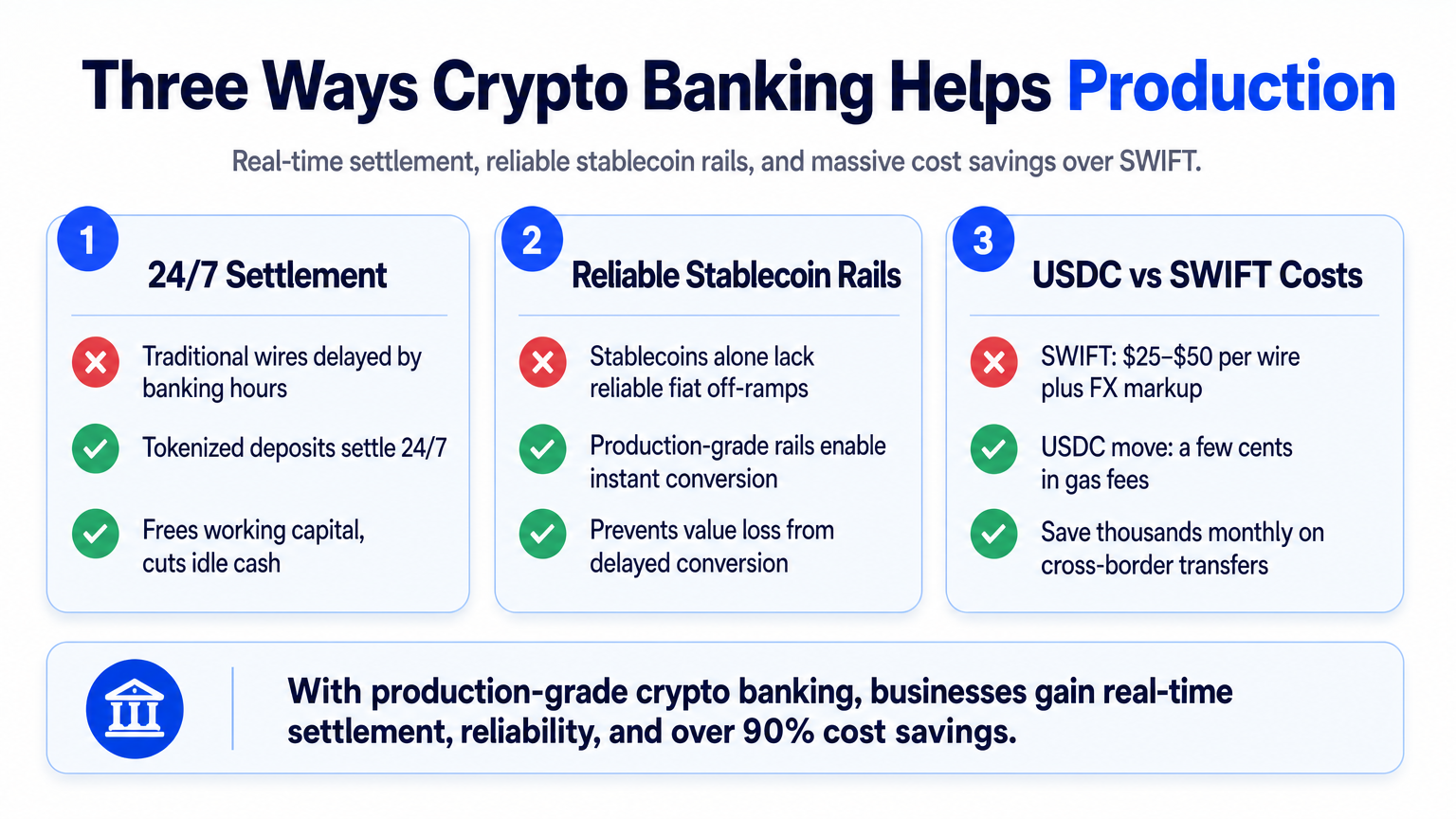
Traditional cross‑border wires depend on correspondent banking cut‑off times. A payment sent Friday evening may land Tuesday. Production‑grade tokenized deposits settle 24/7, releasing working capital and reducing pre‑funding needs. 24/7 international payments on blockchain infrastructure directly improve cash flow.
Vendor payments and payroll in stablecoins are only as reliable as the rails they run on
Stablecoins like USDC are pitched as global settlement tools, but without production‑grade banking rails to move value back into fiat, they’re half‑solutions. If you pay a vendor in USDC but must wait days to convert to EUR through a legacy exchange, the speed advantage evaporates. The reliability of stablecoin payments depends on whether the underlying blockchain infrastructure banks can instantly settle on‑chain and provide a direct fiat off‑ramp.
USDC rails vs. SWIFT cost advantage
SWIFT transfers carry per‑transaction fees, intermediary charges, and FX markups. Moving USDC between wallets costs a few cents in network fees. Businesses that use USDC settlement as their cross‑border rail can avoid SWIFT fees entirely — but only if their banking partner supports low‑cost or free USDC deposits and withdrawals. A SWIFT wire might cost $25–$50 plus FX; over dozens of monthly transactions, the savings add up.
The spectrum of institutional crypto banking
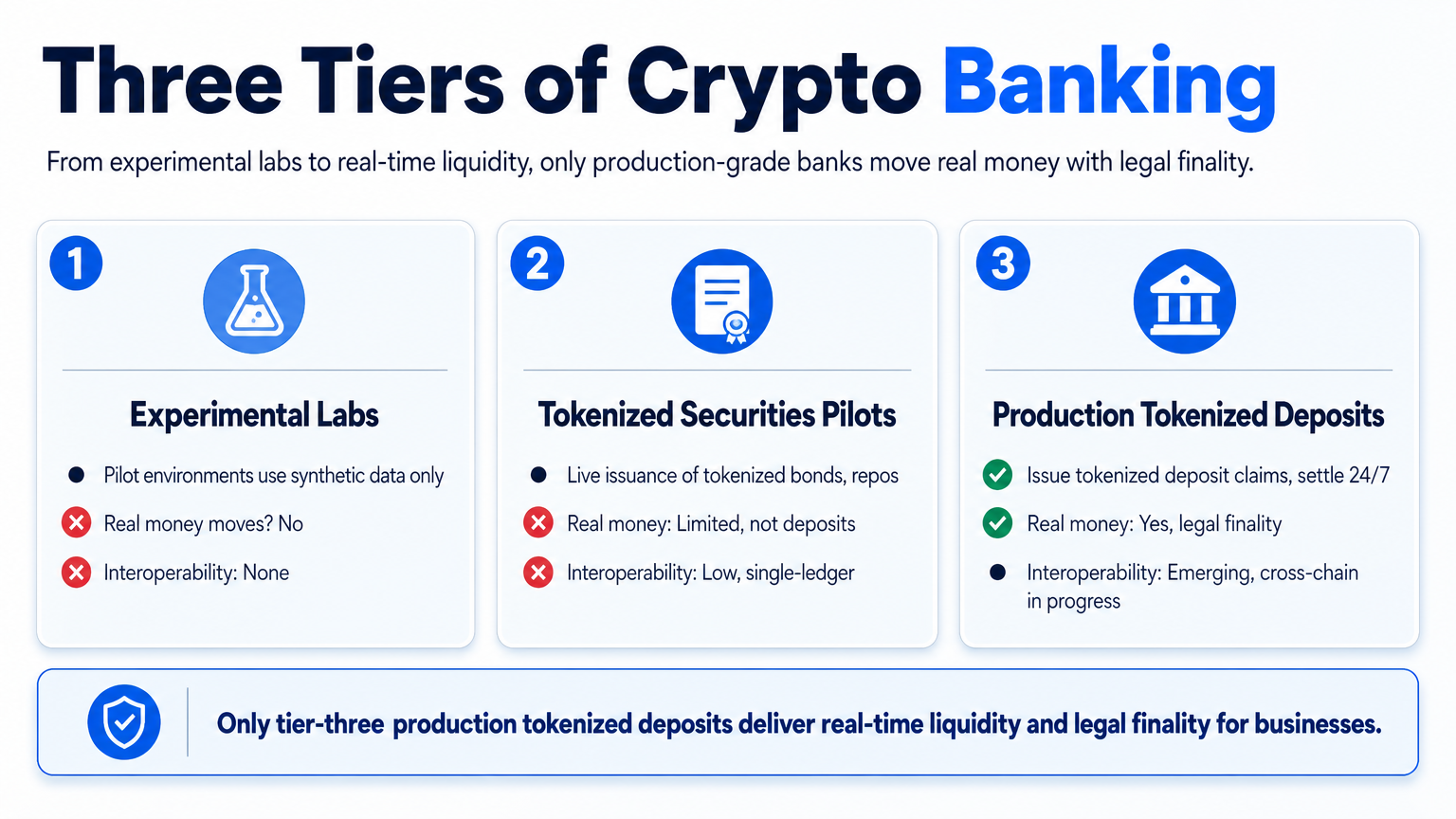
To cut through the noise, map banks and providers onto three tiers (state as of October 2026).
| Tier | Description | Examples | Real Money Moves? | Interoperability |
|---|---|---|---|---|
| Experimental Labs | Pilot environments, synthetic transactions, often internal. | Many regional and global banks in proof‑of‑concept. | No | None |
| Tokenized Securities / Smart Contract Pilots | Live issuance of tokenized bonds, repos on permissioned ledgers, but not broad‑based deposit tokens. | Some European banks, earlier Wall Street efforts. | Limited — securities settle, not general deposits. | Low — mostly single‑ledger. |
| Production Tokenized Deposits | Banks issue tokenized claims on deposits that move 24/7, settle with legal finality, and connect to existing payment infrastructure. | J.P. Morgan (Onyx), Citi, HSBC (Orion) — per PYMNTS. | Yes | Emerging — cross‑chain movement remains a work in progress. |
From experimental labs to real‑time liquidity: the three tiers
The leap from tier two to tier three is monumental. Tier two tokenizes financial instruments; tier three creates a parallel payment rail for tokenized deposits that behave like traditional deposits but move instantly. For a CFO managing DAO treasury management or multi‑entity payroll, tier‑three infrastructure means on‑chain money that is actually usable, not just a test entry.
How legacy banks structure tokenized securities vs. tokenized deposits
Legacy banks start with tokenized securities because they fit existing regulatory frameworks. Tokenized deposits raise deposit insurance, bankruptcy, and finality questions — which is why only a few banks have moved them into production. As Nacha guidance clarifies, a tokenized deposit is a digital representation of a traditional bank deposit, subject to the same legal protections if issued by a regulated bank. Chainlink’s primer on tokenized deposits explains the mechanics. That distinction matters for counterparty risk.
Where neo‑banking platforms fit: unified fiat and on‑chain operations
While tier‑three banks expand, fintech platforms offer a unified experience. Neo‑banking for startups and banking for Web3 companies combine crypto wallets, fiat accounts, and instant conversion — bridging the gap until universal bank‑chain interoperability arrives. A platform like OneSafe provides multi‑currency accounts, free USDC deposits and withdrawals, and ACH/wire capabilities through bank partners, letting businesses operate across fiat and crypto rails from a single interface.
Interoperability: the test that will rewrite the rules
Why moving value across bank blockchains is harder than issuing it
Issuing a digital representation on one bank’s ledger is easy. Moving it to another bank’s ledger requires shared identity, liquidity bridges, and legal agreements — all nascent. PYMNTS confirmed interoperability is the next hurdle. Even J.P. Morgan’s Onyx cannot natively move tokens to Citi’s system without extra orchestration, as LedgerInsights documented.
What seamless movement would unlock
If a treasurer could instantly move tokenized deposits from J.P. Morgan to HSBC and post them as collateral — all on‑chain — the efficiency gains would rival RTGS introduction. Collateral mobility and automated treasury workflows would become possible without manual sweeps. For now, businesses navigate a patchwork of proprietary networks.
Unified interfaces bridge fiat and crypto without waiting for universal standards
Rather than waiting for bank‑wide interoperability, some platforms act as a translation layer. They hold fiat and stablecoin balances, execute conversions, and route payments across multiple rails using the best available path. For a DAO paying contributors in USDC and operating expenses in USD, DAO treasury management can happen in one place: crypto received, instantly converted if needed, and sent via domestic wire or ACH. This approach sidesteps interoperability by using the platform itself as the bridge.
What production‑grade crypto banking means for DAOs and Web3 startups
Converting crypto to fiat without delays
Web3 businesses earn in tokens or stablecoins but pay suppliers and salaries in fiat. The speed of the corporate crypto on‑ramp (and off‑ramp) becomes a working‑capital question. Production‑grade environments offer instant crypto‑to‑fiat conversion, so a token payment received at 2:00 a.m. can pay a vendor by 2:05 a.m.
Free USDC settlements vs. legacy wire fees: the math
Consider a DAO with 30 contributors in 8 countries. Each month, it processes 30 payroll payments and 50 vendor invoices internationally. Using SWIFT at $25–$50 per wire plus FX, costs easily reach $2,000+. Using USDC free sends and a fiat and crypto payments platform with no‑fee USDC deposits and withdrawals, the same volume settles for gas fees — under $10 total. That math becomes real with production‑ready USDC settlement.
Onboarding speed and multi‑signature controls as differentiators
Legacy banks may take weeks to open accounts for crypto‑tied businesses, if at all. Neo‑banking for startups platforms can complete onboarding in under a week, fully digital. Features like multi‑signature controls, role‑based permissions, and automated payment approvals are table stakes. The ability to onboard a multi‑signature treasury immediately separates operational from aspirational.
Actions to take in a split market
Audit your banking stack: production or pilot?
Request a written description of exactly how the bank’s blockchain initiative handles live deposits, settlement finality, and external value movement. If the answer mentions “test environment,” “synthetic,” or “proof of concept,” treat it as a pilot. Map your treasury needs against the three‑tier framework.
Prioritize platforms that natively support wire transfers and stablecoin rails
A crypto business account that can send a domestic ACH, a SWIFT wire, and a USDC transfer from the same balance offers the flexibility a split market demands. Relying on a bank for fiat and a separate exchange for stablecoins doubles reconciliation and settlement risk.
Test interoperability now: can you move funds to your payroll partner in the same asset class?
If your banking partner settles USDC but your payroll provider can’t receive USDC, the chain breaks. Choose a platform that supports end‑to‑end 24/7 international payments from token receipt to fiat disbursement without mid‑stream provider swaps.
What to watch next
Cross‑chain settlement protocols and deposit speeds
Shared settlement protocols — possibly built on public blockchains with permissioned validators — will increase the speed of moving tokenized deposits across institutions. Watch for announcements from consortia like the Regulated Liability Network.
Regulatory clarity on tokenized deposits as deposit‑taking activity
Regulators are scrutinizing whether tokenized bank deposits should be treated identically to traditional deposits for insurance and capital purposes. A clear ruling could accelerate adoption or stall it. Oliver Wyman notes deposit tokens can inherit traditional deposit status, but that depends on jurisdiction.
Bank blockchain consortia consolidation and pricing
If multiple tokenized deposit networks eventually interconnect, liquidity and competition could drive down transaction costs. Persistent fragmentation could create new closed‑loop fee structures — a blockchain version of the SWIFT correspondent model.
What are cryptocurrencies?
Cryptocurrencies are digital assets operating on decentralized, cryptographically secured networks — primarily blockchains — without a central issuer. Bitcoin, ether, and stablecoins like USDC are common. In a crypto banking context, they serve as investable assets, payment mediums, or settlement rails.
Are cryptocurrencies regulated?
Regulation varies by jurisdiction and asset type. In the U.S., federal agencies and states apply money transmission, securities, and commodities rules to crypto activities. Europe’s MiCA framework imposes licensing and prudential requirements. Businesses must assess the regulatory status of each crypto they handle, especially when using crypto business accounts that facilitate conversions.
How does tokenized money differ from holding stablecoins on an exchange?
Tokenized deposits are liabilities of a regulated bank, recorded on a blockchain, and typically carry the same legal protections as a conventional deposit (subject to deposit insurance if applicable). Stablecoins held on an exchange are claims on the exchange itself, not a bank, and may lack bank‑grade guarantees. Tokenized deposits operate within a bank’s compliance framework; exchange‑based stablecoins are only as secure as the exchange’s own treasury. For treasury operations demanding finality and legal certainty, the distinction is critical.
Is my business’s digital cash protected with production‑grade block chain solutions?
Protection depends on the provider. Production‑grade tokenized deposits at a licensed bank should fall under existing deposit insurance schemes (in the U.S., up to $250,000 per depositor, per bank). For non‑bank fintech platforms, protection comes from segregated accounts, state‑of‑the‑art encryption, and institutional‑grade digital asset custody (e.g., Fireblocks) together with mandatory multifactor authentication and compliance protocols. No system can guarantee against value loss from volatile crypto assets, but the production‑grade label signals infrastructure designed to meet the same resilience standards as traditional banking.
Key Takeaways
- Crypto banking is now split between production‑grade banks (J.P. Morgan, Citi, HSBC) and those still in pilots — only the former move real money with legal finality.
- Tokenized deposits offer bank‑issued, on‑chain money that settles 24/7, reducing idle capital and wire fees.
- Free USDC settlement rails make cross‑border transfers dramatically cheaper than SWIFT, provided there’s a direct fiat off‑ramp.
- Interoperability between bank blockchains remains the bottleneck; unified neo‑banking platforms bridge the gap by connecting fiat, stablecoin, and wire rails under one interface.
- Audit your banking stack against the production‑vs.‑pilot framework and choose a platform that supports both wire transfers and stablecoin settlements today.
Ready to move beyond pilots? Open a crypto business account with OneSafe that combines multi‑currency fiat accounts, free USDC transactions, and instant on/off‑ramps for your global operations.