Table of Contents
- Executive Summary
- What Is a Crypto Bank?
- The Race to Be 'First': A Global Timeline
- Inside a Regulated Crypto Bank
- Belarus's Crypto Banks
- How to Choose a Crypto Banking Partner
- Misconceptions and Limitations
- The Next Wave
- Frequently Asked Questions
- Key Takeaways
- Sources
Executive Summary
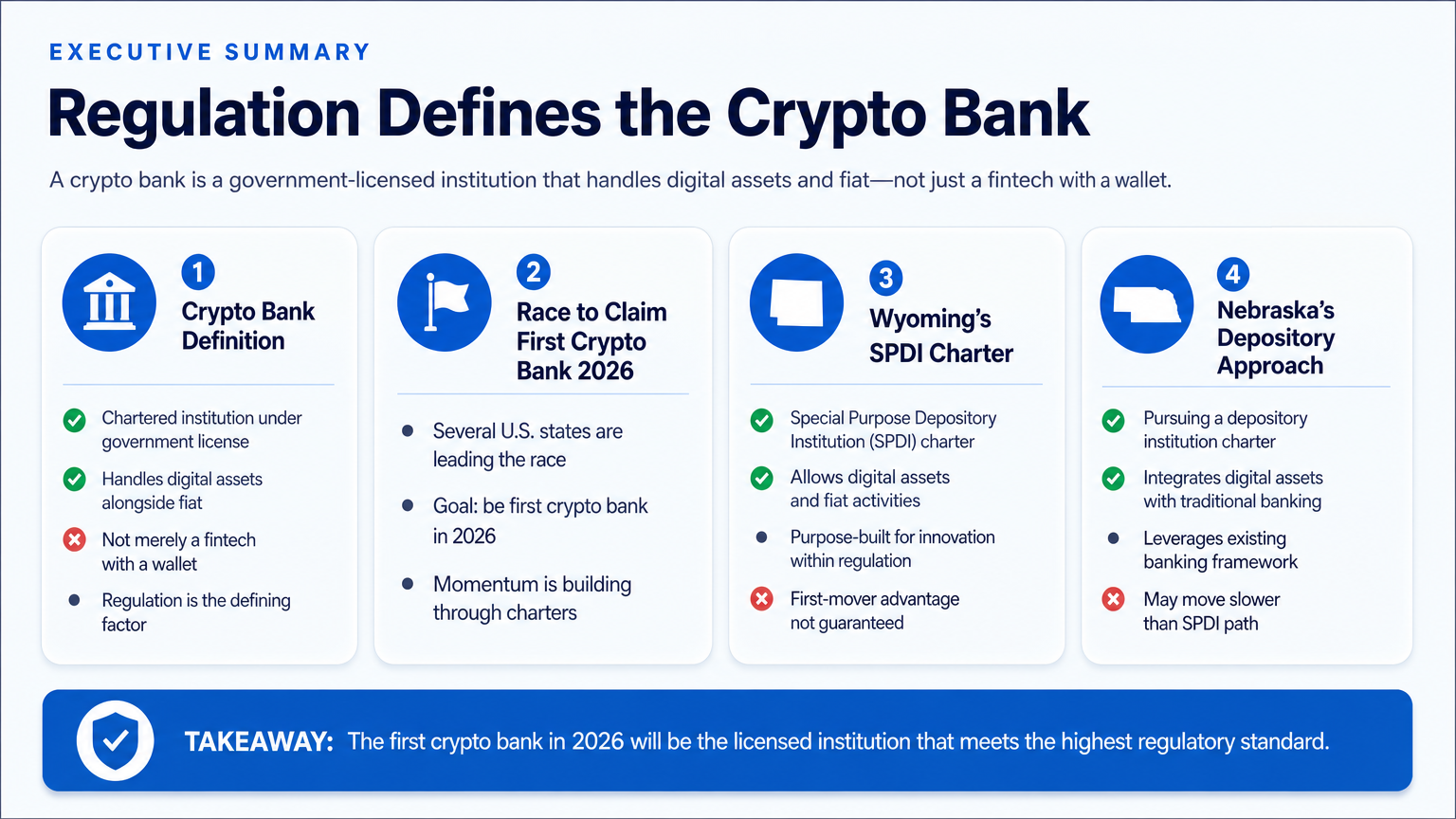
The term crypto bank definition hinges on regulation: a chartered institution handling digital assets alongside fiat under a government license—not merely a fintech with a wallet. The race to claim first crypto bank 2026 spans Wyoming's SPDI charter, Nebraska's depository, Anchorage's OCC trust charter, and Belarus's September 2026 registration of its inaugural crypto banks. For businesses, choosing between a chartered entity and a technology partner like OneSafe shapes treasury, payroll, and payments. This guide explains the licensing gap and how to pick the right infrastructure.
What Is a Crypto Bank?
A crypto bank combines traditional banking with native digital-asset services under a special-purpose charter—like Wyoming's SPDI or Belarus's High-Tech Park accreditation—permitting crypto custody without FDIC insurance on digital holdings. A licensed crypto bank is legally distinct from a conventional bank with a crypto desk; it's designed from the ground up for blockchain assets.
Not every platform moving money between dollars and Bitcoin is a bank. Companies like OneSafe are technology partners—neo-banking platforms providing fiat accounts, corporate cards, and crypto wallets through licensed banks. Fiat sits in segregated accounts at a chartered bank, and digital assets in institutional-grade custody (Fireblocks). This crypto-friendly bank for startups model offers faster onboarding and crypto-native workflows but forgoes deposit insurance.
The Race to Be 'First': A Global Timeline
Wyoming pioneered the SPDI charter in 2020, Nebraska launched a digital asset bank charter, and Anchorage Digital gained an OCC trust charter in 2021. Each jurisdiction announces its own "first," but definitions shift with charter type and services allowed. No single institution holds a universal title.
On September 28, 2026, Belarus's High-Tech Park Supervisory Board registered two companies as residents eligible for first crypto bank 2026 status, as reported by Bitcoin Magazine and Bitbo. The firms still need National Bank accreditation, but the move follows a dedicated crypto banking framework signed earlier in the year. Prime Minister Aleksandr Turchin oversaw the announcement. Belarus created a pathway other European nations haven't replicated—a national crypto banking regime—though headlines calling it a "world first" ignore jurisdiction-specific charter differences.
Inside a Regulated Crypto Bank
A chartered crypto bank holds digital assets directly or through a qualified custodian, with strict segregation. Fiat rails run via correspondent banking, enabling internal crypto-to-fiat conversions that reduce counterparty risk. For crypto custody for business, a chartered bank takes custody itself, theoretically simplifying the regulatory chain—though product evolution can slow.
Licensing requires capital adequacy, AML/KYC protocols, cybersecurity measures, and investor protections. The licensing gap is the key differentiator: most platforms calling themselves a crypto bank aren't chartered; they partner with one. Building a chartered bank takes years, as Belarus's framework-to-registration timeline shows.
Belarus's Crypto Banks
Belarus nests accreditation under the High-Tech Park, offering tax and regulatory benefits for licensed crypto bank status. Once operational, the two firms will custody and transact crypto natively under Belarusian law. This moves crypto banking beyond U.S.-centric charters into a national European regime—though a Belarus license won't passport across the EU. Parallel stablecoin corridors evolve under MiCA (see Stablecoin Regulation in Flux).
How to Choose a Crypto Banking Partner
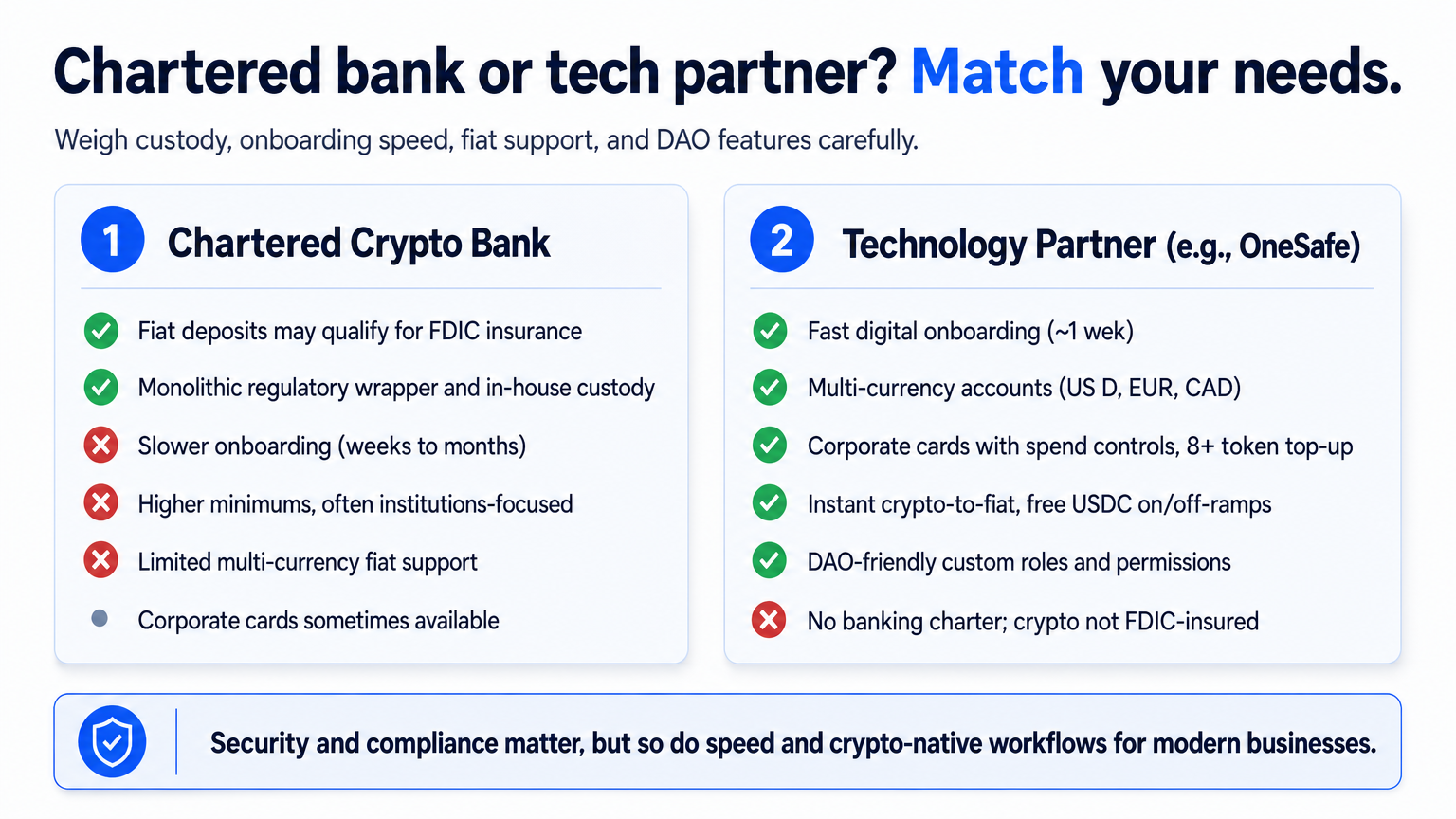
Ask three questions: 1) Who holds fiat and crypto, under what regulatory regime? 2) What custody infrastructure backs digital assets—Fireblocks, Bitgo, or in-house? 3) Does the platform handle daily workflows—payroll, vendor payments, on-chain transactions—smoothly?
A chartered bank suits those prioritizing a monolithic regulatory wrapper and deposit insurance. Trade-offs include slower onboarding, limited flexibility, and higher minimums. A technology partner like OneSafe excels when speed and crypto-native features matter: multi-currency accounts (USD, EUR, CAD), corporate cards, instant crypto-to-fiat, and Fireblocks custody. Fiat sits at chartered partner banks with pass-through protections; crypto balances aren't FDIC-insured. Onboarding takes roughly a week digitally.
| Factor | Chartered Crypto Bank | Technology Partner (e.g., OneSafe) |
|---|---|---|
| Banking License | State or federal charter | Not a bank; fiat via partner banks |
| FDIC/Pass-through | Fiat deposits may qualify; crypto not covered | Pass-through on fiat via partner; crypto not covered |
| Crypto Custody | In-house or qualified custodian | Fireblocks |
| Onboarding | Weeks to months | ~1 week, fully digital |
| Target Clients | Institutions, HNW, regulated entities | Startups, Web3 businesses, DAOs |
| Multi-currency Fiat | Limited majors | USD, EUR, CAD |
| Corporate Cards | Sometimes | Available with spend controls, 8+ token top-up |
| Crypto On/Off-Ramps | In-house, may be slower | Instant conversions, free USDC deposits/withdrawals |
| DAO Features | Rare | Custom roles, permissions, automated workflows |
DAOs and remote-first startups need DAO banking respecting multi-signature governance, not single-signer accounts. A Web3 account assigns transaction approvals by role, auto-settles stablecoin invoices, and tracks fiat and crypto in real time. For many of the 1,000+ businesses across 30+ countries using OneSafe, the question was whether a platform handles all money in whatever form it arrives—without legacy compliance theater built for a non-Web3 world.
Misconceptions and Limitations
The phrase "crypto bank" is deployed loosely. An exchange with a card isn't a bank without the appropriate charter. FDIC insurance covers certain deposit products at insured banks—not crypto, stablecoins, or non-deposit products. At a chartered crypto bank, Bitcoin or USDC isn't government-guaranteed. With OneSafe, fiat may benefit from pass-through insurance via the partner bank; crypto relies on cryptographic security. The "first" designation is jurisdiction-specific: Wyoming, Nebraska, Anchorage, and Belarus each marked milestones under different charter types.
The Next Wave
With Belarus's registration and stablecoin rails linking to bank networks (see the Citi-Coinbase deal), the line between crypto bank and fintech blurs. The future isn't about picking a "crypto bank" label—it's about infrastructure that makes treasury, payroll, and payments run seamlessly, whether chartered or platform-based.
Frequently Asked Questions
What is a crypto bank? A regulated institution holding digital assets directly under a government charter, offering fiat banking, custody, and payment rails—unlike an exchange or partner-bank platform.
Who qualifies as the first crypto bank? No single entity; milestones include Wyoming's SPDI (2020), Nebraska's charter, Anchorage's OCC trust charter (2021), and Belarus's September 2026 registrations.
Is my money safe? Crypto holdings aren't FDIC-insured, regardless of charter. With OneSafe, fiat sits at partner banks (potential pass-through insurance); crypto is secured by Fireblocks.
How does a crypto bank differ from a traditional bank? A crypto bank holds digital assets under a special-purpose charter; it doesn't offer full retail banking or FDIC insurance on crypto.
What is the difference between a bank and OneSafe? OneSafe is a fintech partner providing accounts and crypto via licensed banks and Fireblocks custody—faster onboarding, crypto-native workflows, no banking charter.
Do crypto banks offer FDIC insurance? No—FDIC insurance doesn't cover crypto or stablecoins.
Who can open an account? Businesses passing KYC/KYB; some chartered banks restrict to institutions. OneSafe serves global startups and DAOs with digital onboarding.
Why do Belarus's crypto banks matter? They represent a European jurisdiction building a dedicated licensed crypto banking path, offering a regulated hub for digital-asset services.
Key Takeaways
- No universal "first crypto bank" exists; each jurisdiction defines its own milestone.
- Crypto custody is never FDIC-insured, even at chartered institutions.
- A technology partner like OneSafe delivers fiat+crypto functionality with faster onboarding and DAO-friendly governance.
- Belarus's 2026 registrations create a national framework, but what matters is security, compliance, and workflow fit—not the "bank" label.
Simplify your fiat and crypto treasury with a crypto-friendly business account at OneSafe.
Sources