

A wire transfer fee in the U.S. has a median of $25 for an outgoing domestic wire and $45 for an outgoing international wire, while incoming domestic and international wires each have a median fee of $15. Your total cost still depends on the provider, payment corridor, intermediary banks, and currency conversion.
You approve a contractor payment, check the bank's fee, and expect the recipient to receive the stated amount. Later, the contractor says the deposit arrived short. Your bank charged its advertised wire transfer fee, but another bank in the payment chain deducted a handling charge, and the currency conversion included a markup.
That surprise is common because a wire transfer fee usually describes only one layer of the payment. The cost can combine a sender charge, intermediary deductions, and an FX spread, the difference between the market exchange rate and the rate your provider gives you.
This distinction matters for startups, international small and midsize businesses, technology companies, and web3 teams. A single payment may seem manageable, but repeated contractor payouts, supplier invoices, treasury movements, or customer refunds can make unclear pricing difficult to forecast.
The practical goal is simple. You should be able to identify which fee tier applies, estimate what the recipient will receive, compare a wire with ACH or local rails, and decide when a different payment route makes more sense. The guide starts with the mechanics, then separates domestic and international pricing, breaks down the all-in cost, applies the model to business examples, and finishes with ways to reduce unnecessary charges.
Table of Contents
- Introduction to Wire Transfer Fees for Businesses
- The payment moves through several hands
- Moving money isn't the same as converting money
- A domestic supplier invoice
- One international contractor payment
- Recurring cross-border payouts
- Build your own annual model
- Compare all-in pricing
- Consolidate suitable payments
- Use local rails when they fit
- Negotiate based on payment behavior
- Improve the currency workflow
Introduction to Wire Transfer Fees for Businesses
A finance lead at a growing software company approves an overseas contractor invoice and opens the bank's payment screen. The outgoing international wire fee is visible, the transfer appears ready, and the expected cost seems clear.
The contractor later reports receiving less than the invoice amount. Both records can be correct. The sender's bank charged its stated fee, while an intermediary bank in the payment chain deducted a separate handling charge before the recipient's bank credited the funds.
That makes a wire transfer fee only one layer of the total payment cost. International payments can combine three expenses: the sender's charge, deductions from intermediary or correspondent banks, and an FX spread, the gap between the market exchange rate and the rate applied by the provider. Industry guidance on international wires describes this stacked cost structure.
Practical rule: Use the advertised bank fee as the starting point, then estimate the amount that will actually arrive.
Domestic and international wires also follow different cost patterns. A domestic payment typically uses a simpler national banking route and may remain in one currency. An international payment can involve additional institutions, settlement systems, and currency conversion, making the final price harder to see from the bank's headline charge.
For an occasional payment, a founder may check only whether the transfer is accepted and delivered on time. An operations team must also confirm whether the contractor receives the full invoice amount, whether the payment corridor repeatedly routes through intermediary banks, and whether the exchange rate adds a cost without listing it as a separate fee.
The right comparison is therefore based on the recipient's landed amount. A traditional wire may look inexpensive at the sender level yet cost more after intermediary deductions and FX markup. ACH, local payment rails, or a multi-currency account may produce a different all-in result, depending on the payment route and currencies involved.
By the end of this guide, you'll have a practical method for reviewing those layers before approving a payment and comparing the amount received with the advertised wire fee.
How Wire Transfers Work and Why Fees Exist
A wire transfer can look like one action in your banking app, but the payment may pass through several institutions before the recipient sees the funds. Your bank prepares the instruction, a messaging or payment network carries the details, correspondent banks may provide the route, and the recipient's bank posts the deposit.
Each participant can represent another cost layer. The sending bank may charge an origination fee. A correspondent bank can deduct a handling amount while forwarding the payment. The receiving bank may apply an incoming fee or complete additional checks before making the funds available. The headline bank charge is therefore only the first layer of the all-in price.

The payment moves through several hands
The route usually follows four stages:
- Your bank creates the instruction. You provide the recipient's account details, bank information, currency, and amount. The bank reviews the instruction and debits your account.
- A payment network routes the message. SWIFT is commonly used for international bank instructions. It transmits payment information, while the message itself is not necessarily the final movement of funds.
- Correspondent banks connect institutions. If the sender and recipient banks lack a direct relationship, another bank can act as a bridge. That bank may deduct a fee from the funds in transit.
- The recipient bank credits the account. The receiving institution processes the payment and may charge an incoming fee according to its pricing rules.
This relay explains why an international wire transfer fee may not be a single flat amount. A payment can require more than one bridge, particularly when the currency route or banking relationships are less direct. Market guidance on intermediary deductions places deductions at about $15 to $50 per intermediary hop. Multiple hops can occur on less-traveled corridors.
Moving money isn't the same as converting money
A transfer fee covers payment processing and movement. An FX spread applies when a provider changes one currency into another. Because the spread is built into the exchange rate, it may not appear as a separate line item.
That distinction matters when reviewing the recipient's final amount. A bank can show a modest wire charge while applying a less favorable exchange rate. Compare the stated transfer fee with the conversion rate, then check how much the recipient is expected to receive.
ACH and local rails use a different operating model. ACH is a domestic bank-to-bank network in the United States, while local rails in other countries handle payments within their own markets. Their limits, settlement timing, eligibility rules, and currency requirements vary. A wire may suit an urgent, high-value, or internationally directed payment, but its sender fee does not reveal the full cost by itself.
Domestic vs International Wire Transfer Fees Compared
A domestic vendor payment may show one outgoing charge and settle in the same currency. An international payment can follow a longer route, involve correspondent banks, and require currency conversion. The difference is not just a higher bank fee. It is a different stack of possible costs.
The 2026 U.S. median benchmarks provide a useful starting point. Corpay's wire transfer fee comparison reports a median of $25 for outgoing domestic wires, $45 for outgoing international wires, and $15 for both incoming domestic and incoming international wires.
These figures are benchmarks, not guaranteed prices. Some institutions charge nothing for certain wire types. Others charge about $40 to $50 for international outgoing wires and may add an incoming fee. Online initiation may also cost less than branch-assisted processing, so check the tariff for the channel you will use.
Comparing the main fee components
| Fee Component | Domestic Wire | International SWIFT Wire |
|---|---|---|
| Sender bank fee | Usually a visible outgoing charge for initiating the payment | Usually a visible outgoing charge, often higher than domestic pricing |
| Intermediary deduction | May be absent or less complex when banks have a direct domestic route | May be deducted by one or more correspondent banks |
| Currency conversion | Usually not required when both accounts use the same currency | May add an FX spread when the payment changes currency |
| Incoming fee | The recipient bank may charge for receiving funds | The recipient bank or intermediary may deduct a receiving or handling amount |
| Final amount received | Often easier to predict before submission | Can remain uncertain until settlement if deductions occur in transit |
The table shows why the sender fee is only the first layer. A domestic transfer often has a shorter path and no currency exchange. An international SWIFT payment may collect a sender charge, lose funds to intermediary deductions, and produce an FX markup when currencies change. The recipient's net amount is the practical measure of the full cost.
For a domestic vendor, confirm whether ACH or another local option satisfies the required timing and amount. For an overseas contractor, confirm the delivery currency, the expected net amount, and whether the payment route uses intermediary banks. A broader guide to business-to-business cross-border payments can help compare the operating choices beyond the bank's outgoing fee.
International pricing therefore works like a chain rather than a single surcharge. Domestic wires are often easier to estimate before submission. International wires require a wider check of sender fees, possible deductions, and exchange-rate pricing.
What Makes Up the Total Cost of a Wire Transfer
A founder approves a payment after seeing a sender fee, then learns that the contractor received less than expected. The gap usually comes from three layers: the bank's charge, deductions made during delivery, and the exchange-rate markup. Treat the payment like a worksheet, not a single line item.
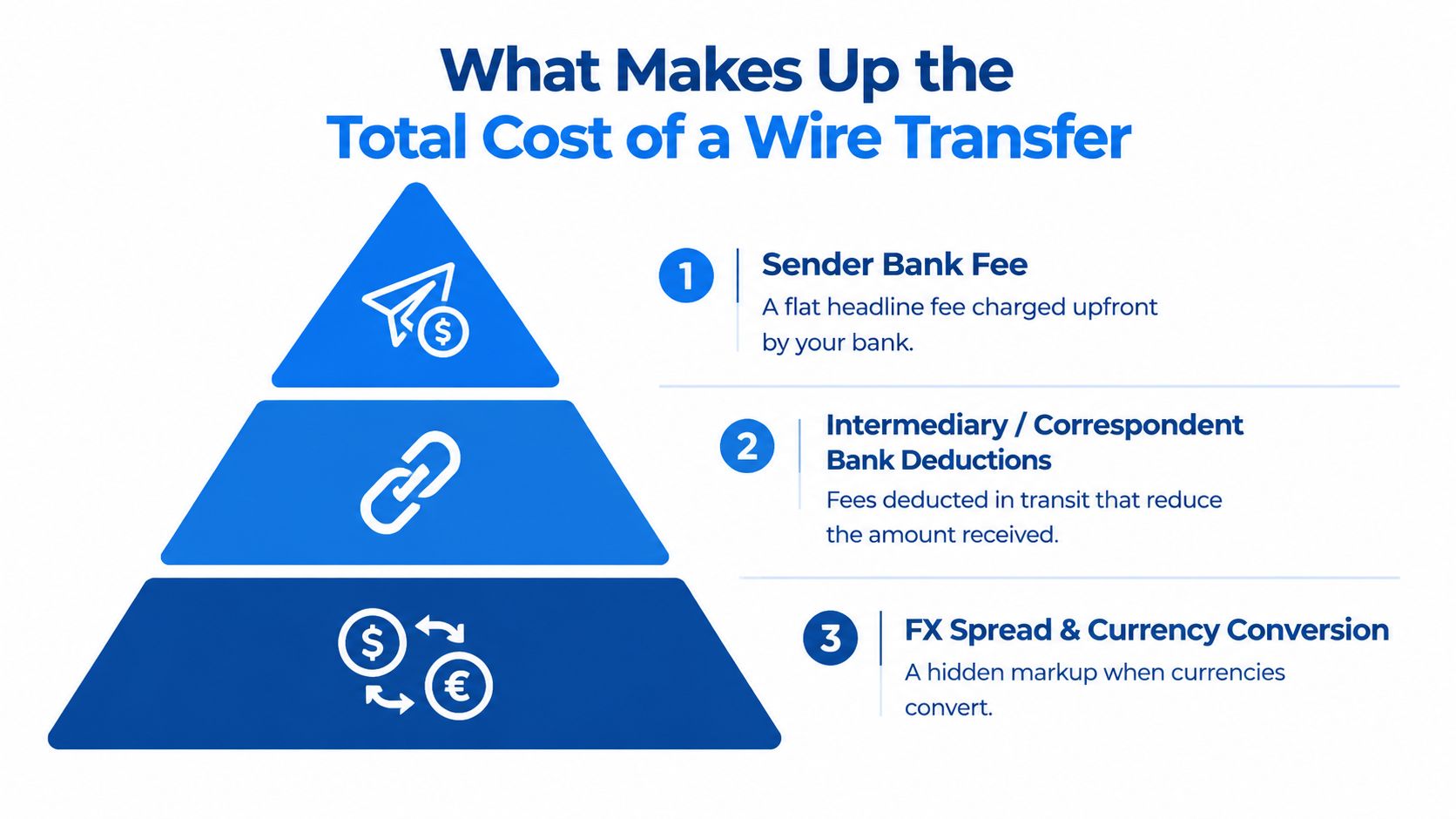
Layer one is the sender bank fee
This is the amount your bank normally displays first. It may appear before authorization, in the transaction confirmation, or as a separate debit from the sending account.
The fee can depend on the transfer type, currency, account plan, and submission channel. An online wire may have a different price from one prepared at a branch. Save the exact amount shown at approval, rather than relying on a remembered fee schedule.
Layer two is the intermediary deduction
A correspondent bank may carry the payment when the sender and recipient banks lack a direct settlement relationship. That bank can remove a handling amount from the funds in transit. The recipient then receives less, even though the sender authorized the correct gross amount.
Intermediary deductions can be about $15 to $50 per hop. A less-traveled corridor may involve several intermediaries, making the final deduction difficult to predict. The payment instruction may include charge options that assign certain costs to the sender or recipient, but the available choices and their effects depend on the banks and corridor.
Ask your provider and the recipient bank what deductions may occur before promising a specific net amount. The sender fee is the first rung of the cost ladder, not the full price.
Layer three is the FX spread
If the payment changes currency, the provider applies an exchange rate that may include a markup over the underlying market rate. For a larger payment, that markup can exceed the visible wire fee.
An independent overview of bank wire fees and all-in costs reports that major U.S. banks often charge about $25 to $65 for an outgoing international wire. After exchange-rate markup and intermediary fees, the total can reach roughly $70 to $115.
Fixed charges take a larger share of a modest transfer than of a large invoice. A fixed sender fee, one or more deductions, and an FX spread can therefore reduce the recipient's net amount even when each individual charge appears manageable.
Record five fields before submission: gross amount, sender fee, expected conversion rate, possible intermediary deductions, and required recipient amount. This worksheet separates the visible bank charge from the true all-in cost and gives the finance team a documented estimate.
Illustrative Wire Transfer Cost Examples for Businesses
A wire can look affordable in the payment screen and cost more by the time funds reach the recipient. The examples below apply the three-layer model, sender fee, intermediary deductions, and FX markup, to common business situations. They illustrate how costs behave, not what a particular bank or corridor will charge. Your provider's schedule and the receiving bank's rules determine the final result.

A domestic supplier invoice
Suppose a U.S. company pays a domestic supplier by wire. The finance team sees the outgoing domestic benchmark of $25, reported in the 2026 Corpay comparison, and records it as the visible payment expense.
The supplier may receive the full invoice amount if the route has no additional deduction and the receiving institution does not charge the recipient. The team should still verify the supplier's instructions and confirm whether ACH can meet the required timing. A domestic wire may be unnecessary for a routine invoice, even when the headline fee appears predictable.
One international contractor payment
Now consider a contractor who invoices in a different currency. The company account is debited for the payment amount and sender charge, then the funds are converted. An intermediary bank may deduct a handling amount during transit, while the FX spread changes how much of the contractor's currency the payment buys.
The accounting distinction is cash debited from the company account versus value credited to the contractor. These amounts can differ even when the sender entered the invoice amount correctly. Record both where possible, and do not promise a net amount until the corridor and charge allocation are understood.
The visible bank fee is only the first entry in the cost record.
Recurring cross-border payouts
Recurring payments reveal inefficiency faster than one-off transfers. If a company pays several contractors separately, each transfer can create its own sender charge and exposure to intermediary deductions. Consolidating suitable payments may reduce the number of payment events, provided the company also checks recipient timing, currency needs, compliance requirements, and internal approvals.
For a modest payment, fixed charges can take a large share of the amount sent. The World Bank's remittance cost benchmark reports a global average of 6.36% of principal, illustrating why small-value cross-border transfers deserve close review.
Build your own annual model
Use a worksheet with these fields:
- Payment count: Record expected transfers by corridor and currency.
- Visible charge: Enter the sender fee for the exact account and payment channel.
- Transit exposure: Note possible intermediary deductions and whether the corridor may use multiple hops.
- Conversion cost: Compare the provider's exchange rate with an independent market reference.
- Recipient requirement: State whether the recipient must receive a gross amount or a guaranteed net amount.
Multiply recurring per-payment costs by planned frequency. Then compare the result with a local-rail, multi-currency, or consolidated workflow. This annual view shows whether the earlier $25 benchmark remains small beside repeated deductions and conversion costs. It also separates the advertised wire fee from the all-in price the business pays.
Proven Ways to Reduce Wire Transfer Fees
A business sending an international payment can see one fee at approval, then receive a smaller amount than expected after intermediary deductions and currency conversion. Reduce the all-in cost by reviewing this stack, rather than optimizing only the bank's advertised sender charge.
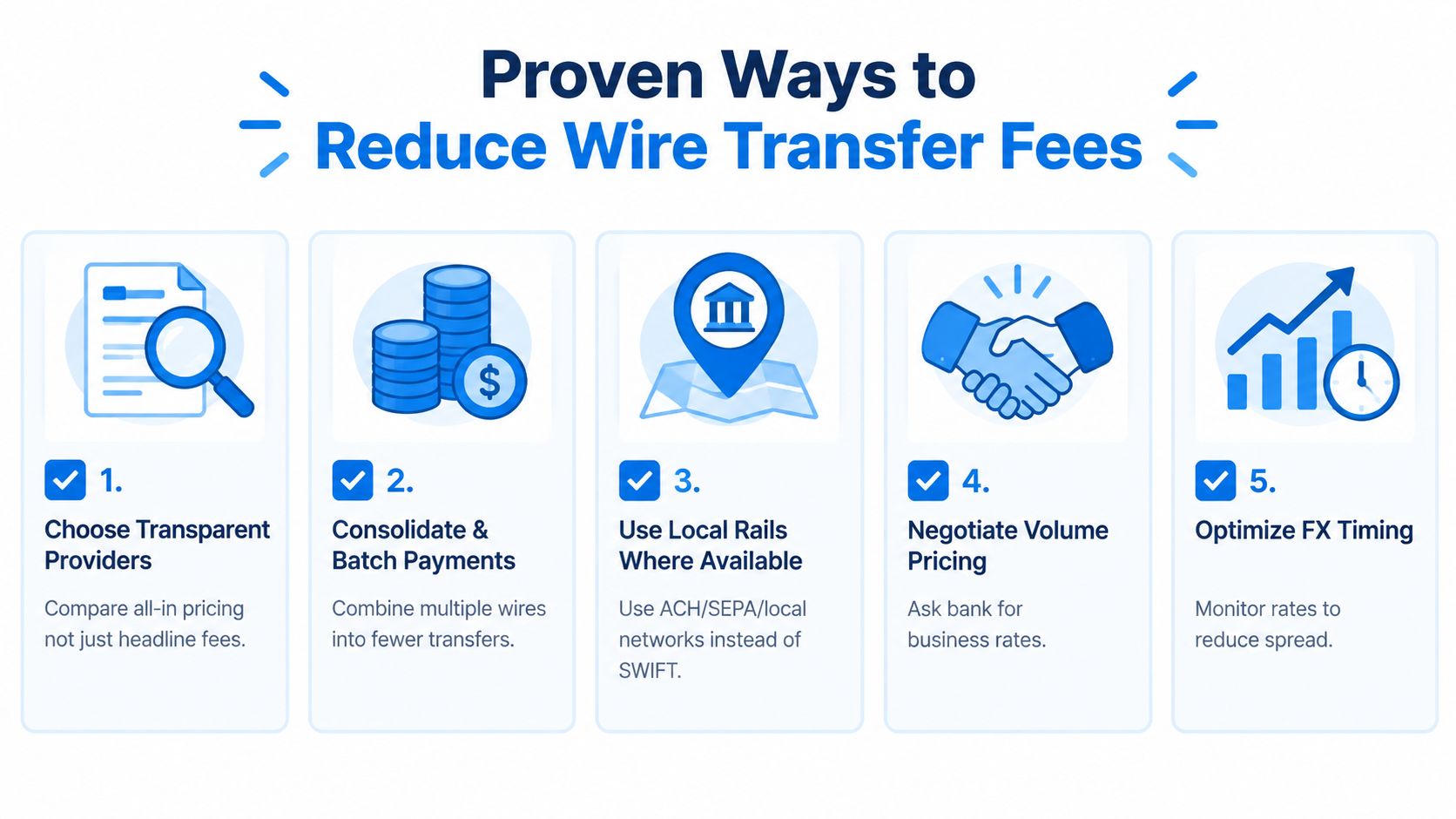
Compare all-in pricing
Ask each provider to map the payment path. Request the sender fee, receiving treatment, possible intermediary deductions, exchange-rate method, and any price difference between online and branch initiation.
A rate sheet is only the starting point. Compare the amount the recipient should receive under the same currency, payment value, and delivery requirement. This makes the difference between the visible fee and the true landed cost easier to identify.
Consolidate suitable payments
Batching can reduce the number of payment events when recipients accept a combined schedule and the business can manage the timing. Keep urgent payments separate, along with payments that would create unacceptable concentration or approval risk.
A treasury policy can specify which invoices may be grouped, who approves the batch, and how finance allocates the combined payment during reconciliation.
Use local rails when they fit
ACH, SEPA, and other local networks may cost less than SWIFT when the sender, recipient, currency, and settlement requirements qualify. Check the tradeoffs first, including payment limits, processing windows, onboarding requirements, and reconciliation work.
Decision test: Choose the rail that meets the recipient's deadline and currency requirement with the lowest documented landed cost.
Negotiate based on payment behavior
Recurring volume gives a business a basis for asking its bank or payment provider about account-level pricing. Bring records of payment frequency, corridors, currencies, and current all-in costs. Discussing only the visible sender fee hides the value of the broader relationship.
For a focused review of institutions that may not charge certain wire fees, see this guide to banks with no wire transfer fees. A waived sender fee does not confirm that intermediary deductions or FX costs have disappeared.
Improve the currency workflow
If the company regularly pays in one foreign currency, holding that currency and settling locally may reduce repeated conversions. Treasury teams can also set a conversion process instead of converting under deadline pressure. Exchange rates remain variable, so timing does not guarantee a better result.
OneSafe is an example of a platform offering multi-currency business accounts, ACH, domestic and international wires, SWIFT transfers, stated FX pricing, and crypto-fiat workflows through one interface. Review eligibility, partner-bank arrangements, corridor support, and the current fee schedule before selecting a provider.
Choosing the Right Wire Strategy and Next Steps
A wire fits when the recipient requires that payment rail, the settlement speed matches the business need, or the corridor lacks a practical local alternative. For a routine domestic payment, ACH may be simpler. A cross-border payment may also settle more efficiently through a local rail or multi-currency account.
Use this approval sequence:
- Confirm the recipient requirement. Ask whether the recipient needs a wire, a specific currency, or a guaranteed net amount.
- Calculate the full stack. Add the sender fee, possible intermediary deductions, and FX markup. The visible bank charge is only one layer of the cost.
- Compare eligible rails. Review ACH, local networks, multi-currency settlement, and other available payment methods.
- Check operating controls. Confirm limits, approvals, reconciliation steps, compliance checks, and delivery timing.
- Record the decision. Save the quoted cost and recipient expectation, then compare them with the amount ultimately settled.
For a direct comparison of bank wire pricing and crypto-related payment costs, review this Bank of America wire fees versus crypto costs analysis.
The useful internal measure is the landed cost per successfully settled payment, not the headline wire transfer fee alone. Review statements by corridor, currency, and recipient. Look for intermediary deductions, unexpected FX differences, delivery delays, and the administrative work required to resolve them. Request all-in quotes from alternative providers so each option is measured on the same basis.
Set a policy requiring finance staff to record the payment rail, currency, sender charge, expected intermediary exposure, and FX rate before release. Founders then see the full treasury cost, while operations teams have a documented basis for choosing a wire, batching payments, or using local settlement.
For recurring cross-border payments, OneSafe offers multi-currency business accounts, ACH, domestic and international wires, SWIFT transfers, corporate controls, and crypto-fiat workflows through one interface. Review eligibility, published pricing, corridor support, and account arrangements before comparing it with the company's current all-in wire cost.


