The maturation of crypto banking accelerated this week as U.S. Bank confirmed it had moved real money across borders using a proprietary stablecoin—a signal that traditional finance is embracing on-chain settlement for the complex demands of global business. On September 9, 2026, the bank executed a live cross-border payment over the public Stellar network with its internally developed USBDC dollar-backed token, according to a Bitcoin Foundation report published September 10, 2026. For founders, CFOs, and treasury teams managing international operations, the test moves cross-border payment solutions from white paper to real-world validation.
Table of Contents
- What Just Happened: U.S. Bank's Live Stablecoin Test
- Why This Matters Now for Global Businesses
- Crypto Banking Today: Where We Stand
- What This Means for Your Business
- How to Position Your Company for the Crypto Banking Shift
- What to Watch Next
- What is crypto banking?
- What does U.S. Bank's stablecoin pilot mean for the future of crypto banking?
- How can crypto banking reduce cross-border payment costs?
- Is crypto banking safe for my business?
- How do I choose a crypto banking platform for my global business?
- What is OneSafe, and how does it help with crypto banking?
- Key Takeaways
What Just Happened: U.S. Bank's Live Stablecoin Test
The transaction transferred value between U.S. Bank entities in North America and Europe, using the bank's own Digital Asset Platform. The USBDC stablecoin ran on Stellar, a public blockchain designed for payments, and the system integrated with the bank's existing compliance and financial rails. U.S. Bank has not disclosed the transfer amount, the transaction hash, settlement time, or the reserve composition backing USBDC. The pilot is internal: as of September 11, 2026, no outside institution or customer can buy, hold, or redeem the token, and the bank describes it as a test, not a publicly available stablecoin.
A top-5 U.S. bank deploying real funds on a public ledger is a departure from sandboxed proofs of concept. It demonstrates that an existing systemically important institution can settle a stablecoin cross-border payment without replacing its compliance stack—a critical hurdle for corporate adoption. This is not a crypto-native startup; it's a regulated bank with legacy infrastructure, showing that blockchain can slot into the existing correspondent banking framework rather than bypassing it entirely.
Why This Matters Now for Global Businesses
For years, global business banking meant a choice: accept the four-day settlement windows and opaque fees of SWIFT, or embrace volatile crypto rails that most suppliers and accountants couldn't touch. The U.S. Bank pilot—alongside parallel moves like the Visa Direct stablecoin payments pilot and 21 other banks issuing stablecoins—shows the two worlds are fusing. A crypto banking platform no longer needs to be a separate, experimental workstream; it can be the primary operating account for a distributed team.
Stablecoin settlement on public blockchains can reduce cross-border transfer time from days to seconds and cut fees by eliminating correspondent bank hops. A March 2026 Federal Reserve note on payment stablecoins and cross-border payments found that these instruments "can materially lower costs" for end-users while preserving the safety of fully reserved assets. The USBDC test, though internal, demonstrates that a bank can maintain reserve integrity and compliance while tapping these efficiencies. Combined with on-ramps from providers like Circle and Stripe, businesses now have a credible path to near-instant settlement without needing a bespoke blockchain integration.
Crypto Banking Today: Where We Stand
The term crypto banking once described consumer apps offering Bitcoin rewards or high-yield lending accounts. That era ended. Today, it encompasses institutional-grade services that treat digital assets as just another currency class—one with programmability and 24/7 settlement. The Stablecoin Payments Surge on Polygon earlier this year and the launch of the ECB's on-chain euro point to a landscape where the question is no longer "if" stablecoins will enter business workflows, but "which."
Much of the coverage still confuses consumer and business crypto banking. Consumer-focused features—zero trading fees, cashback in crypto, lending—receive the most attention. But a global business needs something different: multi-currency accounts that hold fiat and stablecoins natively, corporate cards for vendor payments, and automated on/off-ramps that convert stablecoins to local currency for payroll or taxes. A web3 business banking stack must also handle the complexity of DAO treasuries, token vesting, and transparent reporting—needs that consumer platforms were never built to address.
What This Means for Your Business
When U.S. Bank can send value over Stellar with compliance integrated, the argument that stablecoins are too risky for corporate treasuries weakens. Institutional-grade stablecoin usage for B2B payments is moving from early adopter territory to a regulated, auditable process. As BVNK's guide on blockchain cross-border payments notes, the technology is now mature enough to replace segments of the correspondent banking system without sacrificing control.
Regulatory clarity is opening doors, but patchwork remains. The UK's stablecoin regulation shift and the UAE's 2026 framework offer clear rules, while the U.S. still operates under interagency guidance rather than statute. Africa is writing new payments rules that could leapfrog legacy infrastructure. For a business with subsidiaries across multiple continents, this means stablecoin adoption must be coupled with rigorous jurisdictional analysis—not a one-size-fits-all approach.
The days of separate crypto wallets and fiat bank accounts are numbered. When bank-issued stablecoins become commercial, a company that already runs a unified fiat and crypto banking platform can plug into them without rebuilding its treasury workflow. Conversely, sticking with a traditional bank that has no on-chain capability means you'll be shut out of the speed and cost advantages that competitors are starting to exploit.
How to Position Your Company for the Crypto Banking Shift
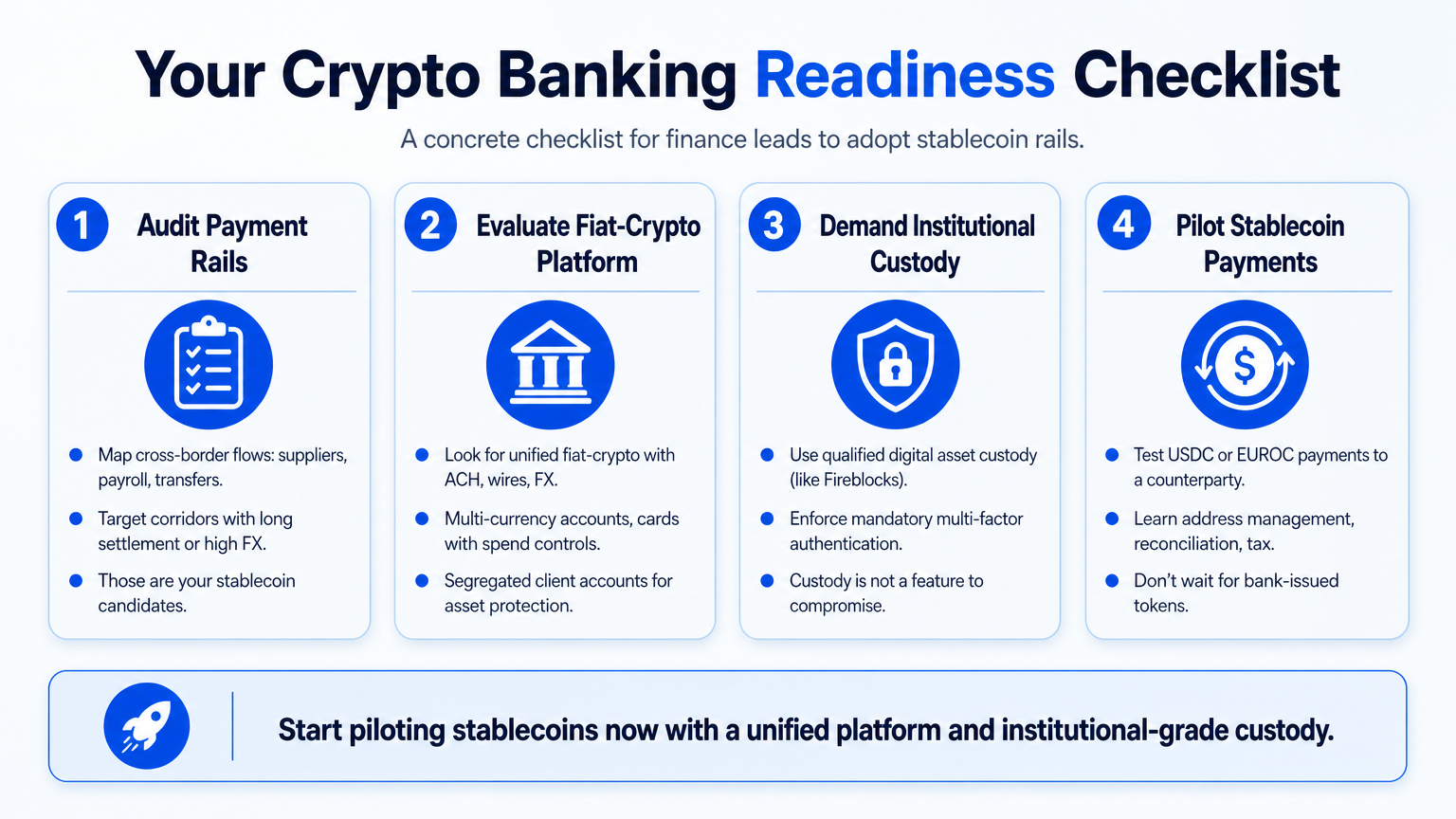
A concrete checklist for finance leads:
- Audit your current payment rails. Map out every cross-border payment flow—suppliers, payroll, inter-company transfers. Identify which corridors have the longest settlement times or highest FX costs. Those are your first candidates for stablecoin settlement.
- Evaluate a unified fiat-crypto platform. Look for a crypto-friendly business account that handles ACH, wires, FX, and stablecoin on/off-ramps from a single interface. The platform should include multi-currency accounts, corporate cards with spend controls, and segregated client accounts for asset protection.
- Demand institutional-grade custody. Any solution must keep digital assets in qualified digital asset custody—preferably with a provider like Fireblocks—and enforce mandatory multi-factor authentication. Crypto banking scams have cost the industry billions; custody is not a feature to compromise on.
- Start piloting stablecoin payments now—don't wait for bank-issued tokens. Use established crypto-native solutions to test USDC or EUROC payments to a friendly counterparty. The operational lessons (address management, reconciliation, tax treatment) are the same regardless of the issuer.
What to Watch Next
U.S. Bank has not disclosed a timeline for commercial availability. Given the cautious approach—internal test, no public wallet or redemption—a commercial launch could be quarters or even years away. The bank must also clarify reserve composition and audit frequency before regulators and corporate users will trust it as a settlement asset.
The Federal Reserve's instant payment service, FedNow, is often positioned as a public-sector alternative to private stablecoins. Yet FedNow operates only in U.S. dollars and within domestic rails. Cross-border use cases still require a bridge asset, exactly the gap that bank-issued or regulated private stablecoins fill. The coexistence question will dominate policy discussions through 2027.
The market is fragmenting: Europe's MiCA framework provides a comprehensive passport, while the U.S. relies on case-by-case approvals. Asia-Pacific hubs from Singapore to Korea are running B2B stablecoin pilots. The business that builds a flexible treasury now—one that can ingest bank-issued stablecoins when they arrive and continue using existing crypto-native options—will be the one that navigates this patchwork without disruption.
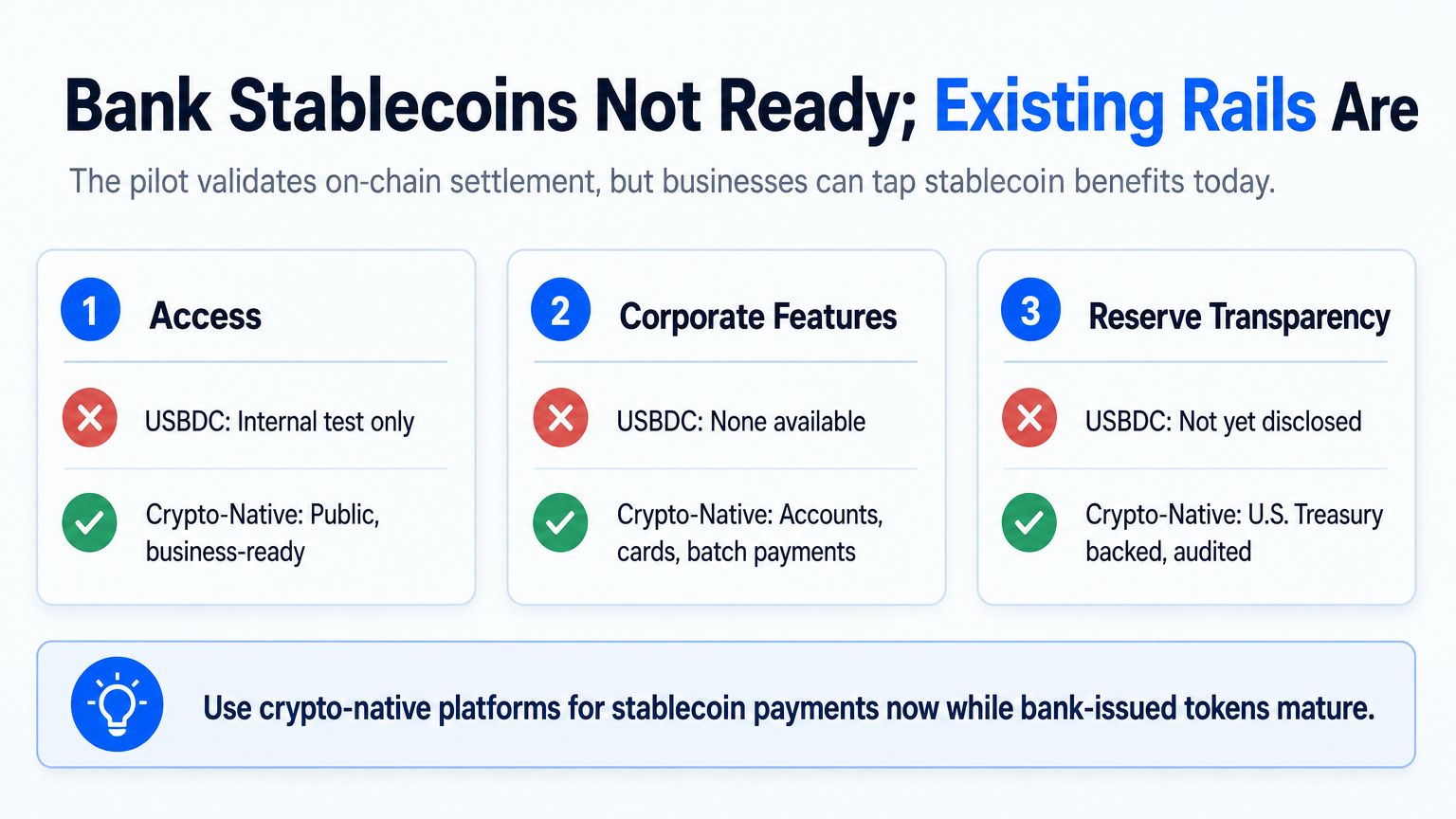
| Aspect | U.S. Bank USBDC Pilot | Existing Crypto-Native Solutions |
|---|---|---|
| Issuer | Regulated U.S. bank | Circle, Tether, or fintech |
| Network | Public Stellar | Ethereum, Polygon, Stellar, Solana, others |
| Compliance Integration | Integrated with existing bank systems | Varies; often relies on third-party KYT |
| Access | Internal test only (Sept. 2026) | Public, with business on-ramps |
| Reserve Risk | Not yet disclosed | Generally U.S. Treasury or equivalent, audited |
| Corporate Features | Not available | Multi-currency accounts, cards, batch payments |
| Cross-Border Speed | Sub-minute (Stellar) | Sub-minute to minutes, network-dependent |
Table: Comparing the USBDC pilot with currently available stablecoin rails. While the bank test validates the model, businesses can act today using crypto-native platforms that already offer the missing commercial features.
What is crypto banking?
Crypto banking is the integration of traditional fiat banking—accounts, payments, cards—with the ability to hold, send, and convert digital assets like stablecoins or cryptocurrencies. It spans both consumer services (trading, rewards) and business services (multi-currency accounts, cross-border payments, treasury management). For companies, crypto banking means treating digital currencies as natively as dollars or euros, with the same compliance, custody, and reporting standards.
What does U.S. Bank's stablecoin pilot mean for the future of crypto banking?
It signals that major U.S. banks see stablecoins as a viable settlement layer for cross-border payments, not just a speculative asset class. By using a dollar-backed token on a public blockchain with existing compliance systems, U.S. Bank demonstrates that the infrastructure for institutional-grade stablecoin payments is operational. The pilot validates the argument that crypto banking can incorporate bank-issued tokens alongside established crypto-native solutions, paving the way for hybrid treasuries that move at internet speed.
How can crypto banking reduce cross-border payment costs?
Stablecoin-based rails eliminate intermediary banks, reduce currency conversion markups, and settle in minutes rather than days. According to the Federal Reserve's March 2026 analysis, these efficiency gains "can materially lower costs" for end users. A global business banking setup that integrates stablecoin cross-border payments avoids SWIFT fees on both ends and minimizes float, freeing up working capital.
Is crypto banking safe for my business?
Safety depends on the provider's security architecture, not the asset class. A safe crypto banking platform should offer: institutional-grade digital asset custody (e.g., Fireblocks), mandatory multi-factor authentication, segregated client accounts, fiat deposit insurance through partner banks, and transparent compliance protocols. Stablecoins themselves are not risk-free: reserve composition and issuer solvency matter. Regulated bank-issued stablecoins may offer additional comfort, but until they launch, businesses using audited, fully reserved stablecoins like USDC with a qualified custodian have a comparable security profile.
How do I choose a crypto banking platform for my global business?
Prioritize platforms that treat fiat and crypto as equal partners in one interface. Essential criteria:
- Multi-currency accounts in the currencies you actually use (USD, EUR, CAD, etc.)
- Corporate cards with spend controls for vendor payments
- Free or low-cost crypto-to-fiat conversions with transparent FX rates
- Automated on/off-ramp for payroll, taxes, and supplier invoices
- Segregated custody, ideally via an independent qualified custodian
- Rapid digital onboarding (within a week, not months)
- No hidden wire or SWIFT fees that undermine stablecoin savings
Avoid platforms that only serve retail traders or that lack clear business features like batch payments, multi-user roles, and audit trails.
What is OneSafe, and how does it help with crypto banking?
OneSafe crypto banking is a financial technology platform—not a bank—that provides a unified neo-banking experience for businesses needing both fiat and cryptocurrency operations. It offers multi-currency accounts (USD, Euro, CAD), domestic and international wires, ACH, corporate cards, and instant crypto-to-fiat conversions. Digital assets are secured through Fireblocks custody, with mandatory MFA and state-of-the-art encryption. OneSafe has processed over $800 million in volume from 1,000+ businesses across 30+ countries, with a fully digital onboarding that typically takes a week. It serves Web3 startups, DAOs, and global enterprises looking for a single interface to manage cross-border payment solutions, treasury, and crypto-native workflows without the overhead of a traditional bank's geographical limits.
Key Takeaways
- U.S. Bank's live stablecoin pilot proves that regulated institutions can settle stablecoin cross-border payments on public blockchains without abandoning existing compliance, accelerating the shift to crypto banking for global businesses.
- The cost and speed advantages of stablecoin settlement are no longer theoretical; businesses can pilot them today using crypto-native platforms to build operational readiness before bank-issued tokens go commercial.
- A bifurcated treasury—fiat here, crypto there—is becoming a competitive liability; unified fiat and crypto banking platforms with institutional digital asset custody and multi-currency accounts are the new baseline.
- Regulatory fragmentation requires a flexible setup that can onboard new stablecoins (bank-issued or native) as they gain local approval, rather than locking into a single issuer.
Start managing your global treasury with a single platform that speaks both fiat and crypto by exploring the OneSafe neo-banking experience.