If you're trying to collect recurring customer payments without turning your finance team into a collections desk, ACH Direct Debit is probably already on your shortlist. It's the rail behind subscription billing, monthly utility drafts, insurance premiums, and a lot of B2B invoicing because it lets a business pull funds from a customer's bank account on an agreed date, instead of waiting for someone to remember to pay.
That makes it look simple from the outside. In practice, it's a rules-based bank-to-bank system with authorization requirements, batch timing, settlement windows, and return handling that can make or break your cash flow. For teams operating across the U.S. and abroad, it's also one part of a broader treasury stack, not the whole stack.
Table of Contents
- From authorization to batch file
- Why timing matters more than people expect
- What finance teams should store
- What high volume changes inside a business
- Why the economics favor repeatable billing
- ACH Direct Debit inside the volume picture
- Build the operating base first
- Don't skip the boring implementation details
- What teams miss most often
- Readiness checklist before the first live debit
- The thresholds that matter
- What reconciliation should actually include
- How this differs from card disputes
What ACH Direct Debit Is and Why It Runs the Recurring Economy
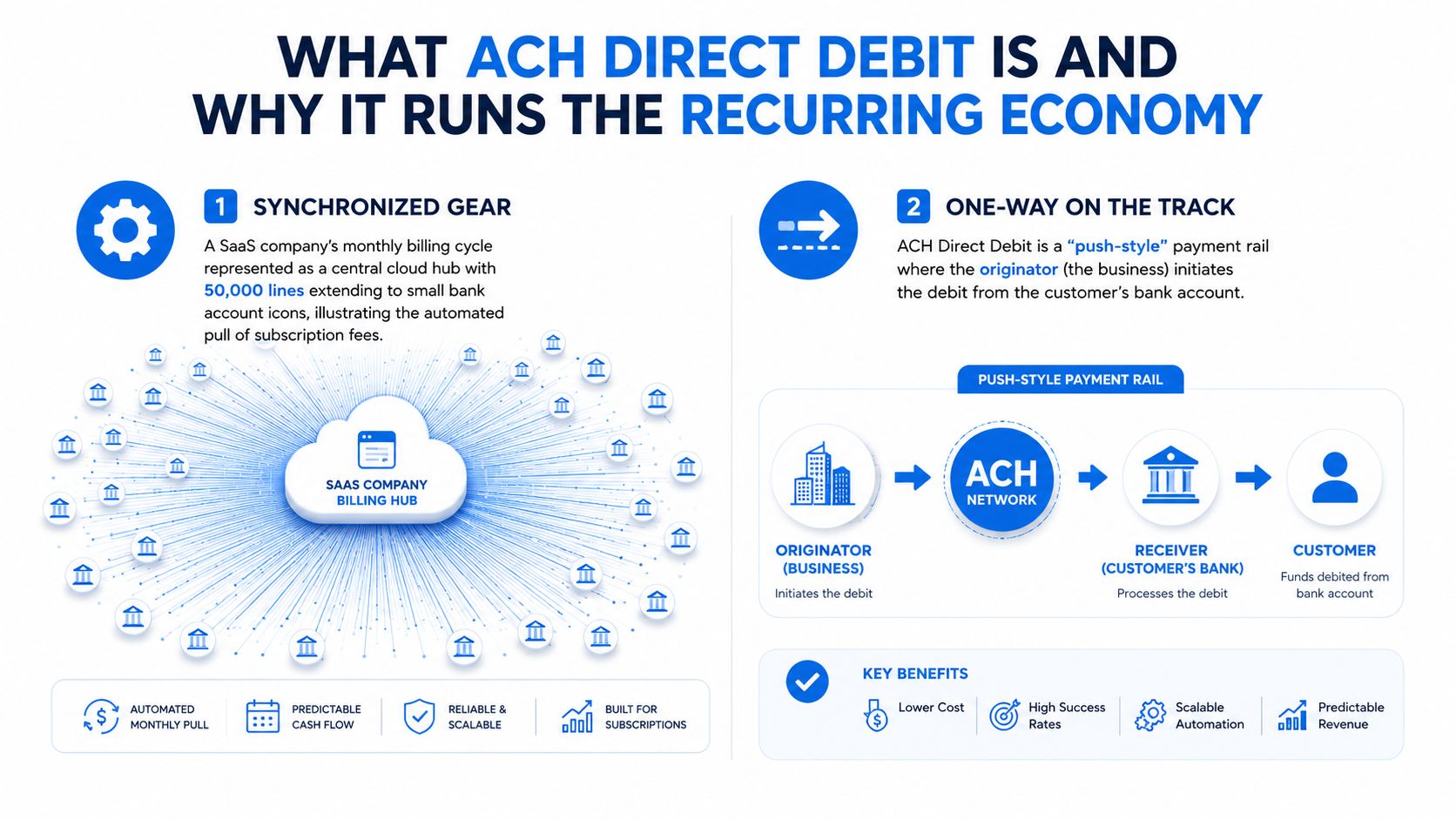
A SaaS company with 50,000 U.S. customers doesn't want 50,000 separate card charges bouncing through a merchant dashboard every month. It wants a predictable billing rail that can collect the same invoice amount from the same bank accounts on the same date, with enough structure to keep reconciliation sane. That's where ACH Direct Debit fits, because the business initiates the pull through the ACH Network under Nacha rules, and the customer has already authorized the withdrawal.
The basic shape of the rail
Think of it as a scheduled bank draft, not a card swipe. The business is the originator, the customer is the receiver, and the transfer moves through the ACH Network under operating rules rather than through a point-of-sale authorization flow. The Federal Reserve's payments data shows how embedded this rail has become, ACH direct debit sits inside a network that processed 35.2 billion payments worth $93 trillion in 2025, including 19.6 billion debits and 15.6 billion credits (Nacha ACH Network volume and value statistics).
That scale matters because recurring businesses rely on predictability more than novelty. Gym memberships, mortgage drafts, insurance premiums, SaaS subscriptions, and vendor invoice collections all benefit from the same core feature, an agreed debit on a known date. In accounting terms, that means fewer manual reminders and fewer one-off payment exceptions.
Practical rule: ACH Direct Debit works best when the customer expects the charge, the amount is recurring or scheduled, and the business can tolerate batch-based settlement instead of instant finality.
Why teams use it even when it isn't flashy
The economics are a big part of the appeal. Compared with cards, ACH is usually the lower-friction option for bank-funded recurring payments, especially when margins are tight and the payment is already authorized. It also suits payroll-related offsets and other automated collections where the business wants a direct tie between the invoice schedule and the cash movement.
The trade-off is operational. ACH Direct Debit is not the right rail when you need immediate certainty, and it doesn't behave like a card terminal with a live approval screen. You're managing authorization hygiene, settlement timing, and the possibility of returns, which is why finance teams need to understand the mechanics before they scale volume.
How ACH Direct Debit Works From Authorization to Settlement
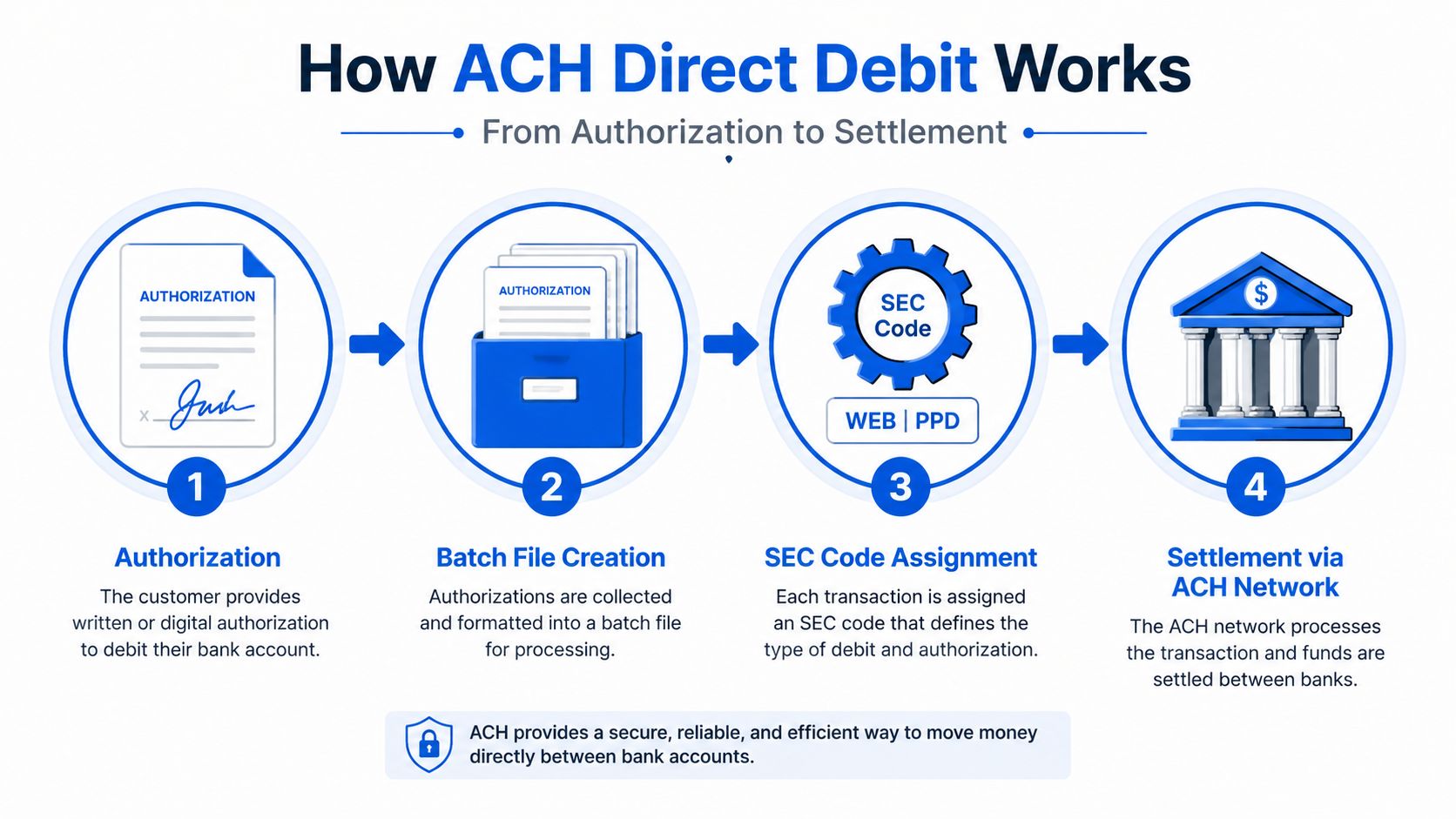
Before a single dollar moves, the customer has to authorize the debit. That authorization can be signed, electronic, or captured through an online flow, but the point is the same, the business needs permission to pull funds on specified terms. For recurring debits, teams should treat that authorization like part of the contract file, because it's what supports the debit if a dispute comes later.
From authorization to batch file
Once billing day arrives, the business doesn't send each debit as a live, individual request. It groups the authorized entries into a batch file, then submits that file through its Originating Depository Financial Institution, or ODFI. Each entry gets tagged with a Standard Entry Class, or SEC, code such as WEB for internet-initiated debits or PPD for preauthorized consumer debits.
That label is not just administrative clutter. The SEC code helps determine the rule set around return rights, dispute timing, and how the transaction was framed at authorization. In other words, the same money movement can carry different operational consequences depending on how it was originated.
Why timing matters more than people expect
Nacha's operating model processes payments across the business day and settles them in scheduled windows, which is why standard ACH debits typically land on a next-business-day basis or, when eligible, through Same Day ACH. For teams that need to fund payouts downstream, that timing matters because the money isn't final the second the file is sent.
The receiving bank, called the RDFI, posts the debit to the customer's account during the network's processing cycle. If the debit is eligible and cut off in time, the originator can see funds sooner. If not, it moves through the next applicable banking day.
Operational insight: treat ACH Direct Debit as a delayed cash movement, not a guaranteed cash event. Treasury teams often hold a reserve or wait for settlement before releasing connected payouts.
What finance teams should store
The authorization record is only half the story. Businesses should keep proof of authorization for at least two years, since disputes can arrive long after billing day. That's especially important for recurring billing, where customers may forget what they agreed to, or think a charge was card-based when it was bank-debited.
A clean process usually includes:
- Authorization capture, with clear consent language and revocation terms.
- Batch creation, so all approved debits are packaged consistently.
- SEC code selection, because WEB, PPD, TEL, and CCD don't behave identically.
- Settlement monitoring, so treasury knows when funds are expected.
- Return handling, since an initiated debit can still come back later.
If you've ever watched a billing run go out and assumed that meant the cash was already yours, ACH will correct that assumption quickly.
ACH Direct Debit vs ACH Credit and Card Debits
A finance team usually compares three things first, who initiates the payment, how fast the money settles, and what happens if something goes wrong. Those differences drive almost every rail decision.
| Dimension | ACH Direct Debit | ACH Credit | Card Debit |
|---|---|---|---|
| Who initiates | Business pulls funds after authorization | Sender pushes funds to a recipient | Merchant initiates a card authorization and capture flow |
| Settlement speed | Typically next-business-day or eligible Same Day ACH | Typically next-business-day or eligible Same Day ACH | Authorizations are fast, full settlement can still take longer |
| Cost profile | Usually lower-cost for recurring collections | Usually lower-cost for routine outbound payments | Usually higher because merchant pricing is percentage-based |
| Dispute path | Return and dispute framework under Nacha rules | Return framework exists, but this is usually payer-initiated money movement | Chargeback system handled through card networks and issuers |
ACH Direct Debit is the better fit when the business has consent and wants to collect on schedule. ACH Credit is the better fit when the business is paying out, for payroll or vendor disbursements, because it pushes money outward instead of pulling it inward. Card debit wins when a customer wants immediate familiarity and a card-network dispute flow is part of the value proposition.
Cost and control tell different stories
ACH Direct Debit usually wins on cost because it avoids the percentage-based economics of card acceptance. Cards can be convenient, but the pricing model is harder to ignore when payments are recurring and the same customer pays every month. For a finance lead, that means ACH can preserve margin on low-ticket or high-frequency billing.
The trade-off is control. Card payments feel instant to end users, but ACH Direct Debit gives the business a cleaner recurring collection model if the authorization is well managed. The question isn't which rail is universally better. It's which rail fits the business model without creating a reconciliation headache.
A short rule of thumb
If the payment is scheduled, consented, and repetitive, ACH Direct Debit tends to be the more disciplined choice. If the payment is a payout, ACH Credit is usually the better internal rail. If the customer experience depends on card familiarity, a card debit may still win even when it costs more.
The Scale of ACH Direct Debit and What It Means for Businesses
ACH Direct Debit sits on the larger-volume side of the ACH Network, and that's not a small distinction. In 2025, the network processed 35.2 billion payments valued at $93 trillion, including 19.6 billion debits and 15.6 billion credits (Nacha ACH Network volume and value statistics). Same Day ACH alone reached 1.4 billion payments valued at $3.9 trillion, up 16.7% in volume and 21.4% in value from 2024 (same source).
What matters for finance teams is not the headline scale by itself. It's what scale changes operationally.
What high volume changes inside a business
Once debit volume rises, the business needs better sponsor-bank support, tighter authorization records, and more disciplined exception handling. A small billing team can sometimes manage a handful of returns manually. That stops working once the debit file starts carrying thousands of recurring entries.
The Federal Reserve also reported that ACH debit transfers grew faster than ACH credit transfers from 2021 to 2024, with debit number and value rising 5.4% and 5.6% per year, respectively (Federal Reserve ACH data). That growth is a sign that recurring bank pulls are not a legacy edge case. They're a core operating rail.
Why the economics favor repeatable billing
ACH Direct Debit works best in businesses where the same account is billed more than once, because the setup work is amortized over time. Subscriptions, insurance, utilities, and B2B invoice collections all benefit from that pattern. The rail is less attractive when the originator has low volume, high churn, or weak verification controls, because operational errors show up fast in return files and can trigger review.
The network's administrative side matters too. Returned items, unauthorized entries, and account mismatches all create work. That's why high-volume originators invest in sponsor-bank relationships, debit filters, and reconciliation tooling before volume gets messy.
Bottom line: ACH Direct Debit is a scale rail, not a novelty rail. If your model depends on repeat collections, its economics make sense. If your model is erratic or high-risk, the compliance burden can outweigh the savings.
ACH Direct Debit inside the volume picture
| Metric | ACH Direct Debit | ACH Credit | Card Debit |
|---|---|---|---|
| Network relevance | Larger-volume side of ACH activity | Important for outbound payments and payroll | Not part of ACH, separate card network economics |
| Processing rhythm | Batch-based, tied to banking windows | Batch-based, tied to banking windows | Authorization-first, capture and settlement follow card rules |
| Business fit | Recurring collections | Payroll and vendor disbursement | Consumer-facing checkout and card-first flows |
For a broader view of ACH operational constraints, especially limits and transaction planning, this guide on ACH transfer limits is useful context for treasury teams.
Implementing ACH Direct Debit in Your Business
Launching ACH Direct Debit is a compliance project before it becomes a payment project. If your team treats it like “turn on bank pulls,” the first return file will usually teach a painful lesson. The safer path starts with identity, account structure, and authorization design.
Build the operating base first
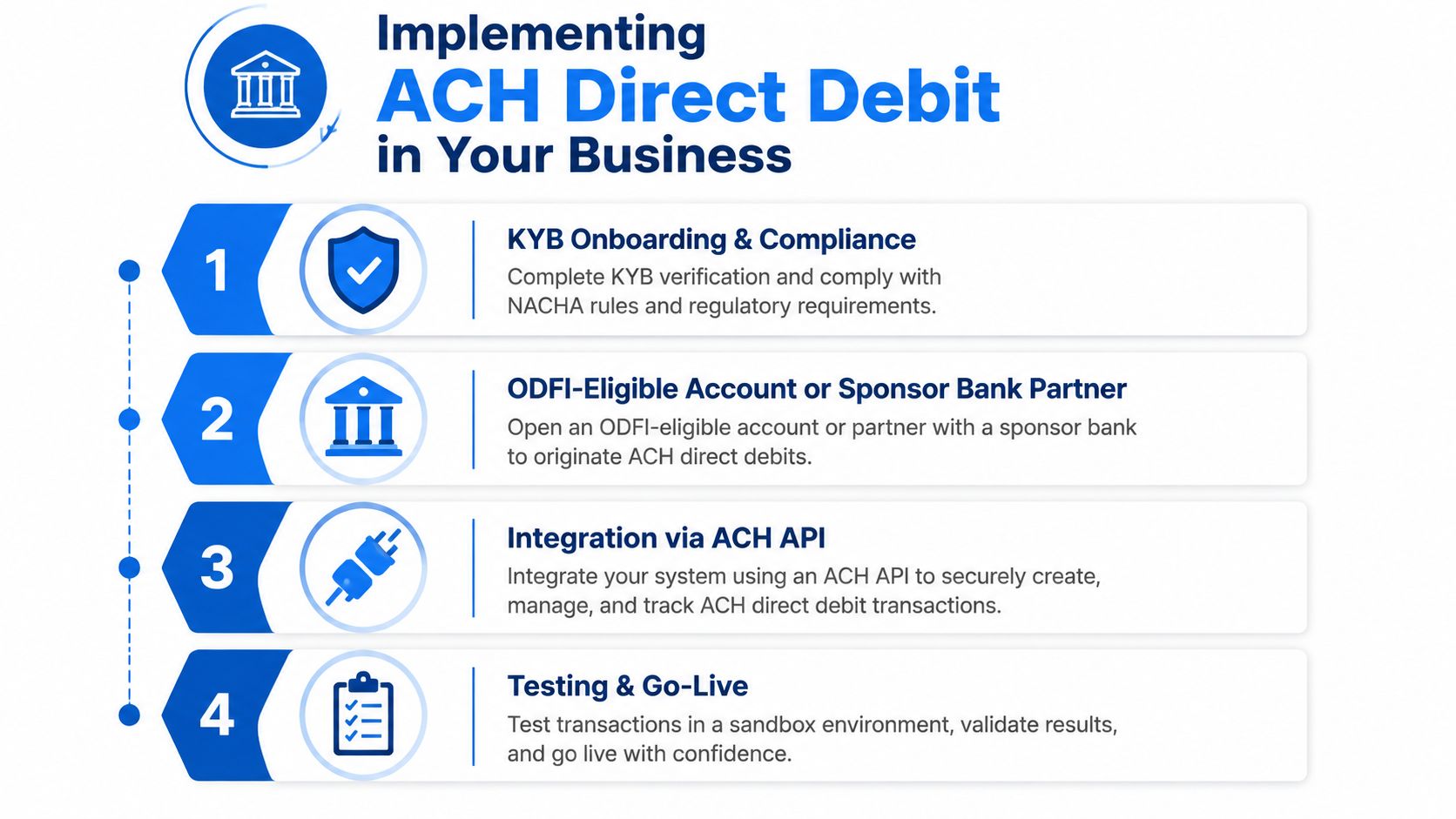
Start with KYB onboarding and confirm that your banking partner can support ACH origination. Some businesses do this through an ODFI-eligible account, while others work through a sponsor bank or processor. Either way, the bank relationship has to support the debit flow, not just hold deposits.
Then define your authorization language. For recurring consumer debits, that means clear consent, clear revocation terms, and a way to prove the customer accepted them. If you're originating from software, the consent screen and the stored record need to match. A vague checkbox with no proof trail is not enough.
Don't skip the boring implementation details
The technical integration is usually straightforward, but the operational details trip teams up. SEC code selection matters, because PPD, CCD, WEB, and TEL imply different collection contexts. Same Day ACH cutoffs matter too, because a file submitted late may settle on the next banking day even if the billing run looked “done” internally.
A sensible rollout usually looks like this:
- Set up the bank or sponsor relationship, so the originator can legally send debits.
- Integrate the ACH API or processor, then map customer records to authorization records.
- Test in a sandbox or test mode, including return handling and notification of change flows.
- Go live with limited volume, not full billing population on day one.
What teams miss most often
Most payment failures are not technical failures. They're process failures. Teams forget to cap early debit amounts, forget to listen for webhook events, or assume the first successful settlement means the setup is stable. It isn't.
If you want a unified place to handle ACH alongside other banking rails, OneSafe is one option. It offers ACH, domestic and international wires, SWIFT transfers, multi-currency accounts, and crypto-compatible treasury features under a single interface, which can reduce the number of systems finance has to reconcile.
Readiness checklist before the first live debit
- Authorization file stored and searchable.
- Return handling path tested end to end.
- Funding calendar aligned with banking cutoffs.
- Reconciliation files mapped to your ledger.
- Exception owners assigned for returns and notifications of change.
If one of those items is missing, the launch isn't ready yet.
Returns, Disputes, and Reconciliation Under NACHA Rules
ACH Direct Debit is not final at initiation. That's the part many finance teams underestimate. A debit can settle and still come back later through the return framework, which means collections logic has to include dispute handling, not just successful posting.
The thresholds that matter
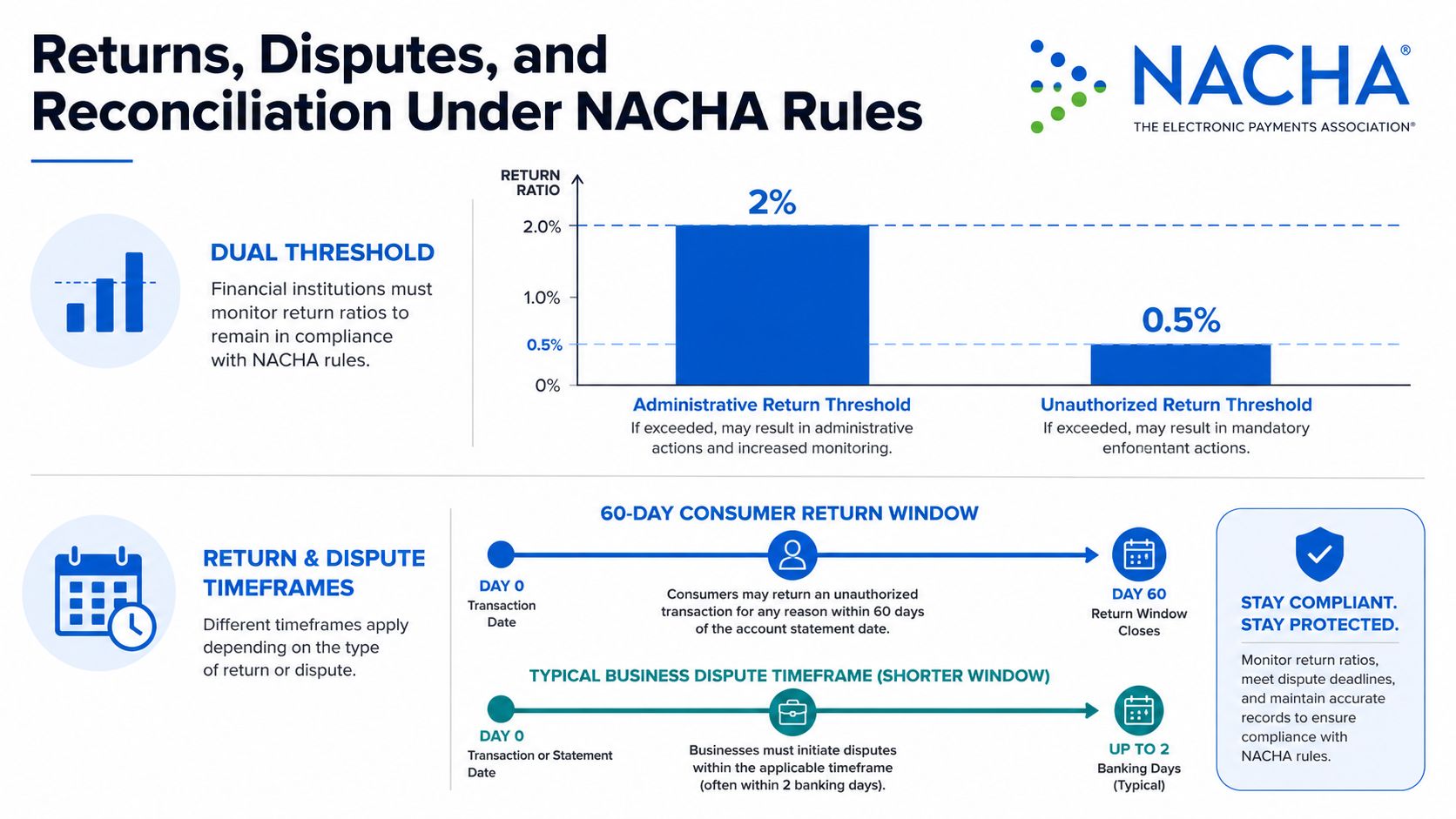
Nacha monitors debit originators for return performance, and a disputed or unauthorized return rate of 0.5% or higher can trigger compliance review and enforcement action (Stripe's explanation of Nacha rules). That threshold is a warning signal, not trivia. It means weak authorization capture, poor account validation, or aggressive retry logic can create network-level problems.
The network also uses administrative return monitoring, which is why teams need clean file handling for return codes and exception files. Consumer unauthorized debits can generally be disputed for up to 60 days (same Nacha rules explainer), so a quiet settlement window does not mean the collection is fully closed.
What reconciliation should actually include
A good reconciliation process matches three layers of data. First, the prenote or authorization record confirms the debit was valid to begin with. Second, the settled file shows what posted. Third, the return file tells you what came back and why.
That gives finance a practical control loop:
- Book the expected debit when the batch is sent.
- Watch the settlement file to confirm cash movement.
- Hold reserves where returns are likely.
- Reverse or reclassify items when the return file lands.
- Escalate unauthorized items to compliance or customer support immediately.
Finance control: if your team can't explain a return code to an auditor, a bank partner, or a customer success manager, the reconciliation workflow isn't mature enough yet.
How this differs from card disputes
ACH does not use the same unified dispute network as card chargebacks. The return reason codes are narrower, the deadlines are different, and the bank-to-bank framework is more procedural. That matters because you can't assume a card-style recovery flow will exist for bank debits.
For a deeper look at the processing side of the rail, this ACH payment processing overview is a useful companion. It helps connect the settlement mechanics to the operational controls finance teams need.
Using ACH Direct Debit Alongside Global and Crypto-Friendly Banking
ACH Direct Debit solves one job very well, collecting USD from U.S. bank accounts. It does not solve every treasury problem a global company has. Most international finance teams need ACH for domestic recurring collections, wires for cross-border settlement, FX for currency conversion, and sometimes crypto rails for treasury or vendor flows.
One rail does not replace the stack
A U.S. customer paying in dollars through ACH and a supplier in Europe getting paid in euros should not force the same payment rail. That's where multi-rail treasury design matters. ACH Direct Debit captures the domestic recurring side, then wires, FX, and crypto-compatible accounts handle the rest of the movement chain.
Running those pieces in separate systems creates friction. Treasury ends up reconciling one ledger for ACH, another for FX, another for wire status, and another for digital assets. That fragmentation is where delays, manual entries, and missed exceptions show up.
Where OneSafe fits
OneSafe sits in that multi-rail layer by combining ACH, domestic and international wires, SWIFT transfers, multi-currency accounts, and crypto-compatible workflows in one platform. For a business that collects USD via ACH and then pays contractors, vendors, or counterparties in another currency, that can reduce the number of account silos and approval paths.
For teams comparing U.S. and international rails, this ACH vs SWIFT explainer helps separate domestic bank pulls from cross-border settlement. If you're also working through entity setup and compliance in other jurisdictions, Israel fintech licensing challenges is a useful resource on how regulatory constraints can shape payment architecture.
Multi-rail examples that make sense
| Use case | Primary rail | Why ACH Direct Debit fits or complements |
|---|---|---|
| U.S. subscription billing | ACH Direct Debit | Low-friction recurring collections from customer bank accounts |
| Vendor payment in another currency | Wire or FX transfer | ACH handles domestic intake, then funds move outward in the target currency |
| Crypto-native treasury flow | Crypto transfer or conversion | ACH can fund the U.S. side before conversion or payout |
| Mixed contractor payroll | ACH Credit plus wires | ACH handles domestic payouts, wires handle cross-border exceptions |
The point is simple. ACH Direct Debit is strongest when it's part of a larger system, not when it's asked to do cross-border work it wasn't built for.
ACH Direct Debit Questions Business Teams Ask Before Going Live
The questions that matter before launch are usually the ones compliance and finance will have to answer later.
Can ACH Direct Debit work for international customers? Not as a default. It's primarily a U.S. domestic rail, so cross-border use depends on partner rails, gateway support, and bank availability. If your customers or vendors sit outside the U.S., you usually need wires or another cross-border method for the non-U.S. leg.
Can it fund instantly? No. Standard ACH Direct Debit settles on banking windows, and Same Day ACH is still a same-day batch rail, not a real-time one. If you need immediate finality, ACH is the wrong assumption to build around.
What happens if a debit is unauthorized? Consumer disputes can run for up to 60 days under the framework referenced earlier, and Nacha monitors unauthorized return rates at 0.5% or higher (Nacha rules explainer). That means authorization storage and exception handling are not optional.
How long should authorization records be kept? At least two years, so the business can support disputes and audits if the debit is challenged later.
Is there a monthly cap? Network rules don't work like a simple consumer card limit. The practical limit is usually set by your bank, your processor, and your own risk controls, not by a single universal ceiling.
If you're comparing entity structures, banking access, or payment setup in a new market, explore The EU Inc. by renn for additional context on business formation and operational setup. That kind of planning matters before you decide which payment rails you can support.
If you need ACH Direct Debit, wires, FX, and crypto-friendly accounts in one operating system, OneSafe gives finance teams a single place to manage those rails and keep reconciliation under control. If recurring collections are becoming harder to run than they should be, visit OneSafe and see how a multi-rail setup can simplify the work.