Same Day ACH has moved from a $25,000 per-entry ceiling in 2016 to $1 million today, with an approved increase to $10 million scheduled for September 17, 2027, according to Nacha's Same Day ACH rules. That sounds like a generous answer to the question “What are the ACH transfer limits?” It usually isn't the answer a finance team needs.
The limit your company encounters is more likely to come from the originating bank, fintech platform, account tier, risk profile, or submission channel. Standard ACH has no universal Nacha-imposed dollar maximum, but your provider can still restrict the amount you can send, the time you can submit it, and the documents required to access a higher ceiling.
This distinction matters for payroll, vendor payments, contractor payouts, treasury transfers, and cross-border operations. A payment can be eligible under network rules and still fail inside your banking interface. The practical task is to identify both ceilings, then choose the rail that matches the payment's value, urgency, and risk.
Table of Contents
- What ACH Transfer Limits Actually Mean
- Core ACH Terminology You Need First
- Network-Level ACH Limits Set by Nacha
- Standard ACH vs Same Day ACH Compared
- Typical ACH Transfer Limits for Personal Accounts
- Typical ACH Transfer Limits for Business Accounts
- How Banks Actually Set Your ACH Limits
- How OneSafe Approaches ACH Limits and Increases
- How to Request an ACH Limit Increase
- ACH Returns and Exception Handling
- Quick Reference for Choosing the Right ACH Path
- Do ACH limits reset on a rolling period or a calendar day?
- Do business and personal accounts at the same bank share one ACH ceiling?
- Does a returned ACH count again against the daily limit?
- Why can a Same Day ACH window close before the published settlement time?
What ACH Transfer Limits Actually Mean
ACH transfer limits have two layers. Nacha establishes the rules for entries moving through the U.S. Automated Clearing House network. Your bank or fintech provider applies its own controls before it submits an outgoing payment.
For standard ACH, Nacha explains that there's no universal dollar maximum imposed across the network. That doesn't mean every account can send an unlimited amount. The originating institution can set per-transaction, daily, monthly, channel, and customer-specific restrictions based on its risk policy.
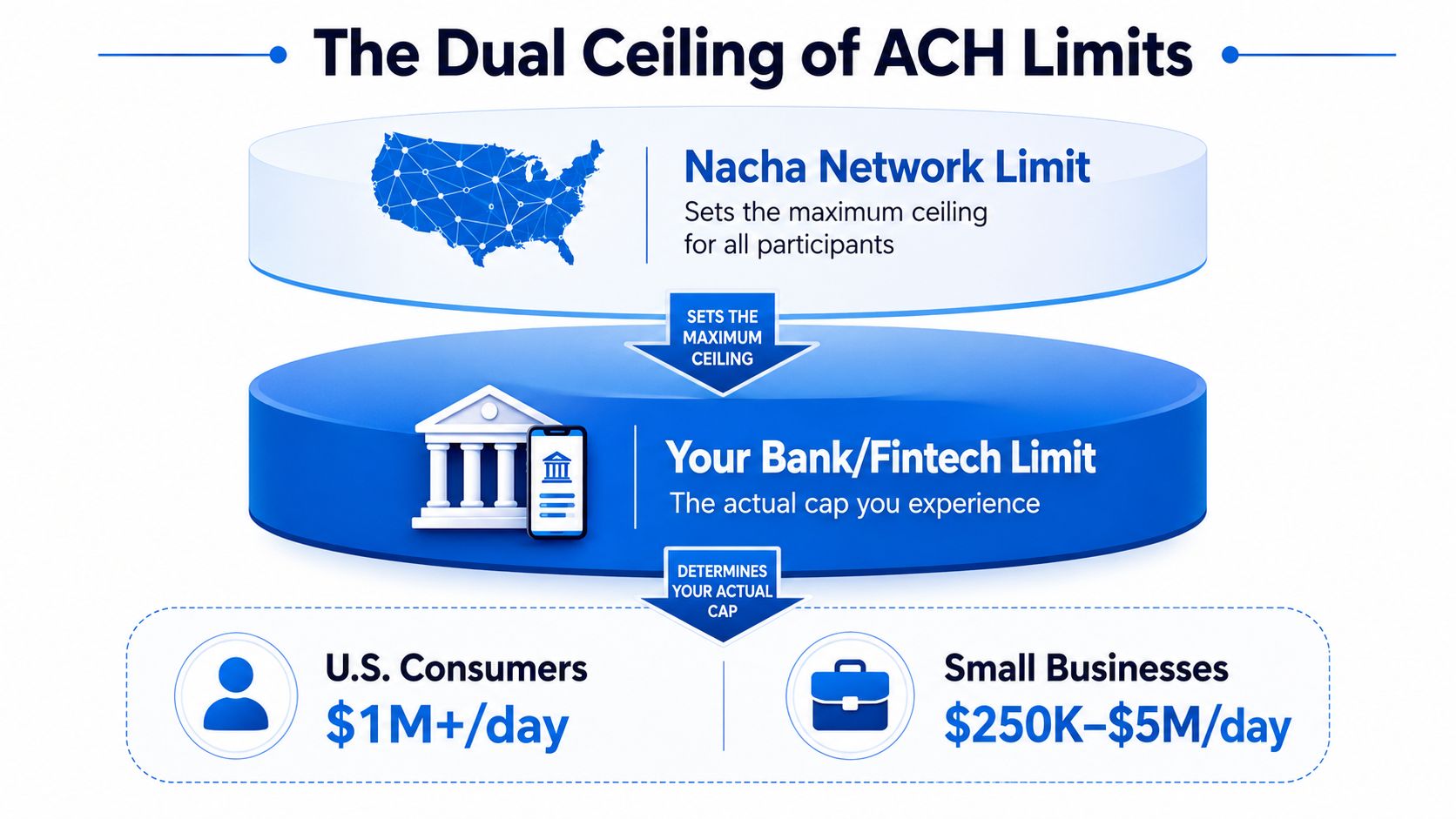
Think of the process as a layered approval model:
- Nacha ceiling: Determines whether the entry is eligible for the network and selected processing rail.
- Bank or fintech ceiling: Determines how much your account can originate through that provider.
- Channel ceiling: Determines whether the payment can be submitted through an app, API, batch file, or relationship manager.
- Operational ceiling: Determines whether funding, approvals, cutoffs, and exception checks are complete.
The last three layers are where most businesses encounter friction. A provider may approve a larger amount after reviewing account history, beneficial ownership, cash balances, and the purpose of the transfer. Teams that need to configure payment methods should therefore document not only which rails they support, but also how limits, approvals, and fallback methods work.
Practical rule: Treat the bank's displayed limit as the operating limit until the provider confirms a higher one in writing.
The sections ahead separate standard ACH from Same Day ACH, explain the roles of the ODFI and RDFI, show how personal and business controls differ qualitatively, and outline a practical increase request. The central conclusion is simple: a network ceiling tells you what ACH can support, while provider policy tells you what your account can do today.
Core ACH Terminology You Need First
ACH stands for Automated Clearing House. It's a U.S. electronic payments network that processes credits and debits through participating financial institutions, generally using batch-based processing rather than a single real-time instruction.
The ODFI, or Originating Depository Financial Institution, is the institution that sends an ACH entry into the network on behalf of its customer. If your business initiates an outbound vendor payment from its bank account, that bank or platform is acting as the ODFI for the transaction.
The RDFI, or Receiving Depository Financial Institution, receives the entry and posts it to the beneficiary's account. The RDFI manages receiving-side processes such as posting, availability, and certain exception workflows. A single bank can be an ODFI for one payment and an RDFI for another.
Same Day ACH is the processing option that allows eligible entries to settle on the same banking day. It has a separate per-entry network limit, so a payment can be acceptable under standard ACH rules but ineligible for same-day processing because of its value or timing.
These roles explain why an incoming payment can behave differently from an outgoing one. The institution originating the payment applies the send-side controls, while the receiving institution manages how it posts and makes funds available.
| Term | Operational meaning |
|---|---|
| ACH | U.S. electronic payment network for credits and debits |
| ODFI | Institution that originates and submits the ACH entry |
| RDFI | Institution that receives and posts the entry |
| Same Day ACH | ACH processing option designed for settlement on the same banking day |
Once those roles are clear, an ACH limit question becomes more precise. Ask whether the payment is outbound or inbound, which institution is the ODFI, and whether the selected rail is standard or same day.
Network-Level ACH Limits Set by Nacha
Nacha sets the network boundary, but it does not impose one universal per-transaction dollar cap on standard ACH. Its ACH payments fact sheet distinguishes ACH payment capabilities from the policies that individual banks and platforms apply to customer accounts.
Same Day ACH has a defined per-entry ceiling. The rail launched in 2016 with a $25,000 limit. That ceiling rose to $100,000 in March 2020 and $1 million in March 2022. The current $1 million limit covers eligible consumer and business credits and debits. Nacha has approved a further increase to $10 million, scheduled to take effect on September 17, 2027.
| Effective phase | Same Day ACH per-transaction cap | Notes |
|---|---|---|
| 2016 launch | $25,000 | Initial Same Day ACH ceiling |
| March 2020 | $100,000 | Formal network increase |
| March 2022 | $1,000,000 | Applies to consumer and business entries |
| September 17, 2027 | $10,000,000 | Approved future increase |
The progression expands the types of treasury payments that ACH can support. Nacha's fact sheet describes Same Day ACH's growth from its launch into a rail handling larger business payments, with cited combined volumes increasing from 347 million to 697.5 million. Those figures describe network activity, not the amount any particular account can send.
That distinction determines how finance teams should investigate a rejected payment. If the amount falls below the applicable network ceiling, the restriction usually comes from the ODFI, bank, or platform. Teams comparing ACH payment processing options should record network eligibility separately from provider-specific limits.
Standard ACH has no Nacha-imposed network-wide per-transaction dollar maximum. Banks and fintech platforms still set their own controls for balance exposure, fraud risk, approval workflows, cutoffs, and account history. A business may therefore encounter a bank ceiling long before it approaches the network's technical capacity. A platform such as OneSafe can provide ACH access for cross-border teams, but the available amount still depends on its configured risk and account policies.
Standard ACH vs Same Day ACH Compared
Standard ACH and Same Day ACH use the same network but support different payment decisions. Standard ACH fits scheduled payroll, vendor runs, and recurring transfers. Same Day ACH is intended for eligible payments where settlement speed justifies earlier operational cutoffs and potentially higher fees.
The current Same Day ACH per-entry cap is $1 million. An approved change would raise that ceiling to $10 million from September 17, 2027, as noted in the Federal Reserve's Same Day ACH FAQ. The limit applies to each entry, rather than only to the total file, so treasury systems need payment-level checks.
| Attribute | Standard ACH | Same Day ACH |
|---|---|---|
| Network dollar rule | No universal Nacha-imposed per-entry maximum | $1 million today |
| Future approved cap | Not specified as a universal standard-ACH cap | $10 million from September 17, 2027 |
| Settlement objective | Scheduled or next banking day processing | Same banking day when eligible |
| Provider cutoff | Set by the originating institution | Set by the provider ahead of an applicable processing window |
| Best fit | Routine payroll, vendors, recurring payments | Urgent eligible business outflows |
The network ceiling does not determine the amount a business can submit. A bank or fintech platform can set a lower cap based on account history, available funds, fraud controls, approval rules, or customer risk. Cross-border teams using a platform such as OneSafe should therefore treat the displayed account limit and submission cutoff as the working constraints, even when the network permits a larger entry.
Provider cutoffs also differ from network settlement windows. A provider may stop accepting files earlier to complete authentication, fraud screening, funding checks, and file preparation. A payment that qualifies for same-day processing at the network level can still miss the provider's operational window.
Fees depend on the provider agreement. Compare standard ACH pricing with any Same Day ACH surcharge, then include the business cost of delayed settlement, manual handling, or using a wire.
For a routine vendor payment, standard ACH usually offers the simpler process. For an eligible, time-sensitive payment submitted before the provider cutoff and within its configured limit, Same Day ACH can reduce settlement delay. Payments above the applicable same-day ceiling require an alternative, such as an appropriately structured split or another payment rail.
Typical ACH Transfer Limits for Personal Accounts
Consumer ACH limits are usually tighter because the bank is managing retail fraud exposure, unauthorized-payment disputes, account history, and a lower level of individualized treasury underwriting. The network may permit a large entry, but a personal account rarely receives access to the full theoretical ceiling by default.
The important distinction is between outbound and inbound activity. A bank may restrict how much a customer can push to an external account while applying a more permissive policy to incoming payroll, benefits, or other credits. The receiving bank still controls posting and availability, even when it hasn't imposed the original outbound limit.
Retail controls commonly vary by:
- Account maturity: Newer relationships can face stricter review until the institution sees stable activity.
- Initiation channel: A mobile app may expose a lower limit than a banker-assisted or authenticated service channel.
- Transfer type: ACH, wire, and other outbound methods may share a combined risk bucket.
- Account history: Returns, overdrafts, unusual destinations, or rapid changes can lead to a temporary restriction.
A customer who needs to move a large personal balance shouldn't rely on a generic internet search result. The relevant number is the limit displayed for that account, transaction type, and channel, plus any hold or review notice attached to the payment.
The safest workflow is to confirm the outbound ceiling before scheduling the payment, not after the transfer fails.
Banks can also apply different rules to recurring transfers and one-time payments. A recurring instruction may have its own authorization profile, while a manually initiated payment can trigger additional authentication. Ask the institution whether the limit resets by calendar day, rolling period, or another internal schedule.
For personal accounts, the operational lesson is that account-specific policy dominates network capacity. If a payment is materially larger than the available outbound limit, the solution may involve a reviewed increase, a different bank channel, or a different rail, rather than a change to the ACH network itself.
Typical ACH Transfer Limits for Business Accounts
Business accounts generally receive more flexible ACH treatment because banks underwrite the entity, its owners, expected cash flows, and payment purpose. Commercial ACH supports payroll, vendor settlement, contractor payouts, tax payments, and treasury transfers, so providers often build tiered controls instead of one universal retail ceiling.
The tiers usually reflect documentation and relationship depth:
| Account tier | Per-transaction approach | Daily approach | Monthly approach |
|---|---|---|---|
| Starter | Conservative provider-defined cap | Controlled outbound aggregate | Lower activity band |
| Growth | Higher limit after account history and review | Sized for recurring operating payments | Expanded with documented cash flow |
| Treasury | Negotiated limit, potentially up to the network ceiling | Managed through treasury controls | Set around expected business velocity |
These labels aren't universal banking standards. They're a useful operating model for comparing what a provider may ask for before increasing access. A startup with clean KYB documentation and predictable payroll may receive a different limit from a mature company with irregular crypto-related flows, even if both hold business accounts.
Inbound ACH can also be treated differently from outbound ACH. The originating institution controls the send-side authorization, while the receiving platform may apply posting, availability, or account-review procedures after funds arrive. That distinction can make “deposit limit” and “send limit” appear inconsistent when they are controlled by different institutions.
Business teams should separate four numbers in their payment design:
- Per-entry authorization, which controls the largest individual payment.
- Daily aggregate, which controls total outbound activity during the provider's measurement period.
- Monthly exposure, which supports broader monitoring of expected cash velocity.
- Available funding, which can prevent a payment even when the formal limit is high.
Most companies don't approach the Nacha ceiling. Their binding constraint is more often the provider's internal policy, the account's documented use case, the channel used to submit the payment, or the funding balance available for settlement.
How Banks Actually Set Your ACH Limits
Banks don't select ACH limits from a single public table. They combine customer information, transaction behavior, channel risk, and operational controls to decide how much an account can originate.
Account age is an early signal. A newly opened relationship has limited behavioral history, so the institution may keep outbound access conservative until it can validate the expected activity. A mature account with consistent funding and predictable recipients can support a more informed risk decision.
Risk review adds another layer. The provider may assess KYB or KYC records, ownership information, prior returns, insufficient-funds events, unusual destinations, and changes in transaction behavior. A clean history doesn't guarantee a high limit, but adverse events can narrow access or trigger manual review.
The submission channel matters too. A retail app, API, batch file, and banker-assisted workflow can carry different controls. An API payment may require whitelisted recipients and approval logic, while an app payment may rely on device authentication and a simpler transaction screen.
| Variable | Effect on limit | Typical direction |
|---|---|---|
| Account tenure | Gives the provider more behavioral history | Longer history can support expansion |
| KYB or KYC profile | Establishes identity and expected activity | Clear documentation supports review |
| Return and funding history | Changes perceived operational risk | Clean performance is more favorable |
| Submission channel | Changes authentication and review depth | Controlled channels may support higher access |
| Relationship scope | Adds balances, payroll, and payment context | Broader relationships can inform increases |
| Stated payment purpose | Connects the amount to a real business need | Specific use cases are easier to assess |
For companies designing a broader banking stack, business account setup and fiat-crypto integration should be evaluated alongside payment permissions. A multi-rail account may still apply separate rules to ACH, wires, cards, and digital-asset conversions.
The result is dynamic rather than purely contractual. A provider can approve a limit increase for a payroll batch, then maintain a different default for ordinary transfers. Finance teams should store the approved amount, expiry conditions, channel restrictions, and review contact in their payment controls.
How OneSafe Approaches ACH Limits and Increases
OneSafe treats ACH as one rail within a broader USD payments stack for cross-border teams. Its documented operating model uses a default outgoing ACH allowance of $50,000 per transaction, a $250,000 daily aggregate, and a $2 million rolling monthly cap for business workflows such as payroll, vendor payouts, and intercompany funding.
Those defaults illustrate a useful design choice. The platform doesn't treat the network maximum as the automatic customer entitlement. It starts with controls sized for expected operating activity, then handles larger or unusual flows through an account-level review.
An increase request routes through the account manager and is tied to evidence. The requested materials include a recent bank statement, beneficial ownership confirmation, and a stated purpose such as a payroll batch or treasury concentration move. Verified accounts can receive an approved increase within two business days, according to the supplied platform information.
The workflow is more practical than asking for “unlimited ACH.” A finance team should explain:
- What the payment is for, such as payroll, vendors, or intercompany funding.
- Why the existing cap is insufficient, including whether the issue is per-entry, daily, or monthly.
- Which payment rail is needed, standard ACH or Same Day ACH.
- Whether the need is recurring, temporary, or tied to a specific settlement event.
Inbound ACH can carry a different ceiling because the originating institution sends the funds and assumes the initial origination controls. That doesn't remove receiving-side review, but it reinforces the need to distinguish push and pull transactions.
The operational conclusion is that limit design should mirror treasury behavior. Keep routine payments inside a predictable default range, reserve same-day processing for time-sensitive outflows, and use documented escalations for exceptional payments. That approach also gives finance teams a clearer audit trail than repeatedly retrying failed transfers.
How to Request an ACH Limit Increase
A successful ACH limit request is a risk-review package, not a request to remove controls. The provider needs enough information to connect the requested amount with a legitimate, funded, and repeatable business activity.
Start with the correct channel. An in-app form may be appropriate for a routine adjustment, while a relationship banker, account manager, or treasury support ticket is more suitable for a large payroll run, vendor batch, or unusual treasury movement. The channel affects how quickly the request reaches the team that can assess it.
Prepare the evidence before submitting:
- Account identity: Make sure the legal entity, authorized users, and beneficial ownership records match the provider's files.
- Financial context: Supply recent statements or balance evidence that supports the expected payment activity.
- Payment proof: Attach a payroll register, vendor invoice, settlement file, or another document showing the business purpose.
- Limit specification: State the requested per-entry, daily, or monthly amount rather than asking vaguely for a higher limit.
- Rail and timing: Explain whether standard ACH works or whether same-day settlement is necessary.
Then describe the payment in operational terms. Include the recipient type, expected frequency, funding source, and whether the increase should remain in place or apply only to a defined period. A precise request reduces the chance that the provider approves the wrong limit dimension.
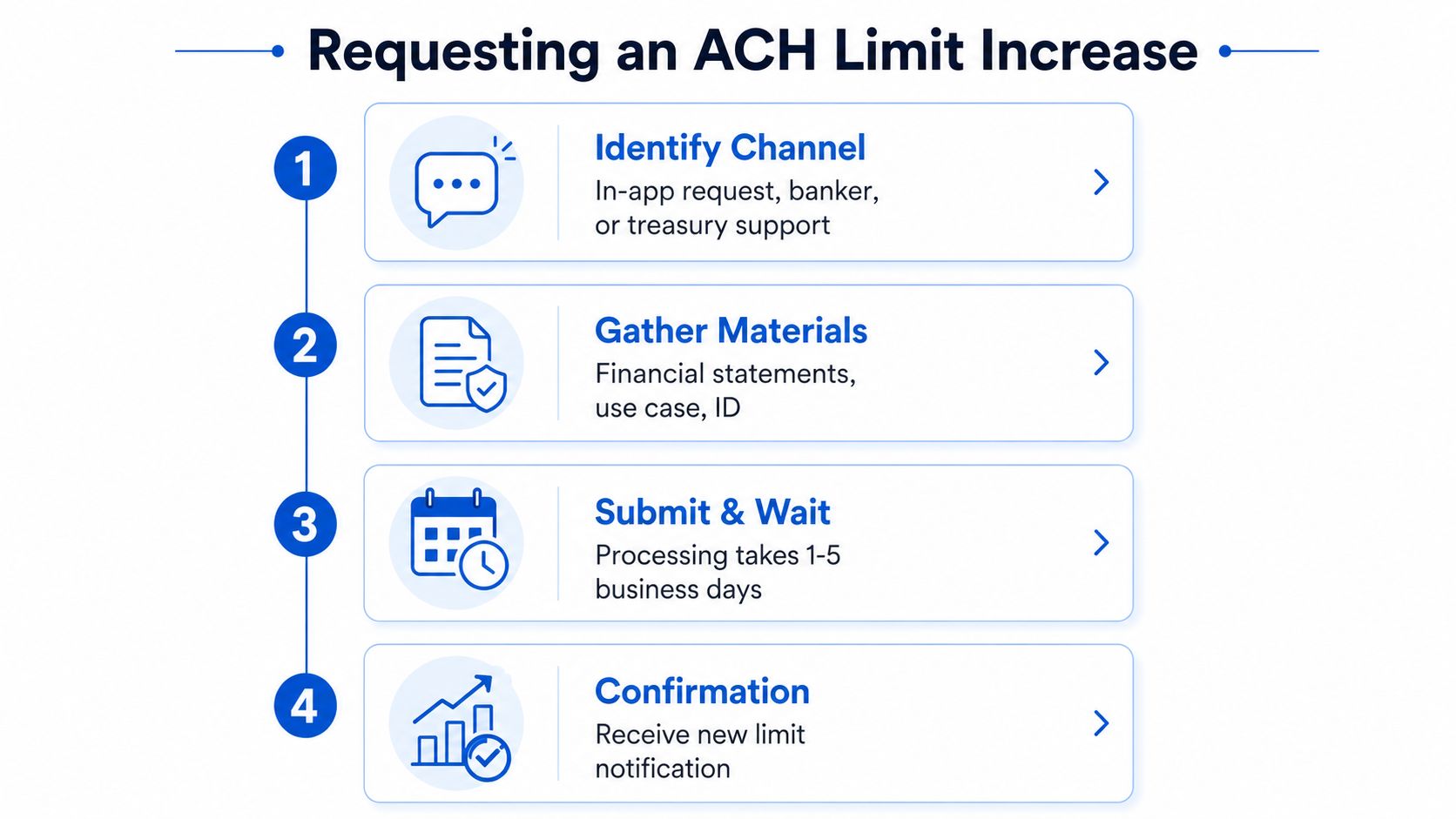
After submission, record the ticket, requested amount, supporting documents, and provider response. If the request is declined, ask which variable constrained it, then reapply with new evidence rather than sending the same request again.
ACH Returns and Exception Handling
An ACH limit isn't only a send-side number. Returns create a second operational constraint because the ODFI must manage exception volume, unauthorized activity, funding exposure, and customer complaints.
Nacha's 2025 operations bulletin on Same Day ACH returns clarifies that same-day processing rules don't prevent same-day processing of returns to forward Same Day ACH entries or entries below the current cap. That means return timing can be more flexible than a simple reading of the forward-payment limit suggests.
The bulletin also addresses return handling for unauthorized and administrative cases. It discusses the relevant unauthorized-entry reason codes, including R10, R11, R29, and R51, as well as different return windows for certain administrative and unauthorized returns. These rules matter because a payment that appears complete can still create an exception workflow requiring reconciliation, customer contact, and account review.
A finance team should connect return monitoring to its payment controls:
- Review the RDFI account activity for return codes and unexpected reversals.
- Separate high-risk counterparties from routine recurring beneficiaries.
- Delay dependent outflows when a return could change available funding.
- Escalate repeated exceptions before requesting a larger origination limit.
A single return doesn't automatically create a new ACH ceiling, but it can trigger provider review or tighter controls. The practical risk is not just the returned amount. It's the effect on trust, available balance, recipient validation, and the institution's willingness to approve future payment volume.
Quick Reference for Choosing the Right ACH Path
The right rail depends on urgency, value, provider eligibility, and the consequence of delay. The matrix below focuses on the decision, not just the nominal network ceiling.
| Payment scenario | Recommended rail | Typical cap | Cutoff (ET) | Settlement | Consider instead |
|---|---|---|---|---|---|
| Payroll run | Standard ACH if scheduled in advance | Provider-defined | Provider-defined | Scheduled banking-day processing | Same Day ACH for urgent corrections |
| Vendor payment | Standard ACH for predictable terms | Provider-defined | Provider-defined | Scheduled banking-day processing | Wire for deadline-critical delivery |
| Refund or recovery payment | Standard ACH when timing allows | Provider-defined | Provider-defined | Scheduled banking-day processing | Same Day ACH for urgent customer remediation |
| Time-sensitive B2B settlement | Same Day ACH if eligible | $1 million per entry today | Provider-defined | Same banking day when eligible | Wire or RTP where available |
| Recurring consumer debit | Standard ACH | Provider-defined | Provider-defined | Scheduled banking-day processing | Card or other authorized rail |
For teams coordinating payroll with broader people operations, a practical HR and payroll software comparison can help connect payment timing with payroll approval and file preparation.
The decision rule is straightforward: if the payment fits the provider's cap and isn't time-critical, use standard ACH; if it needs same-day settlement, evaluate Same Day ACH, wire, or another available rail. Payments above the current Same Day ACH per-entry ceiling require a different structure or payment method.
Teams comparing international settlement should also review ACH versus SWIFT payment workflows, especially when the recipient, currency, or settlement jurisdiction changes.
ACH Transfer Limits FAQ
Do ACH limits reset on a rolling period or a calendar day?
The bank or fintech provider sets this behavior. Confirm whether the displayed allowance resets by calendar day, provider-defined operating day, or rolling window. The answer can affect payment scheduling near cutoff times.
Do business and personal accounts at the same bank share one ACH ceiling?
Usually, institutions manage them as separate account or product buckets. Ask whether linked accounts share exposure, because personal activity may not consume the business account's stated limit, and the reverse may also apply.
Does a returned ACH count again against the daily limit?
The original payment and its return are separate operational events. A return generally reverses the original debit rather than creating another outbound payment. Internal risk controls can still reduce available access or trigger additional review.
Why can a Same Day ACH window close before the published settlement time?
The network settlement schedule and the provider's customer cutoff serve different purposes. A bank may close intake earlier for screening, approval, and file preparation before the applicable settlement window. The 2:45 PM ET window remains a network timing reference, not a guaranteed customer submission deadline, as noted in the Federal Reserve Same Day ACH guidance.
OneSafe offers cross-border businesses a multi-currency account and payment stack that may include ACH, wires, SWIFT, corporate cards, and crypto-compatible treasury workflows. Review current ceilings, record use cases that exceed them, and assess OneSafe's account and escalation process for global operations.