Agentic payments are transactions where AI agents decide when, how, and to whom money moves, executing within your guardrails. This guide addresses crypto-native operations, DAO treasury management, and the fiat-crypto plumbing businesses actually use, grounded in the concrete proof-of-concept work from November 2026.
Table of Contents
- What Are Agentic Payments?
- How Agentic Payments Work: The Emerging Architecture
- The Trust and Security Infrastructure
- Agentic Payments for Crypto-Native Businesses and DAOs
- Preparing Your Business for Agentic Payments: A Practical Framework
- Risks, Limitations, and Common Myths
- The Road Ahead: What’s Next in Agentic Payments
- How Can My AI Agent Truly Understand My Complex Intent?
- Since AI Agents Can Trade Autonomously, Could This Create a Machine-Dominated Financial Market?
- Compared to Traditional Payments, Will Transaction Costs for AI Agent Payments Be Higher or Lower?
- What If My AI Agent Makes a Decision I’m Unhappy With and Completes the Payment?
- As an Ordinary Business, What Should I Do Now to Prepare for AI Agent Payments?
- Key Takeaways
What Are Agentic Payments?
An agentic payment isn’t faster ACH. An AI agent acts on an intention—“pay this invoice if it matches the contract terms and cash position”—by decomposing intent, verifying counterparties, and selecting the payment rail itself. The policy is human; execution is autonomous.
Agentic vs. Automated: The Intelligence Leap
Traditional automation runs rigid workflows. Agentic systems handle ambiguity—resolving mismatched POs or checking Slack threads to release payment or flag with a recommendation. The leap is navigating exceptions without human hand-holding.
Agentic Payments vs. Agentic Commerce: Clarifying the Scope
Agentic commerce covers AI-powered shopping, negotiation, logistics, and payment. Agentic payments are the financial settlement layer after a decision. You can adopt agentic payments in AP without building a full commerce front-end. This guide stays on the payment side—particularly the multi-currency infrastructure for fiat and crypto.
How Agentic Payments Work: The Emerging Architecture
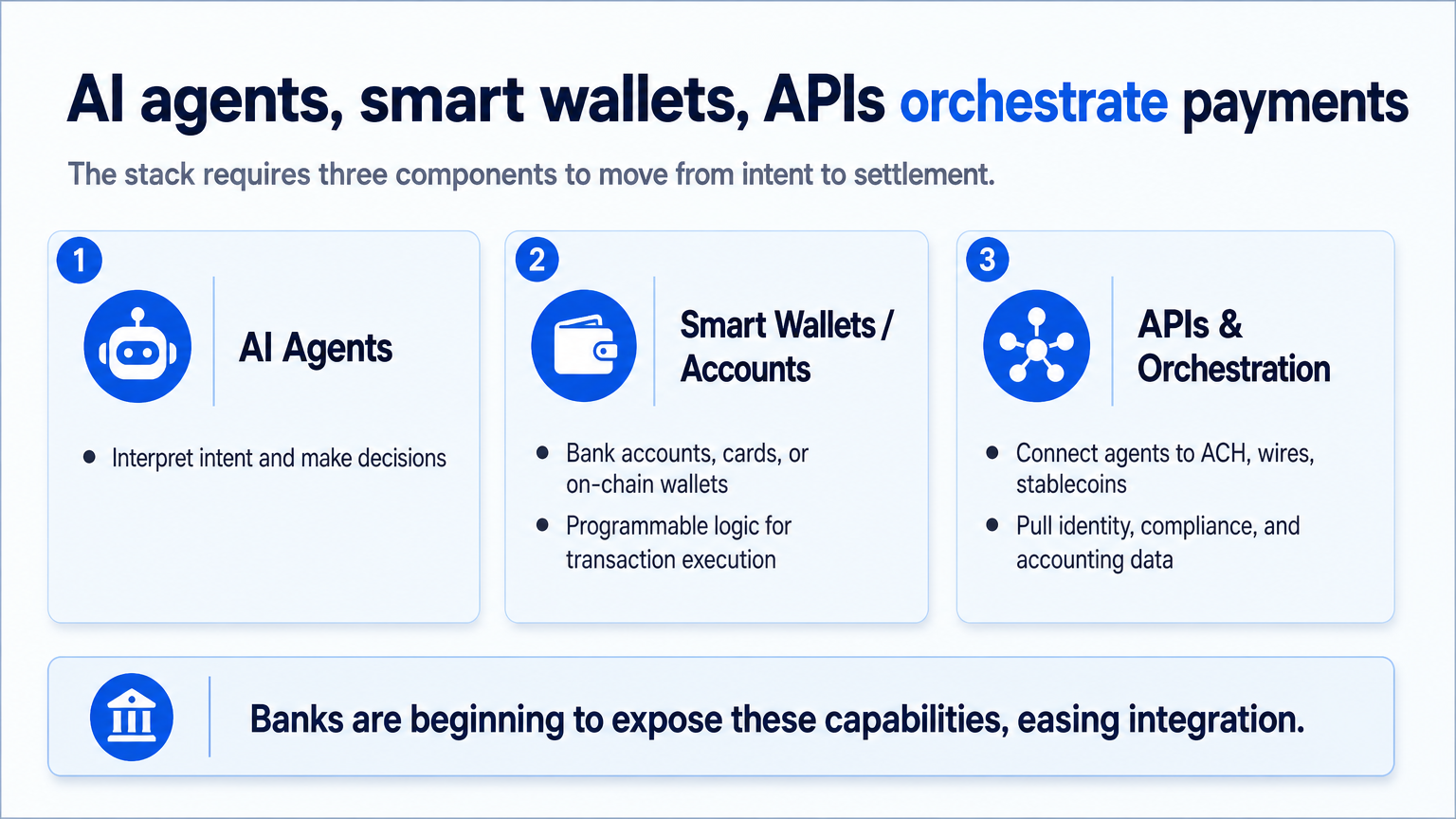
AI Agents, Smart Wallets, and APIs: The Core Trio
The stack requires three components:
- AI agents that interpret intent and make decisions within risk parameters.
- Smart wallets or payment accounts—bank accounts, card issuance engines, or on-chain wallets with programmable logic (AI Agent Payments Infrastructure).
- APIs and orchestration layers connecting agents to rails (ACH, wires, stablecoins) while pulling identity, compliance, and accounting data in real time.
In 2026, banks and fintechs are beginning to expose these capabilities without requiring you to build the orchestration yourself.
Intent Capture and Task Decomposition
The hardest part is accurate interpretation of ambiguous requests. Structured intent templates help: “Pay approved vendor invoices under $10k from USD account; if balance drops below $50k, convert USDC from treasury.” The agent decomposes into sub-tasks—balance checks, invoice matching, FX simulation—with every step logged for auditability.
Tokenization and Trust: The Layer That Makes It Safe
Agentic tokenization replaces sensitive credentials with network tokens scoped to specific merchants, amounts, or time windows. As Mastercard’s framework shows, this prevents reuse if an agent is compromised. On-chain tokenized deposits represent real-world bank balances, letting agents move value across fiat and crypto rails without exposing core credentials.
The Trust and Security Infrastructure
Know-Your-Agent: Authenticating AI Counterparts
Before a payment agent sends $50,000 to a supplier’s agent, you need to know who that agent is and its authority. The know-your-agent (KYA) standard verifies AI agent identity, organizational affiliation, and payment scope. On November 18, 2026, Hyundai Card and Kinexys by J.P. Morgan demonstrated a trust framework using signed mandates and institutional controls. Banks are now testing KYA in invoice and liquidity workflows, separating legitimate AI agents from malicious bots without tripping anti-fraud systems.
Fraud Prevention in an Agentic World
Agentic payments expand the attack surface: authorized agents that behave maliciously or are spoofed. Countermeasures layer KYA with behavioral analytics—does the agent’s pattern match its declared scope?—and policy engines enforcing hard limits and multi-signature approvals. Agentic auditing is mandatory; every decision must be replayable by a human auditor.
Liability and Dispute Resolution: Who Pays When an Agent Errs?
Legal frameworks lag. If an agent misinterprets an intent and pays wrongly, current regs treat it as authorized, leaving you to recover funds. The Hyundai Card–Kinexys proof-of-concept addresses this via mandate parameters—if the agent acts outside its signed mandate, liability shifts. Businesses need clear decision authority in delegation policies and human-in-the-loop for high-value or novel payments. The path forward combines cryptographic proof of mandate execution and contractual agreements between agent-operating entities.
Agentic Payments for Crypto-Native Businesses and DAOs
Why Stablecoins and Blockchain Are a Natural Fit
Stablecoins settle near-real-time, 24/7, without correspondent bank delays—ideal for agentic workflows that move money across time zones. Programmable blockchains let agents execute complex conditions (e.g., releasing payments when an oracle confirms code deployment) without an escrow agent. This makes crypto payments and DAO payments through AI agent payments a natural early use case.
Cross-Chain and Fiat-Crypto Workflows
Real businesses rarely operate on one chain or currency. An agentic autonomous payments platform must handle a DAO paying contributors in USDC on Ethereum while settling a vendor invoice in EUR via SEPA. That requires unified on/off-ramping and cross-chain bridging within the agent’s logic—automatically choosing the cheapest liquidity path between Polygon, Arbitrum, and a fiat account based on real-time fees.
Real-World Use Cases: DAO Treasury Management and Global Payroll
A DAO with multi-sig treasury can let an agent execute recurring payments and small grants under $5,000 that match pre-approved templates, while still requiring multi-sig for exceptions. For global businesses, agentic payroll converts and delivers salaries in local fiat or stablecoins using optimal FX routing, scheduling to local banking days.
Preparing Your Business for Agentic Payments: A Practical Framework
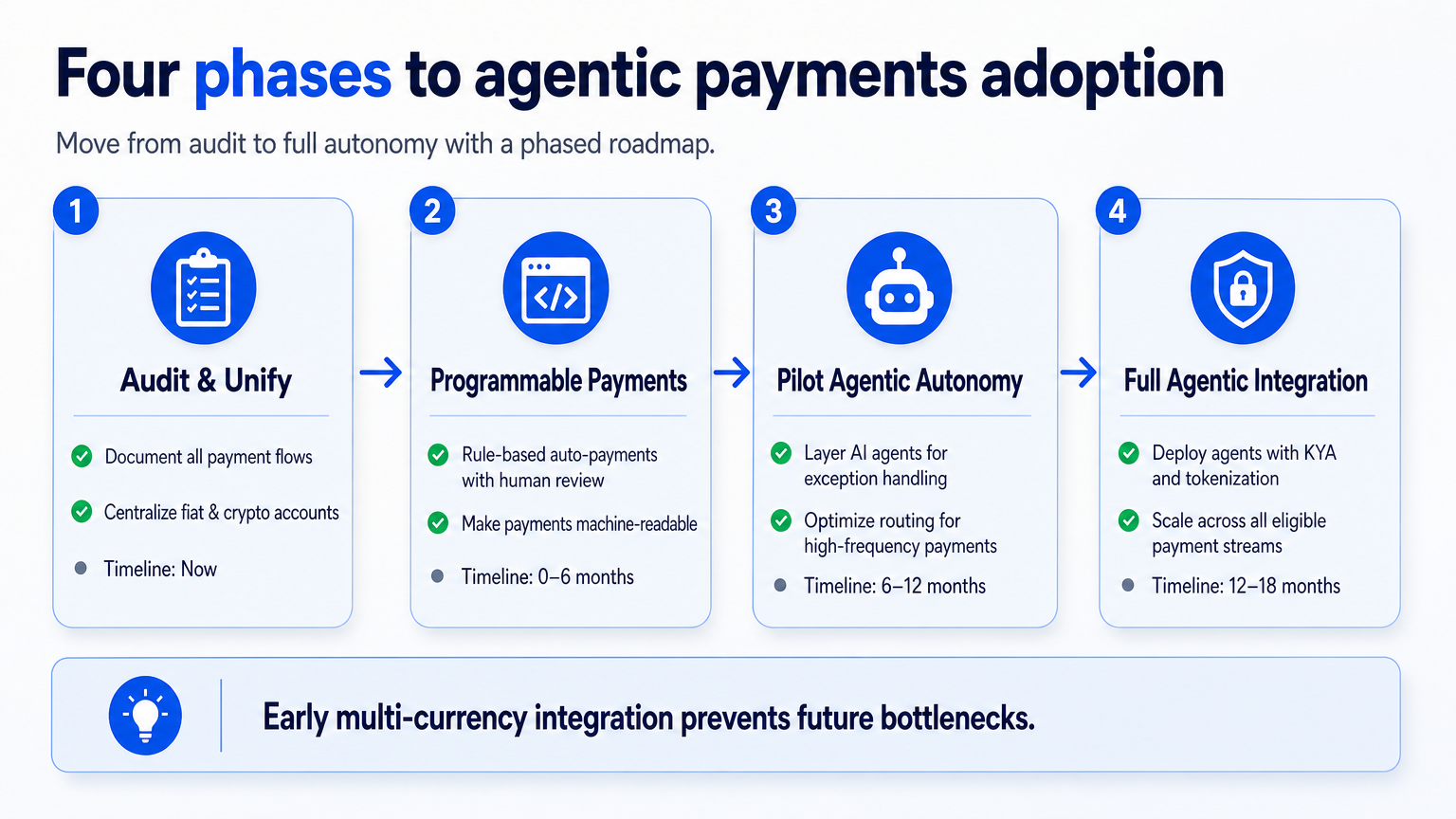
Audit Your Current Payment Stack
Document every payment flow: authorizers, rails, friction points. Fragmented banking portals, crypto wallets, and spreadsheets will only compound chaos under agentic payments. A unified fiat-crypto account structure is a prerequisite.
Start with Programmable Payments, Then Scale Autonomy
Begin by making payments machine-readable and API-triggered. Set up rule-based flows that auto-pay approved invoices up to a limit, with human review for outliers. As trust builds, layer on AI agents to handle exceptions and optimize routing.
Integrate Multi-Currency and Crypto Capabilities Early
Agentic payments will span fiat and stablecoin rails. If your infrastructure can’t natively hold, convert, and send both, you’re creating a future bottleneck. Platforms offering multi-currency accounts, on-chain custody, and corporate cards in one interface—like OneSafe, with fiat and USDC accounts and automated conversion—provide a practical foundation. Regulatory clarity for stablecoin payments has improved significantly; waiting until you “need” crypto rails will delay your agentic roadmap.
Build Compliance and Reporting Now
Agentic transactions generate massive audit trails. Ensure your compliance infrastructure can ingest that data, reconcile with accounting systems, and flag anomalies. Implement real-time transaction monitoring and tagging early so you’re not drowning in unstructured logs when agents scale.
As you streamline financial operations, consider automating other areas—Joyrise analyzes your site, then writes and publishes SEO articles to Webflow, WordPress, or Shopify daily, growing organic traffic while you sleep.
Risks, Limitations, and Common Myths
Adoption Barriers: Merchant Resistance and Platform Gatekeeping
While Visa is building agentic commerce infrastructure, reality is uneven. Major platforms may not allow AI agents to shop on behalf of users, citing fraud and policy concerns. Anti-fraud systems routinely flag agent-initiated transactions as suspicious. Frictionless agentic B2C payments will take longer than optimistic forecasts suggest.
The Machine-Dominated Market Myth
Fears of autonomous trading agents creating uncontrollable markets are misplaced. Payment agents operate within bounded mandates; they execute financial operations, not strategic objectives. The real risk is poorly scoped mandates allowing an agent to drain a treasury faster than a human could.
Is Agentic Payments Really Cheaper? Examining the Costs
Long-term operational savings are real, but early adopters face integration, auditing, and compliance costs. Stablecoin transaction fees can be lower than wires, but you’ll pay for tokenization, orchestration platforms, and possibly higher fraud monitoring premiums. Net cost savings won’t materialize until trust infrastructure standardizes and volume reaches scale. For now, the primary benefit is speed and 24/7 liquidity optimization.
The Road Ahead: What’s Next in Agentic Payments
The 2026 Proof-of-Concept Wave: What We Learned
The Hyundai Card–Kinexys demonstration proved signed mandates, verified agent identity, and institutional controls can enable legally and operationally sound agent-to-agent transactions. KYA pilots confirm banks are moving beyond theory, testing authentication protocols that could become standard within 18 months. The trust layer is being built now; businesses should monitor these standards to align future infrastructure.
Standards and Protocols on the Horizon
Expect KYA to converge with decentralized identifiers, and payment networks to release agent-specific API endpoints. Mastercard’s tokenization work will likely expand into cross-network tokens. The critical watchpoint: interoperability between bank-led and blockchain-native agentic identity systems.
When to Act: Timing Your Agentic Investment
If you move money across borders, pay a large contractor network, or manage a DAO treasury, start the programmable payments phase now. The full agentic leap follows in 12–18 months, once KYA standards commercialize and your processes are API-native. Late movers risk being locked out of incremental efficiency gains.
| Adoption Phase | Key Action | Timeline |
|---|---|---|
| 1. Audit & Unify | Document all payment flows; centralize fiat and crypto accounts into one API-accessible platform. | Now |
| 2. Programmable Payments | Set rule-based auto-payments with human review for outliers. Make payments machine-readable. | 0–6 months |
| 3. Pilot Agentic Autonomy | Layer on AI agents to handle exceptions and optimize routing for non-critical, high-frequency payments. | 6–12 months |
| 4. Full Agentic Integration | Deploy agents with KYA, tokenization, and mandate scoping across all eligible payment streams. | 12–18 months (post-standards) |
How Can My AI Agent Truly Understand My Complex Intent?
Agents don’t understand intent like humans; they decompose it. Provide a structured policy: trigger conditions, decision parameters, fallback rules (e.g., “Pay approved vendor invoices under $5k from USD account; if insufficient funds, sell USDC to cover; else hold for review”). Pair with a system logging reasoning step by step so you can refine the policy.
Since AI Agents Can Trade Autonomously, Could This Create a Machine-Dominated Financial Market?
No. Agentic payments for business operations execute routine, bounded tasks—not speculative strategies. Even autonomous agents in markets operate within human-set risk parameters and circuit breakers. The safeguard is mandate scoping: define what an agent can never do and build it into permissioning.
Compared to Traditional Payments, Will Transaction Costs for AI Agent Payments Be Higher or Lower?
It depends on the rails the agent selects. Stablecoin payments (USDC) can settle with near-zero network fees vs. $25–$50 international wires. However, agents incur costs for tokenization, KYA verification, and orchestration platforms. Early all-in costs may exceed manual ACH. After standardization and volume, costs should dip below traditional cross-border payments. For now, adopt for speed and operational leverage, not fee reduction.
What If My AI Agent Makes a Decision I’m Unhappy With and Completes the Payment?
Under current regs, an agent acting within its scope executes an authorized transaction—reversals are unlikely. Recourse is with the merchant or your dispute process. Mitigate risk with hard transaction limits, short authorization windows, and mandatory human review for non-recurring or high-value payments. Use audit trails to improve policies, not chase reversals. Emerging mandate-based frameworks aim to shift liability when agents exceed signed mandates, but they aren’t universal yet.
As an Ordinary Business, What Should I Do Now to Prepare for AI Agent Payments?
- Centralize payment infrastructure – unify fiat, crypto accounts, cards, and treasury into an API-exposed platform.
- Define payment policies in writing – thresholds, approval hierarchies, preferred rails.
- Pilot with non-critical, high-frequency payments using rules-based automation.
- Track KYA and tokenization standards – plug in when mature without a rip-and-replace.
Key Takeaways
- Agentic payments replace rigid automation with AI-driven decisions, but trust infrastructure—KYA, tokenization, mandates—is still being built, as the 2026 proofs of concept show.
- Crypto-native businesses and DAOs are early adopters because stablecoins and programmable blockchains naturally complement agentic settlement.
- Adopt a two-phase approach: move to programmable, API-driven payments now; add agentic autonomy later when standards solidify.
- Don’t chase cost reduction in the short term; the immediate benefit is 24/7 operational speed and simpler cross-currency treasury management.
- Liability for agent errors is a live issue—scoped mandates with audit trails are your best defense until legal frameworks catch up.
Start building your unified fiat-crypto payment foundation today at OneSafe.