HSBC’s tokenized fund on Ethereum marks a new era for crypto banking, merging traditional finance with on-chain operations for businesses and DAOs.
On November 21, 2026, HSBC quietly turned a corner for crypto banking—not by launching a new stablecoin or custody service, but by making a tokenized fund available on the Ethereum blockchain. For years, “crypto banking” meant neobanks offering business accounts that could hold USDC alongside fiat, or exchange APIs letting corporates park crypto-derived cash. HSBC’s move changes the game: it brings a piece of mainstream, regulated traditional finance onto a public blockchain, with all the operational and treasury implications that carries for global businesses and DAOs.
This article unpacks what just happened, why it matters now, and exactly what steps a startup or decentralized organization can take to stay ahead—without getting lost in hype.
Table of Contents
- What Just Happened: HSBC’s Tokenized Fund Hits Ethereum
- Why This Matters Now for Crypto Banking
- The Background: Crypto Banking in 2026
- What HSBC’s Move Means for Your Business or DAO
- What HSBC’s Tokenized Fund Means: Your Questions Answered
- What to Watch Next
- Key Takeaways
What Just Happened: HSBC’s Tokenized Fund Hits Ethereum
HSBC, one of the world’s largest banking groups, expanded its retail tokenized fund offering to the Ethereum network. The product—a money-market-like vehicle previously available via a private ledger—is now accessible to eligible Hong Kong investors on a public blockchain, according to a Traders Union report published on November 21, 2026. (source) The fund tokens represent shares in a low-risk traditional asset pool, but ownership records and transfers live natively on Ethereum.
By moving from a permissioned internal ledger to a public, EVM-compatible chain, HSBC signals that tokenized funds have passed the pilot stage. A closed-loop test can prove technology; a launch on Ethereum—where tokens could potentially interact with DeFi protocols, on-chain wallets, or even automated treasury contracts—puts the concept into operational territory. Regulatory eligibility restricts who can hold them, but the infrastructure matches the one businesses and DAOs already use for stablecoin and crypto treasury management.
Why This Matters Now for Crypto Banking
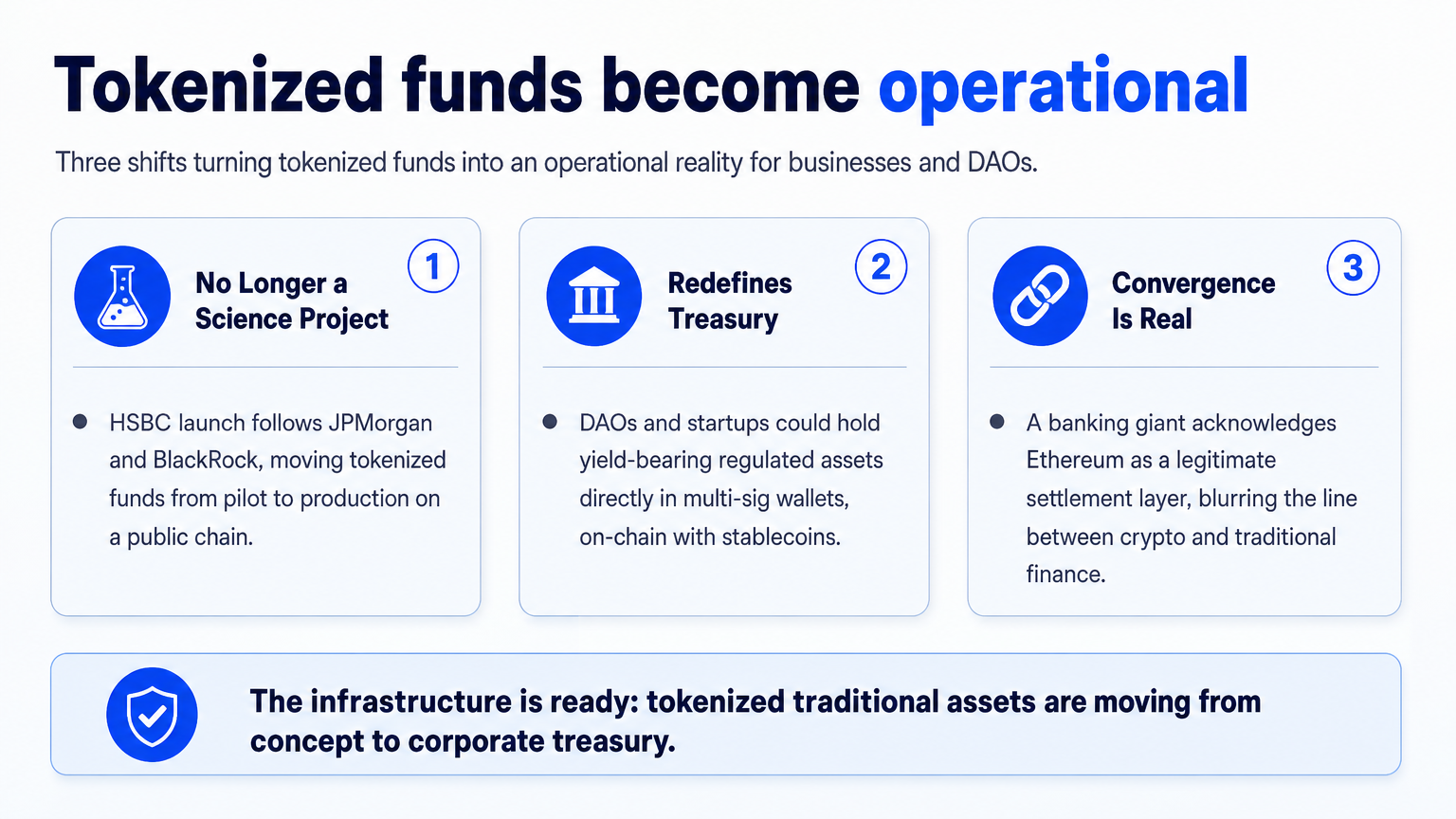
Tokenized traditional assets are no longer a science project
Real, live retail-accessible tokenized products have been sparse. The HSBC launch follows a broader trend: JPMorgan’s Kinexys platform, BlackRock’s BUIDL tokenized money-market fund, and other pilots. HSBC’s move is among the first to put a tokenized traditional fund on Ethereum for retail or mass-affluent investors, even if initially limited to Hong Kong. As the Federal Reserve Bank of New York notes, tokenized investment funds are emerging as practical tools. This shifts Ethereum tokenization from a capital-markets curiosity toward something that could affect how companies hold cash equivalents.
For businesses and DAOs, it redefines treasury possibilities
Until now, a DAO or Web3 startup holding idle working capital chose between stablecoins or cashing out to fiat for a bank product—breaking the on-chain workflow. A tokenized fund like HSBC’s could, if accessible to entities across jurisdictions, allow holding traditional yield-bearing assets directly in a multi-signature wallet. The asset would still be a regulated security, but settlement and custody layers would be on-chain, compatible with existing DAO treasury management tools.
The convergence of legacy finance and Web3 infrastructure
HSBC’s rollout embodies the convergence of legacy finance and Web3 infrastructure. It’s a banking giant acknowledging the blockchain as a legitimate settlement layer, not just a speculative playground. For businesses relying on crypto-fiat integration, the line between “crypto” and “traditional” banking will only blur further—and those not prepared for tokenized assets may find treasury operations split across incompatible systems.
The Background: Crypto Banking in 2026
Modern platforms provide business crypto banking services: multi-currency accounts, corporate cards, wire and ACH transfers, foreign exchange, and seamless on/off-ramps. Security and compliance are table stakes—custody often relies on institutional-grade providers like Fireblocks, and KYB processes onboard businesses in days. Still, regulations remain fragmented.
Earlier institutional crypto moves focused on custody for large investors or proprietary tokenization for wholesale participants, leaving a gap for mid-market companies. A startup wanting to pay vendors with USDC, hold a euro balance, and eventually park treasury in a tokenized fund found no single interface. Unified crypto banking platforms bridge this by offering institutional crypto adoption without multiple banking relationships and on-chain tools.
What HSBC’s Move Means for Your Business or DAO
Concrete treasury implications
If tokenized traditional funds become open to corporate entities, a business could hold working capital in a regulated, low-risk product on-chain. For a DAO, a multi-sig wallet might hold USDC, ETH, and HSBC fund tokens—visible on one dashboard. Cash management and yield generation no longer require off-chain banking portals that break the audit trail. Redemptions may not be instant, so allocation decisions must account for time-to-cash windows.
How a unified platform like OneSafe eliminates fragmentation
A platform natively supporting fiat and crypto—like OneSafe—can serve as a single pane of glass for this new treasury landscape. A business could hold fiat in segregated multi-currency accounts, convert between crypto and fiat, and—when tokenized fund shares become widely available—custody those tokens through the same interface, all secured by institutional-grade infrastructure. This eliminates the need to juggle a traditional bank for payroll, a crypto exchange for stablecoin payments, and a separate wallet for tokenized securities. OneSafe is not a bank (services are provided by partners) but fills the operational gap earlier institutional crypto moves left open.
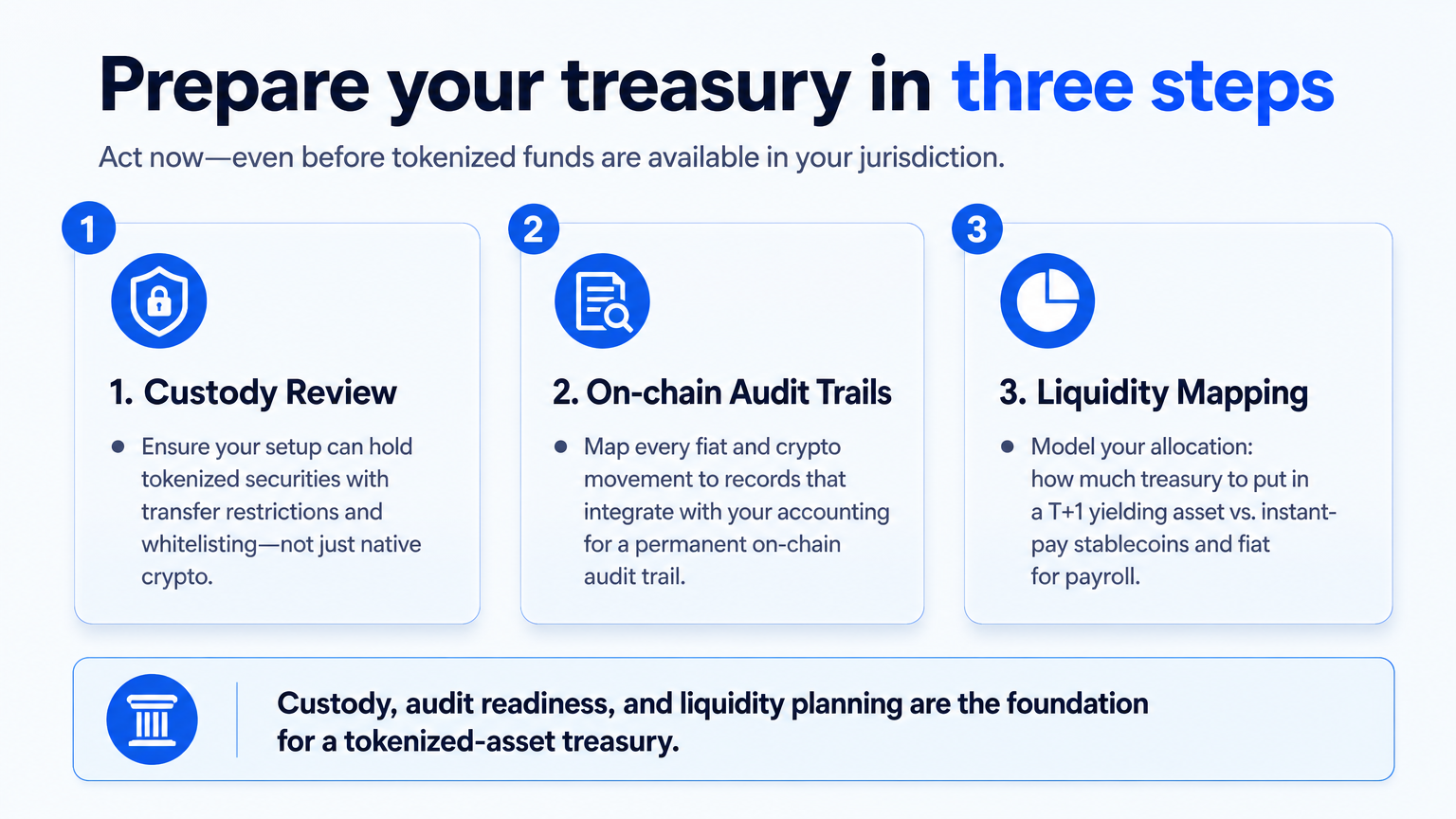
Three steps to prepare
Even before tokenized funds are available in your jurisdiction, you can act now.
| Step | Action | Why it matters |
|---|---|---|
| 1. Custody review | Assess whether your current setup (wallet, multi-sig, or third-party provider) can securely hold tokenized securities—not just native crypto. | Tokenized funds often represent regulated securities; your custody must support issuer-enforced transfer restrictions and whitelisting. |
| 2. On-chain audit trails | Ensure every treasury movement—fiat and crypto—is mapped to records that integrate with your accounting. | Holding fund tokens on-chain creates a permanent, auditable trail that can simplify reporting if your tools can consume it. |
| 3. Liquidity mapping | Model how much treasury you’d allocate to an on-chain yielding asset relative to instant-pay stablecoins and fiat for payroll and vendor payments. | Tokenized fund redemptions likely operate on T+1 or T+2 settlement; you need enough liquid buffer to avoid shortfalls. |
A platform that already supports instant crypto-to-fiat conversions and automated payment workflows makes this mapping easier because you can simulate flows before a tokenized fund allocation is live.
What HSBC’s Tokenized Fund Means: Your Questions Answered
What just happened with HSBC and crypto banking?
On November 21, 2026, HSBC made a tokenized investment fund available to eligible Hong Kong investors on Ethereum. The launch moves tokenized traditional assets from private pilots to a public, production-grade chain—connecting a legacy bank’s product with the Web3 infrastructure underlying much of business crypto banking.
Why does HSBC's tokenized fund matter for my business or DAO?
It signals that tokenized funds are becoming operationally real. If your treasury already spans fiat and crypto, holding a regulated, low-risk traditional asset on the same chain as your stablecoins could reduce banking relationships and simplify cash management. It also forces treasury teams to prepare for programmable traditional products.
How can I use tokenized assets in my company's treasury?
Direct access is limited today. Treat tokenized assets as a new treasury class alongside fiat and stablecoins. Once available, you could hold money-market-like fund shares in your on-chain wallet, track value alongside other reserves, and redeem to stablecoins or fiat—maintaining an unbroken audit trail. Platforms offering crypto-fiat integration and multi-currency accounts, like OneSafe, are already built to accommodate such expansions.
What should I do to prepare?
Start with the three steps above: custody review, audit trail fit for on-chain securities, and liquidity mapping. Also monitor regulatory developments—Hong Kong is a testbed, but other centers are watching.
How does a crypto banking platform differ from holding crypto in a wallet?
It integrates fiat accounts (with bank partners), corporate cards, wires, FX, bill payments, and accounting sync—with institutional-grade custody. You can pay contractors in USDC, settle a supplier in euros, and hold tokenized fund shares all from one dashboard with role-based permissions—something a standalone wallet can’t match.
Are tokenized funds safe, and how do they interact with traditional banking rails?
Safety depends on the underlying assets and issuer’s regulatory standing. HSBC’s fund operates within Hong Kong’s securities framework, carrying protections akin to conventional money-market funds. Interacting with banking rails involves redeeming tokens for fiat or stablecoins and moving funds via standard infrastructure—a process a crypto banking platform can automate. Settlement lag of one or two business days is the main risk, so treasuries must plan accordingly.
What to Watch Next
Will other global banks follow—and how fast?
HSBC is a bellwether. Banks that have tested tokenized deposits or funds may accelerate Ethereum-based offerings. More trad-fi assets on public chains will push mid-market and corporate banking to integrate those instruments into day-to-day services.
The regulatory wildcard
Hong Kong’s sandbox enabled this retail launch. The U.S. stance on tokenized securities remains unsettled. Track Singapore, the EU pilot regime, and the U.S. with the same rigor applied to stablecoin policy. For context on regulation’s treasury impact, see Crypto Treasury Management Under the New U.S. Stablecoin Rules. Businesses that want to keep their audience informed about crypto banking trends can use automated content tools like Joyrise: grow organic traffic while you sleep to scale production without manual effort.
Open question: Will tokenized funds ever be spendable via corporate cards or payroll?
The next frontier is instant redemption and conversion to fiat for a card swipe or payroll batch. Current settlement times make that impractical, but as payment networks and APIs evolve, the concept of crypto corporate banking may eventually include automated liquidation of fund tokens for spend transactions—turning treasury into a fully integrated, real-time asset.
Key Takeaways
- HSBC’s tokenized fund on Ethereum (November 21, 2026) signals that regulated traditional assets are moving to public blockchains, directly impacting how businesses and DAOs approach crypto banking.
- Tokenized funds could allow a DAO or global startup to hold yield-bearing, regulated assets on-chain alongside stablecoins, simplifying treasury and preserving audit trails.
- Preparing now means reviewing custody, unifying on-chain and fiat recordkeeping, and mapping liquidity to handle trade-offs between instant payments and slower fund redemptions.
- A unified platform that handles fiat, crypto, and—eventually—tokenized securities eliminates the fragmentation that forces teams to juggle separate banks, wallets, and exchanges.
- The pace of bank adoption and regulatory clarity outside Hong Kong will determine how soon these instruments become practical treasury tools for the mid-market.
To start building a treasury stack ready for tokenized assets, open a OneSafe account today.