You searched “what is MPC” and got a customs app. The MPC that matters for your digital assets is Multi-Party Computation—a cryptographic way to authorize transactions without any single party holding the secret.
Table of Contents
- The Three Meanings of MPC
- Multi-Party Computation in Plain Language
- How MPC Compares to What You Already Know
- MPC in Your Tech Stack
- The Trade-Offs Nobody Mentions
- What is Multi-Party Computation?
- How does MPC protect cryptocurrency private keys?
- How is MPC different from a multi-signature wallet?
- What are the risks of using MPC for digital asset custody?
- Why do modern neo-banks and crypto platforms advertise MPC?
- Why This Definition Matters When You Pick a Financial Partner
- Key Takeaways
The Three Meanings of MPC
Mobile Passport Control
The U.S. Customs app lets travelers skip lines. Free, no interview, separate from Global Entry. Not what you’re asking about in finance.
Marathon Petroleum and ticker confusion
MPC also means the NYSE-listed Marathon Petroleum (shares ~$373.86) and a crypto derivatives ticker tracked by CoinGlass. Neither is the custody tech you need to evaluate.
Multi-Party Computation: the cryptography securing your assets
When Fireblocks or a neo-bank says MPC, it means private keys are split into fragments held on independent machines. No single machine ever sees the full key. Transactions are signed through a coordinated computation without reassembling the key—digital asset protection rebuilt from math.
Multi-Party Computation in Plain Language
A private key is split into mathematically random shares using a threshold scheme. Those shares live on separate, independent environments. To sign a transaction, each share produces a partial result, and the protocol combines them into a valid signature. The full key never exists anywhere.
Imagine three chefs each holding part of a recipe on locked tablets. To make the sauce, any two meet, input their fragments into a mixing machine, and the sauce comes out—no one ever sees the complete recipe. Compromise one tablet, nothing is learned. That’s distributed key management.
How MPC Compares to What You Already Know
MPC vs. multi-sig
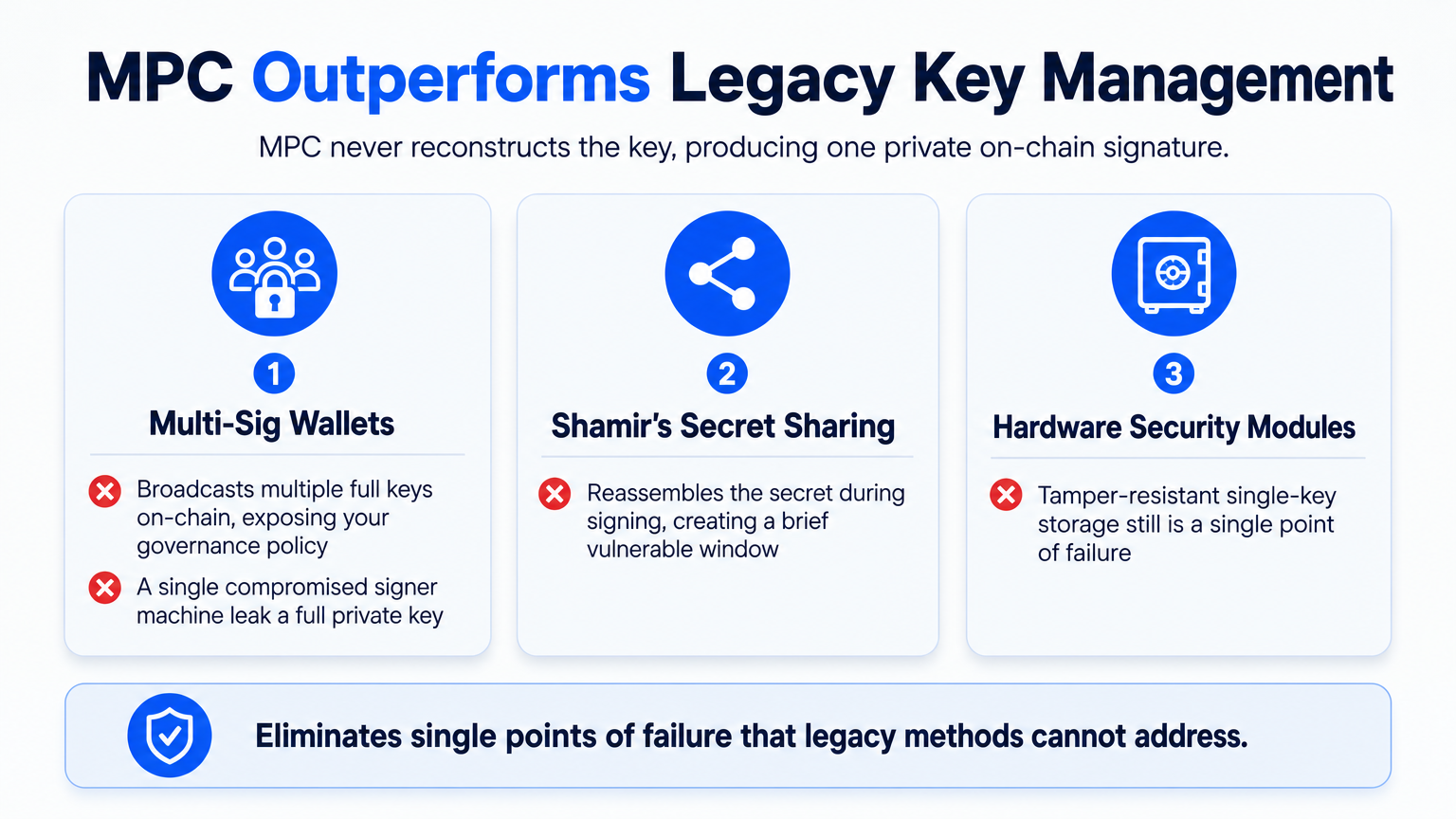
Multisig requires multiple full keys and broadcasts them on-chain, making your policy visible. MPC produces a single signature indistinguishable from a standard wallet, keeping your security architecture private. If one multisig signer’s machine is compromised, a full key leaks; stealing one MPC share gives nothing. The Safe Blog explains: “With MPC, the private key is never created in its entirety. With multisig, multiple complete keys exist and must be protected independently”(Safe Blog).
MPC vs. Shamirs Secret Sharing
Shamir also splits a secret but reassembles it during use, creating a vulnerable window. MPC never reconstructs; shares compute in place. No key ever sits in one memory space.
Hardware Security Modules (HSMs)
HSMs are tamper-resistant boxes for single-key storage, but remain a single point of failure. Modern setups often run MPC shares inside HSMs to combine physical and mathematical security.
MPC in Your Tech Stack
How a DAO treasury can approve a USDC payout
A DAO sets a threshold (say, four-of-seven core contributors), each holding a key share on their device. No individual can move funds. The MPC signing ceremony runs inside secure enclaves like Intel SGX, so even the OS can’t observe it. Platforms like OneSafe use Fireblocks MPC to surface a clean approval dashboard on top.
Why neo-banks that route crypto custody through MPC reduce counterparty risk
MPC key shares can be split so the bank holds one, you hold one, a trustee holds one. A two-of-three quorum means the bank cannot unilaterally spend your assets, and you can’t bypass compliance. The bank becomes a transaction coordinator bound by math.
What a CFO should ask a platform about its key management architecture
| Question | Mature MPC answer |
|---|---|
| Where do key shares live? | At least two cloud providers and one on-premises HSM; no two shares on same infra. |
| Quorum structure? | Configurable threshold (e.g., three-of-five) with client-held or trustee-held share. |
| Dealer setup? | One-time ceremony in isolated environments, full key discarded immediately, auditable. |
| Can you change policy without moving funds? | Yes—MPC supports share refresh and threshold adjustment on the same address. |
| What if you disappear? | We hold one share; you and backup signers hold enough to reconstruct quorum via alternative coordinator. |
The Trade-Offs Nobody Mentions
Signing latency
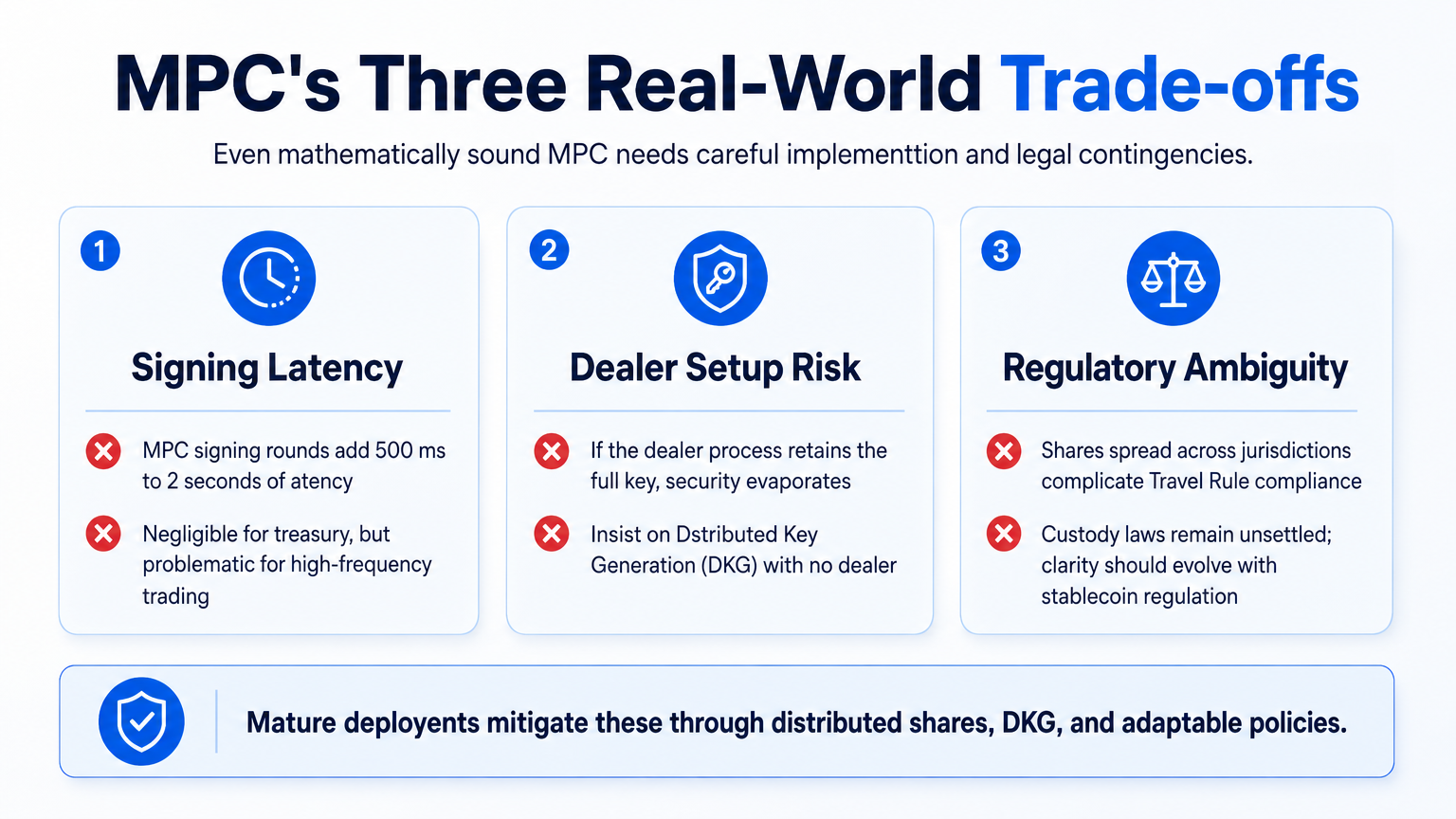
MPC rounds add 500 ms – 2 seconds. Negligible for treasury, meaningful for high-frequency trading.
Dealer setup risk
If the setup process (dealer) retains the full key, security evaporates. Insist on distributed key generation (DKG), where parties generate shares cooperatively with no dealer ever seeing the full key.
Regulatory ambiguity
Shares spread across jurisdictions complicate Travel Rule compliance and asset custody laws. The NIST threshold schemes project acknowledges this: “In a threshold scheme, the secret is shared among multiple parties, and a subset of those parties can reconstruct the secret—but the legal implications of distributed custody remain unsettled”. Expect clarity to evolve with stablecoin regulation.
What is Multi-Party Computation?
MPC is a cryptographic protocol that lets multiple parties, each holding a fragment of a secret, jointly compute a result (like a digital signature) without revealing any fragment and without ever assembling the secret. It originated from Yao’s 1982 “millionaires’ problem”(IEE Digital Privacy).
How does MPC protect cryptocurrency private keys?
An MPC wallet splits a private key into n shares distributed to n devices. To sign, at least t shares each perform a local computation and exchange partial results. The protocol combines them into a valid signature. No full key is generated or reassembled. Even t-1 compromised devices reveal nothing. Fireblocks describes this as “a cryptographic system where a private key is split into encrypted shares that are independently stored and computed upon, eliminating the single point of compromise”(Fireblocks).
How is MPC different from a multi-signature wallet?
Multisig broadcasts multiple full keys on-chain, raising fees and exposing policy. MPC produces one signature, cheaper and private. Chainlink notes: “Secure multi-party computation enables trust-minimized collaboration because no single node can access the full data set”(Chainlink). The security lives in the cryptographic layer, not the smart contract.
What are the risks of using MPC for digital asset custody?
- Dealer compromise: full key captured at setup— mitigated by DKG.
- Quorum collusion: if t share-holders collude, they can sign— avoid by distributing shares among entities with genuine separation.
- Implementation bugs: math proofs aren’t bug-free code. The 2023 threshold ECDSA library flaw was a wake-up call.
- Share loss: too many shares lost makes funds unrecoverable. Mature deployments include encrypted, offline cold backups.
Why do modern neo-banks and crypto platforms advertise MPC?
MPC enables fully digital onboarding with institutional-grade security. A business can generate its share on a mobile device and start transacting in under a week—no hardware wallet shipment, no notary. Coinbase says, “MPC wallets remove the single point of failure without requiring users to manage multiple seed phrases or hardware devices”(Coinbase).
Why This Definition Matters When You Pick a Financial Partner
Speed of onboarding
MPC-native platforms collapse setup time because key generation is software-based. Identity verification becomes the only bottleneck, not physical security ceremonies.
Cross-currency workflows
The same MPC quorum authorizes fiat wires and on-chain USDC payouts, with crypto-to-fiat conversion in one workflow.
One checklist to verify MPC maturity
- Is key generation distributed (DKG) or dealer-assisted?
- Can we or a trustee hold a key share?
- Threshold configurable?
- What happens if the platform is down 48 hours?
- Public security audit of the MPC library—when, by whom?
- Are shares in software, HSMs, or both? Can we specify geographic distribution?
If the salesperson can’t answer “yes” to at least five, the MPC claim is a logo, not a foundation.
If you found this content through search, platforms like Joyrise can help sites rank for similar queries.
Key Takeaways
- Multi-Party Computation splits a private key, signs without reassembly, and eliminates single points of compromise.
- MPC produces one on-chain signature, keeping governance invisible; unlike multisig, no single full key exists.
- Real-world risks: dealer compromise, collusion, bugs, share loss. Measure maturity by how these are addressed.
- Neo-banks adopt MPC for fast digital onboarding and cross-asset security.
- Choosing a partner without understanding key management is like buying a vault without knowing who has the combination.
Ready to manage business treasury across fiat and crypto with MPC-grade security? Open a OneSafe account to see how a platform built on Fireblocks custody streamlines multi-currency operations without compromising on cryptographic integrity.