If you run a business that touches crypto—paying a freelancer in USDC, holding Bitcoin on the balance sheet, or just trying to figure out whether you need a new tax form—you need a working definition of what is digital asset that doesn’t get lost in abstraction. A digital asset is any item of value that exists in a purely digital representation, recorded on a cryptographically secured distributed ledger (a blockchain), and capable of being owned and transferred without a traditional intermediary. That’s the operational litmus test for finance leads: if it lives on-chain and you can control it with a private key, you’re dealing with a digital asset.
Table of Contents
- What is digital asset?
- How Digital Assets Actually Work
- A Real Business Example: Paying a Vendor in USDC
- What types of digital assets are there?
- How do digital assets compare to traditional assets?
- How can digital assets benefit portfolios?
- What regulatory considerations apply to digital assets?
- Why Digital Assets Matter for Your Business Right Now
- What to Read Next
- Key Takeaways
What is digital asset?
The IRS definition—and why it matters for business
The IRS classifies digital assets as property, meaning every taxable event—selling crypto for fiat, trading tokens, or paying with stablecoins—generates a gain or loss. Its Digital Assets guidance covers "any digital representation of value that is recorded on a cryptographically secured distributed ledger or any similar technology," including convertible virtual currencies, stablecoins, and NFTs, but excluding fiat digital representations until they become CBDCs. This classification triggers new reporting under Form 1099-DA, detailed below. (For a broad overview, see Investopedia’s What Are Digital Assets? Definition, Types, and Their Importance; for tax specifics, What is a digital asset for tax purposes? from CoinLedger breaks down reporting obligations.)
A practical, journalist‑friendly definition you can act on
Consumer sources often broaden digital asset to include personal files like photos or domain names, but in business and compliance, that scope doesn’t apply. If your controller asks, "Is this USDC payment a digital asset?" the answer is yes because it’s a representation of value on a blockchain. Personal digital files aren’t taxed or custodied the same way. So stick with the ledger-based meaning: an on-chain token you can hold, send, and settle without a bank. The National Institute of Standards and Technology concisely calls it a "digital representation of value" in its Digital asset - Glossary | CSRC.
How Digital Assets Actually Work
Blockchains, wallets, and keys—in plain language
A blockchain is a decentralized database that permanently records transactions across a network of computers. Every digital asset lives at a specific address on that ledger. You don’t "store" Bitcoin; you hold the private key that proves control of the address. A wallet manages those keys. To send a payment, you sign a transaction with your private key; the network validates it and updates the shared ledger. No single entity can reverse or block it.
Ownership without a bank: public ledgers and private control
Because the ledger is public and distributed, ownership doesn’t require a traditional custodian. You can self-custody assets or use a regulated custodian. This replaces reliance on a bank’s solvency with trust in the blockchain protocol and your own key security. For businesses, that means settling with a supplier directly, in seconds, without correspondent banking.
A Real Business Example: Paying a Vendor in USDC

From approval to settlement in three steps
Suppose your marketing agency in Argentina invoices you $5,000. Instead of a SWIFT wire that takes days, you pay in USDC—a stablecoin pegged 1:1 to the dollar. Here’s the flow:
- Approve and fund: Your finance team approves the invoice. You either hold USDC in a business wallet or convert $5,000 fiat to USDC on a platform like OneSafe that handles both (supporting free USDC withdrawals and instant conversion).
- Execute payment: Send 5,000 USDC to the vendor’s wallet address. The transaction confirms in under a minute on networks like Ethereum Layer 2 or Solana.
- Settlement: The vendor receives the stablecoin and can off-ramp to local currency almost immediately, avoiding FX spread and bank delays.
What the books look like: fiat ↔ crypto accounting and cost‑basis tracking
The accounting entry has two legs. Buying USDC gives you a digital asset with a cost basis equal to the fiat spent. Sending it to the vendor is a disposition: you realize a gain or loss based on the USDC’s fair market value at transfer. Your bookkeeper records:
| Transaction | Debit (USD) | Credit (USD) | Notes |
|---|---|---|---|
| Purchase of 5,000 USDC | Digital Asset (USDC) 5,000 | Cash 5,000 | Recorded at cost |
| Payment to vendor | Expense (Marketing) 5,000 | Digital Asset (USDC) 5,000 | Disposed at transfer-time FMV; gain/loss to P&L |
If USDC’s price drifts a fraction of a cent, you book a tiny gain or loss. Multiply this across hundreds of payments, and automated cost-basis tracking becomes essential.
What types of digital assets are there?
The International Capital Market Association (ICMA) breaks down the terminology in 2. What are virtual assets, crypto assets and (native) digital assets? », helping to distinguish between asset categories. Here’s the landscape that matters for payments, treasury, and compliance.
| Asset type | What it is | Business use case |
|---|---|---|
| Cryptocurrency (e.g., Bitcoin, Ether) | Native blockchain token, typically volatile, no central issuer | Treasury reserve, speculative investment |
| Stablecoin (e.g., USDC, PYUSD) | Token pegged to a fiat currency, issued by regulated entities | Cross‑border vendor payments, payroll, working‑capital management |
| NFT (Non‑Fungible Token) | Unique token representing ownership of a digital or physical item | Tokenized invoices (emerging), digital collectibles, membership access |
| CBDC (Central Bank Digital Currency) | Digital liability of a central bank, not yet widely live | Wholesale settlement between financial institutions, future retail uses |
| Security/Utility Token | Token representing equity, debt, or platform access rights | Fundraising, loyalty programs, tokenized securities |
Stablecoins, NFTs, and CBDCs—where each fits in your cash‑flow
Stablecoins are the workhorse for operational finance: programmability plus price stability allows 24/7 payments without volatility. NFTs rarely enter day‑to‑day treasury, though some companies tokenize receivables. CBDCs remain experimental—Deutsche Bank’s participation in Project Simbolon (Deutsche Bank AG, November 16, 2026) demonstrated wholesale CBDC settlement between Singapore and Germany using zero‑knowledge proofs, pointing to future infrastructure. For now, stablecoins are the practical bridge.
How do digital assets compare to traditional assets?
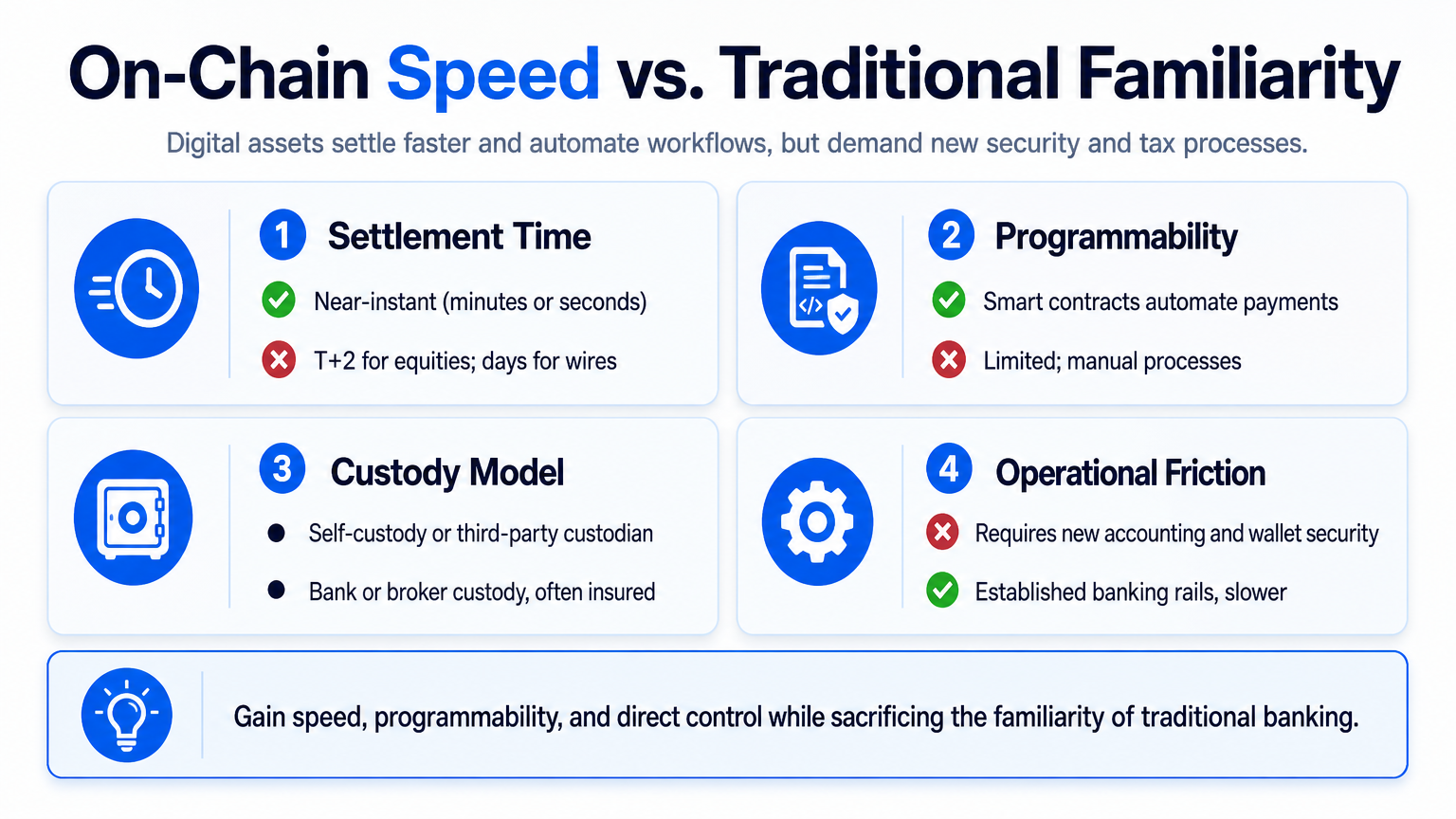
| Dimension | Digital Asset (on‑chain) | Traditional Asset (e.g., stock, fiat bank balance) |
|---|---|---|
| Ownership record | Public, distributed ledger | Centralized ledger (bank, transfer agent) |
| Settlement time | Near‑instant (minutes or seconds) | T+2 for equities; hours to days for cross‑border wires |
| Custody model | Self‑custody or third‑party custodian (e.g., Fireblocks) | Bank or broker custody, often insured |
| Programmability | Smart contracts automate payments, escrow, revenue splits | Limited; requires custom legal agreements and manual processes |
| Regulatory classification | Property (IRS); varying globally | Securities, commodities, cash—well‑established frameworks |
| Operational friction | Requires new accounting workflows, cost‑basis tracking, wallet security | Established banking rails, but slower and more expensive internationally |
The key trade‑off: you gain speed, programmability, and direct control while sacrificing the familiarity of traditional banking. Internal processes for security, key management, and tax compliance must be built.
How can digital assets benefit portfolios?
Business portfolios include cash and reserves for operations. Stablecoins reduce the “dead time” of funds in transit. Instead of pre‑funding a foreign bank account and waiting, a company can hold a portion of treasury in USDC and release payments on demand, 24/7. That improves liquidity and cuts FX fees. While some firms add Bitcoin as a reserve (with significant volatility risk), stablecoins offer low‑volatility blockchain settlement without directional market exposure. The net effect is higher liquidity velocity—your money works more hours across time zones.
What regulatory considerations apply to digital assets?
The IRS treats digital assets as property, so every transaction is taxable. The most urgent 2026 development is Form 1099‑DA. As clarified by Forvis Mazars US on November 23, 2026, for sales after 2025, brokers must report cost basis only on covered assets (those held in the customer’s account). For noncovered assets, basis reporting is voluntary. Thus, if you move assets between wallets and exchanges, you’re responsible for accurate gain/loss calculations. Continuous accounting is essential.
Legislative efforts like the Digital Asset Definitions from Senator Lummis aim to create a clear statutory framework. Custody infrastructure is maturing: the CFTC recently opened a settlement path for digital asset trust companies (Legal 500), and institutional adoption is growing—CoinDesk’s October 2026 report shows traditional financial firms building out custody and settlement. Compliant, insured custodial solutions are becoming available. Don’t forget sanctions: any on‑ramp or off‑ramp partner must have robust OFAC screening.
Why Digital Assets Matter for Your Business Right Now
Cross‑border payments: faster, cheaper, and programmable
SWIFT wires are slow and expensive. A stablecoin cross‑border payment settles in minutes, costs pennies, and can be automated with smart contracts. Businesses already use stablecoins to redefine business hours and eliminate weekend cutoffs.
Treasury efficiency: how stablecoins cut working‑capital friction
By replacing pre‑funded accounts with a stablecoin balance, you deploy cash exactly when needed. Platforms that combine fiat and crypto with real‑time conversion let you pool working capital and pay out locally without multiple bank relationships.
Tax compliance has teeth: Form 1099‑DA and covered‑vs‑noncovered reporting
With the 1099‑DA regime, every crypto transaction can leave a compliance trail the IRS can cross‑check. Businesses must adopt digital asset accounting practices that track cost basis in real time, not year‑end.
Institutional infrastructure is finally arriving (custody, settlement, on‑ramps)
Projects like Simbolon show central banks exploring programmable settlement. Authorized trust companies can now hold digital assets under CFTC oversight, and major banks offer tokenized funds. You can access custody solutions like multi‑party computation (MPC) wallets that secure assets without every employee managing a hardware key.
What to Read Next
- Crypto Treasury Management After the Bitcoin Crash — how to separate operational stablecoin holdings from speculative exposure.
- Stablecoin Payments Go Live: What Visa’s Move Means for Your Business — real‑world settlement infrastructure already in production.
- AI Agents and Stablecoins Rewrite Crypto Treasury Management — programmatic payments are the next frontier.
- HSBC’s Ethereum Fund and the Future of Crypto Banking — tokenized traditional assets blur the line between old and new finance.
- What Is MPC? Multi‑Party Computation Explained — the security model that makes institutional custody practical.
Key Takeaways
- A digital asset, for business purposes, is any on‑chain token you can hold, send, and settle without a bank intermediary—stablecoins are the most operationally relevant type.
- Every transaction has tax implications: the IRS classifies them as property, and Form 1099‑DA now mandates basis reporting for covered assets, so continuous cost‑basis tracking is essential.
- Stablecoins eliminate cross‑border settlement delays and middle‑bank fees, turning working capital into a 24/7 resource.
- Regulatory infrastructure—custody, reporting, institutional settlement—is maturing quickly, reducing operational risk.
- Don’t conflate digital assets with personal digital files; in finance, it’s all about the ledger.
For businesses looking to automate their blog content, Joyrise: grow organic traffic while you sleep analyzes your site and publishes SEO articles daily to Webflow, WordPress, or Shopify, with your first article written before you pay.
Ready to bring fiat and crypto operations into a single, secure platform? Open a OneSafe account and start settling payments globally in minutes.