
Meta description: The Yuno-Coinbase deal makes stablecoin checkout a one-click option for merchants, bringing web3 payments mainstream. Learn what it means for your business.
On October 7, 2026, payment orchestration platform Yuno announced a partnership with Coinbase that lets merchants add one-click stablecoin checkout without building a separate integration—a concrete move that pulls web3 payments closer to everyday commerce. The integration embeds Coinbase Payments Acceptance directly into Yuno’s existing stack, making stablecoin acceptance an option for merchants across sectors like digital goods, gaming, travel, and cross-border commerce.
Stablecoin volumes are driving this moment. The partnership press release cited $10.2 trillion in stablecoin transaction volume over the past 12 months—a 63% year-on-year increase. That’s a scale that makes orchestration players like Yuno treat stablecoin payments not as an experiment but as a payment rail alongside cards and local wallets.
Table of Contents
- Why This Partnership Matters for Web3 Payments Right Now
- Web3 Payments 101: What Founders and Finance Leads Need to Know
- Implications for Your Business: From Global Startups to DAOs
- How Platforms Like OneSafe Help Bridge Fiat and Web3 Payments
- What to Watch Next: Open Questions Shaping Web3 Payments
- Key Takeaways
Why This Partnership Matters for Web3 Payments Right Now

Until now, accepting stablecoins at checkout meant stitching together separate crypto gateways, wallet infrastructure, and manual token-to-fiat conversion—a multi-month integration project. The Yuno-Coinbase deal collapses that complexity. By placing Coinbase payments inside an orchestration layer already used for card networks, bank transfers, and alternative payment methods, the partnership reduces the integration lift to zero for existing Yuno merchants:
- No separate KYC/KYB flow—the existing merchant identity and risk controls extend to the new method.
- Unified settlement and reporting through the same dashboard that handles fiat flows.
- The ability to turn on stablecoin checkout as a toggle, rather than launching a multi-month project.
This removes the main barrier that kept stablecoin acceptance off the roadmap. Yuno’s move signals orchestration platforms now treat stablecoin rails as just another payment method. The Yuno partnership confirms that integration work has shifted from the merchant to the infrastructure layer.
Web3 Payments 101: What Founders and Finance Leads Need to Know
A web3 payment is an on-chain transfer of stablecoins between two wallets, settled on a distributed ledger without card networks or correspondent banks. Merchants use a web3 payment gateway to accept these assets, which can auto-convert to fiat or be held as stablecoins. For integration guides, see this walkthrough of web3 payment gateways and enabling web3 payments.
The practical stack: a blockchain network processes value transfer, smart contracts can automate splits or escrow, and a fiat on/off-ramp converts between bank balances and tokens. Most merchant-facing implementations use stablecoins to avoid volatility. Services like Stripe’s stablecoin payments and Cross River’s stablecoin API provide the plumbing without running nodes. The key difference from traditional rails: settlement is global, peer-to-peer, and operates 24/7, bypassing batch-processing and banking-hour constraints of ACH or SWIFT.
For further context on how web3 banking accounts fit into this infrastructure, see the definitive guide to banking for web3 companies and the FAQ on what web3 banking is.
Implications for Your Business: From Global Startups to DAOs
The Yuno-Coinbase announcement signals a future where a merchant’s checkout offers stablecoin checkout alongside Visa, PayPal, and local bank transfers. That has concrete implications for managing money globally.
What are the concrete benefits of stablecoin payments for global businesses?
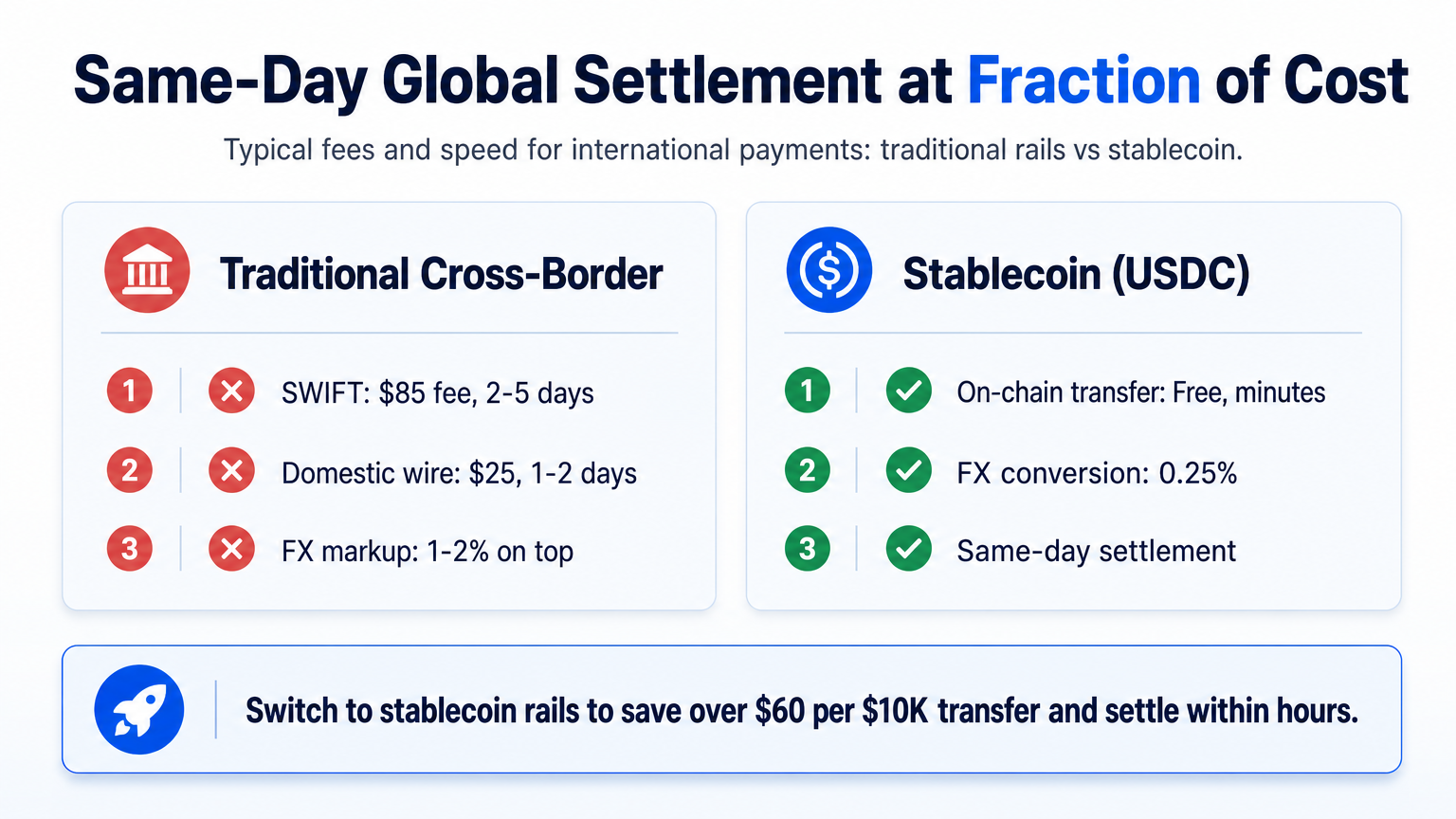
The numbers matter most. A traditional international card transaction can carry 2–3% in fees plus a 1–2% FX markup; a cross-border wire might cost $15–$50 and take 2–5 business days. By comparison:
- Fees: On-chain stablecoin transfers cost fractions of a cent to a few dollars, with no percentage-based interchange.
- Speed: Settlement finalizes on-chain within minutes, versus days for wires. Even with fiat conversion orchestration, total settlement is under a day.
- Global reach without currency fragmentation: A stablecoin like USDC works everywhere, eliminating dozens of local currency accounts. As Visa’s analysis on stablecoin payments explains, instant cross-border value movement compresses working capital cycles.
For businesses with global suppliers or a distributed workforce, stablecoin payments cut treasury fragmentation costs. The Yuno integration reduces the last major friction—acceptance—by letting existing merchant accounts add crypto payments without leaving their orchestration environment.
Below is a comparison of the typical cost structure on a unified fiat-crypto platform like OneSafe (fees as of October 2026):
| Transaction Type | Typical Settlement Time | Fee on OneSafe Platform |
|---|---|---|
| Domestic wire (deposit) | 1–2 business days | $10 per deposit |
| Domestic wire (withdrawal) | 1–2 business days | $25 per withdrawal |
| SWIFT (international wire) | 2–5 business days | 0.35% + $50 |
| USDC deposit/withdrawal (crypto) | Minutes (blockchain confirmation) | Free |
| Currency conversion (FX) | Near-instant | Up to 0.25% or prevailing FX rate |
For a $10,000 international payment, a SWIFT transfer costs $85 in fees; sending USDC on-chain is free on the deposit/withdrawal side, with an optional 0.25% FX fee if conversion to fiat is needed—a saving of over $60 per transaction with same-day settlement.
How can a neo-banking platform simplify fiat and crypto operations for startups and DAOs?
Companies using stablecoins operationally often juggle a traditional bank and a separate crypto exchange or wallet, creating reconciliation nightmares. A neo-banking for businesses platform collapses those silos. OneSafe, built for global businesses, Web3 startups, and DAOs, provides multi-currency accounts, ACH, domestic and international wires, bill payments, and free USDC deposits and withdrawals—all through one interface. Digital assets are secured on Fireblocks, and KYB-compliant onboarding takes about a week. This architecture means:
- A DAO receives stablecoin payments from a DeFi protocol and pays contributors in fiat or crypto from the same dashboard, without moving funds between wallets and banks.
- A global startup pays a supplier in Europe via SEPA, converts customer USDC receipts to USD, and issues virtual corporate cards to team members—without opening multiple local bank accounts.
- The platform absorbs the on/off-ramp and FX complexity, so the finance team sees one unified ledger.
The result: fewer manual transfers, lower fees, and a single source of truth for both fiat and crypto payments.
What should founders and finance leads consider before integrating web3 payments?
Use this checklist to evaluate any web3 payment integration, through an orchestration layer like Yuno or a direct gateway:
- Settlement asset and conversion flow: Does the integration auto-settle in fiat, or will you hold stablecoins? If holding, have a treasury policy and on/off-ramp partner ready.
- Supported stablecoins and networks: Confirm support for widely accepted, fully reserved stablecoins like USDC on networks with deep liquidity (Ethereum, Solana, Polygon).
- Compliance and KYC/AML: Who handles due diligence? Orchestration platforms should already cover it under existing licenses; direct integrations require AML, sanctions screening, and possibly money transmitter licensing.
- Fee structure beyond on-chain gas: Some gateways charge a volume percentage or mark up FX. Factor in chargeback risk differences—stablecoin payments are final, reducing dispute costs.
- Operational workflow for reconciliation: Will payment data feed natively into your ERP? Manual reconciliation from raw wallet exports can become a bottleneck.
- Custody of private keys: Decide between non-custodial (you control keys) or a custodial model with institutional-grade security (e.g., Fireblocks). A regulated neo-banking platform that handles custody under one hood reduces operational risk for most businesses.
How Platforms Like OneSafe Help Bridge Fiat and Web3 Payments
As discussed in the 2026 guide to neo-banking in the USA, a business neo-bank bridges fiat and crypto operations. The downstream money management—splitting treasury between stablecoin yield strategies, paying international vendors, or managing contributor payroll in tokens—requires a unified platform. Platforms that do this well provide:
- Unified fiat-crypto accounts: Hold both and move value internally without forced stablecoin-to-fiat conversions.
- Programmable permissions for DAOs: Customizable roles and approval workflows that map to multisig governance while connecting to the banking system.
- Automated on/off-ramps: Instant conversions at published, low FX rates so treasury decisions aren’t delayed by manual exchange trades.
For businesses moving toward web3 payments, the combination—orchestration-acceptance on the front end, unified fiat-crypto operating account on the back end—is quietly becoming the default stack. It turns a fragmented set of tools into a process that resembles managing a normal business account, just with additional rails.
What to Watch Next: Open Questions Shaping Web3 Payments
Are stablecoin payments secure and compliant enough for mainstream use?
Yes, with caveats. Stablecoins like USDC operate under transparent reserve reporting and regular attestations. Custody infrastructure (e.g., Fireblocks) carries SOC 2 Type II certifications and insurance. When a regulated orchestration platform or neo-bank handles the acceptance, the merchant inherits that compliance framework. However, regulatory clarity remains uneven. The U.S. stablecoin legislation debate continues, and while the OCC’s crypto banking charter fight has created pathways, state-level money transmitter licensing still adds friction. The safer path is to work through a partner that already holds the necessary licenses and performs KYC/AML upfront. As Paxos notes, stablecoin payments can be fully compliant when issued by regulated entities and integrated through licensed financial intermediaries.
Another development to watch: enterprise ERP integration. Earlier in 2026, Circle and SAP announced stablecoin settlement inside SAP ERP, a move that, combined with Yuno’s merchant-side ease, points toward stablecoins becoming a boring payment rail integrated into standard business software. The remaining question is how quickly mid-market businesses—not just the technology-native ones—will follow.
Key Takeaways
- The Yuno-Coinbase deal, live as of October 7, 2026, lets merchants add stablecoin checkout without new development, removing the main integration barrier for mainstream web3 payments.
- Stablecoin transaction volumes hit $10.2 trillion over the past year, and global businesses can now access cheaper, same-day cross-border settlement by treating stablecoins as a standard payment rail.
- The real operational win comes when acceptance is paired with a unified fiat-crypto platform that handles on/off-ramping, custody, and treasury in one place, collapsing the fragmentation between traditional and crypto finance.
- Before integrating, finance leads should vet the full settlement, compliance, fee structure, and reconciliation workflow—not just the front-end payment gateway—to avoid hidden complexity.
- Regulatory tailwinds and enterprise ERP integrations are converging, but the cautious approach is to route stablecoin flows through licensed, compliant infrastructure rather than direct, unmediated wallets.
Explore how to simplify fiat and crypto operations for your global business or DAO by opening a OneSafe account.