On October 7, 2026, Circle’s USDC and EURC landed inside SAP—a deal that puts stablecoin payments directly into the same ERP screens treasury teams already use to run global commerce. The integration, delivered via Tereina and surfaced through SAP Pay, marks the moment enterprise-grade stablecoin rails went production-ready. For any business moving money across borders, that changes the cost and speed equation overnight.
Table of Contents
- What Just Happened: Circle USDC SAP Integration
- Why This Matters Now for Global Businesses
- Stablecoin Payments 101
- The Chargeback Trade-Off: A Feature for B2B
- What Circle’s SAP Move Means for Your Business
- How to Start Using Stablecoin Payments Today
- Which stablecoins are supported?
- Which blockchains are used?
- How do stablecoin conversions work?
- Are there chargebacks?
- Launching a stablecoin strategy
- What does Circle’s SAP integration mean for non-enterprise companies?
- What to Watch Next
- Key Takeaways
What Just Happened: Circle USDC SAP Integration
Circle embedded USD Coin (USDC) and Euro Coin (EURC) into the SAP-backed Tereina platform. The flow reaches corporate users through SAP Cloud ERP and the agentic B2B interface SAP Pay. Circle CEO Jeremy Allaire called stablecoins “a core infrastructure layer for global commerce,” while Tereina CEO Cedric Bru framed it as a shift in where payments happen, not a new product line (Yahoo Finance, October 7, 2026). Separately, Kyriba and Circle are building pipes for intercompany liquidity using USDC. Together, these moves confirm that corporate stablecoin use cases have moved from pilot to live infrastructure in months.
Why This Matters Now for Global Businesses
Cross-border stablecoin transactions bypass the correspondent banking chain: multiple intermediaries, opaque FX spreads, and settlement that stretches to three or more business days. Now a treasury manager in SAP can initiate a USDC payment that settles in seconds, at a transparent cost. For companies paying suppliers across time zones, the speed compounds. The integration also removes a psychological barrier. SAP’s customers—manufacturers, logistics firms, pharma companies—can now pay a supplier in USDC without leaving their ERP. That flips stablecoin perception from experimental to a treasury tool as ordinary as a SWIFT message.
Stablecoin Payments 101
A stablecoin is a digital token pegged to a fiat currency, typically backed 1:1 by reserves. USDC, for example, holds cash and short-duration government bonds (Mastercard). In a corporate treasury, it functions as a payment rail: fiat converts to USDC, the tokens move to a supplier’s wallet, and the supplier off-ramps back to local fiat—often within an hour (Circle). The ERP integration abstracts wallet and chain complexity behind familiar interfaces.
Payment giants agree on the strategic logic. Stripe reintroduced crypto payments with USDC in 2024, Visa expanded stablecoin settlement in 2025, and Paxos now issues branded stablecoins. Fireblocks frames the primitive as “composable”—embeddable into invoicing, payroll, and treasury management without rebuilding the stack (Fireblocks).
The Chargeback Trade-Off: A Feature for B2B
Stablecoin transactions are irreversible once confirmed on-chain. No chargebacks. Consumer rails treat this as a flaw—Stripe’s initial product included limitations precisely because buyers expect dispute resolution. For B2B, it’s a feature. It kills friendly-fraud losses, cuts administrative overhead, and provides finality that a wire approximates but at higher cost. The industry is split: consumer platforms warn about fraud liability shift, while enterprises see cost savings. The rational treasury view: irreversible settlement is an advantage when counterparties are vetted. That means using platforms with strong KYB/KYC, optional escrow smart contracts, and auditable on-chain records. Crypto-native banking platforms like OneSafe layer exactly those controls onto stablecoin flows, bridging irreversible settlement with enterprise risk management.
What Circle’s SAP Move Means for Your Business
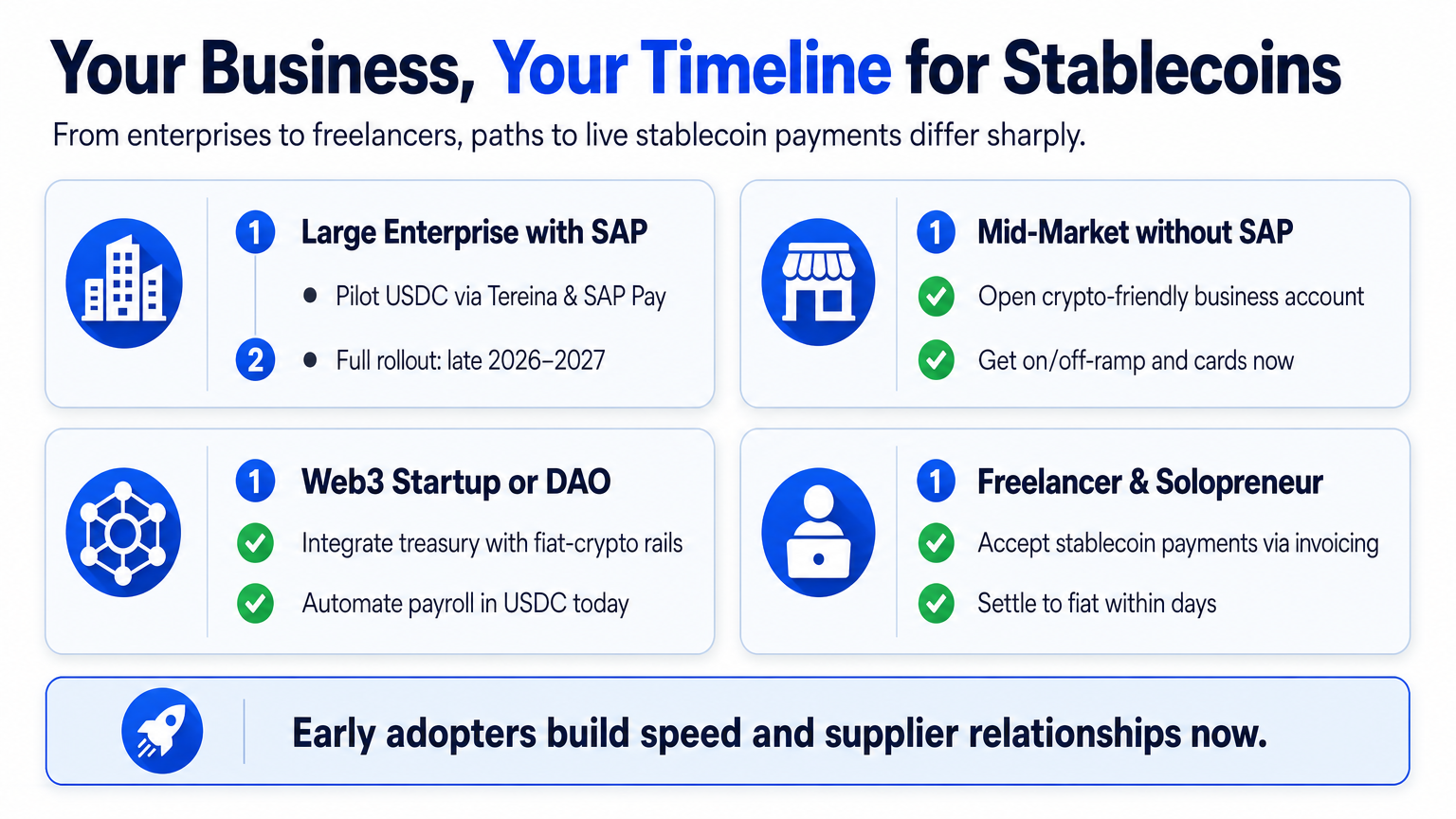
| Business Type | Today’s Options | Timeline |
|---|---|---|
| Large enterprise with SAP | Wait for module rollout; pilot USDC payments via Tereina and SAP Pay once available | Late 2026–2027 |
| Mid-market company without SAP | Use a crypto-friendly business account with stablecoin on-ramp/off-ramp and corporate cards | Now |
| Web3 startup or DAO | Integrate treasury management with fiat-crypto banking; automate payroll and vendor payouts in USDC | Now |
| Freelancer/solopreneur | Accept stablecoin payments via invoicing platform that settles to fiat | Within days |
For enterprises
If you run SAP, native USDC rails will eventually arrive inside the ERP. Until then, treasury teams can map flows that benefit most from near-instant settlement: emerging-market payables, intra-group liquidity sweeps, and time-sensitive trade finance.
For startups and DAOs
You don’t need an ERP module. Platforms like OneSafe give you segregated fiat accounts, ACH and wires, free USDC deposits/withdrawals, corporate cards topped up in eight-plus tokens, and a stablecoin on-ramp off-ramp that converts fiat to crypto and back without touching SAP. A DAO can pay contributors in stablecoins, invoice a client in fiat, and manage DAO treasury management in a single interface today.
How to Start Using Stablecoin Payments Today
Choose a crypto-friendly banking partner
A crypto-friendly business account that fuses fiat and stablecoin rails removes the need for a separate exchange, wallet, and bank. Look for:
- Multi-currency fiat accounts with local ACH and wire.
- Free or low-fee USDC deposits and withdrawals.
- Instant crypto-to-fiat conversion (the stablecoin on-ramp off-ramp).
- Corporate cards with spend controls.
- Institutional-grade custody (Fireblocks) and mandatory MFA.
OneSafe combines all of this and has onboarded over 1,000 businesses across 30+ countries, processing $800M+ in transaction volume. Onboarding takes about a week.
Map your fiat ↔ crypto flow
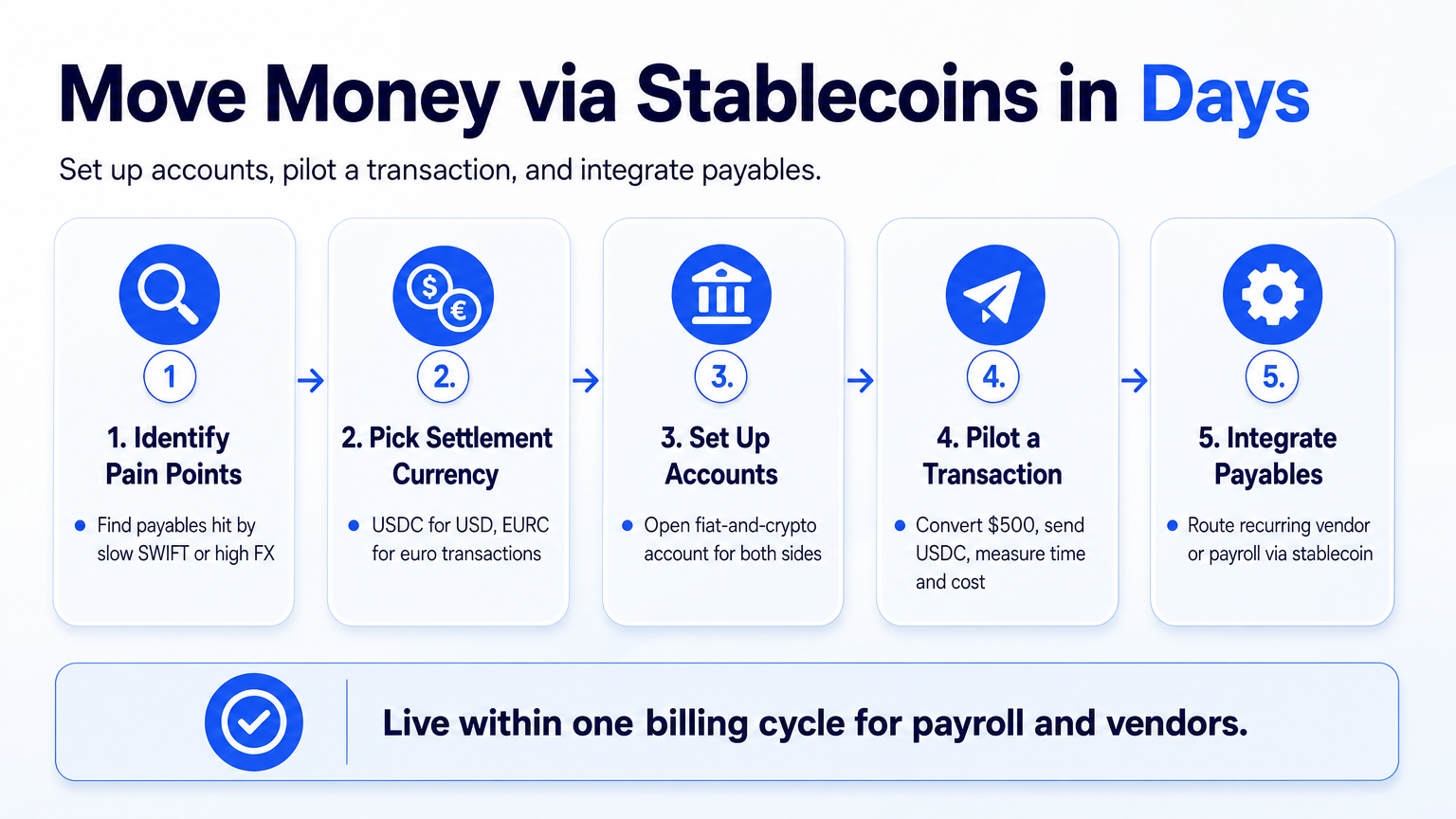
- Identify pain points: Which payables/receivables suffer from slow SWIFT or high FX?
- Pick a settlement currency: USDC for USD, EURC for euro.
- Set up accounts on both sides: Your business opens a fiat-and-crypto account; your counterparty needs a compatible wallet or account.
- Pilot: Convert $500 of fiat to USDC, send it, have the recipient off-ramp. Measure time and cost.
- Integrate payables: Route a recurring vendor invoice or payroll through the stablecoin rail. For companies already doing stablecoin payments for payroll and vendors, steps 4 and 5 can be live within one billing cycle.
Which stablecoins are supported?
Within the Circle–SAP integration, USDC and EURC are the initial currencies, covering the two largest invoice currencies. OneSafe supports USDC for deposits/withdrawals, with more stablecoins available for conversion and card top-ups. Other fiat-pegged tokens (GBP, JPY) will follow as liquidity proves out in enterprise corridors.
Which blockchains are used?
USDC runs natively on Ethereum, Solana, Avalanche, and others. The Tereina integration abstracts the chain layer. For direct wallet management, Solana offers sub-second finality and near-zero fees, ideal for high-volume payments. Platforms like OneSafe auto-route over optimal chains.
How do stablecoin conversions work?
The stablecoin on-ramp starts when a business wires fiat to its crypto-enabled account; the platform instantly converts it to USDC. To pay an invoice, USDC is sent to the supplier’s wallet. The supplier off-ramps through its own platform: USDC is converted to local fiat and deposited in a bank account. The full cycle can complete in under an hour, versus days for a wire.
Are there chargebacks?
No. Irreversible settlement removes costly reconciliation for B2B. Internal controls—purchase orders, escrow for large first-time payments, KYB-vetted partners—reduce risk of sending to a fraudulent wallet.
Launching a stablecoin strategy
- Audit your payment stack: Find flows that need faster finality.
- Choose an execution partner: For SAP, wait for Tereina. Otherwise, open a business account that handles fiat and stablecoins with corporate cards.
- Set compliance on-ramps: KYC/KYB enforced; for DAOs, multi-sig and role-based permissions.
- Pilot end-to-end with one supplier or payroll batch.
- Expand gradually as confidence builds, integrating with accounting software.
What does Circle’s SAP integration mean for non-enterprise companies?
It validates the rail, erases the “speculative” stigma, and will increase suppliers willing to accept USDC. Non-enterprise businesses don’t need to wait. A neo-banking platform that merges fiat accounts, crypto custody, and payment rails can execute the same logic without ERP overhead. Circle’s move signals that cross-border stablecoin transactions are main-net ready; the infrastructure to use them already exists. Early movers build the experience and supplier relationships that become a competitive moat.
What to Watch Next
- Regulation: As dollar-backed stablecoin volume surges inside SAP, the OCC and Federal Reserve face pressure to clarify crypto banking charters and stablecoin rules.
- ERP competition: Oracle, Microsoft Dynamics, and Workday may follow with their own stablecoin rails.
- Cross-border corridors: Will a German manufacturer pay a Vietnamese supplier via USDC through SAP Pay, and will the local bank accept the off-ramp without friction?
- Kyriba–Circle liquidity: The partnership hints at moving cash between subsidiaries on stablecoin rails, bypassing notional pooling and FX conversions.
- Enterprise-grade banking: Demand for platforms offering crypto treasury management with robust controls and multi-currency fiat rails will accelerate.
Key Takeaways
- Circle USDC SAP integration, announced October 7, 2026, puts stablecoin payments inside the world’s most widely used ERP ecosystem.
- Corporate stablecoin use cases—cross-border payables, intercompany settlement—are production-ready, not just pilots.
- Irreversible settlement is a B2B advantage when paired with strong counterparty due diligence and compliant banking platforms.
- Non-enterprise companies and DAOs can access the same speed and cost benefits today via crypto-friendly business accounts that bundle fiat and stablecoin rails.
- The open question is whether to build the operational muscle now, before the SAP rollout makes stablecoin payments table stakes.
Ready to move money across borders in minutes, not days? Open a free business account at OneSafe and unify fiat and stablecoin rails without waiting for an ERP module.