Table of Contents
- Executive Summary: What “No-Fee” Business Banking Actually Means in 2026
- Understanding Business Bank Accounts and the Fee Landscape
- The Hidden Costs of Traditional “No-Fee” Business Checking
- Why Modern Businesses—Startups, DAOs, and Global Teams—Need More Than a Free Account
- Is a No-Fee Business Account Right for My Startup?
- How Neo-Banking Platforms Like OneSafe Redefine Fee-Free Business Banking
- How Do I Open a Business Checking Account?
- Mistakes and Myths About No-Fee Business Accounts
- Key Options at a Glance
- Next Steps: Getting a Truly Fee-Transparent Account
Executive Summary: What “No-Fee” Business Banking Actually Means in 2026
“Business bank accounts with no fees” is the financial industry’s favorite bait-and-switch. A 2026 list from CNBC names Bluevine and others as top free business checking options, while Money Crashers’ October 2 roundup praises accounts with no monthly maintenance fees. Here’s the truth: most of these accounts turn “free” into a loss leader for high transactional fees.
If you’re a founder, DAO contributor, or finance lead at a global company, the promise of a free business bank account rarely survives its first international wire or crypto conversion. This guide dissects the real costs hiding in traditional no-fee business banking, then shows why neobanking platforms like OneSafe offer a transparent alternative — one that handles fiat and crypto in the same interface without surprise markups.
Understanding Business Bank Accounts and the Fee Landscape
What a business bank account is—and what it isn’t
A business bank account separates company funds from personal money. It’s a checking or savings account opened under a legal business entity — LLC, corporation, partnership, or DAO. It handles payroll, vendor payments, tax obligations, and revenue. Legally, mingling personal and business funds pierces the corporate veil, so a dedicated account is non-negotiable even for solo founders. It is not a credit line, investment account, or crypto wallet at legacy institutions. Traditional banks treat it as a simple ledger with little API access and no native multi-currency capability.
The common fees that lurk behind “no monthly maintenance”
Banks loudly advertise “business checking no monthly fee.” Then the statement arrives with:
- Domestic wire outgoing: $15–$30
- International wire (SWIFT): $30–$50 + hidden FX markup
- Cash deposit fee: 0.2–0.5% after a low threshold
- Inactivity fee, paper statement fee, overdraft “protection” transfer fee
- Account closing fee if you leave within 90 days
A Slash roundup confirms several of these fees persist even when monthly charges are waived. The absence of a subscription doesn’t mean you pay zero. You pay per action, and the per-action price is steep.
How most banks structure their “free” tiers with conditions
Open a PNC Basic Business Checking account and you’ll see a $10 monthly fee — waived if you maintain a $500 average balance. Truist’s Simple Business Checking lists similar balance requirements. Fall below the minimum for a single day, and the fee hits. These banks want your idle deposits, not your activity.
The Hidden Costs of Traditional “No-Fee” Business Checking
What are the hidden costs of 'free' business checking accounts?
Hidden costs fall into three buckets: international transaction markups, compliance-triggered holds, and opportunity loss from fragmented systems. A “free” account that can’t process a EUR payment without manually converting at a 3% spread costs more than a premium account with built-in FX at 0.25%. Sending a $50,000 wire through a typical no-fee account might cost $1,500–$2,500 in combined fees and rate padding; the same via a transparent neobank like OneSafe costs about $250 (0.25% FX + wire). That’s a 6×–10× gap.
Monthly maintenance vs. transactional fees: the trade-off in practice
Bank of America’s free tier waives the monthly charge if you spend $250 on a business debit card, while the international wire fee remains $45. For a distributed team with monthly contractor payouts in multiple currencies, transactional fees pile up faster than any subscription.
International wires and FX: where “no-fee” accounts get expensive fast
Here’s the uncomfortable truth: global business account no fees is a myth in the legacy world. When you wire €20,000, the bank converts your dollars at a proprietary rate — often 2–5% off the interbank rate — and adds a SWIFT fee of $35–$50. The combined hit can exceed 5%. Holding EUR directly and paying in EUR eliminates that conversion at the transfer point. Neobanks like OneSafe give you segregated global accounts so you keep euros as euros.
Account minimums and the real cost of falling below them
Many “free” accounts require a $1,000–$5,000 average daily balance. Drop below the threshold for one day and a $15 fee hits. Over a year, that’s $180 — more than a premium account’s annual cost. Add the 5% interest you could earn elsewhere on that locked cash, and you’re giving up $250 a year. For a bootstrapped startup, this is a misallocation of capital.
Why Modern Businesses—Startups, DAOs, and Global Teams—Need More Than a Free Account
The rise of crypto and Web3: what traditional banks can’t offer
DAOs and crypto-native startups need custody for digital assets, settlement in stablecoins, and the ability to pay contributors in USDC. A checking account that can’t hold crypto creates operational paralysis. As stablecoin regulation moves rapidly in 2026 (see our Stablecoin Regulation analysis), seamless fiat-to-stablecoin movement is becoming the standard. Traditional banks can’t participate.
Multi-currency operations: breaking free from multiple banking relationships
Maintaining one bank for USD, another for EUR, and a third for crypto means stitching together a Frankenstein finance stack. Reconciling transactions across platforms wastes time and invites errors. A single platform with multi-currency accounts and native FX at competitive rates eliminates the overhead. Our guide on is global finance reliable? explores why unified infrastructure matters.
Onboarding speed and digital-first management: the new baseline
Founders expect to open an account in minutes with a laptop and photo ID. Traditional banks still make you wait days or weeks; digital-first platforms complete KYB within a week. Delays in account opening mean delayed vendor payments and lost momentum.
Is a No-Fee Business Account Right for My Startup?
The answer hinges on your operational reality. If your startup is US-only, never wires internationally, never touches crypto, and can comfortably maintain a $1,500 minimum balance, a business account for startups like Bluevine or Capital One’s free checking may work. But if you pay freelancers abroad, receive stablecoin settlements, or operate across jurisdictions, that “free” account quickly becomes expensive and restrictive. A startup planning to scale globally should start with a platform that handles multi-currency and crypto from day one — even if the monthly fee is $0 for a basic tier. The total cost of ownership of a limited free account far exceeds a transparent platform once you factor in hidden costs no-fee checking doesn’t advertise.
How Neo-Banking Platforms Like OneSafe Redefine Fee-Free Business Banking
OneSafe Review: A Fee-Transparent Neo-Bank
OneSafe combines fiat and crypto accounts, corporate cards, and automated payments in one interface, with no hidden conversion costs. It uses transparent fee tables: flat 0.25% FX fee, 0.15% fiat deposit/withdrawal fee, wire withdrawals at $25, SWIFT at 0.35% + $50, and free USDC deposits/withdrawals. For a business moving $100,000 across currencies and on-chain rails monthly, total costs run several hundred dollars — vs. thousands at a traditional bank. This is a DAO business bank account because it supports on-chain transactions natively: a DAO can hold USDC, convert to EUR for payroll, and pay US vendors via ACH, all within one account with role-based permissions.
Security is institutional-grade: MFA required on signup and digital assets in Fireblocks custody. Over 1,000 businesses have processed more than $800 million through the platform. The full architecture is detailed in our guide to crypto business bank accounts.
How Do I Open a Business Checking Account?
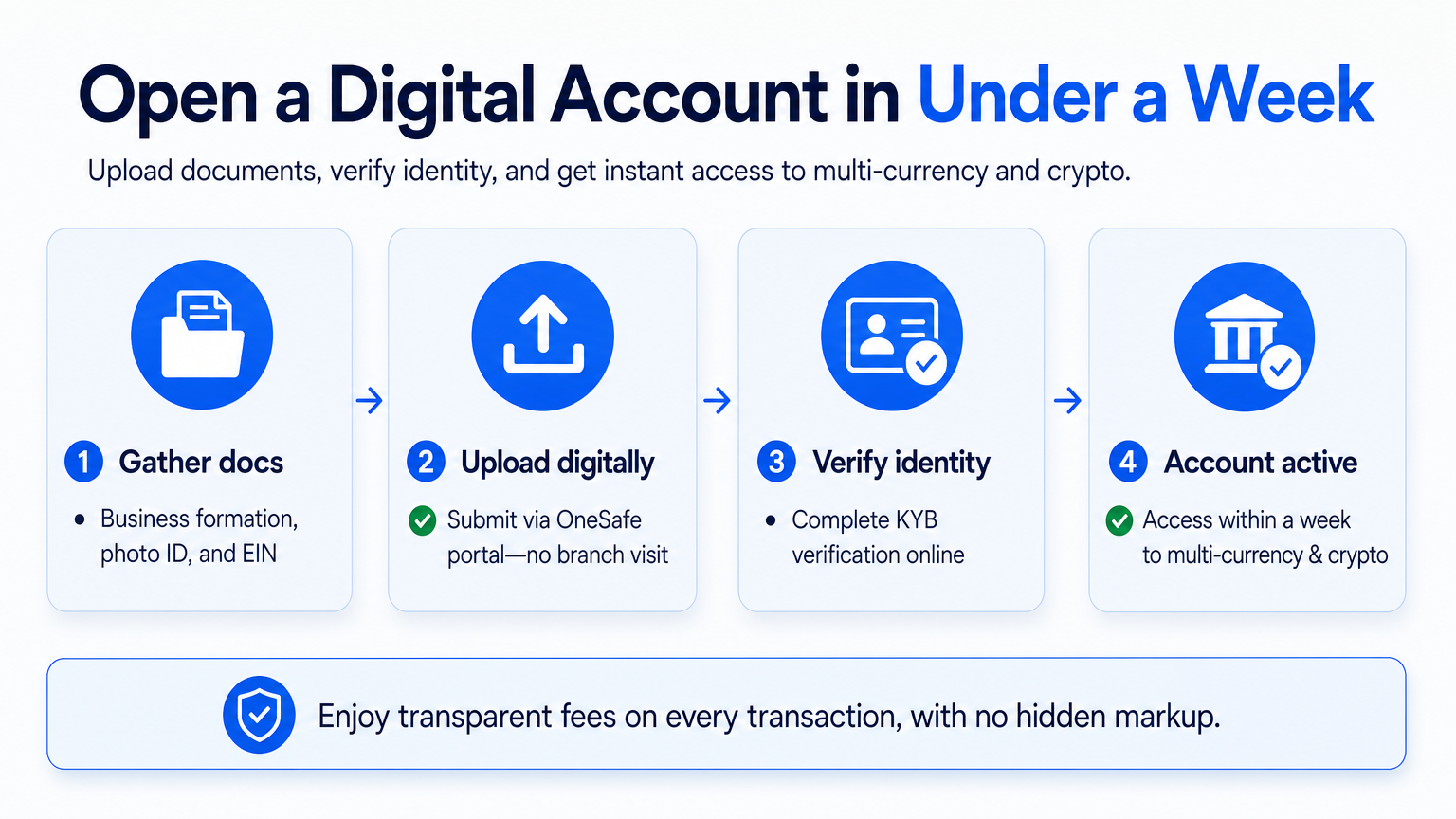
Opening a business checking account requires: business formation documents (Articles of Incorporation or LLC operating agreement), government-issued photo ID for each beneficial owner, and for US companies, an Employer Identification Number (EIN). Some banks also ask for a business license or proof of address. With OneSafe, the entire process is digital: upload documents, complete identity verification, and the account is typically active within a week. No branch visits, no paper forms. Once approved, you gain access to multi-currency accounts, virtual corporate cards, and on-chain wallets with transparent fees displayed before every transaction. For businesses ineligible due to OFAC sanctions or certain US state restrictions, check with support@onesafe.io.
Mistakes and Myths About No-Fee Business Accounts
“No fees means no costs”
The most expensive myth. A World Bank study found the average cost of sending $200 across borders is 6.2% globally. The “free” checking account hides its cut in the exchange rate, so a $200 transfer might actually cost $12 in lost value. Real cost is the difference between what you send and what arrives.
“All no-fee accounts are basically the same”
Wrong. Bluevine offers 1.5% interest and no monthly fee but charges $15 for outgoing wires and doesn’t support crypto. The “honestly free” credit union account covers domestic ACHs but gouges you on international wires. Compare accounts on the functions you’ll actually use, not the sticker price.
“My business isn’t big enough for a dedicated account yet”
If you have an EIN and receive revenue, you need a business account. Commingling personal and business funds jeopardizes limited liability protection. A free business bank account may suffice at launch, but if you plan to scale internationally or touch crypto, start with a platform that can grow with you.
Key Options at a Glance

| Account | Monthly Fee | International Wire Cost | Crypto Support | Multi-Currency | Best For |
|---|---|---|---|---|---|
| Bluevine | $0 (1.5% APY up to $250k) | $15 outgoing + FX markup (not disclosed) | No | USD only | US-only, no wires |
| Truist Simple Business Checking | $0 (with min. balance) | $30–$50 + undisclosed FX spread | No | USD only | Local businesses with stable balances |
| PNC Basic Business Checking | $10 or waivable with $500 balance | $30–$50 + undisclosed FX spread | No | USD only | Small business with low activity |
| OneSafe (Free plan) | $0 | Wire $25, SWIFT 0.35% + $50; FX 0.25% | Yes (free USDC on/off) | Multiple fiat currencies | Crypto-native, global startups, DAOs |
Next Steps: Getting a Truly Fee-Transparent Account
No-fee business banking without hidden costs is achievable if you choose a platform built for modern workflows. Key takeaways:
- “No monthly fee” is a red herring — focus on the total cost of transactions you actually run.
- Traditional free checking accounts bury a 2–5% spread in FX, making cross-border payments far more expensive than a transparent alternative.
- Crypto-native businesses and DAOs need an account that handles both fiat and digital assets natively; no mainstream “no-fee” business checking account offers that.
- Neobanks like OneSafe deliver a unified platform with flat, predictable fees and fast onboarding, eliminating hidden costs and fragmented banking relationships.
Stress-test any account by asking for the all-in cost of a $10,000 international wire, and demand the FX spread. Then choose the platform that matches how you actually operate.
Ready to bring fiat and crypto under one transparent roof? Open your OneSafe account today.