
You're probably at the point where the card is almost solved, except for one line in the application that changes the whole risk profile. Your company has revenue, you've separated most of the books, and you still don't want to sign away your home or personal credit just to get working capital on a card that's branded as “business.” That tension is exactly where business credit card no personal guarantee required products matter, and it's also where the marketing gets fuzzy fast.
The phrase sounds simple, but the core question is never just whether a card says “no personal guarantee.” It's whether the issuer is underwriting your company on its own merits, or whether it's expecting you to clear a corporate hurdle that only established businesses can clear. That distinction matters even more for web3 entities and cross-border SMEs, where the legal structure, banking footprint, and source of operating liquidity often look nothing like a local startup bank file.
Table of Contents
What a Personal Guarantee Actually Means for Your Business
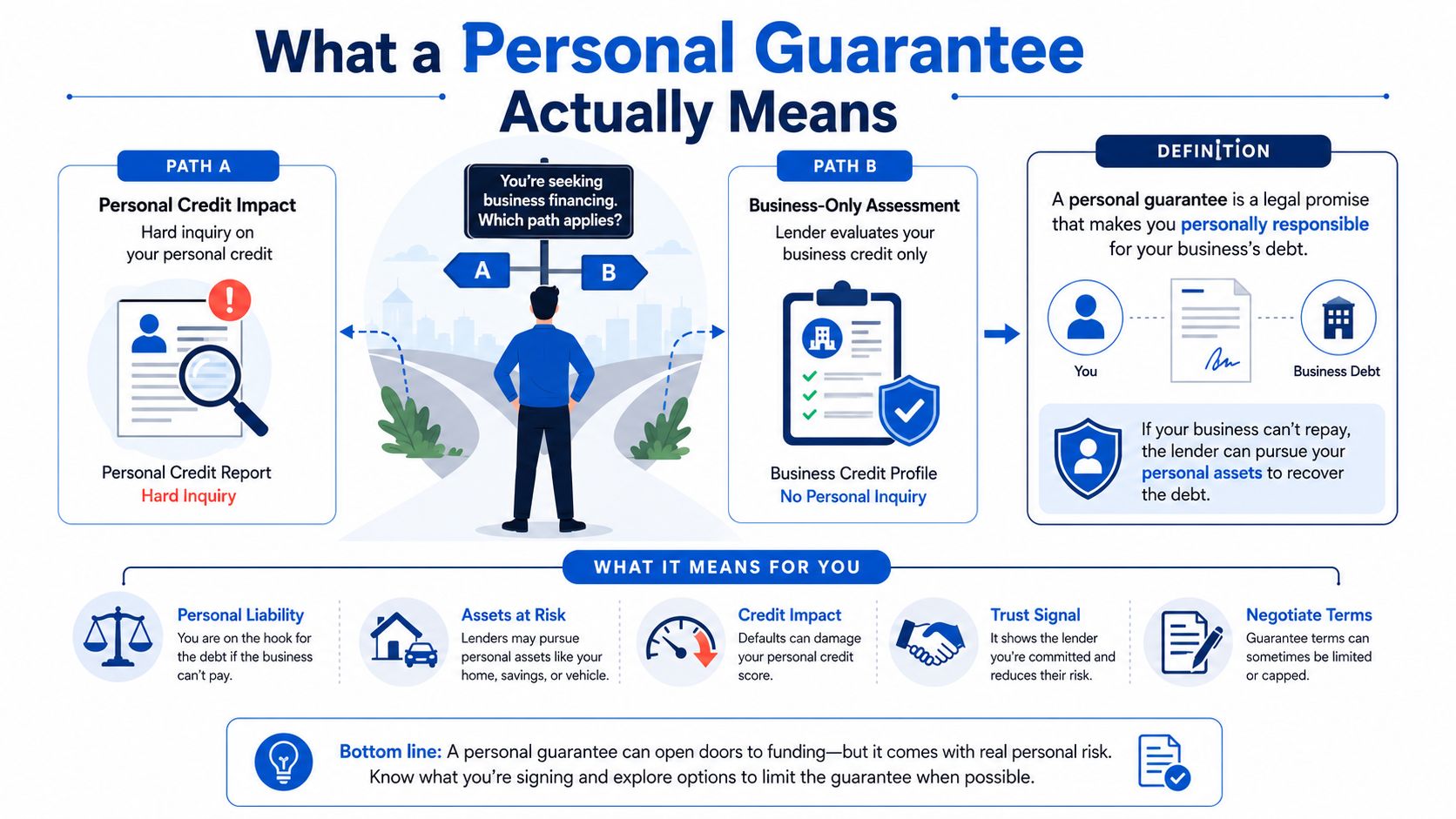
A personal guarantee is the clause that turns a business card from a company obligation into your obligation if things go wrong. In practice, that means the issuer can look beyond the entity if the balance goes unpaid, because you've signed a separate promise to cover the debt. For a founder who has finally cleaned up their books, that one signature can feel like dragging personal assets back into a business problem.
Why the structure matters
The structural change is bigger than people expect. Industry guidance says cards without a personal guarantee are usually corporate credit or charge cards aimed at incorporated businesses, not standard small-business cards, and they commonly require a formal entity such as an S corporation or C corporation. Many issuers also look for at least $1 million in annual revenue, with some requiring $3 million or more before they waive the guarantee, which is why these products cluster around established firms rather than brand-new startups CardRates.
That's also why the label alone can be misleading. A founder may search for a business credit card no personal guarantee required and land on a product page that sounds open to anyone, but the actual program may be a corporate card with tighter entity, liquidity, and operating-history expectations. In other words, the promise is about liability, but the offering is usually about maturity.
Practical rule: if a card is truly no-PG, the issuer is betting on the business file, not your household balance sheet.
That shift changes how the product behaves. No-PG programs are often charge cards or corporate cards, so they tend to look more like spend-control tools than traditional revolving consumer-style credit. The card may still be useful, but the underwriting and the day-to-day operating model are different enough that treating it like a normal small-business card is how founders waste time.
How Issuers Underwrite Without a Personal Guarantee
Once the personal guarantee is removed, the issuer needs another way to measure repayment risk. That usually means the company is underwritten as a separate credit entity, and the file has to show that the business can support spend on its own. The founder's FICO score may matter less, but the review does not get easier, it becomes more specific.
The four pillars underwriters inspect
The first pillar is legal separation. Ramp notes that applicants usually need an incorporated entity with an EIN, and the business has to look like a real operating company rather than a side account with invoices attached. If the entity paperwork is thin, the application often stalls before anyone gets to the rest of the file Ramp.
The second pillar is liquidity and revenue quality. Issuers review business bank balances, cash flow, and revenue trends, because without a personal backstop they need confidence that the company can absorb the card balance from operations. Current industry explanations also note that many no-PG cards do not check personal credit at all, so strong cash flow can matter more than a polished consumer profile Payline Data.
The third pillar is business credit history. Some issuers reference a PAYDEX score near 80 as a benchmark, while others look for a clean Experian Intelliscore profile or a similarly low-risk bureau file. The practical point is simple, if the business has no bureau footprint, the issuer leans harder on bank statements and revenue consistency. That is the underwriting reality behind many marketing claims about business credit cards no personal guarantee required.
The fourth pillar is industry risk. Cards without a PG are usually reserved for businesses that do not look volatile on paper. Bankrate's guidance is clear that these products are typically corporate cards with high revenue expectations, and a weak operating history or insufficient reserves can still lead to denial even when the owner has solid personal credit Bankrate.
Underwriting takeaway: no personal credit check is not the same as no underwriting.
For web3 entities and cross-border SMEs, the issuer usually probes one layer deeper. Treasury structure, beneficial ownership, cash movement patterns, and where the operating team sits can matter as much as the entity documents. A company that receives revenue in one country, settles in another, and keeps assets in a third has to show clean controls, not just growth.
A useful parallel is the bank-style review outlined in Stewart Accounting Services small business loan criteria. The lender wants proof that the entity can stand alone. With a no-PG card, the issuer is deciding whether it trusts the business enough to remove the founder's promise entirely.
The operating file matters too. A dedicated business account with regular inflows, stable outflows, and enough reserve balance gives underwriters something concrete to evaluate. For teams that run both fiat and crypto flows, OneSafe's bank account setup and business fiat-crypto integration resource is relevant because it shows how to keep those movements separated without making the company look fragmented.
Preparing Your Business to Qualify Without a Guarantee
The fastest way to improve your odds is not polishing the application form, it's making the company look separable and bankable before you apply. That starts with a dedicated business account and a clean paper trail. If the company's money still drifts through personal accounts, the underwriter sees friction, not maturity.
Build the file before you build the pitch
The legal wrapper comes first. Incorporation documents, EIN confirmation, and a clear operating entity matter because they show the issuer that the debt belongs to a real business, not a loosely organized founder profile. For cross-border teams, this separation matters even more when ownership, treasury, and operating staff sit in different countries.
After that, banking behavior becomes the main signal. A business account that sees regular inflows, consistent outflows, and stable reserves tells a different story than an account opened last week for the sole purpose of applying. That's why the internal account setup guidance in OneSafe's bank account setup and business fiat-crypto integration resource is relevant for teams that need one operating layer for both fiat and crypto movements.
Then comes credit history. Vendor accounts that report, on-time payments, and a predictable monthly rhythm help create the kind of business profile no-PG issuers want to see. You're not trying to game the file, you're trying to make the company legible as an independent borrower.
What readiness looks like in practice
A six-figure-revenue LLC with clean books should have a different packet than a pre-revenue C corp. The LLC's file should emphasize bank balances, revenue continuity, and recent tax or financial statements. The pre-revenue C corp needs stronger proof of capitalization, investor support, or internal treasury strength, because the issuer won't see sales yet.
Keep the balance sheet boring. In no-PG underwriting, boring often beats impressive.
For web3-native founders, the biggest mistake is assuming treasury visibility equals bankability. A multisig wallet, a stablecoin runway, and a strong cap table can be operationally healthy, but the card issuer still wants documentation it can normalize, usually around incorporation, bank activity, and cash flow. The smoother you make that translation, the fewer questions the underwriter has to ask.
Realistic Alternatives When You Cannot Get No-PG Approval Yet
Sometimes the right move is to stop pushing the same application and use a bridge product that makes the company easier to underwrite later. The right temporary tool depends on what is missing, whether that is credit history, spend control, or a cleaner line between company spending and founder spending.
Four paths that show up in practice
A secured business card is the most direct fallback if you need a card relationship and can post a deposit. It still helps build credit history, but the trade-off is plain, because cash gets tied up to establish the limit. That can make sense for a younger entity that needs bureau history more than flexibility.
A fintech-issued corporate card can fit startups and digital businesses better because many of these programs underwrite to cash flow instead of consumer credit. Issuers and platforms such as Ramp, BILL Divvy, Rho, Slash, and Stripe's corporate card have all leaned on business fundamentals, but each one still wants the entity to look operationally credible Slash. Some are closer to spend-management systems than revolving credit, which matters if you need policy controls more than borrowing room.
A net-30 vendor account is slower, but it can help if the goal is future eligibility rather than immediate card convenience. The value is in trade credit, not rewards. If the vendor reports and payments stay clean, you build the type of payment history underwriters notice later.
A virtual or expense card program often solves the operational problem when the business is already spending, but the founder does not want to hand out personal cards or chase reimbursements. These setups help with controls, approvals, and vendor-specific limits, which is why finance teams use them when discipline matters before borrowing power.
How to choose the bridge
If you want business credit history, pick the option that reports. If you want spend control across teams or entities, pick the option with stronger policy tooling. If you need cross-border or crypto-adjacent spend, pick the platform that can handle those flows without manual workarounds.
OneSafe fits here as one operational option among several because it combines multi-currency accounts with corporate cards and fiat-crypto workflows. That does not make it a universal answer, but it does make it relevant for teams that need card controls and treasury movement in the same place.
For teams comparing card programs alongside broader finance stacks, OneSafe's alternatives to Brex overview helps clarify where card access ends and banking infrastructure begins. That difference matters because a no-PG card only helps if the rest of the operating workflow can keep up.
Special Considerations for Web3 and International SMEs
A conventional U.S. startup can sometimes get away with a simple entity, a domestic bank account, and a clean revenue trail. Web3 organizations and international SMEs usually can't. Their ownership structures are messier, their banking paths are more fragmented, and the issuer often has to decide whether the legal entity even looks like something it can safely extend credit to.
Why the standard roadmap breaks down
Take a representative DAO with a multisig treasury. The entity may have clear governance rules, but the issuer still wants a borrower it can map to a recognized legal and banking structure. If the treasury sits in crypto wallets, payments flow through multiple signers, and spend approvals happen on-chain, the business may be real operationally while still being hard to underwrite in a card file. That's why many generic no-PG guides miss the actual blocker, which is not spend volume, it's entity legibility.
An international SME faces a different version of the same problem. A Cayman-incorporated company, for example, may have real revenue, real counterparties, and real staff, but it still has to prove separation, documentation consistency, and a banking relationship that the issuer understands. If the operating currency, legal domicile, and card usage jurisdictions all differ, the file can look disjointed even when the business is healthy.
Default, chargebacks, and closure risk
The legal exposure also changes in a no-PG environment. A card without a personal guarantee doesn't mean the company is invisible to collections, chargebacks, or account closure. It means the issuer is looking first to the entity, and the entity can still be exposed if the account goes sideways. For founders managing treasury across several entities, that's a governance issue as much as a financing issue.
A no-PG card reduces personal exposure, but it doesn't erase operational accountability.
That's why issuer risk tolerance matters so much for this segment. Some programs will accept cleaner entity separation and a strong treasury profile. Others will decline a company that looks operationally sound but doesn't fit the issuer's playbook for incorporation, banking geography, or account monitoring. The gap isn't usually ideology, it's file compatibility.
For DAOs specifically, OneSafe's DAO finance guide is useful because it treats treasury, payments, and operational controls as a single problem. That's the frame web3 teams need. A card is only one part of the stack.
Your Eligibility Checklist and Documentation Packet
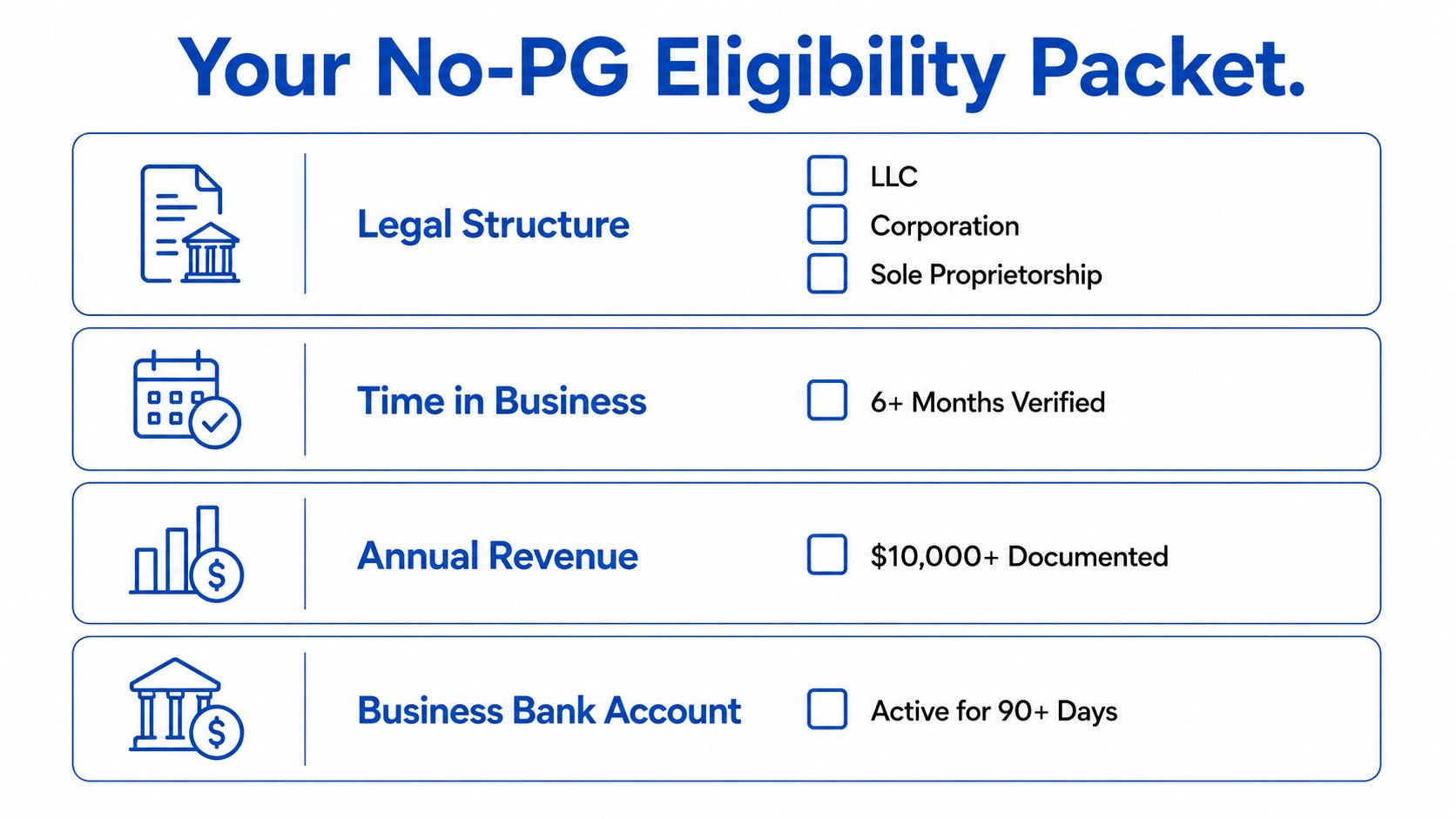
If you want a yes, the file needs to answer two questions fast. Is the company a real, separable borrower, and can it clearly pay what it spends? Everything in the packet should support one of those answers.
Quick eligibility check
- Legal structure: Corporation or LLC is a cleaner signal than a sole proprietorship.
- Time in business: Multiple months or longer of real activity is more convincing than a fresh filing.
- Revenue and cash position: The stronger the operating balance and revenue trail, the easier the review.
- Business credit profile: A visible bureau footprint helps, even if the issuer leans more on banking data.
- Industry risk: Low-risk, stable operations tend to fit no-PG programs more easily.
- Bank relationship: A dedicated business account with consistent activity reduces friction.
Documents to assemble first
Start with incorporation documents and EIN confirmation. Those two items tell the issuer the entity exists and can borrow as itself. After that, gather recent business bank statements, because liquidity and transaction consistency are usually the next thing the underwriter checks Bankrate.
Then add recent tax filings or internal financials, depending on what the company has. If there's a credit file, include the business bureau reports so the underwriter doesn't have to guess at the profile. If there's no strong bureau history yet, front-load the banking and revenue evidence instead.
For web3 or international entities, include whatever proves operational footprint in plain language. Payment rail records, counterparties, invoices, and treasury documentation can all help, but only if they clearly tie back to the legal entity that's applying. The goal is a packet that reads left to right without forcing the analyst to translate every page.
Reframing Approval as Issuer Risk Tolerance
A no-PG approval is less about your personal credit score than it is about whether the issuer trusts the business enough to skip the founder backstop. That's why a founder with excellent consumer credit can still get turned down, and why a business with a thinner personal file can sometimes get approved if the entity looks strong. The underwriter is reading the company, not just the person behind it.
That framing also explains why the essential work happens over time. The business needs cleaner separation, better liquidity, a more legible credit footprint, and a narrower risk profile before the application becomes easy. For founders who want to go further into structured financing later, it can help to compare top SBA lenders after the company's operating base is stable, because the next credit milestone often depends on the same discipline you used to get the card.
The durable takeaway is simple. Waiving the personal guarantee shifts the risk onto the entity, but it doesn't remove risk. It just changes who has to absorb it, and that means the win is not the approval itself, it's keeping the business healthy enough to deserve the approval the next time too.
If you need a platform that can handle multi-currency business accounts, corporate cards, and crypto-compatible operations in one place, OneSafe is built for that workflow. Visit OneSafe to see how its accounts and cards can fit into a no-PG-ready operating stack for global teams.


