
The Trump administration is reportedly exploring joint ventures with private stablecoin firms to export dollar-backed tokens into overseas markets—a development that could reshape stablecoin regulation for every global business, DAO, and fintech platform that relies on them. According to a Bloomberg report covered by Altcoin Buzz on September 24, 2026, the plan is an explicit attempt to reinforce the dollar’s reserve-currency status and lift demand for U.S. Treasuries. For the 1,000+ businesses and DAOs that already move fiat and crypto across borders, the news isn’t about a peg change today; it’s about which issuers will be legitimate, where, and with whose backing—starting now.
Table of Contents
- What Just Happened
- Why This Matters for Global Businesses Now
- What Makes a Stablecoin 'Regulated'?
- The Reported Joint-Venture Plan: What We Know and What's Unclear
- What the Plan Means for the Stablecoins Your Business Holds
- The DAO and Web3 Startup Implications
- How OneSafe Has Weathered Stablecoin Regulatory Shifts
- Your Near-Term Action Plan
- What to Watch Next
- Key Takeaways
What Just Happened
On September 24, 2026, Altcoin Buzz reported that the Trump administration is weighing US stablecoin regulation 2026 joint ventures with private stablecoin companies, citing a Bloomberg report. USDT and USDC, which together command roughly 90% of the $292.49 billion stablecoin market, are the obvious vessels. The plan would enlist the Treasury, State Department, and the U.S. International Development Finance Corporation (DFC) to forge partnerships that place dollar stablecoins in more wallets abroad. No policy has been adopted, but the direction is clear: the U.S. government wants to extend its monetary influence through regulated digital dollars, not leave the field to uncoordinated private issuance.
This isn’t an academic exercise. The U.S. Treasury has already published proposed rules implementing the GENIUS Act on March 2, 2026, defining what constitutes compliant stablecoin issuance domestically. A federal push overseas would naturally elevate the status of issuers that meet those domestic standards and, potentially, downgrade those that don’t.
Why This Matters for Global Businesses Now
If you’re a Web3 startup, a DAO, or a cross-border enterprise that holds USDC or USDT as working capital or uses them for payroll and supplier payments, the message is simple: the kind of stablecoin you hold—and where its issuer is regulated—may soon determine your banking access, partner risk appetite, and compliance burden. Dollar stablecoin joint ventures backed by the U.S. government signal that the government isn’t content to sit back and let stablecoins circulate. It wants to pick winners.
For businesses that have spent years building operations on top of a particular dollar stablecoin, a shift in which token carries an implicit government seal could force treasury reviews. Even without formal rule changes, the prospect of a “preferred issuer” category will begin to shape the due diligence checklists of banks, payment processors, and compliance platforms.
What Makes a Stablecoin 'Regulated'?
A stablecoin is considered “regulated” when its issuer holds a valid license from a recognized financial authority—such as a state trust charter in New York, a future federal license under the GENIUS Act, or an equivalent overseas license (e.g., under MiCA in the EU). The label implies the issuer meets minimum reserve, disclosure, and AML/KYC requirements. Without such a license, a stablecoin may still operate but carries higher counterparty and compliance risk for the businesses that hold it.
The Reported Joint-Venture Plan: What We Know and What's Unclear
Which agencies are involved—and who would set the rules
The Bloomberg report names the Treasury, State Department, and the DFC as likely participants. The Treasury’s role would include setting conditions for issuer eligibility—tying participation to the same standards it is already shaping through GENIUS Act rulemaking. The State Department and DFC would focus on diplomatic and financial infrastructure abroad. What’s unclear is whether the government would take an equity stake, offer loan guarantees, or simply provide a policy umbrella for U.S. firms entering foreign markets.
How this could narrow the field of ‘acceptable’ stablecoins
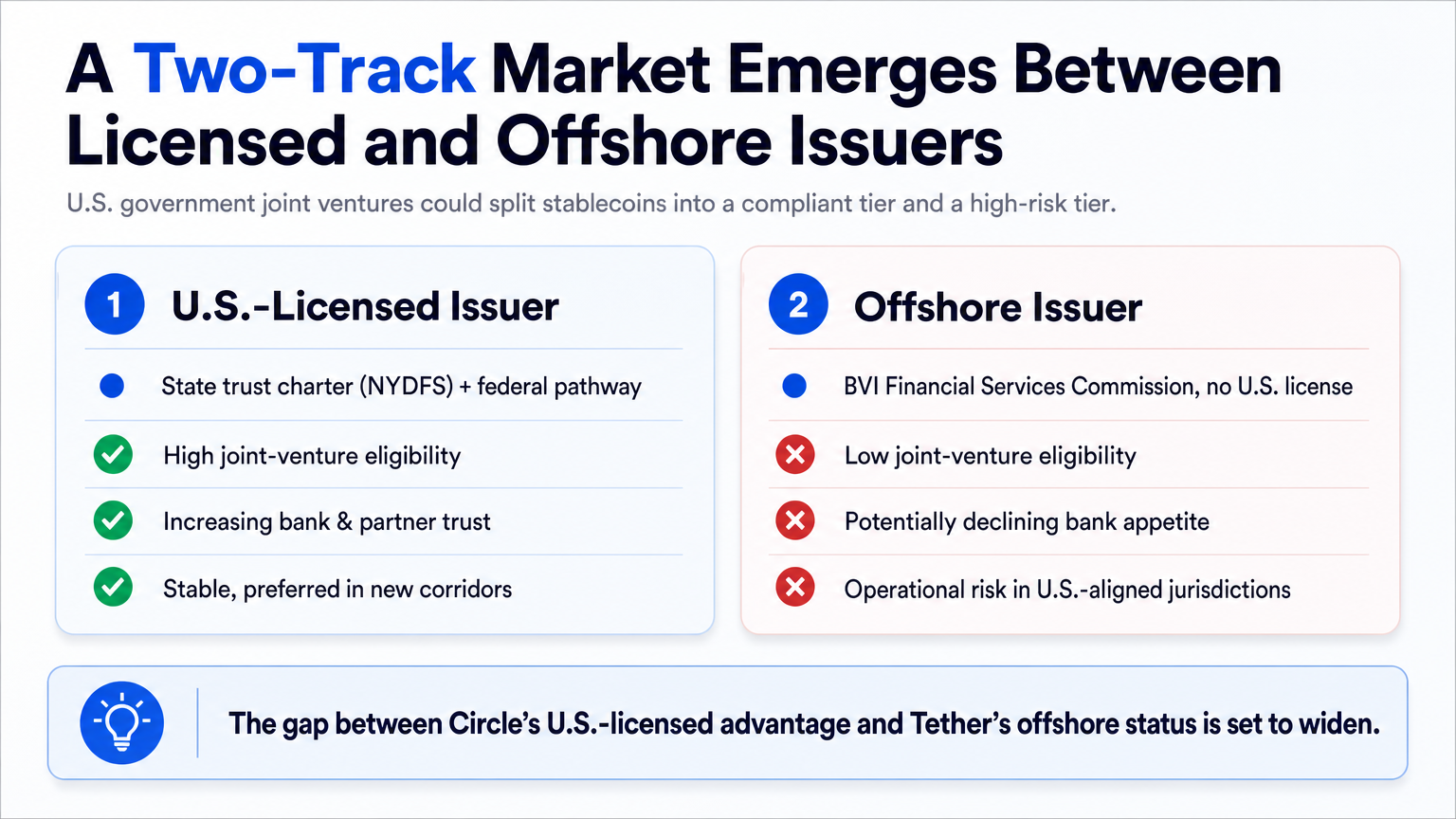
If U.S. government-backed dollar stablecoin joint ventures pick winners based on regulatory standing, the pool of “acceptable” stablecoins could shrink. Issuers with a state trust charter—like Circle’s New York BitLicense—already enjoy a compliance advantage. A joint-venture endorsement from Washington would turn that advantage into a near-monopoly on government-backed distribution.
A simple table clarifies the emerging two-track system:
| Factor | U.S.-licensed issuer (e.g., Circle) | Offshore issuer (e.g., Tether) |
|---|---|---|
| Primary regulatory authority | State trust charter (NYDFS) + anticipated federal pathway | BVI Financial Services Commission, no U.S. license |
| Likely joint-venture eligibility | High – meets domestic standards | Low – lacks U.S. regulatory nexus |
| Bank & partner risk appetite | Increasing – seen as compliant and gov-friendly | Potentially declining if U.S. policy tilts toward federal standards |
| Impact on global users | Stable, possibly preferred in new corridors | Operational risk in jurisdictions that adopt U.S. signaling |
What the Plan Means for the Stablecoins Your Business Holds

USDT vs. USDC: might the regulatory gap widen?
The USDT USDC regulation difference is already a practical concern for treasury teams, and this plan could widen it. Circle has steadily built a reputation as a regulated, transparent issuer, publishing monthly attestations and holding reserves in a segregated bankruptcy-remote entity. Tether, while dominant by volume, has faced persistent questions about reserve composition and has no U.S. regulatory license. A joint-venture framework that rewards U.S.-licensed issuers could further bifurcate the market, making USDC the default for any business that wants to remain aligned with U.S. policy.
This does not mean USDT will disappear. It remains the most liquid stablecoin across many non-U.S. exchanges and DeFi protocols. But for a corporate treasury, the calculus is shifting: if your banking partner adopts a stricter compliance posture based on U.S. signals, holding USDT may become harder to explain during an audit or a counterparty review.
Will a government seal of approval change banking access?
Almost certainly yes. Banks already apply a risk-based approach to crypto clients. A government-endorsed stablecoin distribution network would give those banks a clear hierarchy of which assets are “safe.” A stablecoin compliance for businesses approach that relies on a single, unlicensed token could start to look like an operational risk. We’ve already seen a preview: in 2024, several banks quietly restricted services to firms holding significant USDT balances, citing reserve and licensing concerns. A formal U.S. push would codify that instinct.
The DAO and Web3 Startup Implications
Jurisdictional exposure: where does your stablecoin issuer sit?
DAOs often hold stablecoins in a multisig wallet managed by a Cayman Islands foundation or a Swiss association, but the actual tokens may be issued by a company in the British Virgin Islands—or Delaware. The joint-venture plan highlights a crucial gap: jurisdictional mismatch. If the U.S. starts treating certain stablecoins as “government-backed” and others as not, a DAO that thought it was jurisdiction-agnostic may face hard questions from its banking partner, its exchange, or its contributors about which assets sit on its balance sheet. This DAO treasury stablecoin risk isn’t in the code; it’s in the off-ramps.
Banking partners: why your fiat off-ramp matters more than ever
Fiat off-ramps are the Achilles’ heel of crypto-native organizations. When stablecoins need to be converted for payroll, vendor payments, or tax obligations, the banking relationship is what matters. That bank will increasingly look at the regulatory pedigree of the stablecoin issuer, not just the dollar peg. A neo-banking platform like OneSafe, which provides crypto-friendly business banking with integrated stablecoin on/off-ramps, can abstract some of this complexity—but even the most adaptable fintech relies on partner banks that ultimately follow government signals.
How OneSafe Has Weathered Stablecoin Regulatory Shifts
A single pane of glass for fiat and stablecoin movements
OneSafe, a financial technology platform built for global businesses and DAOs, has processed over $800 million in transaction volume from more than 1,000 businesses across 30+ countries since its launch. It combines multi-currency accounts (USD, EUR, CAD), corporate cards, and crypto on/off-ramps in a single interface. That architecture lets a business hold USDC in a Fireblocks-secured custody environment, pay a supplier in euros via SWIFT, and sweep excess fiat back into stablecoins—all under the same dashboard.
Compliance built in, not bolted on
The platform’s compliance layer is not an afterthought. OneSafe conducts KYB checks during onboarding, applies OFAC sanctions screening at the account level, and maintains segregated global accounts through its banking partners. Digital asset custody sits on Fireblocks, with MFA enabled by default. While OneSafe is not a bank and does not offer FDIC insurance, its design philosophy—embedding compliance at the infrastructure level—mirrors the direction regulators are pushing.
Your Near-Term Action Plan
Here are five specific moves any business or DAO that holds stablecoins should make this quarter:
- Map every stablecoin holding by issuer jurisdiction. Separate USDC (US) from USDT (BVI) and any other tokens. Note the legal entity name and licensing status of each issuer.
- Review your fiat off-ramp bank’s stablecoin policy. Ask your banking partner directly whether they treat USDT and USDC differently and whether they anticipate any changes tied to U.S. government signaling.
- Run a jurisdiction exposure drill on your DAO treasury. If your DAO is incorporated in the Cayman Islands but holds assets of a US-licensed issuer, that’s generally stable; if your issuer is offshore and your bank is in a jurisdiction that aligns with U.S. policy, flag the mismatch.
- Model a partial USDT-to-USDC conversion plan. Understand the liquidity, tax, and custody implications of shifting a portion of your treasury from an offshore to a U.S.-licensed stablecoin.
- Evaluate your financial operations platform for multi-jurisdiction compliance. A platform that natively supports both fiat and stablecoins, like OneSafe’s neo-banking stablecoin integration, can reduce the operational friction of adapting to new requirements.
What to Watch Next
The joint-venture plan is still a report, not a final policy. Watch for:
- A formal Treasury announcement or DFC funding authorization that would turn the plan into an active program.
- The final GENIUS Act rules, which will define which stablecoin issuers are eligible for federal licensing—and, by extension, for any government-backed overseas initiative.
- Guidance from the Federal Reserve on payment stablecoins and cross-border payments, especially after its March 2026 note.
- Signs that non-U.S. jurisdictions (such as the EU and the UK) adjust their own rules in response to a U.S. push, potentially accelerating a global stablecoin framework 2026.
Key Takeaways
- A U.S. government push to export dollar stablecoins via joint ventures could create a two-tier market favoring federally-licensed issuers.
- Businesses holding USDT may face rising friction with banking partners as U.S. signals strengthen.
- DAO treasuries need an immediate jurisdictional audit—the mismatch between issuer location and banking partner poses concrete DAO treasury stablecoin risk.
- Compliant fintech infrastructure, like OneSafe’s integrated fiat-and-stablecoin platform, will become more critical than ever for global operations.
- The rule of thumb for 2026: know your stablecoin issuer’s license, or risk being locked out of the off-ramp.
Explore how your business can manage both fiat and stablecoin exposure with built-in compliance at OneSafe’s unified financial platform for global companies.


![How to Open a Business Bank Account for LLC [Neobank Workflow]](https://cdn.prod.website-files.com/65202616cfa1bf1882f3db51/6ab564b075bebde25f443ac9_6ab564aee90c0fd31d6d37f5_how-to-open-business-bank-account-for-llc-neobank-header.png)
