
On September 28, 2026, Citi and Coinbase announced two products that bring stablecoin regulation into the mainstream of global banking: dedicated Coinbase payment accounts backed by Citi, and stablecoin acceptance for Citi’s institutional clients. The news signals a turning point for corporate stablecoin payments—and for every business that moves money across borders. The same infrastructure already exists outside big-bank partnerships: platforms like OneSafe have offered integrated fiat-crypto accounts for years. The Citi-Coinbase deal confirms that the operational and regulatory ground has shifted permanently.
Table of Contents
- A Landmark Partnership: What Citi and Coinbase Just Announced
- Why This Matters for Global Businesses
- The Rapidly Evolving Stablecoin Regulation Landscape
- What the Deal Reveals About the Future of Corporate Banking
- How Forward-Thinking Businesses Should Prepare
- FAQ: Stablecoin Regulation and Corporate Use
- Open Questions
- Key Takeaways
A Landmark Partnership: What Citi and Coinbase Just Announced
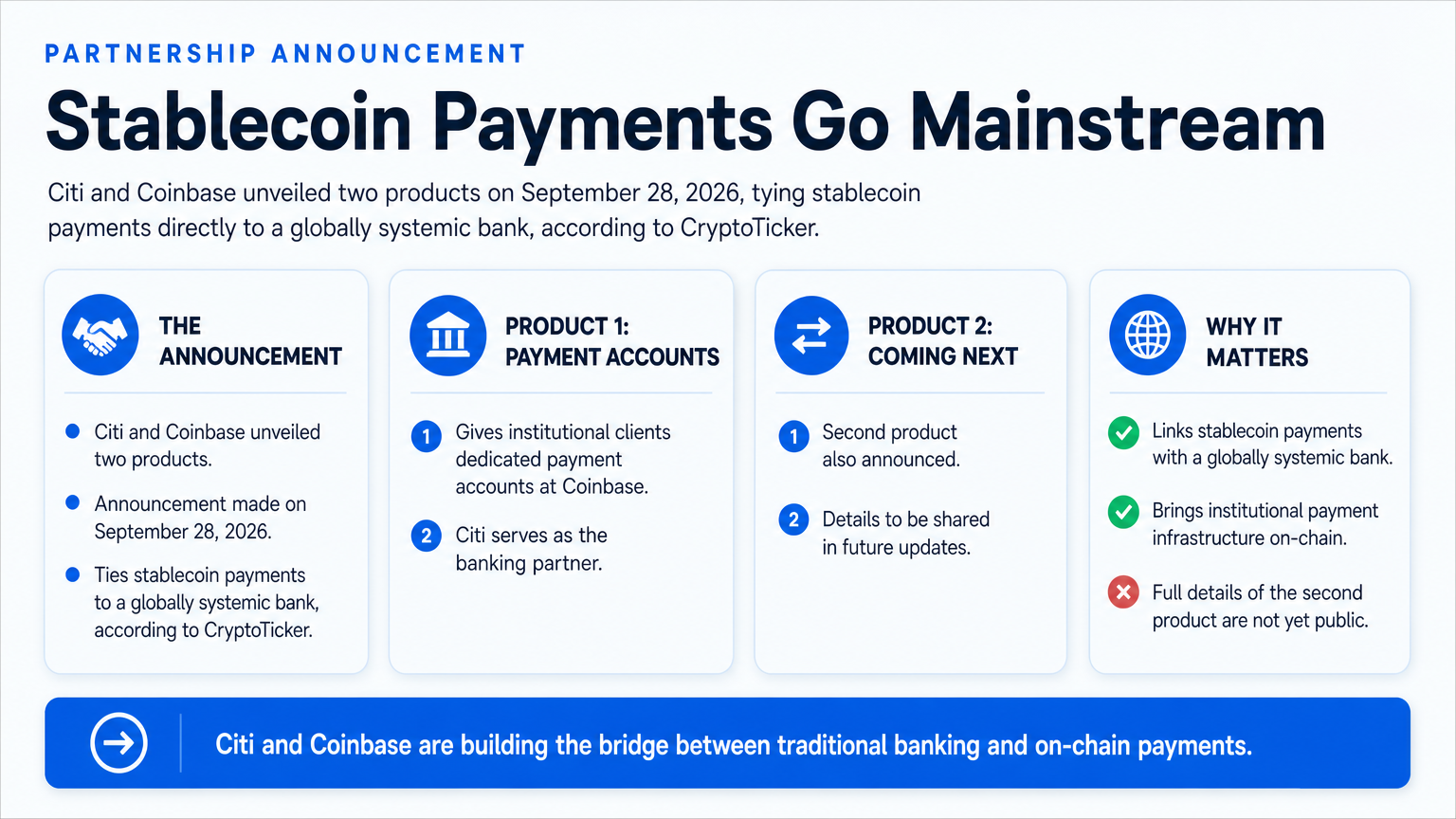
Citi and Coinbase unveiled two products on September 28, 2026, tying stablecoin payments directly to a globally systemic bank, according to CryptoTicker. The first gives institutional clients dedicated payment accounts at Coinbase, with Citi as the banking partner. The second enables Citi’s corporate clients to accept stablecoin payments directly. Both are initially US-only; fees, settlement times, and supported stablecoins were not disclosed. What distinguishes this from earlier exchange-custody models is the explicit participation of a major depository institution—blurring the line between bank-issued stablecoins and bank-grade custody and payment rails.
For companies outside the US, the announcement coincides with tighter constraints in Europe: under MiCA, Article 50 effectively bans interest-bearing stablecoin holdings, and Section 23 of the German Income Tax Act complicates tax treatment for crypto gains.
Why This Matters for Global Businesses
The timing is not coincidental. 2026 has crystallized stablecoin regulation 2026 frameworks on both sides of the Atlantic. In March, the US Treasury issued a proposed rule to implement the GENIUS Act, and the OCC followed with a bulletin on supervisory expectations for national banks engaging with stablecoins. MiCA’s stablecoin provisions became fully applicable across the EU.
The Citi-Coinbase announcement removes any remaining doubt that stablecoin payments are moving inside the regulated perimeter. For corporate treasurers, CFOs, and founders, that means:
- Compliance costs are coming, but also standardized rules that make stablecoins a legitimate payment rail for invoices, payroll, and supplier settlements.
- Non-US businesses must reconcile US-led innovation with local rules—like MiCA’s interest ban or Germany’s tax code—adding complexity a US-only lens misses.
- First-mover advantage belongs to those who adopt compliant fiat-crypto banking flows before competitors do.
The urgency isn’t about the Citi-Coinbase product itself—it won’t be generally available overnight—but about the signal: global crypto regulation is closing the gap between traditional banking and stablecoin settlements.
The Rapidly Evolving Stablecoin Regulation Landscape
The US Multi-Agency Framework
The US has moved from fragmented state money transmitter licenses to a multi-agency federal architecture. Treasury’s proposed rule defines stablecoin issuance and sales under federal law, while the OCC bulletin clarifies how national banks can custody reserves and provide related services. The FDIC and Federal Reserve are aligning on prudential standards for bank-held stablecoin deposits. For corporate payments that touch a US bank, this means coming capital, liquidity, and AML requirements—much like traditional correspondent banking. The Citi-Coinbase product is effectively a test case for operationalizing those rules. The shift mirrors recent Treasury certification rulemaking and signals that compliance is now a product feature.
MiCA and the European Approach
Europe enacted a comprehensive regime for stablecoin issuers and service providers under MiCA. Key constraints for businesses: asset-referenced token issuers must hold reserves in approved credit institutions and cannot pay interest (Article 50), and member-state tax treatments vary—Germany’s Section 23 can tax stablecoin gains if held less than a year. Any corporate stablecoin use in the EU must involve an authorized e-money token issuer and a registered crypto-asset service provider. Treasury strategies built without these rules expose European subsidiaries to immediate compliance risk.
What the Deal Reveals About the Future of Corporate Banking
A global bank anchoring stablecoin accounts signals that stablecoin regulation 2026 is now productized. For years, crypto-native firms relied on exchanges or unregulated wallets while traditional banks observed. The Citi-Coinbase deal inverts that: a bank is the operational spine, not just a correspondent.
Yet businesses don’t need to wait for a bespoke Citi relationship. The same outcome—a unified fiat and crypto payment platform with compliance baked in—has been available from neobanking for web3 providers. OneSafe, for instance, already gives startups and DAOs segregated global accounts, crypto-to-fiat conversions, and automated payment workflows, without the overhead of a legacy banking relationship. The deal’s real significance is that it validates the model: fiat-crypto banking is now a standard corporate requirement, not a niche experiment, much like the shift Jeeves’ $110M raise signaled for embedded banking.
How Forward-Thinking Businesses Should Prepare
Audit Your Stablecoin Usage and Compliance Posture
Map every touchpoint where your business touches stablecoins—supplier payments, payroll, treasury holdings, customer receipts. A simple checklist:
- Identify all wallets and accounts holding or transacting in stablecoins.
- Document each issuer’s regulatory status under applicable jurisdiction (GENIUS Act, MiCA, etc.).
- Map fiat-to-stablecoin flows, noting intermediaries and their licensing.
- Review tax exposure per jurisdiction, with attention to MiCA’s interest ban and short-term capital gains.
- Test reserve attestations—don’t assume all stablecoins are equal.
This audit is not one‑off. As rulemaking finalizes and EU guidance evolves, the compliance landscape will shift again before year‑end.
Consider a Fiat-Crypto Financial Partner
The Citi-Coinbase product will be US‑centric and bank‑gated. Businesses operating across multiple jurisdictions, or those needing faster onboarding and multi-currency capabilities, should evaluate platforms that already deliver unified fiat and crypto financial operations. OneSafe supports USD, Euro, and CAD accounts, on‑ramp and off‑ramp for crypto, and virtual corporate cards with spend limits—all through a fully digital onboarding that typically completes within a week. It partners with banks to offer a compliance-ready interface that aligns with DAO stablecoin compliance and cross-border payment needs.
The relevant metric is not whether a business has a Citi relationship, but whether its infrastructure can process stablecoin transactions with the same reliability, transparency, and legal certainty as fiat wires.
FAQ: Stablecoin Regulation and Corporate Use

What are stablecoins and how are they regulated?
Stablecoins are digital assets pegged to a fiat currency. In 2026, the US GENIUS Act and EU MiCA define federal and bloc-wide standards for issuance, custody, and payments. The Citi-Coinbase deal is the latest indicator that these rules are being productized.
What does the Citi-Coinbase announcement mean for my business?
It means bank-grade stablecoin payments are entering the mainstream. Businesses already using stablecoins will soon have a regulated option; regulators and auditors will increasingly expect that standard. It accelerates the convergence of fiat and crypto treasury management, making a unified banking platform a competitive necessity.
How can a business use stablecoins while staying compliant?
Compliance rests on: choosing a regulated issuer (e.g., USDC under GENIUS or an authorized e-money token under MiCA), custody with a licensed partner, full transaction records for AML/tax, and structuring flows to respect local bans (like MiCA’s interest prohibition). Platforms like OneSafe embed many of these controls by default through KYC/KYB, automated reporting, and permissioned roles.
Do I need a bank partnership like Citi’s, or are there alternatives today?
No, a direct bank partnership isn’t required. Existing platforms already provide integrated fiat-crypto accounts. The table below compares the known features of the Citi-Coinbase accounts with OneSafe’s current capabilities.
| Feature | Citi-Coinbase (as announced) | OneSafe (currently available) |
|---|---|---|
| Account type | Dedicated Coinbase payment accounts, backed by Citi | Business accounts with segregated global sub-accounts |
| Currencies supported | Not disclosed | USD, Euro, CAD; more soon |
| Fiat on/off‑ramp | Stablecoin acceptance for Citi clients | ACH, wire, SWIFT, crypto-to-fiat conversions |
| Crypto custody | Coinbase (Citi as banking partner) | Fireblocks-based custody with MFA |
| Multi‑currency cards | Not mentioned | Virtual cards with spend limits, top‑up in 8+ tokens |
| Onboarding speed | Varies; likely relationship‑based | Fully digital, typically within one week |
| Availability | United States initially | 30+ countries, except OFAC‑sanctioned states and certain US states |
| Compliance structure | Citi BSA/AML framework and Coinbase KYC | Partner bank compliance, KYB, EIN verification for US companies |
| Fees | Not disclosed | Fiat deposit/withdrawal 0.15%; wires $25/$10; SWIFT 0.35% + $50; crypto (USDC) free |
How does MiCA affect my business in Europe?
MiCA requires any stablecoin used for corporate payments to be issued by an authorized e‑money token issuer. The ban on interest (Article 50) prohibits sweeping stablecoins into interest-bearing accounts in a MiCA‑regulated entity. Tax treatment varies—Germany’s Section 23 can create taxable events on short-term holdings. Work with a platform that ensures the stablecoin issuer and service provider are MiCA‑compliant.
Open Questions
Several developments will shape whether the Citi-Coinbase model becomes the template:
- Final GENIUS Act rules from the OCC, Fed, and FDIC—expected later in 2026—will set exact capital and liquidity requirements, potentially altering economics.
- MiCA Level 2/3 measures will clarify how the interest ban applies to multi‑currency platforms used by non‑EU parent companies.
- Competitor bank responses: if other global banks follow, a fragmented network of bank‑branded stablecoin accounts could emerge.
- Tax authority guidance in Germany, the UK, and Singapore will determine whether stablecoin-denominated corporate payments trigger taxable events on every conversion.
- Interoperability between bank-grade accounts and DeFi protocols remains unresolved; moving stablecoins between a Citi‑backed account and on‑chain lending may still face friction.
Key Takeaways
- The Citi-Coinbase products mark the first time a major global bank anchors corporate stablecoin accounts, signaling that stablecoin regulation 2026 has moved from policy to infrastructure.
- While US-only initially, businesses worldwide face tighter compliance under MiCA, the GENIUS Act, and local tax codes—waiting for a bespoke bank partnership is a compliance risk, not a strategy.
- Integrated fiat‑crypto banking platforms already deliver multi‑currency accounts, stablecoin on/off‑ramps, and DAO‑compatible governance without a direct global bank relationship; the Citi-Coinbase model validates this approach.
- A proactive audit of your stablecoin touchpoints, issuer compliance, and tax exposure is the single most actionable step you can take today.
Start building your compliant fiat-crypto foundation at onesafe.io.