
The crypto banking landscape shifted meaningfully on September 29, 2026, when Jeeves announced a $110 million funding round to scale its stablecoin-native banking platform for global enterprises, as reported by Finextra Research on that date. The raise, one of the largest in the sector this cycle, underscores a broader evolution: stablecoin-native business banking is no longer an experiment—it is becoming the operating system for international startups, Web3 teams, and DAOs that need to move money across borders without the friction of legacy rails.
Table of Contents
- What just happened: Jeeves’ $110M stablecoin banking raise
- Why this matters now for global businesses and DAOs
- The crypto banking landscape: where does this fit?
- What founders and finance leads should do next
- Open questions and what to watch
- Key Takeaways
What just happened: Jeeves’ $110M stablecoin banking raise
The numbers and the backers
Jeeves, originally known for its corporate card and expense management product, secured $110 million to expand a platform where stablecoins are the default settlement rail, not an afterthought (Finextra Research, September 29, 2026). While the investor syndicate was not fully detailed in the initial report, the size alone signals conviction that enterprises are ready to run treasury, payroll, and vendor payments on stablecoin infrastructure.
What stablecoin-native actually means for banking
Stablecoin-native means the core ledger, account structure, and payment flows of the platform are built around stablecoins—typically USDC or EUROC—rather than a traditional fiat core with a crypto widget tacked on. Balances sit as on-chain stablecoins, and fiat conversion happens at the edge when a user needs to pay a supplier in USD or EUR, or when a DAO moves funds between DeFi protocols and a local bank account. The Bank of England explains stablecoins as digital tokens designed to hold a steady value, often pegged to a fiat currency, making them useful for payments without the volatility of other crypto assets. A stablecoin-native architecture removes the reconciliation delays and multi-bank hops that plague businesses juggling separate fiat and crypto accounts.
Why this matters now for global businesses and DAOs
Fragmented fiat and crypto operations are a growth tax
For a startup with engineers in Lisbon, a treasury in USDC, and customers paying in EUR and USD, the default setup often involves a traditional business bank account, one or more crypto exchanges, and a manual spreadsheet to track it all. Each hop adds latency, fees, and compliance exposure. When a DAO needs to pay contributors, the problem compounds: governance-approved stablecoin payouts must eventually settle in local fiat, often through multiple intermediaries. A unified crypto banking platform collapses those steps—something that platforms like OneSafe address by combining multi-currency fiat accounts, corporate cards crypto top-ups, and on-chain crypto management in a single interface. The operational cost of fragmentation becomes a real drag on growth as transaction volumes scale.
Stablecoins are becoming business infrastructure, not just trading pairs
Stablecoin payment volume surpassed $220 billion in the first quarter of 2026, a milestone that moved the asset class from speculative trading into serious commercial utility. The Federal Reserve noted in a December 2025 note that stablecoins could displace a meaningful share of bank deposits if they become widely used for payments, fundamentally altering how credit and intermediation work. Jeeves’ raise—and the broader push by platforms to offer stablecoin banking—reflects that shift. Businesses are treating stablecoins as working capital, not just a bridge between crypto trades. For global entities, stablecoins offer near-instant settlement, typically lower cross-border costs, and 24/7 availability, qualities that legacy correspondent banking cannot match.
The crypto banking landscape: where does this fit?
Consumer crypto apps vs. business platforms
Most crypto-friendly financial tools were built for individuals—buying, selling, and holding assets. Business crypto banking requires a fundamentally different feature set: multi-user access with role-based permissions, high transaction limits, automated reconciliation, invoice management, and integration with accounting systems. Consumer apps lack the governance controls a DAO needs, where multi-signature approvals and on-chain transparency are non-negotiable. This distinction is why a dedicated crypto banking platform for enterprises, like the one Jeeves is building, matters: it separates casual usage from the operational backbone a company runs on.
Key capabilities to evaluate in a crypto banking platform
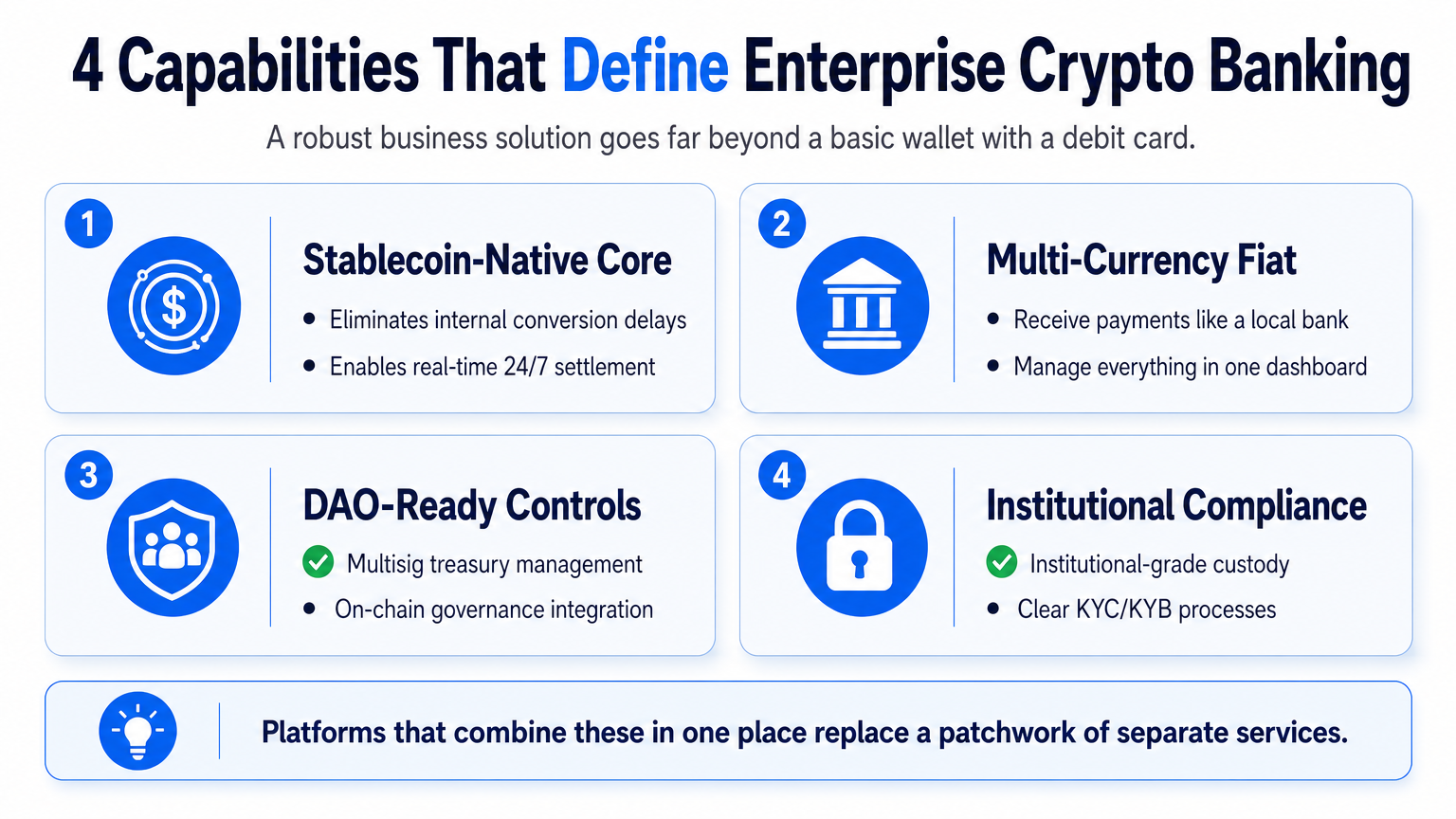
When assessing any platform—whether Jeeves, OneSafe, or another—founders should look beyond a sleek dashboard. The following table distills the capabilities that differentiate a robust business crypto banking solution from a basic wallet with a debit card.
| Capability | Why It Matters | What to Verify |
|---|---|---|
| Stablecoin-native core | Eliminates internal conversion delays; enables real-time 24/7 settlement | Are balances held as on-chain stablecoins by default? |
| Crypto to fiat on/off-ramp | Allows seamless movement between DeFi and traditional payments | Fees, speed, and supported fiat currencies for conversion |
| Multi-currency fiat accounts | Reduces the need for multiple bank relationships globally | Which currencies are supported? Are virtual IBANs or local account details available? |
| Corporate cards crypto top-up | Enables operational spend directly from stablecoin balances | Can cards be issued instantly, and what are the FX fees? |
| Role-based access and DAO controls | Critical for decentralized teams with multisig treasury management | Are on-chain governance tools natively integrated? |
| Compliance and custody infrastructure | Protects assets and ensures regulatory alignment | Is custody through a qualified custodian like Fireblocks? How is KYC/KYB handled? |
| API and accounting integrations | Automates financial close and reduces manual work | Does it connect to QuickBooks, Xero, or internal ERPs? |
Platforms that offer all of these in one place—like OneSafe, which provides segregated global accounts, Fireblocks-secured custody, and instant crypto to fiat conversions—can replace what would otherwise be a patchwork of three or four separate services. (Banking services are provided by its partners; OneSafe itself is a technology company, not a bank.)
What founders and finance leads should do next
Audit your current banking stack for crypto readiness
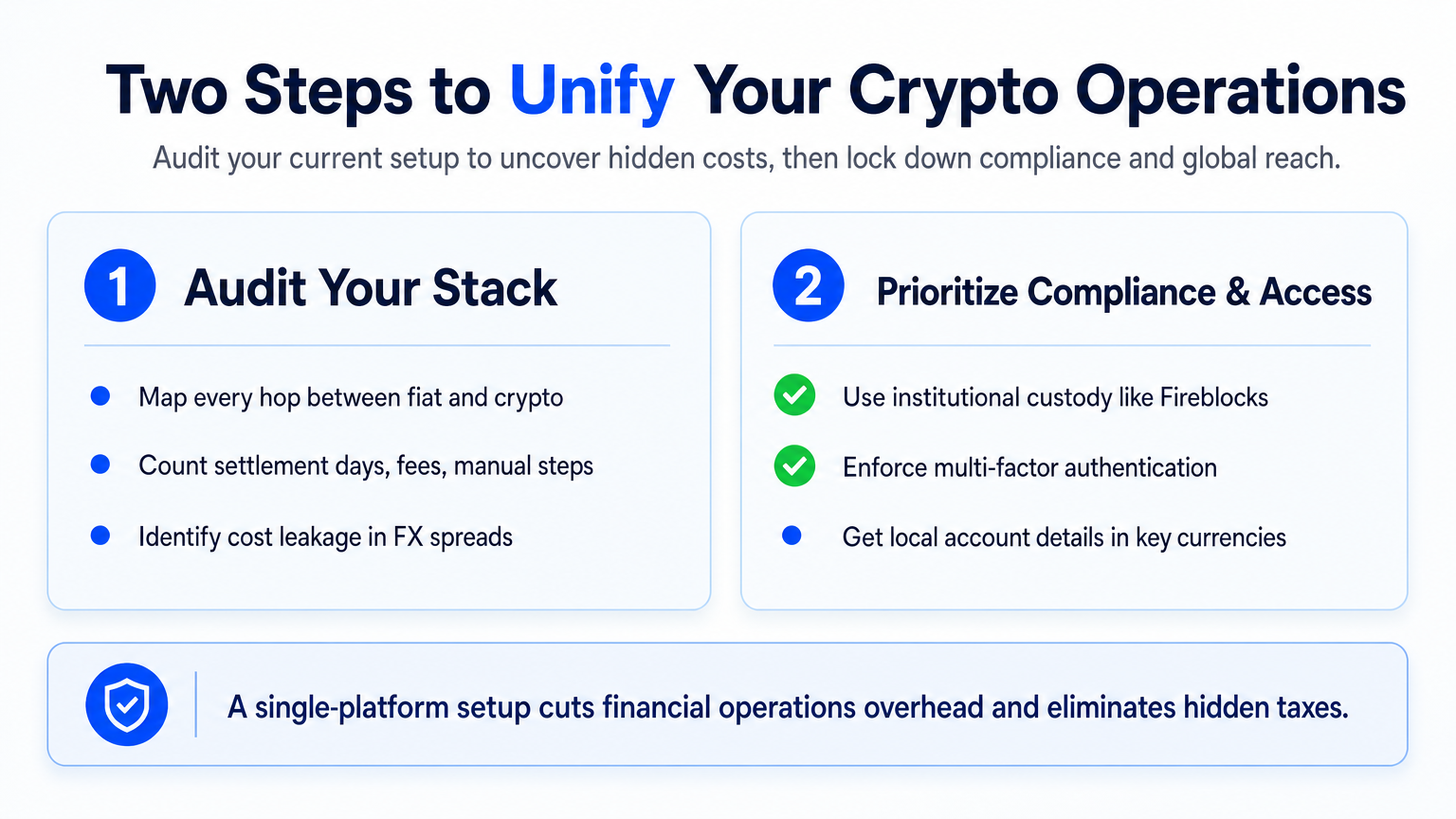
Pull a month of transaction data and map every hop where value moves between fiat and crypto. Count the settlement days, the intermediary fees, and the manual steps. For most global teams, you’ll find at least three separate providers and a meaningful cost leakage hidden in FX spreads and withdrawal fees. A single-platform crypto banking setup often cuts total financial operations overhead by reducing counterparties and automating reconciliation. If you’re already running a significant portion of treasury in stablecoins but still paying suppliers through a legacy bank that doesn’t support on-chain settlement, you’re paying a hidden tax.
Prioritize compliance, custody, and multi-currency access
The appeal of instant stablecoin settlement must be balanced with rigorous compliance. As TRM Labs outlines in its stablecoin risk mitigation blueprint for financial institutions, proper onboarding, transaction monitoring, and asset segregation are non-negotiable. Choose a crypto banking platform that uses institutional-grade custody (like Fireblocks), enforces Multi-Factor Authentication, and supports the fiat currencies you need. For DAOs, ensure the platform allows custom roles and permissions for treasury signers. Global businesses should look for platforms that give them local account details in multiple currencies, so you can receive payments as if you had a local bank account, while managing everything through a single interface. The best neobanks for global fiat and crypto enterprises now offer exactly that combination.
Open questions and what to watch
Will stablecoin-native banking become the default?
The Jeeves announcement is the latest in a string of signals—Limited’s $19 million seed round earlier this year, HIFI’s $37 million stablecoin payments raise—that institutional money is betting on the stablecoin banking model. Yet it’s still early. Most businesses still operate on fiat rails, and the infrastructure for mass adoption of stablecoin-based business accounts is nascent. Whether stablecoin-native banking becomes the default depends on two things: first, whether platforms can achieve the same reliability and deposit guarantees (through partnership structures) that traditional banks offer, and second, whether regulators provide clear, workable licensing pathways for stablecoin issuers and the platforms that custody them.
Regulatory tailwinds and residual risks
The regulatory environment is shifting rapidly. The recent Citi-Coinbase deal, for example, connected a major U.S. bank with a crypto-native exchange to offer business payment services based on stablecoins, signaling a degree of regulatory comfort. However, frameworks differ by jurisdiction, and U.S. regulators are still debating whether stablecoin reserves require bank-like oversight. The stablecoin regulation landscape remains fragmented. For businesses, this means you must monitor which regions a platform is licensed to serve, and whether your stablecoin provider meets evolving reserve and redemption requirements. The safest approach is to use platforms that maintain clear segregation of customer funds, partner with regulated banking institutions, and provide transparent reporting.
Key Takeaways
- A $110 million raise by Jeeves on September 29, 2026, signals that stablecoin-native business banking is attracting serious capital and moving toward mainstream enterprise adoption.
- Businesses and DAOs that currently manage separate fiat and crypto rails are paying an operational growth tax that unified crypto banking platforms can eliminate.
- Evaluating a crypto banking platform requires looking beyond crypto support to custody, compliance, role-based access, and multi-currency fiat capabilities.
- For global startups, the maturation of platforms like Jeeves and others means cross-border payments, treasury management, and payroll can increasingly run on stablecoin rails with traditional banking-grade controls.
- Regulatory clarity is improving but remains uneven; businesses should prioritize platforms with institutional custodians and transparent compliance frameworks.
Ready to unify your fiat and crypto operations in a single, global business banking platform? Explore OneSafe, built for startups and DAOs that need both worlds.