What is a Web3 account? A unified fiat-and-crypto operating system for businesses that replaces wallets and bank accounts with one compliance-ready interface. It’s not just a wallet address; it’s a team-ready financial platform that bridges traditional banking rails with stablecoins, multi-currency ledgers, and treasury controls. If you’re a founder wiring suppliers in euros while paying contributors in USDC—and tracking it on a spreadsheet—this definition changes how you think about business banking.
Table of Contents
- What is a Web3 account?
- How does a Web3 account differ from a traditional business bank account?
- How does a Web3 account differ from a standalone crypto wallet?
- Why would a business need a Web3 account instead of just a bank account?
- What can you actually do with a Web3 account?
- Is my money safe in a Web3 account?
- How quickly can I open a Web3 account?
- What fees come with a Web3 business account?
- Can a DAO use a Web3 account? (DAO banking)
- Key Takeaways
What is a Web3 account?
A standalone crypto wallet (like MetaMask or Ledger) gives you a public/private key pair to sign transactions. A Web3 account wraps that capability inside a regulated, multi-signature environment that also holds fiat, issues corporate cards, and enforces role-based permissions. It’s the difference between a personal checking account and a business checking account—transposed to a world where you settle in stablecoins and wire in USD on the same ledger. For a deeper look at the wallet layer, see Web3 wallets: A complete guide.
Every operational piece sits in one place: ACH and wire transfers, crypto on‑ and off‑ramps, bill payments, and accounting integrations. This avoids the chain of ad‑hoc tools that grows when a startup holds cash at a traditional bank, USDC in a hot wallet, and a separate payroll wallet. By collapsing those silos, a Web3 account reduces reconciliation time and human error.
A traditional business bank account gives you fiat-only rails, slow international wires, and zero native support for on‑chain assets. A self‑custody wallet gives pure crypto control with no fiat bridge, no permissions for a CFO, and no recourse if a key is lost. A Web3 account sits between the two: it pairs the compliance wrapper and support you’d expect from a bank with the ability to hold and move digital assets directly. It’s a neobank for crypto built for operating companies.
How does a Web3 account differ from a traditional business bank account?
The fundamental shift is natively unified ledgers. A traditional bank account can only hold fiat; any crypto activity requires a separate exchange or custodian, with manual sweeps and FX costs. A Web3 account—often called a fiat and crypto account—combines both asset classes under one entity’s name, with sub-accounts in multiple currencies. You can receive a EUR wire, convert it to USDC at competitive FX, and send that stablecoin to a DAO contributor—all from one dashboard. Traditional banks impose rigid hours, days-long settlement for international wires, and slow compliance. A crypto-friendly bank account from a platform like OneSafe uses digital‑first KYB/KYC and typically settles domestic wires same‑day.
How does a Web3 account differ from a standalone crypto wallet?
A standalone crypto wallet—whether non‑custodial like MetaMask or a hardware device—is a single-purpose tool for signing transactions. It holds no fiat, offers no corporate card, and can’t enforce rules like “$10,000 USDC outflow requires CFO approval.” A Web3 account provides multi‑sig treasury controls and custom roles that mirror your org chart: a team lead initiates a payment, a finance manager approves, and the CEO retains final sign‑off. It’s the difference between a personal cash box and a corporate treasury suite. This matters even more now that Thirdweb’s September 2026 launch made account abstraction APIs widely available (Quasa.io, 2026-09-27), turning programmable business accounts with custom spending logic, gas sponsorship, and social recovery into commodity infrastructure.
Why would a business need a Web3 account instead of just a bank account?
Juggling a separate bank account, a treasury multi‑sig, and an exchange wastes time on manual sweeps, incurs hidden FX spreads, and creates audit gaps. A business crypto wallet with integrated fiat rails eliminates the need to pre‑fund fiat pools before converting to crypto—the conversion happens inside the platform’s FX engine. The result is lower operational drag and fewer settlement failures; it’s the difference between closing a vendor contract on Friday and funding it instantly.
Who gains the most: startups, DAOs, and global teams
- Startups pay remote contributors with a domestic wire to a US developer and a USDC payout to a designer in Argentina—all from one balance overview. Web3 startup banking streamlines these multi-rail payments.
- DAOs enforce governance proposals via permissioned roles and multi‑sig treasury, turning on-chain votes into fiat off‑ramp payments without a separate exchange. This is DAO banking in practice.
- Global teams use multi‑currency accounts and integrated FX at 0.25% to avoid the 3%+ spreads that legacy banks bury. CoinGecko’s 2026 crypto card roundup (CoinGecko, 2026-09-23) showed that spending digital assets in daily transactions is now mainstream; a business topping up those cards from its crypto balance accelerates accounts‑payable.
What can you actually do with a Web3 account?
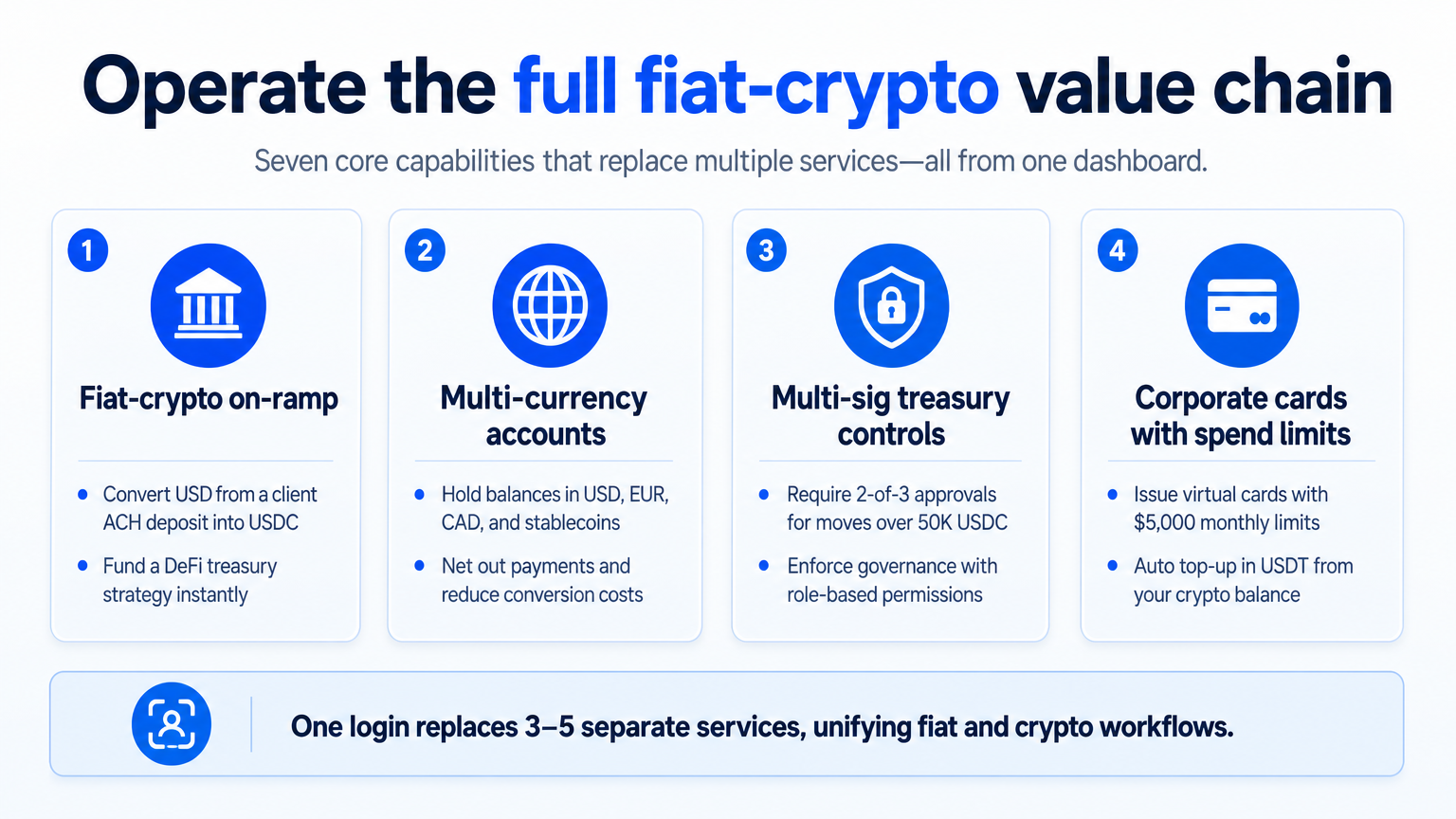
A crypto business account lets you operate across the full fiat‑crypto value chain. The table below distills the core capabilities:
| Capability | Real‑world example |
|---|---|
| Fiat‑crypto on‑ramp | Convert USD from a client ACH deposit into USDC to fund a DeFi treasury strategy |
| Fiat‑crypto off‑ramp | Sell ETH received from a token sale and wire EUR to a supplier |
| Multi-currency crypto account | Hold balances in USD, EUR, CAD, and stablecoins to net out payments and reduce conversion costs |
| Multi‑sig treasury controls | Require 2‑of‑3 approvals to move more than 50K USDC out of the main operating wallet |
| Corporate cards with spend limits | Issue a virtual card to a marketing lead with a $5,000 monthly limit that tops up in USDT |
| Automated payment workflows | Schedule recurring stablecoin payouts for contributors; set a rule that pays invoices in the currency they were submitted |
| Crypto‑native bill pay | Pay a contractor’s invoice in USDC on‑chain while automatically marking the payment in the accounting feed |
Under the hood, platforms like OneSafe aggregate banking partners and custodian infrastructure so one login replaces three to five separate services.
Is my money safe in a Web3 account?
Fiat funds sit in segregated bank accounts at partner institutions. Crypto assets are secured through institutional custodian technology like Fireblocks, which uses multi‑party computation (MPC) and hardware‑grade isolation—similar to the key management approach of Web3Auth. No single employee can move digital funds unilaterally; private key material never leaves a secure enclave. While no deposit is FDIC insured, the combination of dedicated fiat segregation and custody‑grade crypto storage is far stronger than a hot wallet on a laptop.
Mandatory multi‑factor authentication protects every sensitive action. State‑of‑the‑art encryption covers data in transit and at rest. Ask your provider for their SOC 2 Type II report—an auditor’s attestation that security controls are designed and operating effectively. A legitimate Web3 bank account provider will have that report available under NDA. On-chain transaction logs give more transparency than a traditional bank statement ever could.
How quickly can I open a Web3 account?
Onboarding is fully digital and typically done within a week. You fill out a business profile, upload formation documents, and verify identity—no branch visit, no paper signature card. Many platforms collect initial info in under ten minutes and finish verification behind the scenes, contrasting with the 2–4 weeks legacy banks often take.
For US entities, you’ll need Articles of Incorporation/Organization, an EIN letter, and government photo ID for each beneficial owner over the threshold. Non‑US entities provide a registration certificate and director ID. DAOs using a wrapper entity need trust formation documents plus council member IDs. The process mirrors modern remote business account opening, but a Web3 account still requires entity verification.
What fees come with a Web3 business account?
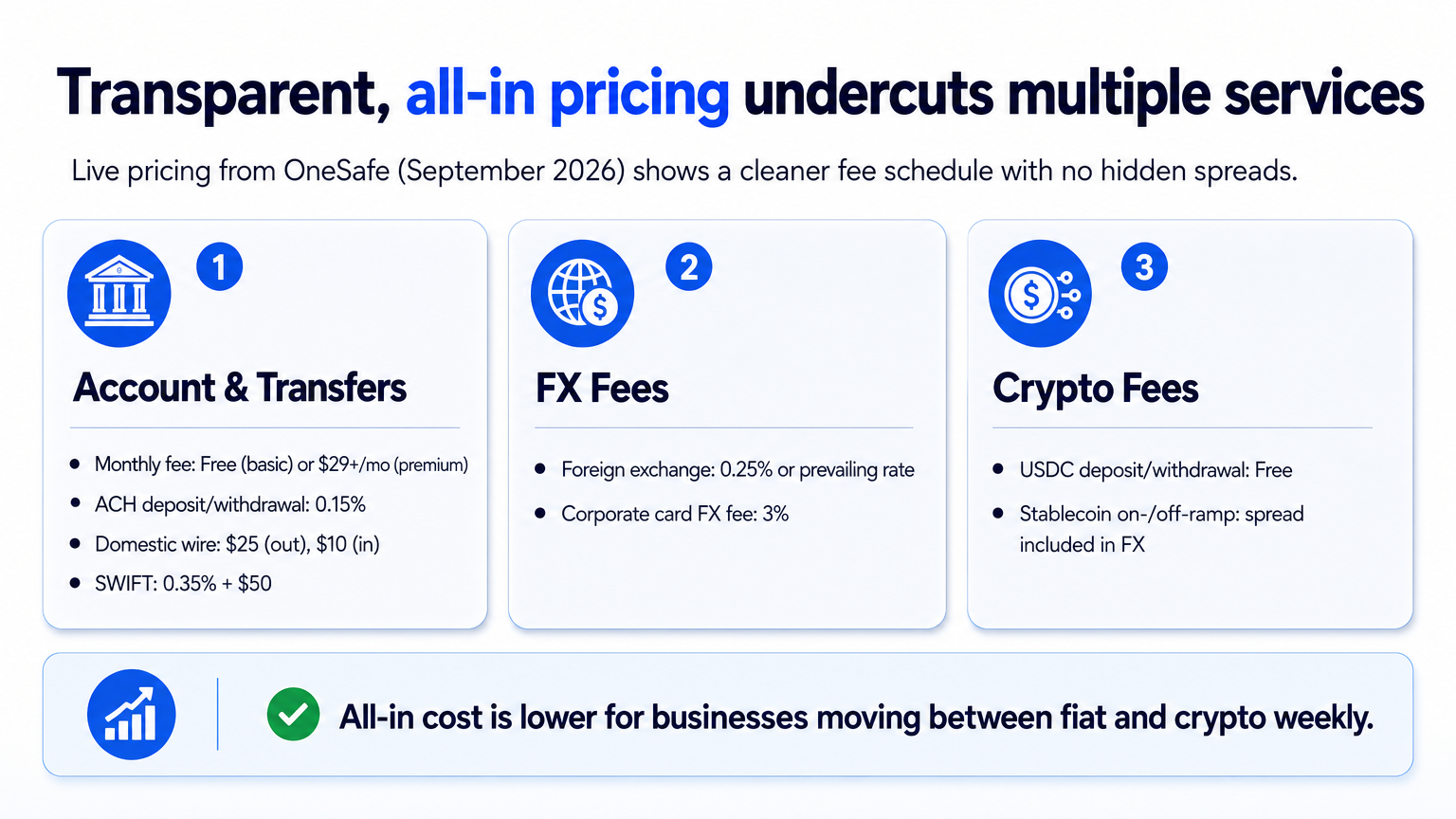
Fee schedules are cleaner because platforms rarely bury spreads in spot FX. Live pricing from OneSafe (September 2026):
| Fee category | Amount |
|---|---|
| Monthly account fee | Free (basic) or $29+/mo (premium) |
| Fiat deposit / withdrawal (ACH, domestic) | 0.15% |
| Wire withdrawal (domestic) | $25 |
| Wire deposit (domestic) | $10 |
| SWIFT deposit / withdrawal | 0.35% + $50 |
| Foreign exchange (FX) | 0.25% or prevailing rate |
| Corporate card FX fee | 3% |
| Crypto deposit / withdrawal (USDC) | Free |
| On‑ramp / off‑ramp (stablecoins) | Spread included in FX rate |
These replace subscription costs, per‑transaction spreads, and exchange withdrawal fees you’d otherwise pay across multiple services. The all‑in cost is usually lower for businesses that move between fiat and crypto weekly, though a single-currency domestic checking account may find a traditional bank cheaper.
Can a DAO use a Web3 account? (DAO banking)
Yes. DAO banking becomes practical when a Web3 account bridges the gap between on-chain governance and fiat operations. Customizable roles map to a DAO’s multisig signers: a working group lead proposes a payout, the multisig approves it above a threshold, and a view‑only auditor role lets the community monitor balances without execution power.
Assets are secured institutionally (e.g., Fireblocks) so no single member controls keys. Automated workflows and invoicing in fiat and stablecoins close the loop from Snapshot vote to payment. This replaces manual, trust‑based off‑ramps with an auditable, self‑serve treasury.
Key Takeaways
- A Web3 account unifies fiat and crypto under compliance, permissions, and spend controls—not a standalone wallet or bank.
- Manual sweeps disappear, cutting settlement delays and audit gaps.
- Startups, DAOs, and global teams gain from multi-currency crypto accounts, multi‑sig treasury, and integrated on/off‑ramps.
- Layered security: segregated fiat, MPC-based crypto custody, mandatory MFA, and SOC 2 audits (though no FDIC insurance).
- Transparent fees: free or low-cost monthly plans, wires $10–$50, FX 0.25%, and often free stablecoin transfers.
Ready to stop juggling bank logins and wallet seed phrases? Sign up for OneSafe and manage fiat and crypto from a single, permissioned business account.