On September 30, 2026, the Treasury interim final rule took effect, turning a new page in stablecoin regulation by formalizing the stablecoin issuer certification process under the GENIUS Act. The rule prescribes the form and procedure for state payment stablecoin regulators to gain federal approval—directly reshaping obligations for businesses that pay vendors, run payroll, and hold working capital in stablecoins.
Table of Contents
- What is the Treasury’s new stablecoin certification interim final rule?
- Why this matters now for stablecoin users
- The background: from a state patchwork to federal certification
- What the ranking pages miss for non‑issuers
- Recommended actions for founders and finance leads
- What to watch next and open questions
- Key Takeaways
What is the Treasury’s new stablecoin certification interim final rule?
The U.S. Department of the Treasury issued an interim final rule on September 29, 2026, effective the next day, that operationalizes the certification pathway in section 4(c)(4) of the GENIUS Act. The regulations, reported by VitalLaw on September 29, create the official form and a structured approval‑and‑denial procedure for the Stablecoin Certification Review Committee (the “Committee”).
The interim final rule at a glance
- Effective date: September 30, 2026.
- Prescribes a certification form for state payment stablecoin regulators.
- Establishes a Committee process to review and approve or deny certifications.
- Interim status: The Committee will revise the forms and procedural regulations after public comments, due by late November 2026.
What the Stablecoin Certification Review Committee will approve or deny
A state regulator must demonstrate that its supervisory and examination framework for payment stablecoin issuers meets the federal standard in the GENIUS Act—covering reserve composition, redemption, disclosure, and operational safeguards. The Committee evaluates the submitted form and supporting materials, then issues an approval or denial. This stablecoin issuer certification decision is the gatekeeper for federal recognition.
What does the Stablecoin Certification Review Committee do?
Announced by the Federal Reserve on September 24, 2026, the Committee’s sole function is to review state payment stablecoin regulators’ certifications. A successful certification means stablecoins issued under that state’s regime become federal payment stablecoins, gaining access to the federal payment system and satisfying key federal compliance requirements.
Why this matters now for stablecoin users
The GENIUS Act effective date and the compliance clock
The GENIUS Act, signed into law on July 17, 2025, established a comprehensive US stablecoin framework for payment stablecoins. Its key operative dates are approaching: by the effective date (expected mid‑2027 after completion of rulemakings), only payment stablecoins issued by a certified state‑regulated entity or a federally‑chartered issuer may be lawfully used in certain inter‑state commerce and payment system contexts. The Treasury rule kick‑starts the certification pipeline, giving state regulators a concrete form. For businesses, acting early reduces disruption to stablecoin compliance for businesses.
Issuer certification vs. user obligations: who this rule actually touches
The interim final rule directly addresses state payment stablecoin regulators and issuers, not the businesses that use stablecoins. Morgan Lewis has focused on issuer opportunities, while Triple‑A has highlighted compliance burdens. Non‑issuer companies are not required to certify, register, or submit forms. However, after the effective date, if a business’s chosen stablecoin lacks a certified issuer, its legal validity in commercial transactions is jeopardized. This turns stablecoin counterparty risk into a hard compliance variable.
What does the rule change for businesses that use stablecoins?
Under the new payment stablecoin rules, finance teams must now ask: Is the token we hold backed by a certified issuer? The answer is accessible through a formal, federally recognized certification. The rule incentivizes issuers to seek state certification quickly, progressively narrowing the list of business‑grade payment stablecoins.
The background: from a state patchwork to federal certification
How stablecoin regulation has worked in the US until now
Previously, the US had no dedicated federal stablecoin framework. Most dollar‑pegged stablecoins operated under state money transmitter or trust charters, with federal agencies (SEC, CFTC, FinCEN) adding piecemeal oversight. The result was an unsettled patchwork. As noted by Latham & Watkins and the Congressional Research Service, the GENIUS Act creates a voluntary certification pathway to bring qualifying state‑regulated issuers into a coherent federal regime.
How does the GENIUS Act certification process work?
A state payment stablecoin regulator submits a certification to the Committee, attesting that its regime meets or exceeds federal standards. The Committee reviews using the Treasury interim final rule’s form and process. Approval means the issuer can issue federal payment stablecoins eligible for Fed clearing and settlement; denial leaves the token without the federal safe harbor—critical for lawful inter‑state use.
Why certification changes the confidence calculation
The Brookings Institution has described US stablecoin regulation as an unresolved jurisdictional battle. In contrast, Ripple’s institutional guide sees the oversight architecture clarifying. The Treasury rule formalizes a state‑to‑federal gate but leaves open residual state enforcement. A state certification is a strong signal of federal acceptance, not blanket immunity. Finance teams must monitor both Committee approvals and state actions.
What the ranking pages miss for non‑issuers
Updating vendor due diligence and stablecoin counterparty checks
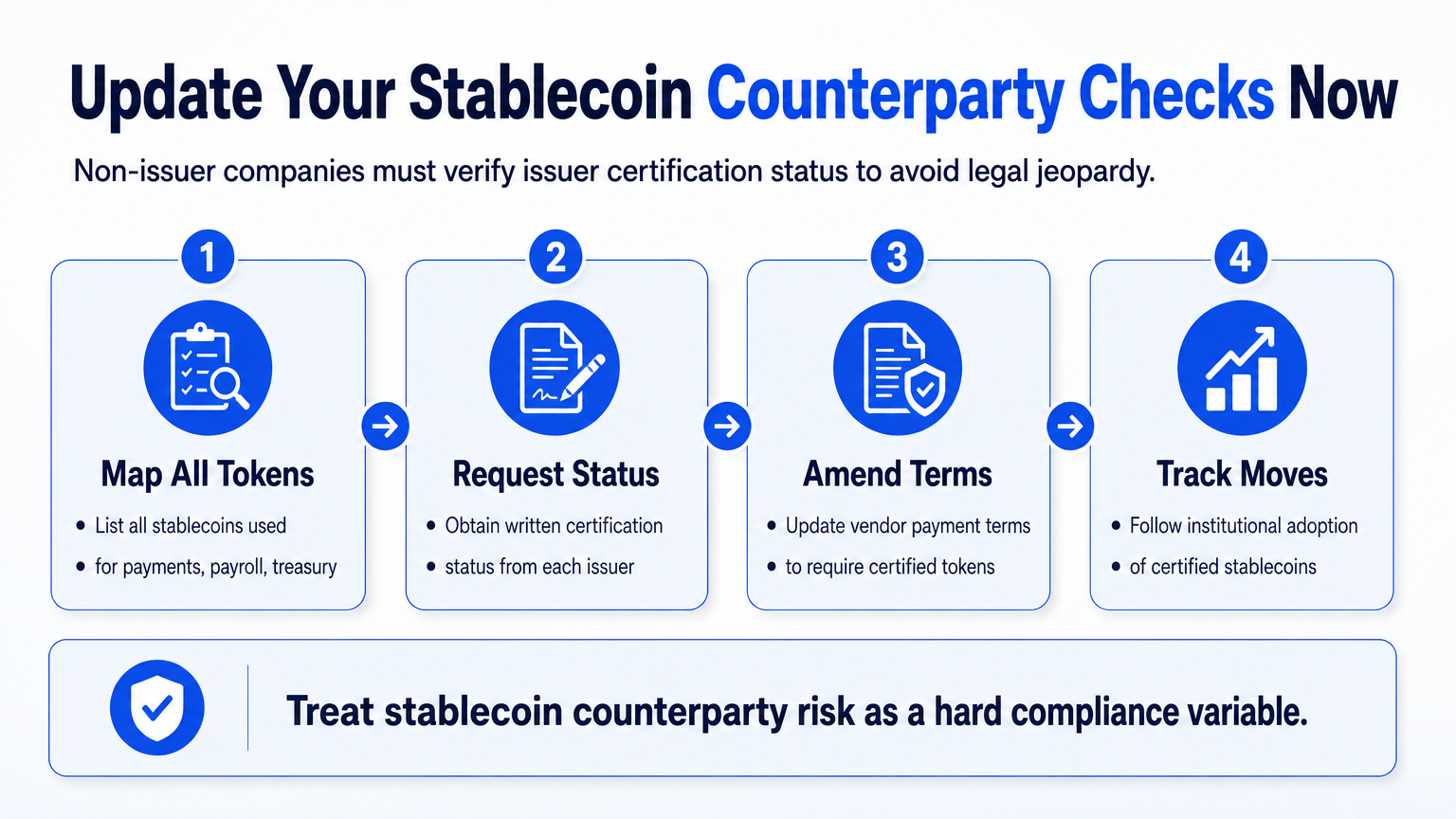
Most commentary treats certification as issuer‑side. For a business, it changes the counterparty risk profile of every stablecoin balance. Before the effective date:
- Map every stablecoin token used for payments, payroll, and treasury.
- Obtain from each issuer a written statement on their certification application status.
- Update vendor payment terms to specify only certified‑issuer stablecoins after the compliance deadline.
- Follow institutional moves like Citi‑Coinbase bank‑grade stablecoin payments that signal the push toward certified‑quality issuance.
What DAOs and Web3 startups should require from an issuer
DAOs and Web3 startups often hold significant treasury in stablecoins and make on‑chain payments. For them, the rule creates a demand‑side filter: only use stablecoins with a clear path to state certification. Require:
- Publicly accessible reserve composition reports and attestations.
- Redemption rights aligning with GENIUS Act—same‑day par redemption.
- A disclosed legal entity subject to a certified state regulator’s examination.
These expectations mirror the broader trend toward Web3 account infrastructure that treats fiat and on‑chain money as a single compliance surface.
How should DAOs and Web3 startups handle stablecoin payments now?
Immediately conduct a stablecoin payment inventory. If you pay contributors or vendors in a stablecoin that may not pass certification, open a transition path: migrate to a pending‑certification token or bridge to fiat rails. Add a certification‑status verification step to your treasury policy—similar to checking a bank’s FDIC status but for stablecoins. Integrating real‑time compliance data into treasury operations, as explored in Oracle’s 24/7 treasury push, is rapidly becoming table stakes.
How OneSafe users can keep fiat and crypto operations compliant
OneSafe’s platform provides segregated multi‑currency accounts, corporate cards, and automated payment rails, letting users quickly shift vendor payouts between fiat and certified‑path stablecoins without fragmenting operations. OneSafe is a financial technology company, not a bank; banking services are provided by partner banks. For stablecoin compliance for businesses, OneSafe users can:
- Hold fiat in USD, Euro, and CAD accounts while monitoring issuer certification status.
- Convert crypto to fiat (and vice versa) instantly, with free USDC deposits and withdrawals, to maintain flexibility as certification lists crystallize.
- Leverage unified transaction tracking to tag payments by stablecoin certification status.
OneSafe does not itself certify stablecoins. The key is to treat the platform as a compliance‑agnostic execution layer while managing stablecoin selection and counterparty risk independently.
Recommended actions for founders and finance leads
Do non‑issuer companies need to act before the GENIUS Act effective date?
Yes. No filing is required, but holding a stablecoin that later loses its federal safe harbor poses real risk. Early identification and mitigation smooth the transition and reduce disruption to payroll, vendor relationships, and working capital.
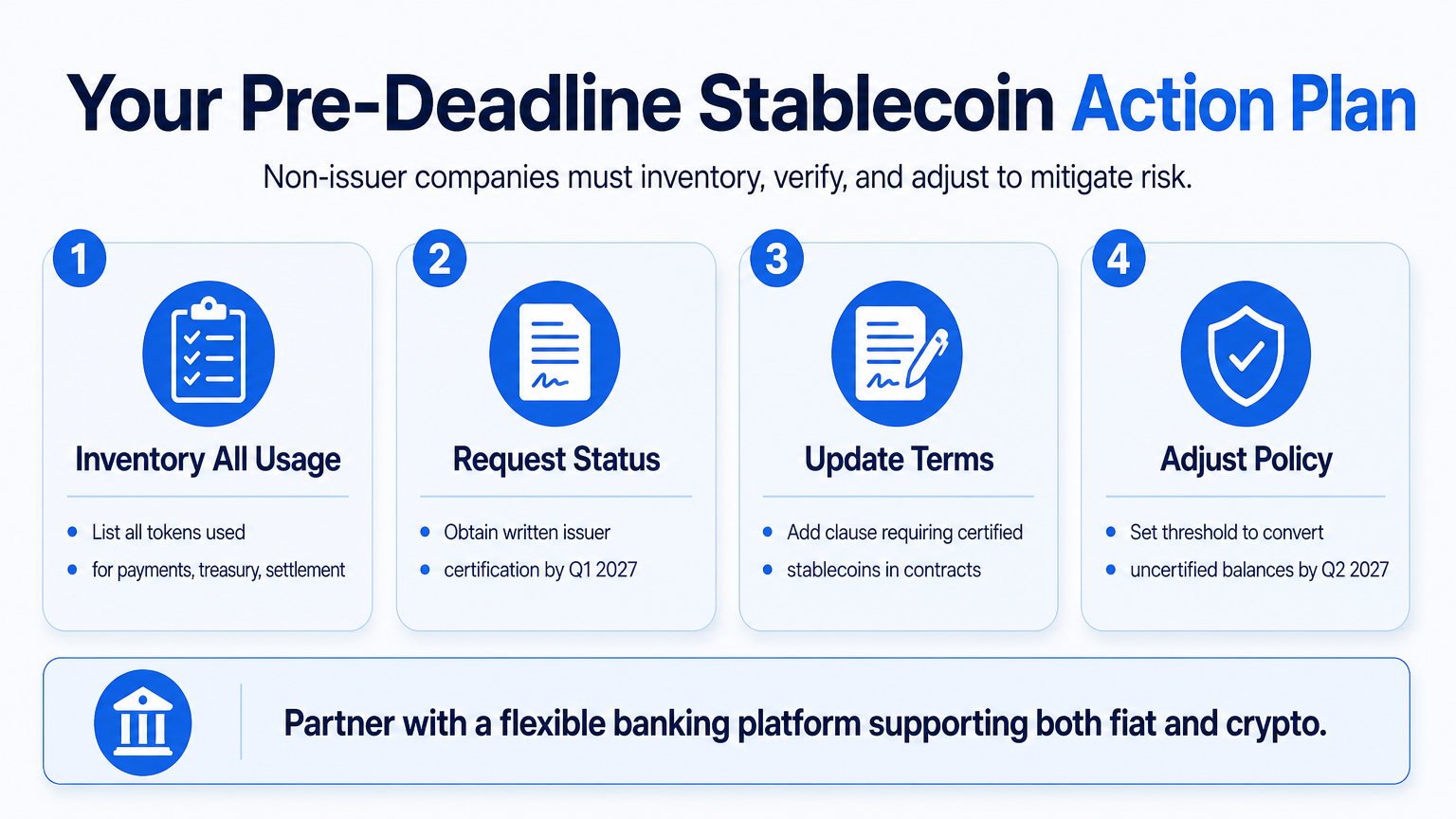
A practical checklist before the GENIUS Act effective date
| Action item | Deadline | Detail |
|---|---|---|
| Inventory all stablecoin usage | Within 30 days | List tokens used for payments, treasury, and on‑chain settlement. |
| Request issuer certification status | Q1 2027 | Contact the issuer (or its banking partner) for a written update on state certification. |
| Update vendor payment terms | Before next renewal | Add a clause requiring stablecoin payments to be in a token issued by a Committee‑certified state‑regulated issuer. |
| Adjust treasury policy | Q2 2027 | Set a threshold for when uncertified stablecoin balances must be converted to fiat or a certified token. |
| Partner with a flexible banking platform | Now | Ensure your banking layer supports both fiat and crypto, so you can pivot as certification evolves. |
Questions to ask your banking and payments partners
- “Which stablecoins do you support, and what is their issuer’s certification status under the GENIUS Act?”
- “How will your platform handle a stablecoin that loses federal eligibility mid‑transaction?”
- “Can you provide reports that flag transactions involving non‑certified stablecoins before the compliance deadline?”
- “What conversion paths do you offer between fiat and certified‑path stablecoins, and at what cost?”
What to watch next and open questions
What should finance teams watch for next on stablecoin regulation?
- Comment deadline and revisions. The Committee accepts public comments through late November 2026; form and procedural changes could tighten or relax requirements.
- First wave of state certifications. Approvals or denials for major issuers’ home states will signal the practical scope of the federal safe harbor.
- State‑level enforcement and preemption disputes. State attorneys general may bring consumer‑protection actions; litigation is possible.
- International developments. With EU (MiCA) and UK frameworks advancing, cross‑border businesses must map multiple compliance timelines. As reported in US stablecoin regulation push abroad, American regulatory moves shape global joint ventures and market structure.
For the latest stablecoin regulatory updates, finance teams should monitor the Committee’s website and set aside early‑2027 time to adjust policies.
Whether widely used stablecoins receive state certification
The biggest open question is whether stablecoins like USDC and PYUSD will be issued under a certified regime. If a major stablecoin’s home‑state regulator fails to get certification, the token’s federal standing could be cast into doubt. Until first certifications are granted, businesses should diversify stablecoin treasury and keep a ready fiat‑conversion option.
Key Takeaways
- The Treasury interim final rule, effective September 30, 2026, formalizes the Stablecoin Certification Review Committee’s process for approving state payment stablecoin regulator certifications under the GENIUS Act.
- Non‑issuer businesses have no direct filing obligation, but their stablecoin holdings and vendor payment flows will be exposed if the issuer lacks certification after the effective date.
- DAOs and Web3 startups should immediately inventory stablecoin usage, demand issuer certification roadmaps, and update payment terms to require certified‑regime tokens.
- The rule leaves open preemption questions and state‑enforcement risks; a state certification is a strong signal but not a bulletproof safe harbor.
- Comments are due by late November 2026, and the Committee will likely revise the certification forms thereafter—requiring active monitoring.
For global businesses and DAOs that need a single platform to manage fiat and crypto finances as stablecoin regulation evolves, explore how OneSafe provides multi‑currency accounts, seamless on‑off ramps, and the controls your team needs at OneSafe.