The card statement arrives, but the finance team still can't explain several transactions. Receipts sit in email threads, a contractor has paid for a business tool personally, and a DAO contributor has used a card issued for travel to fund an unrelated software subscription. Month-end close stretches while someone exports transactions, asks for missing documentation, converts currencies, and tries to determine which legal entity should absorb each charge.
That's the practical problem with corporate card expense management. Issuing cards gives employees a convenient payment method, but it doesn't automatically create control, clean accounting data, or an audit trail. Those outcomes require a connected operating model that covers policy, provisioning, approvals, reconciliation, security, and adoption.
Table of Contents
The Reality of Corporate Card Expense Management
Most expense programs don't fail in a dramatic way. They deteriorate through small exceptions. A missing receipt gets approved because close is approaching. A manager forwards an approval by email. Finance downloads a card statement, copies data into a spreadsheet, and promises to clean up the coding later. In a web3 company, the same process may also involve a crypto-to-fiat conversion, a wallet transaction, or a payment made for an entity in another jurisdiction.
The symptoms become obvious at month-end. Finance spends too much time filling gaps, employees complain that rules are unclear, and leaders can't see committed spend until after the money has moved. A mature program reverses that timing. It captures transactions at the source, applies policy before or at authorization, routes only meaningful exceptions to people, and sends structured data into the accounting system.

Why card growth doesn't solve visibility
Corporate cards already handle much of the traditional travel burden. A JPMorgan benchmarking survey found that corporate cards paid for 85% of airfare, 74% of hotel costs, and 70% of car rental costs, with about 82% of travel spending captured on some type of company-issued card. The same survey reported corporate card spending rebounding from $138 billion in 2008 to $156 billion, with a projection of $186 billion by 2015, demonstrating how cards became a core mechanism for managing travel and entertainment spend at scale. (JPMorgan corporate card benchmarking survey)
The weak point is often the layer around the card. A 2024 survey found that 46% of firms increased corporate card usage, while only 2% increased expense-management software adoption. Software usage remained within a 39% to 47% range since 2021, while the average close took 14 days. The leading pain points were time spent filling out reports, policy guidance and compliance, and card reconciliation. (2024 corporate card and expense-management survey)
Practical rule: A card program creates transaction data. An expense program turns that data into governed, usable accounting information.
What a mature program looks like
The target isn't to make every employee submit more paperwork. It's to make routine spend easy to authorize and difficult to misuse. A finance team should be able to answer who spent the money, for what business purpose, under which entity, in which currency, against which budget, and with what supporting evidence.
For web3 and international teams, add two questions: did the payment touch a digital asset or wallet, and can the company prove the conversion and settlement path? If those answers require manual detective work, the program has a visibility gap even if every card transaction appears on the statement.
Designing an Effective Corporate Card Policy
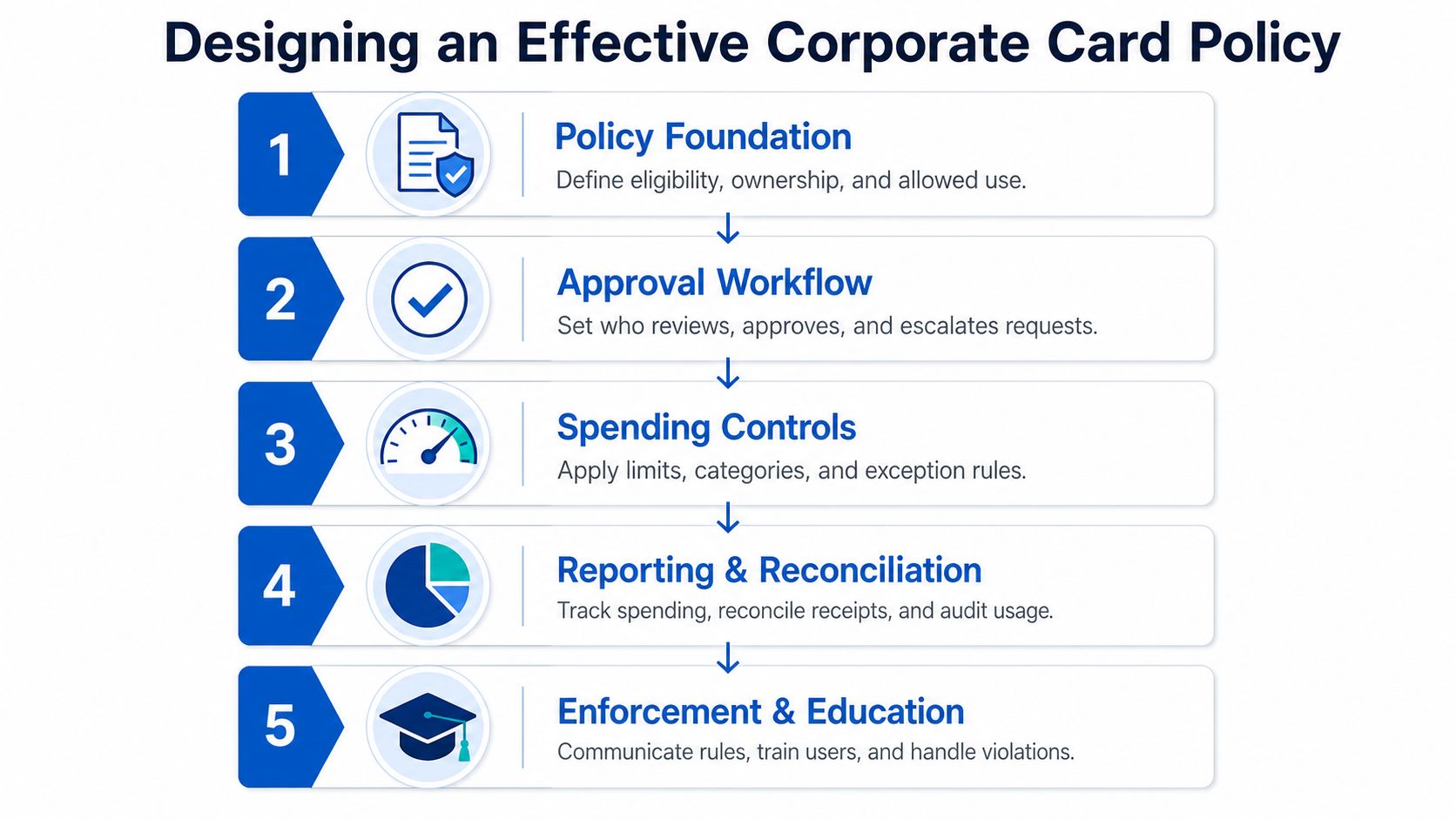
A policy should tell an employee what they can do at the moment of spending, not merely give finance a document to cite after a violation. Write it around decisions, approval thresholds, evidence requirements, and exceptions. Avoid language such as “reasonable business expenses” without defining who decides what reasonable means and how that decision gets recorded.
Start with the policy foundation
Define permitted use cases first. Separate travel, subscriptions, contractor payments, client entertainment, operational purchases, and emergency spend. Each category may need a different card, limit, approver, and documentation standard. A card for a conference trip shouldn't automatically work for software, and a card for a recurring vendor shouldn't be available for personal travel.
Then specify:
- Eligible spend: State what the company will pay for and what it won't.
- Evidence: Require receipts, business purpose, attendees where relevant, project or cost-center coding, and any required invoice.
- Approval ownership: Name the role responsible for approving each category and exception.
- Timing: Require employees to attach documentation promptly, while transactions are still easy to identify.
- Consequences: Explain what happens when documentation or policy compliance is missing.
The policy should distinguish a blocked transaction from an exception. A blocked transaction prevents spend that clearly falls outside the card's purpose. An exception allows legitimate judgment, but only when the approver records the reason. That distinction keeps managers from turning every declined transaction into an informal override.
Balance control with operating reality
Overly broad policies create leakage. Overly rigid policies create workarounds, especially in web3 companies where contributors may operate from different countries and vendors may accept different payment rails. Build a default rule that works for normal cases, then create a documented path for unusual but legitimate spend.
For example, a travel card might allow airlines, hotels, ground transport, and meals, while a separate virtual card handles a conference vendor. A team member who needs an unplanned purchase can request a temporary limit increase with a stated business purpose and expiry date. The control remains visible, and finance doesn't need to maintain a permanent exception.
Your policy also needs an entity rule. An employee may work for a parent company while incurring costs for a subsidiary, foundation, or DAO. Require the cardholder to select the benefiting entity and project before submission. Don't rely on finance to infer that allocation from a merchant name weeks later.
Use plain language, examples, and a short decision tree. Put the policy inside the card and expense workflow where possible, then reinforce it through onboarding and periodic training. A policy employees can't find or interpret won't protect the business.
Provisioning Cards and Configuring Multi-Currency Controls
Provisioning starts with the business purpose, not the employee's job title. A senior employee may need a higher travel limit, but they don't necessarily need unrestricted software, cash-equivalent, or digital-asset-related spend. Create a card profile for each recurring use case, then assign the person, entity, budget, and approval path.
Build the card around a defined role
Use physical cards for durable operational needs and virtual cards for vendors, trips, projects, and controlled experiments. A virtual card tied to one vendor is easier to cancel and reconcile than a shared card passed between team members. Temporary cards also reduce the risk of leaving unused credentials active after an event or contractor engagement ends.
Configure controls at the point of issuance:
- Assign ownership. Record the cardholder, manager, legal entity, department, project, and intended purpose.
- Set spending limits. Use limits that reflect the approved budget and expected frequency, rather than granting broad access for convenience.
- Restrict merchants. Apply merchant-category controls to prevent a travel card from becoming a general purchasing card.
- Define geography. Review where the card will be used, especially when employees or contractors work across borders.
- Set approval behavior. Decide which transactions can proceed automatically and which require pre-approval.
- Create a review date. Reassess access when a project, trip, contract, or employment relationship ends.
A card should be locked quickly when suspicious activity appears or when the holder no longer needs it. Don't treat card cancellation as the only offboarding control. Remove access, revoke linked permissions, collect outstanding documentation, and confirm that recurring vendors have moved to an approved payment method.
Handle currencies as an accounting problem
Suppose the company's base account is in USD and a contractor in Europe needs to pay a EUR-denominated vendor. Decide whether the company will hold EUR, convert at payment time, or settle from USD. Each option affects the exchange rate, the timing of the accounting entry, and the amount ultimately charged.
The workflow should preserve the original transaction currency, the settlement currency, the exchange rate used, and any applicable fee. Finance needs those details for reconciliation and for understanding whether a variance came from pricing, timing, or foreign exchange. Employees shouldn't have to guess which currency to select or whether a conversion is permitted.
For a global web3 team, separate card spend from treasury activity. A card transaction for hosting is an operating expense. A conversion from a stablecoin to fiat may support that expense, but it also creates a treasury record that needs its own approval and audit trail. Don't collapse both events into one vague expense line.
When comparing providers, review multi-currency account support, card settlement behavior, FX disclosures, entity segregation, and accounting exports. OneSafe's corporate card offering is one option to assess for cards, spending controls, and multi-currency business operations. The decision should depend on the company's jurisdictions, currencies, controls, and accounting requirements, not on card availability alone.
Building Approval Workflows and Reconciliation Systems
Approval design should reflect risk, not hierarchy for its own sake. A manager can approve routine spend within a budget, but a transaction that changes entity exposure, involves a new vendor, or touches a digital asset may need finance or treasury review.
A small team might use one manager approval and a finance exception queue. A larger organization can route by amount, category, entity, project, and vendor status. The important point is that each rule must have an owner and a fallback. An approval request that sits with an unavailable manager is a control failure and an operational bottleneck at the same time.
Separate routine review from exception review
Routine transactions should move with minimal handling when they fit the card's purpose, have supporting evidence, and remain within budget. Exceptions deserve attention because they carry ambiguity or risk. Useful exception reasons include missing documentation, unusual merchant category, duplicate-looking transaction, unrecognized cardholder activity, cross-entity allocation, and currency mismatch.
Create escalation paths for each type. A missing receipt belongs with the cardholder. A questionable business purpose belongs with the manager. A suspicious merchant or repeated authorization failure belongs with finance or security. A wallet-related transaction may require treasury and compliance review.
Design approvals around questions: Is the spend authorized, documented, correctly allocated, and safe? If the system can answer those questions automatically, don't make a manager repeat the work.
Reconcile continuously
The strongest process begins when the transaction appears, not when the statement closes. Match the card authorization or cleared transaction to the receipt, vendor, employee, entity, GL account, project, and approval record. Where the system can't match automatically, send the item to an exception queue with a clear reason.
Accounting integration should preserve source data and status changes. A transaction exported to the ledger as “travel” without its entity, project, currency, and approval context still leaves finance with cleanup. Review the platform's accounting software integration approach for transaction import, categorization, and journal-entry workflows before committing to an implementation.
A practical reconciliation cadence is near real time for high-risk activity and frequent review for routine spend. Finance should monitor pending authorizations, cleared transactions, unmatched receipts, failed imports, rejected entries, and stale exceptions. Don't allow a spreadsheet to become the unofficial system of record.
For multi-entity operations, reconcile by entity before consolidating. A parent-level dashboard can show total exposure, but the underlying ledger must retain the legal entity that incurred the cost. This matters when employees share cards, vendors invoice different subsidiaries, or a foundation and operating company use related services.
Fraud Prevention, Security, and Compliance Strategies
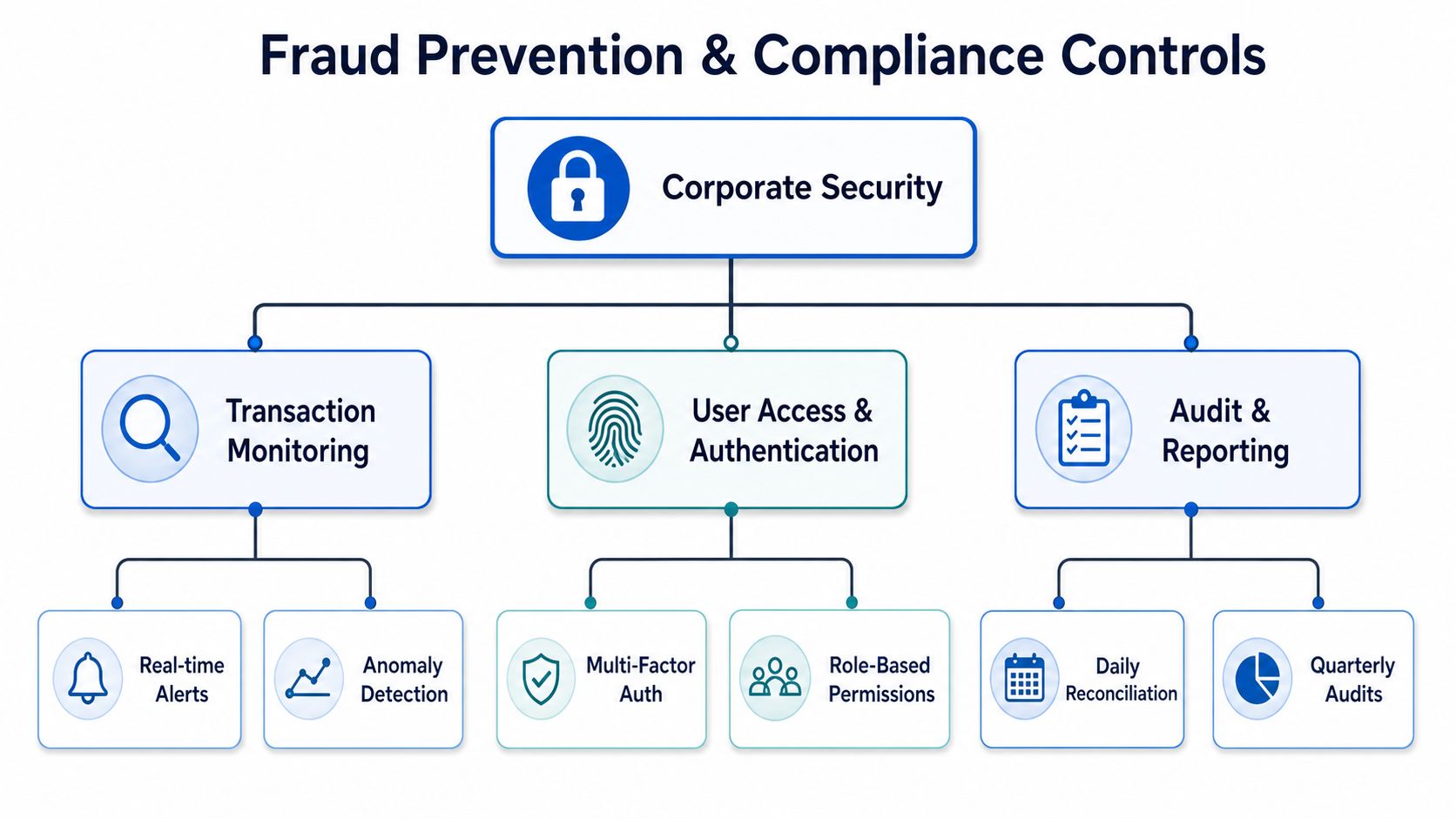
A corporate card program has two security surfaces. The first is the payment instrument, where limits, merchant controls, authentication, and alerts can stop or expose suspicious activity. The second is the accounting and custody trail, where the company must explain what happened, who authorized it, and how the transaction relates to the business.
Web3 adds another layer because a payment may move through a wallet, exchange, custodian, or conversion service before it reaches a vendor. A card control won't explain a wallet transfer, and a blockchain transaction alone won't prove the business purpose. Keep the payment evidence, approval, wallet or account identifier, conversion record, vendor information, and accounting treatment connected.
Put controls before the loss
Require multi-factor authentication for card administration, approvals, treasury actions, and changes to account permissions. Use role-based access so a cardholder can't change their own limits or approve their own exception. Separate payment initiation from approval where the transaction carries material financial or compliance risk.
Monitor for patterns rather than relying only on individual transaction thresholds:
- Unusual merchant behavior: Review new categories, repeated declines, rapid retries, and transactions inconsistent with the card's stated use.
- Identity and access changes: Alert on new devices, changed beneficiaries, permission escalation, and activity outside expected working patterns.
- Duplicate or split activity: Look for repeated amounts, related merchants, and multiple transactions that appear designed to avoid an approval threshold.
- Wallet and conversion movement: Preserve addresses, counterparties, network details, conversion records, and the internal business purpose.
- Dormant access: Lock unused cards and remove access that no longer matches a current role or project.
Maintain an audit trail that records authorization, approval, edits, rejection, reversal, and settlement. For digital assets, use controlled custody and documented wallet ownership. The record should allow an independent reviewer to follow the path from budget decision to final payment.
Treat compliance as an operating workflow
Jurisdictional requirements vary, so the company should map obligations by entity, payment type, employee location, vendor location, and asset type. KYB and KYC procedures should support onboarding, beneficial-owner review, sanctions screening, transaction monitoring, and escalation. A documented AML and KYC procedure helps teams assign responsibility instead of treating compliance as a one-time onboarding task.
Chargebacks also need an evidence process. Preserve invoices, delivery records, correspondence, approvals, and proof of service, then use a practical resource on how to prevent chargeback disputes to strengthen the company's response and documentation discipline.
Tax and financial reporting require consistent treatment of fiat expenses, crypto payments, conversions, fees, and gains or losses where applicable. Don't let employees choose accounting treatment in an unstructured comment field. Give finance a controlled taxonomy and require the right supporting evidence for each transaction type.
Tracking KPIs and Managing Change Adoption
A dashboard should tell finance where control is weakening and where employees are struggling. It shouldn't merely display every transaction in a different format.
Start with a small operating scorecard:
| KPI | What it reveals | Management response |
|---|---|---|
| Card penetration | How much eligible travel and expense spend runs through approved card rails | Map spend outside the program and address the largest leakage points |
| Receipt compliance | Whether cardholders provide usable evidence | Improve capture prompts, training, or enforcement |
| Coding cycle time | How long transactions remain uncoded or unmatched | Fix chart-of-accounts mapping and ownership |
| Policy-violation rate | Where rules fail or employees misunderstand them | Adjust controls or clarify policy language |
| Active card utilization | Whether issued cards serve a real purpose | Close dormant cards and redesign provisioning |
| Close cycle | Whether expense operations delay accounting | Prioritize stale exceptions and integration failures |
A Mastercard benchmark found average card-driven T&E spend at 62%, while best-in-class programs target 85% or more and TCG client data showed 84.5% of total program T&E flowing through cards. The same source reported a traditional method capturing 59% to 100% of total travel costs, compared with a broader capture model averaging 114%, which reinforces the need to map end-to-end spend rather than count card transactions alone. (Mastercard T&E benchmark)
Metrics only improve behavior when employees understand the reason for the change. Train people using the transactions they make, publish examples for cross-border and web3 payments, and give managers a clear exception standard. Roll out controls in stages, review rejection patterns, and adjust rules that create friction without reducing risk.
Moving Forward with Your Expense Program
Corporate card expense management works when the company treats the card as one control point in a larger system. The policy defines acceptable behavior, provisioning limits exposure, approvals assign judgment, reconciliation protects the books, and security controls preserve trust across fiat and digital-asset workflows.
Start with a transaction map. Identify every card, reimbursement route, entity, currency, wallet-related payment, accounting destination, and manual spreadsheet. Then choose the highest-risk gap, usually unmatched spend, unclear ownership, weak entity allocation, or uncontrolled card access.
Use this implementation sequence:
- Document the current flow: Follow a transaction from authorization through the ledger.
- Create card profiles: Tie each card to a purpose, owner, entity, budget, and expiry or review date.
- Write usable policy: Define permitted spend, evidence, approvals, and exceptions in plain language.
- Automate reconciliation: Match receipts, coding, approvals, currencies, and ledger entries.
- Add security review: Enforce MFA, role separation, alerts, custody controls, and audit trails.
- Measure adoption: Track penetration, compliance, coding time, utilization, and close performance.
- Iterate with evidence: Use exception patterns and employee feedback to refine controls.
Don't issue more cards until the existing program can explain its spend. Build the operating discipline first, then scale access as the data proves the controls work.
OneSafe provides multi-currency business accounts, global payment rails, corporate cards with spending controls, and crypto-compatible workflows for companies operating across borders and in web3. Review OneSafe to assess whether its account, card, approval, and settlement capabilities fit your expense management requirements.