On October 31, 2026, Binance announced its crypto asset recovery effort had reached 90% coverage of the $6.3 billion in client assets stolen in the industry’s largest-ever cyberattack. The October 2026 Binance hack placed stablecoin regulation squarely under the microscope, as the Circle Tether freeze of millions in stolen funds demonstrated both the protective power and the centralizing risks of regulated stablecoins. For businesses that rely on these digital dollars for payroll, cross-border payments, and treasury management, the episode is an operational stress test exposing the fragile bridge between consumer protection and control.
Table of Contents
- What Just Happened: Binance Hack and $6.3B Recovery Effort
- Why the Binance Hack Matters for Stablecoin Regulation
- Background: How Stablecoin Regulation Works Today
- What This Means for Businesses Holding Stablecoins
- What to Watch Next in Stablecoin Regulation
- Key Takeaways
What Just Happened: Binance Hack and $6.3B Recovery Effort
The October 31 Attack and Its Immediate Fallout
On October 29, 2026, attackers breached Binance, making off with approximately $6.3 billion in customer cryptocurrency, according to Bloomberg. Binance pledged to cover losses through its Secure Asset Fund for Users (SAFU) and company reserves. By October 31, the exchange said it had reserved more than $6.3 billion and that roughly $3 billion had been frozen on blockchain networks, as The Cryptonomist reported. Withdrawals were expected to resume by November 1, but the recovery effort exposed the critical role of centralized actors in a supposedly decentralized ecosystem.
Circle Tether Freeze: Gatekeepers in Action
Crucially, the Circle Tether freeze response was swift: USDC and USDT linked to the hack were blocked following law enforcement requests, preventing off-ramping into fiat. Binance acknowledged these asset freezes were instrumental in reaching 90% coverage. For regulators, it was a real-world proof of concept: stablecoin issuers can function as gatekeepers, much like traditional financial intermediaries. For businesses, it was a stark reminder that the oversight enabling consumer protection also introduces centralized control points that can freeze their own funds, a tension central to stablecoin regulation.
Why the Binance Hack Matters for Stablecoin Regulation
Asset Freezing as a Regulatory Superpower
The hack highlighted the freeze mechanism as a regulatory superpower. Under the GENIUS Act stablecoin framework and similar rules, issuers must comply with sanctions screening, KYC, and law enforcement requests. A court order or valid government directive can render tokens unspendable. The Circle Tether freeze wasn’t arbitrary; it followed existing legal channels. This benefits consumer protection—stolen funds can be clawed back—but creates a direct stablecoin counterparty risk for businesses: your funds live on a ledger an issuer can blacklist. Stablecoin oversight balances financial integrity with the autonomy businesses expect from crypto.
Consumer Protection vs. Centralization Risk
The freeze power embodies the trade-off. Without centralized control, hacks mean unrecoverable losses, eroding trust. But the same control can be triggered by regulatory ambiguity, compliance errors, or overzealous enforcement. A startup seeing its USDC frozen—even temporarily—faces an immediate liquidity crisis. This reframes business crypto banking strategy: stablecoin regulation is vital for security but introduces intermediary risk that businesses must actively manage.
Background: How Stablecoin Regulation Works Today
What are stablecoins?
Stablecoins are digital assets pegged to a stable reference, typically the U.S. dollar, and used for trading, payroll, and DeFi. USDT and USDC together command hundreds of billions in market cap. Their utility rests on the promise of 1:1 redemption, backed by reserves of cash, Treasury bills, and liquid instruments, governed by regulatory frameworks.
How are stablecoins regulated in the US?
The GENIUS Act stablecoin legislation established a dual federal-state pathway. The OCC can charter national issuers, while states retain authority over non-chartered entities. Key requirements include 1:1 reserve backing with high-quality liquid assets, regular attestations, and AML compliance. The OCC’s final rule detailed ongoing supervisory expectations. The result: stablecoin issuers operate much like narrow banks, with the power and obligation to freeze assets under specific legal conditions.
How are stablecoins regulated abroad?
Globally, the picture is fragmented. The EU’s MiCA regulation, fully applicable since 2025, imposes strict licensing and reserve requirements, and supervisors can order funds frozen. Other jurisdictions from Singapore to the UAE have their own frameworks. For a business holding stablecoins across borders, overlapping rules create a complex compliance landscape. A USDC payment settled through a European entity may face different freeze mechanics, making an understanding of local regulations and issuer policies essential.
What This Means for Businesses Holding Stablecoins
What risks do stablecoins pose for businesses?
Beyond de-pegging and reserve transparency, the Binance hack 2026 spotlights counterparty control risks:
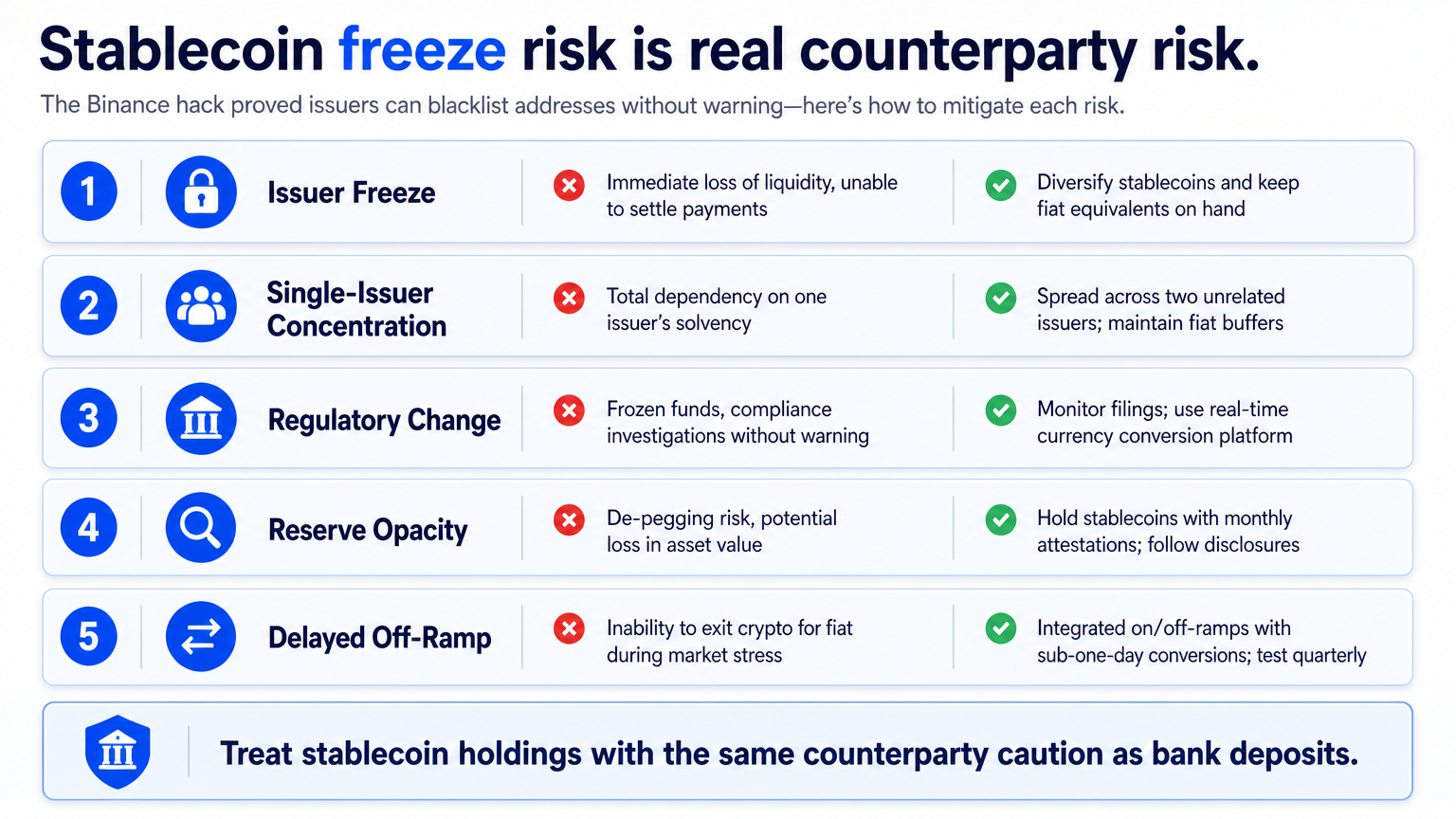
- Freeze risk: An issuer can blacklist your address without warning, even on a false positive, halting operations.
- Concentration risk: Relying on a single stablecoin or issuer creates a single point of failure.
- Regulatory whipsaw risk: A new sanctions designation can retroactively affect tokens you already hold.
These are treasury-level risks requiring the same rigor as managing fiat bank relationships.
Operational Resilience: Why You Need a Unified Fiat-Crypto Stack
The operational lesson: stablecoin holdings can’t be treated as bearer instruments. They demand the same contingency planning as any bank deposit—the ability to move funds quickly between fiat and crypto rails. A unified financial platform combining multi-currency fiat accounts with seamless crypto on/off-ramps lets you instantly convert stablecoins to dollars or euros across segregated accounts, reducing single-issuer exposure. For DAOs and Web3 teams, crypto treasury management with automated workflows and role-based permissions becomes critical for continuity.
Counterparty Risk: When Your Stablecoin Can Be Frozen
Consider a scenario: you hold USDC in a self-custodied wallet funded legitimately from a DEX that unknowingly received tainted funds. A regulator identifies the link, and Circle freezes the tokens pursuant to a legal request. Recovery would require costly legal action. This is not hypothetical—the Binance recovery proved issuers can freeze assets rapidly. The 2026 stablecoin regulation environment makes clear that businesses must treat stablecoin holdings with the same counterparty caution as bank balances at a single institution.
| Risk Factor | Business Impact | Mitigation Action |
|---|---|---|
| Issuer freeze of stablecoin wallets | Immediate loss of liquidity, inability to settle payments | Diversify across multiple stablecoins and fiat equivalents; keep operational funds in segregated accounts with instant conversion capability |
| Single-stablecoin concentration | Total dependency on one issuer’s solvency | Spread treasury across at least two unrelated issuers and maintain fiat buffers for critical expenses |
| Regulatory change or enforcement action | Frozen funds, compliance investigations | Monitor filings regularly; use a platform with real-time currency conversion |
| Reserve opacity or attestation gaps | De-pegging risk, loss in value | Hold stablecoins with monthly attestations from reputable audit firms; follow issuer disclosures closely |
| Delayed off-ramp during market stress | Inability to exit crypto positions for fiat | Use integrated on/off-ramps with sub-one-day conversions; test exit process quarterly |
What to Watch Next in Stablecoin Regulation
Will the Binance Hack Trigger New Rules or Enforcement?
Regulators will likely cite the incident to fast-track emergency freeze protocols and issuer coordination mandates. The speed of the Circle Tether freeze has already drawn praise from U.S. Treasury officials. Expect guidance clarifying when and how issuers must cooperate with law enforcement across jurisdictions. Freeze risk will become more formalized, not less. The GENIUS Act already contains asset recovery provisions, but the hack may accelerate a standardized inter-issuer freeze network, entrenching centralized control while reducing accidental freezes.
How can my business protect its stablecoin holdings after the Binance hack?
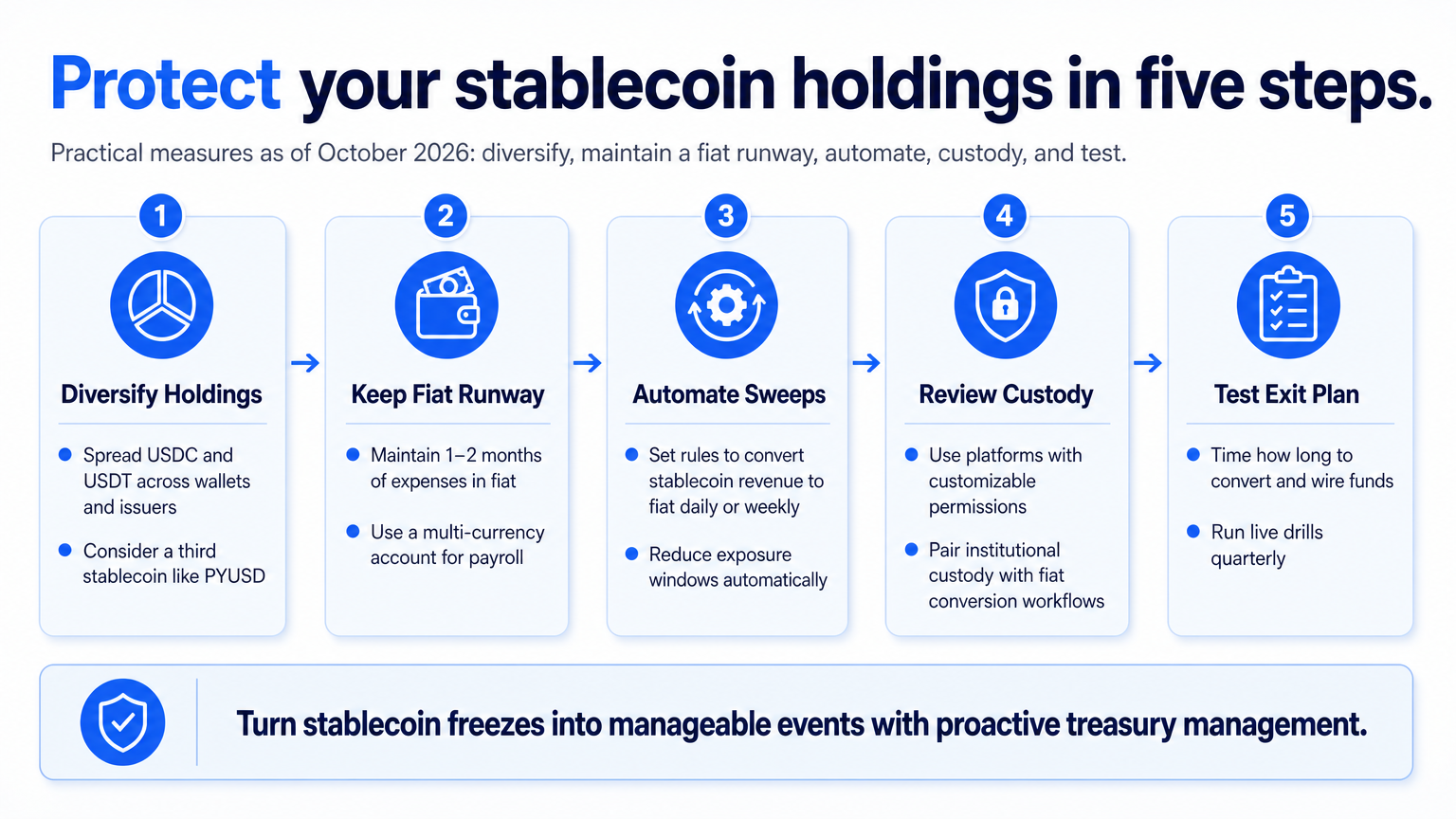
Practical steps as of October 2026:
- Diversify: Spread USDC and USDT across multiple wallets and issuers; consider a third stablecoin like PYUSD for a portion of your treasury.
- Maintain a fiat runway: Keep one to two months of operating expenses in traditional fiat within a multi-currency account that covers payroll and vendors if crypto rails freeze. OneSafe, for example, offers segregated global accounts in USD, Euro, and CAD alongside crypto.
- Automate treasury sweeps: Set rules to convert incoming stablecoin revenue to fiat daily or weekly, reducing exposure windows. Platforms supporting crypto payroll can automate salary disbursements in fiat.
- Review custody and control: Use platforms with customizable permissions so no single signer can expose the treasury. Institutional custody (e.g., Fireblocks) mitigates theft risk but not issuer freeze risk—pair it with fiat conversion workflows.
- Test your exit plan quarterly: Know exactly how long it takes to convert stablecoins to fiat and wire funds to a backup account; run live drills.
The Role of Crypto-Native Banking Platforms in a Regulated World
The Binance hack demonstrates that crypto banking security isn’t only about preventing theft—it’s about building architecture that stays functional when part of the system freezes. Platforms bridging fiat and crypto natively, with instant conversions and integrated compliance, give businesses agility. For DAOs, a unified stack also solves DAOs crypto management: reconciling on-chain transactions with off-chain bookkeeping. As oversight tightens, a single interface for both asset classes becomes essential.
Key Takeaways
- The Binance hack 2026 recovery showed stablecoin issuers can freeze funds rapidly—a win for consumer protection that creates new counterparty risk.
- Stablecoin freeze risk means diversification and a ready fiat buffer are no longer optional.
- A unified fiat-crypto stack allows startups and DAOs to convert, hold, and spend assets without single-issuer dependency, turning freezes into manageable events.
- Post-hack, GENIUS Act stablecoin mechanisms and global frameworks will likely intensify freeze protocols, making proactive treasury management essential.
- Crypto-native banking platforms combine segregated fiat accounts, instant conversions, and secure custody, offering resilience amid tightening oversight.
Rapid shifts in stablecoin regulation demand constant communication with users and stakeholders. Joyrise plans, writes and publishes illustrated SEO articles to your Webflow blog every day, letting you read your first article before you pay—so your content stays current without draining internal resources.
Open a OneSafe account to unify your fiat and crypto operations on a single, resilient platform.