Stablecoin regulation shifted from theory to immediate operational reality on October 31, 2026, when Tether’s reserve surplus nearly doubled to $7.95 billion. For finance leads and founders using stablecoins for payroll, treasury, and cross-border payments, that number signals a sharp rise in the compliance bar. This article connects the development directly to business decisions: what the surplus means for regulatory pressure, and which steps you can take now to reduce exposure while preserving speed.
Table of Contents
- What Just Happened: Tether’s $7.95B Reserve Surplus
- Why This Matters Now for Businesses Using Stablecoins
- The State of Stablecoin Regulation: A Quick Primer
- How the Tether Surplus Changes the Regulatory Conversation
- Action Plan for Finance Leads and Founders
- What to Watch Next
- Key Takeaways
What Just Happened: Tether’s $7.95B Reserve Surplus
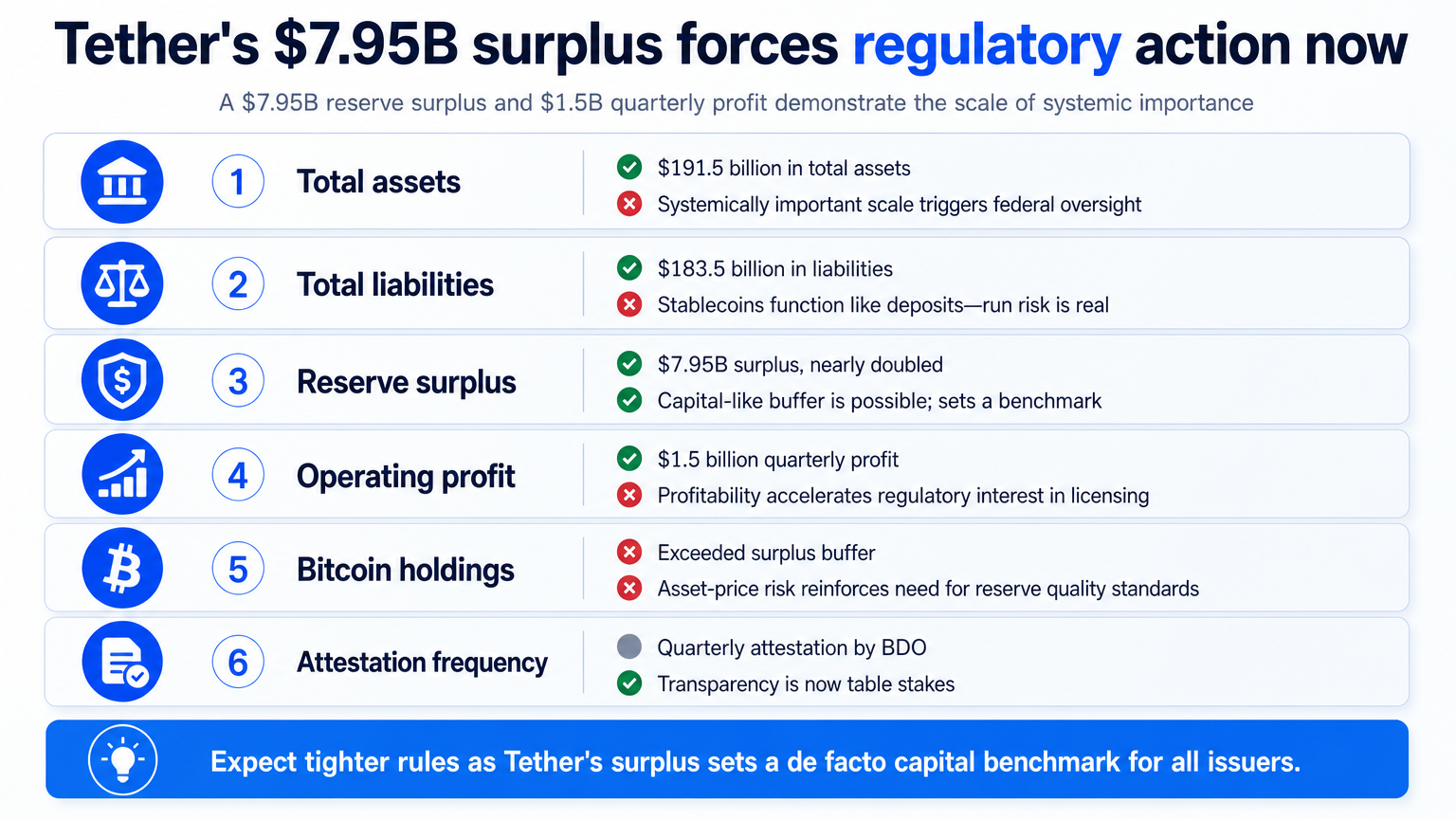
According to a quarterly attestation by BDO covered by the Bitcoin Foundation on October 31, 2026, Tether held $191.5 billion in assets against $183.5 billion in liabilities at the end of September 2026. The resulting $7.95 billion surplus jumped from $4.1 billion at June’s close, while $1.5 billion in operating profit came mainly from interest on its Treasury-heavy portfolio. Notably, Tether’s Bitcoin holdings now exceed the surplus buffer itself—a fact that underscores the issuer’s willingness to hold risk assets alongside its cushion. (See the full attestation on Tether’s transparency page.)
The near-doubling in a single quarter gives Tether a capital-like shock absorber few non‑bank financial institutions can match, and it pushes stablecoin regulation from whether issuers need more oversight to how soon and in what form. A $7.95 billion surplus makes Tether too large for regulators to ignore.
Why This Matters Now for Businesses Using Stablecoins
Issuer strength invites regulatory attention: the scale argument
Tether’s $191.5 billion asset base now rivals many regional banks. Even without a formal designation, that scale triggers the logic behind the GENIUS Act: a non‑bank payment stablecoin issuer of this size must meet federal safety‑and‑soundness standards. The larger the Tether reserve surplus, the louder the call for federal licensing and consolidated oversight.
Trust and counterparty risk are no longer theoretical
Holding USDT for daily operations exposes you to the credit quality, liquidity, and redemption terms of a single issuer. A near‑doubling of the surplus may look reassuring, but the buffer is still smaller than Tether’s Bitcoin holdings—introducing asset‑price volatility into the backstop. Finance teams now treat stablecoin holdings as counterparty risk that deserves the same scrutiny as any bank deposit.
The compliance bar is rising for every stablecoin you hold or transact with
If you use USDT or USDC for payroll, vendor payments, or treasury management, regulators’ focus on issuers will inevitably extend to your business. Know Your Business (KYB) expectations are tightening, and the line between “just a payments rail” and a banking relationship is blurring. Companies without a clear, documented rationale for choosing a specific stablecoin—and a process for assessing its issuer’s condition—will face uncomfortable questions during audits and bank onboarding. For companies that rely on crypto business banking services, banking partners will soon demand proof of federally compliant stablecoin usage.
The State of Stablecoin Regulation: A Quick Primer
What are stablecoins and how are they regulated?
Stablecoins are crypto assets pegged to a reference asset, most commonly the US dollar, used for payments, trading, and remittances. In the US, regulation currently relies on a patchwork of state money transmitter laws without a single federal framework for payment stablecoin issuers—but that is changing fast. Internationally, the EU’s MiCA framework and the FSB’s recommendations are setting global benchmarks.
What is the GENIUS Act and why does it matter for US operations?
The Guiding and Establishing National Innovation for US Stablecoins (GENIUS) Act, with its final rule published by the OCC in 2026, creates a federal licensing pathway for payment stablecoin issuers. It requires high‑quality liquid asset backing, regular examinations, and capital and liquidity standards. Paul Hastings’ comprehensive guide notes that the Act preempts certain state requirements, channeling all significant US‑dollar‑pegged stablecoin activity into a single federal oversight regime. For any business using these tokens, the issuer’s regulatory status will soon be unambiguous: either it is federally licensed or it cannot operate legally at scale. The prudent view is to assume the federal framework will be the sole standard within 12–18 months, and align stablecoin counterparties accordingly. USDC regulation will follow a similar path—Circle’s pursuit of a federal license under the Act sets comparable transparency expectations.
How the Tether Surplus Changes the Regulatory Conversation
How does Tether’s record profit and surplus affect stablecoin regulation?
Tether’s surplus acts as a de facto capital buffer, proving that a non‑bank issuer can hold reserves well in excess of liabilities. For regulators, this demonstrates two things at once: stablecoin issuance can be highly profitable—attracting more entrants and more risk—and a well‑capitalized issuer is feasible, establishing a benchmark that they will now demand from all others. The signal for businesses is clear: expect tighter rules, not looser ones, and assume that any issuer not matching Tether’s transparency and buffer will face enforcement or lose market access. The surplus accelerates federal licensing because it shows large issuers can meet heightened capital requirements without breaking their model, while smaller or opaquer issuers will struggle—exactly the competitive dynamic the GENIUS Act was designed to create.
Action Plan for Finance Leads and Founders

Tether’s surplus growth, GENIUS Act implementation, and international coordination mean stablecoin compliance is no longer optional. Here is a concrete framework you can implement now.
- Map every stablecoin exposure. List all wallets, smart contracts, and off‑ramp partners where stablecoins are used, noting token, chain, and custody arrangement.
- Assess issuer risk for each token. Document the issuer’s regulatory status, attestation quality, and reserve composition. Use your own assessment—not a third-party rating.
- Set limits. Cap exposure to any single issuer (e.g., USDT) as a percentage of monthly operating float; rotate excess above that threshold into a federally supervised stablecoin or fiat.
- Document the business rationale. Be ready to show why a particular stablecoin was chosen—payment speed, market depth—and why the benefit outweighs the issuer’s risk profile.
- Automate compliance. Integrate stablecoin transaction screening and KYB checks into your payment or treasury platform to handle the lowering regulatory threshold.
- Secure a compliant fiat off‑ramp. Ensure your banking partner understands crypto and can process stablecoin flows without freezing accounts. This point is also where crypto on‑ramp regulation applies: any on‑ramp converting fiat to stablecoins must meet the same KYB and licensing requirements.
How can a platform like OneSafe help manage stablecoin-related regulatory risk?
OneSafe (a financial technology company; banking services provided by its partners) offers a unified platform for fiat and crypto transactions. It reduces regulatory surface area by consolidating payments, conversions, and custody into a single, auditable interface with role‑based permissions, automated KYB, and transparent reporting—fewer counterparties to vet, clearer compliance posture.
What specific steps should DAOs take to handle stablecoin compliance?
DAOs often lack traditional legal entities and dedicated finance teams. These priorities matter most:
- Custody, not just control. Use a qualified custodian or institutional vault (like Fireblocks, integrated by OneSafe) for stablecoin reserves, rather than leaving them on a rotating multisig.
- Transparent reporting for token holders. Publish a quarterly treasury report that includes stablecoin issuer risk assessments and attestation grades—essential for trustworthy DAO treasury management.
- Permissions and process. Implement roles so no single signer can move treasury funds without multi‑factor approval and an auditable log.
Will tighter stablecoin regulation change the way I pay vendors or run payroll?
Yes, but acting now makes the transition manageable. For business stablecoin payments to suppliers, if your recipient accepts USDT but the issuer’s regulatory status is unclear, route the payment through a compliant stablecoin that your platform can auto‑convert—adding a small step but eliminating counterparty risk. For payroll, ensure the stablecoin used is issued by a federally compliant entity, your flow includes KYC and sanctions screening, and any fiat conversion goes through a regulated off‑ramp. Bundling payroll with a platform that handles both fiat and stablecoin rails allows you to pay a contractor in USDC and an employee in USD from one compliant ledger.
Here is a summary table of Tether’s Q3 2026 figures and their regulatory implications.
| Metric | Q3 2026 Value | What It Signals for Regulation |
|---|---|---|
| Total assets | $191.5 billion | Systemically important scale triggers federal oversight |
| Total liabilities | $183.5 billion | Stablecoins function like deposits—run risk is real |
| Reserve surplus | $7.95 billion (nearly doubled from $4.1B) | Capital‑like buffer is possible; sets a benchmark |
| Operating profit | $1.5 billion | Profitability accelerates regulatory interest in licensing |
| Bitcoin holdings | Exceeded surplus buffer | Asset‑price risk reinforces need for reserve quality standards |
| Attestation frequency | Quarterly (BDO) | Transparency is now table stakes |
What to Watch Next
Tether’s next attestation. Markets will watch whether the $7.95 billion surplus holds, and whether Bitcoin volatility erodes the buffer. A decline gives regulators ammunition; a further increase cements the de facto capital standard.
GENIUS Act milestones. Joint OCC‑Federal Reserve guidance on transition timelines is expected by early 2027. Enforcement against any non‑compliant issuer will reprice risk across all stablecoins.
Other issuers’ disclosures. Circle and other would‑be federal licensees must match or exceed Tether’s transparency and capital levels. Watch for new attestation formats and capital injections.
International alignment. MiCA’s stricter reserve requirements and the FSB’s global recommendations will pressure the US to maintain equivalency—potentially triggering 2026 stablecoin regulation tweaks that affect cross‑border payment flows. To keep your team updated on stablecoin news, Joyrise plans, writes and publishes illustrated SEO articles to your Webflow blog every day, covering regulatory shifts like these as they unfold.
Key Takeaways
- Tether’s surplus near‑doubling to $7.95 billion makes the issuer systemically significant and accelerates federal stablecoin regulation under the GENIUS Act.
- Businesses must treat issuer counterparty risk as a real operational threat and document their rationale for token choice.
- A six‑step compliance framework—map exposure, assess issuer risk, set limits, document rationale, automate screening, secure a compliant off‑ramp—can be implemented immediately.
- A unified fiat‑and‑crypto platform reduces regulatory surface area, especially valuable for DAOs and startups without institutional banking.
- Expect tighter rules and align stablecoin operations now with the assumption that federal licensing will be the sole standard within 18 months.
For a financial operating system that bridges fiat and stablecoin rails with the compliance guardrails your business needs, open a OneSafe account and start onboarding in minutes.