
On October 29, 2026, Binance confirmed a $6.3 billion theft—the largest crypto heist ever—upending safety assumptions across digital assets. By November 6, Forbes reported the breach put banks on alert as they prepare to issue stablecoins, exposing crypto security risks they must address (Forbes). For businesses using crypto banking platforms to unify fiat and digital assets, the hack directly challenges how they vet and trust financial infrastructure.
Table of Contents
- The Binance Hack: A $6.3 Billion Wake-Up Call for Crypto Banking
- Why the Binance Breach Matters for Business Crypto Accounts
- Crypto Banking 101: What Every Founder Should Re-Evaluate
- Security Beyond the Bank: How Platforms Fortify Business Assets
- Action Plan: What Businesses Must Demand from Their Crypto Banking Partner
- What the Hack Means for Stablecoins and DAO Treasuries
- Open Questions and What to Watch Next
- What does the Binance hack mean for crypto banking?
- How can businesses protect their crypto assets after this breach?
- What security features should a crypto banking platform offer?
- Is my business’s money safe in a crypto banking account?
- How do platforms like OneSafe handle security differently?
- What should DAOs look for in a crypto banking partner now?
- Key Takeaways
The Binance Hack: A $6.3 Billion Wake-Up Call for Crypto Banking
Reuters reports the attack exploited a sophisticated social-engineering operation, siphoning assets from hot wallets; Tether and Circle froze suspicious funds within hours (Reuters). Forbes’ November 6 analysis warns that the hack exposes security vulnerabilities institutional stablecoin issuers must now explicitly address with regulators and corporate clients, transforming crypto banking security into a boardroom-level requirement overnight. Although the incident occurred on an exchange, its ripple effects hit neo-banking for startups and DAOs. Business leaders must now re-examine custody, access controls, and counterparty risk—a single operational loss could shutter a company in minutes.
Why the Binance Breach Matters for Business Crypto Accounts
From exchange losses to platform trust
Businesses use specialized crypto banking features—segregated accounts, corporate cards, automated payables—not exchange wallets. Yet the Binance hack erodes trust across the sector. A founder will naturally ask: if Binance can be breached, how safe is my multi-currency account with a newer platform? Legitimate crypto banking services insulate client funds through custodial separation, unlike exchanges that commingle. The burden of proof has shifted: businesses must now verify these protections are real.
DAOs and startups are in the crosshairs
Startups and DAOs with lean teams often manage treasury in stablecoins. The hack shows threat actors will spend months infiltrating an organization—BBC reporting detailed how fake job interviews compromised staff (BBC). For a DAO relying on multi-signature wallets, this is chilling: social engineering can bypass robust on-chain security if the human layer is weak. DAO treasury management now requires granular permissions, automated payment workflows, and immutable audit trails—features non-negotiable since October 29.
Crypto Banking 101: What Every Founder Should Re-Evaluate
Fiat-and-crypto under one roof
Crypto banking unifies traditional banking with crypto to fiat conversion and stablecoin custody, enabling a startup to pay US vendors in dollars and European freelancers in USDC from one interface. But convenience creates concentration risk; founders must now scrutinize how assets are held, not just how they move.
The standards that just became non-negotiable
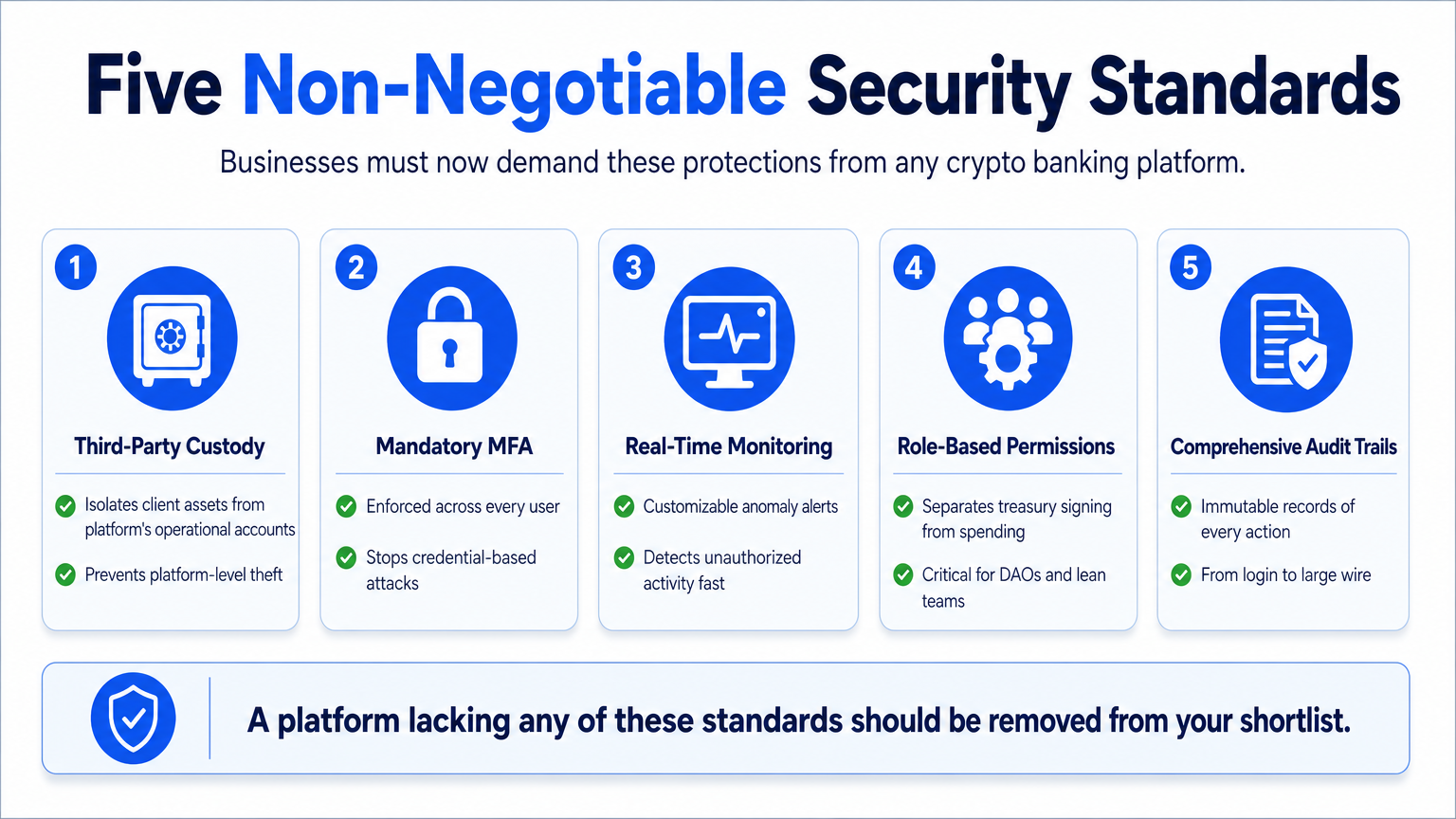
Before the hack, many businesses accepted vague security reassurances. Now, specifics are required. The baseline:
- Third-party custody that isolates client assets from the platform’s operational accounts
- Mandatory multi-factor authentication enforced across every user
- Real-time transaction monitoring with customizable anomaly alerts
- Role-based permissions that allow DAOs and teams to separate treasury signing from day-to-day spending
- Comprehensive audit trails for every action, from login to large wire
A platform that cannot demonstrate these standards should be removed from any shortlist.
Security Beyond the Bank: How Platforms Fortify Business Assets
Custody and the Fireblocks difference
The key lesson: platforms must not hold client funds in a single pool. Leading services mitigate this with institutional custodians like Fireblocks, which stores assets in multi-party computation (MPC) wallets. This separation means a front-end compromise can't access underlying assets. Fireblocks distributes key shares across independent parties, so no single breach can move funds. For a startup managing runway in USDC, this architecture turns a platform hack into a contained event.
Encryption, MFA, and real-time monitoring
Beyond custody, hardened platforms enforce encryption at rest and in transit, mandatory MFA enabled by default, and automated monitoring that flags anomalies—for example, a corporate card used in an unexpected jurisdiction or a wire to a new counterparty. These defenses won’t stop a determined insider threat, but they create a layered posture that raises the cost and complexity of an attack.
OneSafe’s security stance—no gloss, just facts
OneSafe, publishing this analysis, illustrates the post-Binance standard: digital assets via Fireblocks custody, mandatory MFA on signup, encryption and compliance protocols, no commingling of client funds, and DAO-customizable roles. While banking services are partner-delivered, its architecture reflects the demands businesses must now bring to every secure crypto banking conversation.
Action Plan: What Businesses Must Demand from Their Crypto Banking Partner
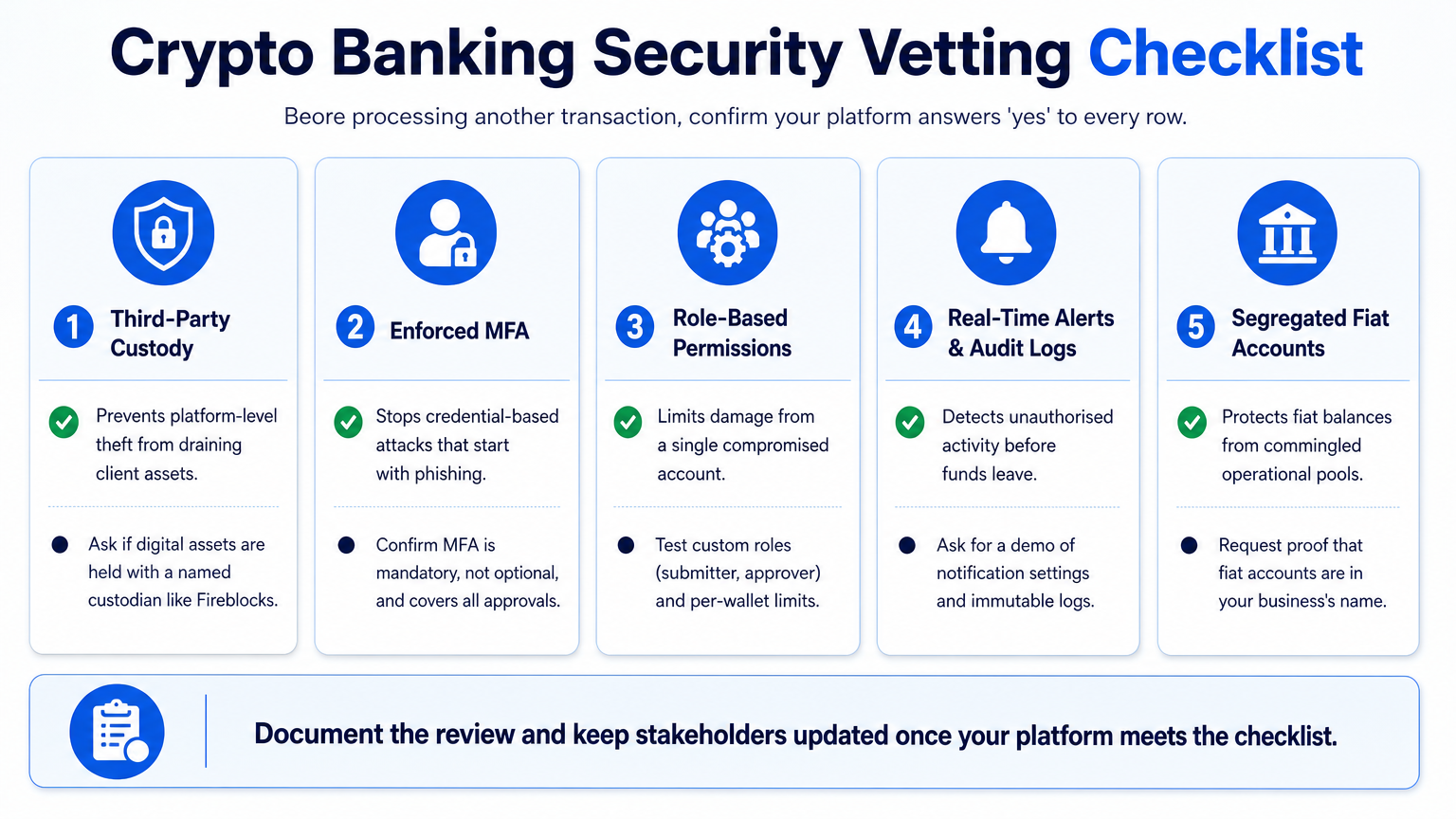
The following framework turns the Binance hack into a concrete vetting checklist for secure crypto banking. Before processing another transaction, confirm that your platform answers “yes” to every row.
| Security Requirement | Why It Matters After the Binance Hack | What to Verify |
|---|---|---|
| Third-party custody | Prevents platform-level theft from draining client assets. | Ask if digital assets are held with a named custodian like Fireblocks. Verify that you can view your own on-chain balances. |
| Enforced MFA | Stops credential-based attacks that start with phishing. | Confirm MFA is mandatory, not optional, and covers all login and transaction approvals. |
| Role-based permissions | Limits damage from a single compromised account (critical for DAOs). | Test that you can assign custom roles (e.g., submitter, approver) and set per-wallet spending limits. |
| Real-time alerts and audit logs | Detects unauthorized activity before funds leave. | Ask for a demo of notification settings and immutable transaction histories. |
| Segregated fiat accounts | Protects fiat balances from commingled operational pools. | Request proof that your fiat accounts are held in your business’s name at a partner bank, not a single omnibus account. |
Verify custody arrangements
Insist on documentation that your crypto assets are held in your own segregated address on the custodian’s infrastructure, not an internal ledger.
Test authentication and permission controls
Walk through a scenario: what happens if a team member’s credentials are compromised? Look for platform-native controls that prevent a single user from moving treasury without additional approvals.
Demand transparency and auditable trails
A crypto banking platform should provide a searchable, uneditable log of every event—login, transfer, permission change—accessible to your own compliance or accounting team.
Once your platform meets the checklist, document the review and keep stakeholders updated. Joyrise plans, writes and publishes illustrated SEO articles to your Webflow blog every day, and you can read your first article before you pay.
What the Hack Means for Stablecoins and DAO Treasuries
Stablecoin safety under scrutiny
Stablecoin usage is surging for business payments. Forbes explicitly warns that banks issuing stablecoins face crypto security checks they may not have prepared for. For a startup with a USDC runway, the question is: is it as secure as fiat? Custody answers that. Stablecoin bank risk materializes when tokens are treated as internal ledger entries; with Fireblocks custody, stablecoins exist as on-chain assets beyond the platform’s reach. Stablecoin safety is less about the token, more about the vault.
DAO treasury risk and customizable safeguards
DAOs managing millions on-chain are especially vulnerable to social engineering. Governance can be manipulated if role controls are flat. Post-hack, DAOs must demand platforms that allow:
- Multi-signature transaction approval flows
- Per-role limits on spending and crypto conversions
- Automated payment workflows that require on-chain confirmation
- Integration with DAO governance tools
Platforms without customizable roles and permissions for DAOs leave treasuries exposed to the same human-layer vulnerabilities that brought down Binance.
Open Questions and What to Watch Next
The fallout from the $6.3 billion hack is evolving. Key open questions for business crypto banking include:
- Will bank-issued stablecoins now face mandatory security certifications analogous to SOC 2, but for crypto custody?
- How will regulators distinguish between exchange failures and dedicated business crypto banking platforms?
- Will insurance for digital assets held in crypto banking accounts become available at a reasonable cost?
- Can DAOs legally enforce contractual obligations on platform partners when a breach originates in social engineering?
Founders should watch for new custody standards, state-level stablecoin rules—like the evolving framework discussed in Florida Stablecoin Regulation: What Businesses Need to Know—and any guidance on platform liability post-hack. The security posture that was “best in class” before October 29, 2026 is now the minimum.
What does the Binance hack mean for crypto banking?
The hack transformed security from a back-office concern into the primary selection criterion for business crypto banking. A platform’s ability to prevent loss—not just handle payments—now determines viability.
How can businesses protect their crypto assets after this breach?
Verify five concrete protections: third-party custody, enforced MFA, role-based permissions, real-time monitoring, and segregated fiat accounts (see Action Plan checklist).
What security features should a crypto banking platform offer?
Custody via a named independent custodian, mandatory MFA, role-based access, immutable audit trails, and segregated fiat accounts—all demonstrable, not just described.
Is my business’s money safe in a crypto banking account?
Safety is measurable. Third-party custody, MFA, and transaction transparency dramatically reduce platform-level breach risk. Without them, money is exposed. For adjacent breach fallout, see Crypto Banking Alert: Chainalysis Breach Fallout.
How do platforms like OneSafe handle security differently?
OneSafe separates the banking interface from asset storage via Fireblocks custody, so no internal compromise can access client crypto. MFA is enforced from signup, and DAO-specific controls (customizable roles, multi-signatory approval) mean compromised credentials alone cannot move funds when custody is MPC-secured.
What should DAOs look for in a crypto banking partner now?
DAOs need on-chain-aware permission structures, not just a shared login: streaming transactions into governance tools, role-based treasury access with spending limits, automated multisig-confirmed payment flows, and immutable logs. Without multi-person approval by design, a single compromise can drain millions. For broader strategies, read Stablecoin Payments After the $6B Binance Incident.
Key Takeaways
- The $6.3 billion Binance hack on October 29, 2026, made demonstrable security the top requirement for any business crypto banking relationship.
- Businesses must now verify third-party custody, enforced MFA, role-based permissions, real-time monitoring, and segregated fiat accounts before trusting a platform.
- Stablecoin holdings are only as safe as the custody architecture behind them—Fireblocks-level separation is the new benchmark.
- DAOs face unique social-engineering threats; a crypto banking partner with customizable roles and multisig workflows is no longer a luxury but a necessity.
- The hack has pushed crypto banking security from a back-office checkbox to a board-level priority, and regulators are watching.
Open a business account that meets the post-Binance security standard



