When $6.3 billion in digital assets vanished from Binance on October 29, 2026, the crypto banking sector faced a legitimacy crisis. The breach, reported by PYMNTS on November 2, dwarfs every previous exchange exploit and forces a hard conversation about the security promises behind business crypto accounts, fiat-crypto integration, and DAO banking. For companies bridging fiat and crypto operations, the hack is not a distant headline; it is a direct indictment of how operational and treasury risk have been managed.
Table of Contents
- What Happened: The $6.3B Binance Breach
- Why This Matters for Businesses Relying on Crypto Banking
- Crypto Banking in 2026: A Quick Primer
- From Breach to Blueprint: How to Protect Your Business
- What to Watch Next
- Key Takeaways
What Happened: The $6.3B Binance Breach
A Timeline of the Largest Crypto Theft
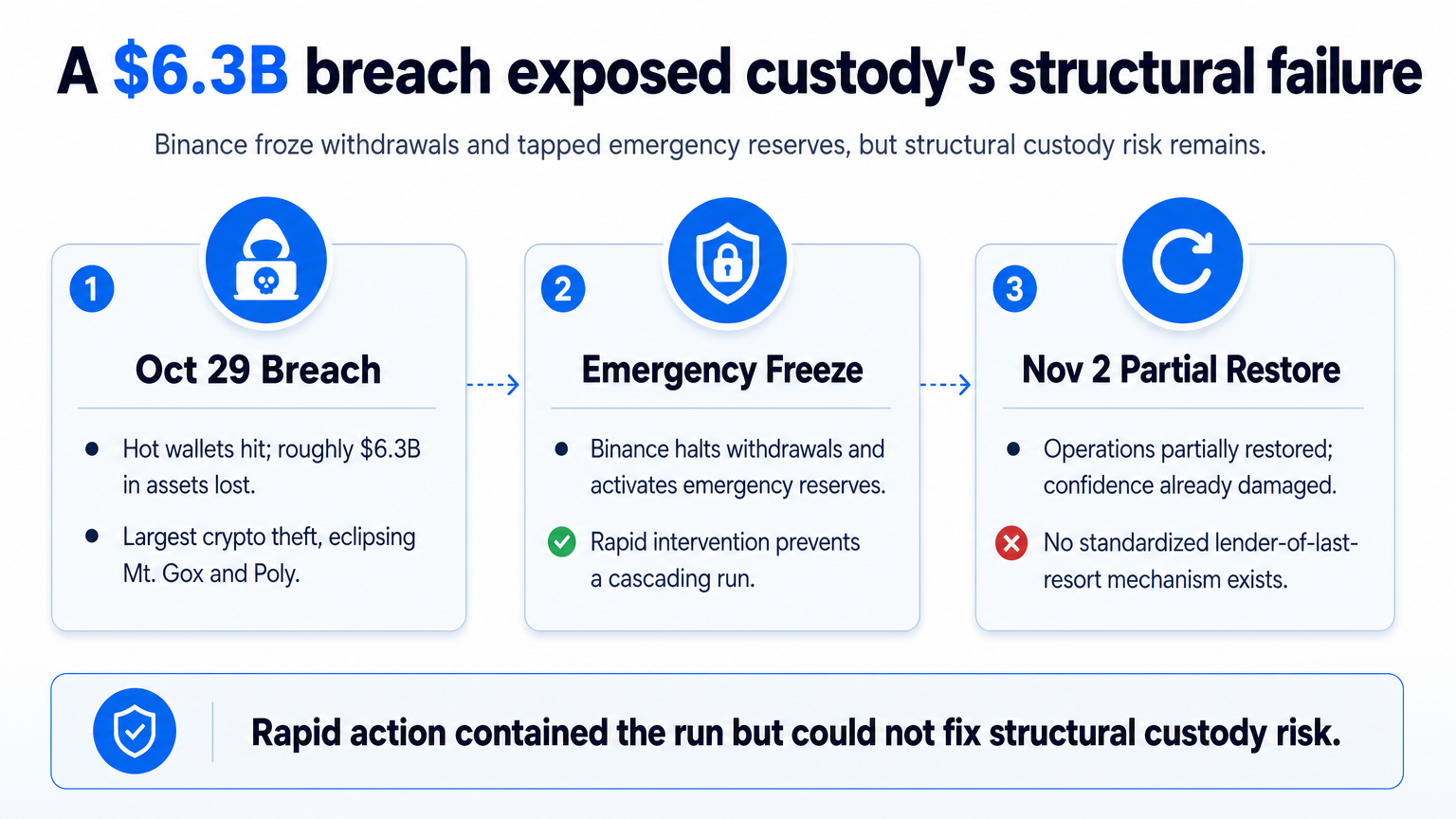
On October 29, 2026, Binance — the world’s largest cryptocurrency exchange by volume — suffered a security incident that resulted in the loss of approximately $6.3 billion in digital assets. The scale eclipses the 2014 Mt. Gox collapse (roughly $450 million at the time) and the $600 million Poly Network exploit of 2021. According to PYMNTS (November 2, 2026), the theft targeted hot wallets and exposed systemic weaknesses in how exchanges manage and segregate customer funds.
While technical details remain under forensic review, the immediate impact was clear: Binance froze withdrawals, activated emergency reserves, and worked with law enforcement and blockchain analytics firms to trace and freeze stolen funds. By November 2, the platform had partially restored operations, but confidence had already been damaged.
How Binance Contained the Damage — and What It Couldn't Fix
Binance’s response showed the effectiveness of rapid intervention — and the limits of a system without a standardized lender-of-last-resort mechanism. The exchange tapped its SAFU (Secure Asset Fund for Users) and corporate treasuries to cover losses, preventing a cascading run. Yet as PYMNTS noted, crypto “still lacks standardized mechanisms to absorb losses and restore liquidity” the way traditional banking does through deposit insurance and central bank facilities.
What Binance could not fix is the structural risk: conflating exchange and custodian roles. When an exchange doubles as the primary store of value for business operating capital, any breach becomes an existential threat to every firm that kept working capital there. The hack also exposed the inadequacy of “bank-grade security” marketing — a phrase used loosely across the industry but, as the $6.3 billion hole shows, not universally backed by the custodial rigor regulators expect of actual banks.
Why This Matters for Businesses Relying on Crypto Banking
The Flaw in TradFi Safety Promises
Institutional crypto platforms frequently advertise “bank-grade” security. Yet Binance was regarded as a well-capitalized, heavily invested exchange with a dedicated emergency fund. Its breach demonstrates that such claims warrant deeper scrutiny. A platform can call itself secure while still running hot wallets large enough to lose $6.3 billion in a single attack. For businesses, the lesson is not to avoid crypto banking but to demand verifiable, third-party audited proof of security architecture, not glossy marketing.
The industry must adjudicate a conflict. Many established exchanges have invested heavily in compliance and custody. But the Binance breach shows that even a market leader can fail catastrophically. Security claims in crypto banking must be treated as hypotheses, not guarantees. Due diligence requires examining custody models, insurance coverage, and proof-of-reserves practices with the same rigor a bank would apply to a correspondent relationship.
When Your Exchange Is Also Your Bank
Many Web3 businesses and DAOs have historically used a single exchange to park fiat, hold crypto, and process payments. This convenience creates a single point of failure. If the exchange halts withdrawals — as Binance did — payroll, vendor payments, and treasury rebalancing freeze. The hack exposes the danger of commingling operational fiat and crypto custody with a trading venue that also faces market, counterparty, and security risks.
The incident also highlights a liquidity trap: businesses holding a mix of fiat and crypto on the platform found themselves unable to convert assets or move funds precisely when they needed to. As regulatory blowback intensifies, companies that haven’t separated fiat rails from crypto custody will face not only security risk but also compliance risk.
Crypto Banking in 2026: A Quick Primer
What is a crypto bank and how does it work?
A crypto bank — more accurately a crypto banking platform — combines digital asset custody with traditional banking functions: holding fiat deposits, facilitating payments, issuing corporate cards, and enabling fiat-crypto conversions. Some are licensed banks; many are technology companies that partner with chartered banks to offer accounts. Their core value is bridging the on-ramp and off-ramp between fiat and cryptocurrencies while providing institutional-grade security for digital assets. For businesses, this replaces separate exchange accounts and traditional bank accounts.
Are cryptocurrencies regulated, and will that change?
Cryptocurrency regulation remains a patchwork. Some jurisdictions (the EU’s MiCA framework, Dubai’s VARA, Singapore’s PSA) impose licensing and capital requirements on exchanges and custodians. Others rely on enforcement actions. The Binance hack is accelerating the push for tighter crypto regulation 2026. South Korean regulators, reported by PYMNTS, are already stress-testing how an exchange collapse could spill into traditional banks. Expect new prudential standards — possibly akin to Basel III for crypto custodians — that mandate higher capital buffers, recovery plans, and ring-fencing of customer assets. This regulatory overhang is both a necessary safeguard and a potential compliance burden for smaller platforms. Our look at the OCC's stablecoin regulation outlines one direction this could take.
How are cryptocurrencies bought, traded, and sold in a business context?
For a business, the flow typically starts with an on-ramp: depositing fiat via wire or ACH into a platform that converts it to crypto (often stablecoins). The business might then trade to cover expenses, hedge against currency risk, or manage treasury. Off-ramps convert crypto back to fiat for payroll, vendor payments, or tax obligations. A unified crypto banking platform simplifies this by consolidating all steps into one interface, but the Binance hack underscores that each step — custody during the holding period, liquidity for conversion, and the banking link — carries distinct risks that must be evaluated separately.
Why is the cryptocurrency market volatile, and how does that affect banking?
Volatility arises from speculative trading, liquidity fragmentation, and sensitivity to regulatory news. For a business holding crypto on its balance sheet, intraday price swings can alter treasury value significantly. A crypto banking platform that offers real-time conversion to stablecoins or fiat can mitigate this, but only if its rails are operational and liquid. The Binance breach created a double shock: a drop in market confidence and a temporary freeze on conversions, demonstrating how volatility multiplies operational risk when the platform itself is compromised. Businesses need contingency plans for rapid conversion outside their primary exchange.
From Breach to Blueprint: How to Protect Your Business
What security safeguards should a crypto banking platform have?
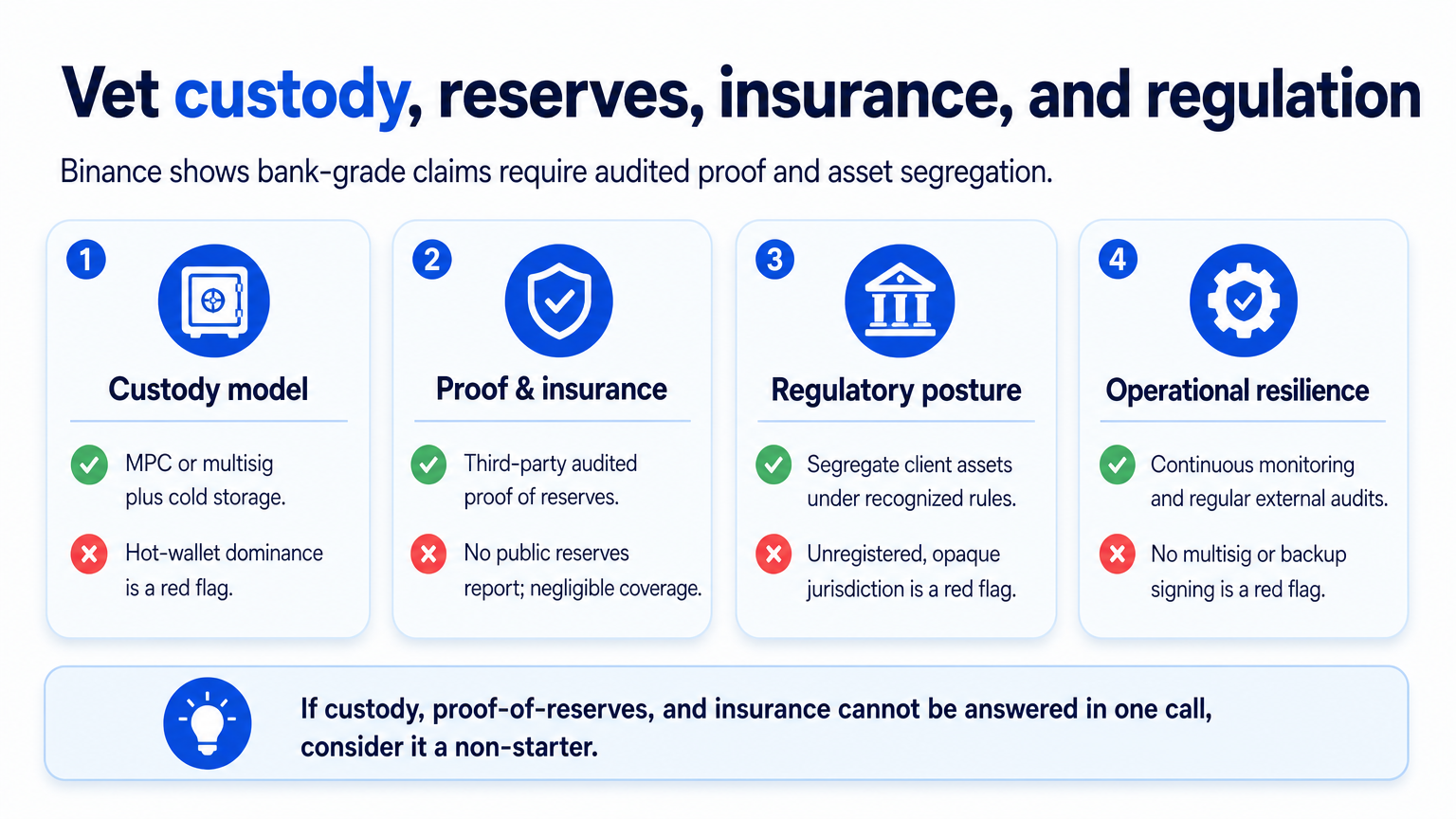
After a $6.3 billion wake-up call, the minimum bar for crypto banking security has risen. A credible platform should demonstrate:
- Multi-party computation (MPC) or multi-signature wallets combined with cold storage. Hot wallets should hold only transaction-necessary liquidity, with the bulk of assets offline.
- Third-party audited proof of reserves. A platform should publish regular, verifiable attestations that client assets are fully backed. Self-certification isn’t enough.
- Insurance coverage. A crime and specie policy that covers hacking, internal fraud, and physical loss provides a layer of protection. The scope and limits must be disclosed.
- Regulatory compliance and segregation of client assets. Even if not a bank, the platform should segregate client funds from corporate assets and operate under a recognized regulatory framework with capital requirements.
- Continuous monitoring and penetration testing. A robust security posture includes real-time threat detection and regular external audits.
External guidance like the FDIC’s interagency statement on crypto-asset safekeeping outlines expectations for banking organizations that hold crypto — expectations that should apply to any custodian of business assets.
How can a business evaluate a crypto banking partner after the Binance hack?
This is no longer a tick-box exercise. The Binance breach introduces a new calculus: vet the partner as if your company’s entire treasury depends on it.
| Evaluation Criteria | Key Questions to Ask | Red Flags |
|---|---|---|
| Custody model | How is the private key managed? Is it MPC with cold storage? Who are the third-party custodians? | Hot wallet dominance, no named custodian, keys held by a single entity without segregation. |
| Proof-of-reserves | Does the platform publish a real-time, independently audited attestation? Can you verify your own balances on-chain? | No public reserves report, reliance on “we’re safe” statements. |
| Insurance | What is the coverage amount relative to assets under custody? What exclusions apply? | No insurance or a policy with negligible limits. |
| Regulatory posture | What licenses does it hold? In which jurisdictions? Is it subject to periodic audits? | Unregistered, based in an opaque jurisdiction, no clear regulator. |
| Fiat-crypto integration | How are on- and off-ramp liquidity managed? Is fiat held in a segregated bank account separate from exchange funds? | All assets pooled in one exchange account; slow or opaque conversion. |
| Operational redundancy | Can you initiate a withdrawal or trade if the platform’s primary key is compromised? Are there backup signing mechanisms? | No multisig, no contingency process, reliance on a single operational point. |
| DAO-specific governance | For DAOs: Does the platform support on-chain voting for transactions, customizable roles, and quorum requirements? | No DAO-native features; treats a multisig address as a simple corporate account. |
For businesses that need to separate fiat and crypto rails while still enjoying a unified dashboard, a platform that uses segregated banking partners and independent custodial infrastructure can reduce the single-point-of-failure risk that felled Binance users.
The decision rule: if a platform cannot transparently answer the custody, proof-of-reserves, and insurance questions in a single call, consider it a non-starter for holding operating capital.
The hack also underscores the need for a dedicated secure crypto off-ramp that isn’t tied exclusively to a single exchange. A platform that provides direct banking integrations — for ACH, wire, and bill pay — offers a buffer so that even if the exchange leg of the system is stressed, the fiat side remains functional. For DAOs, this hybrid approach is especially critical, as many operate with purely on-chain governance but must settle real-world obligations.
What to Watch Next
Regulatory Overcorrection or Smart Guardrails?
In the coming months, expect a flurry of proposed rules. The South Korean stress test mentioned by PYMNTS is a template for other jurisdictions: regulators will want to ensure that a crypto exchange collapse doesn’t trigger a broader financial disruption, especially as banks increasingly provide services to crypto firms. The risk is overcorrection — capital requirements so onerous they stifle innovation and force platforms offshore. The upside: clear, enforceable standards for institutional crypto custody that make it easier for businesses to identify safe partners. Our analysis of stablecoin regulation details how one area is already moving toward bank-like oversight.
For teams that need a steady publishing cadence for those policy updates and security explainers, Joyrise plans, writes, and publishes illustrated SEO articles to your Webflow blog every day.
The Rise of the Hybrid Platform (and Why DAOs Need It)
One trend the Binance hack will accelerate is the shift toward unified fiat-crypto neo-banking platforms that are not pure exchanges. By decoupling trading from custody, these platforms let businesses hold assets in segregated, insured environments while still converting and spending on demand. For DAOs, which often manage treasuries in both tokens and stablecoins, this hybrid model provides DAO banking with native on-chain governance support and fiat payment rails. The hack has made the case that a DAO’s treasury should never sit on a single exchange’s hot wallet.
Will Insurance Become Table Stakes?
Post-breach, insurance will move from a nice-to-have to a baseline requirement. Institutional clients and enterprise businesses will demand proof of coverage before onboarding. Platforms that cannot secure comprehensive crime insurance will be excluded from the consideration set entirely. The $6.3 billion loss will also reshape the market for crypto insurance, likely driving up premiums and narrowing coverage for custodians that cannot demonstrate rigorous controls.
Key Takeaways
- The Binance hack of October 29, 2026, was the largest crypto theft in history, costing an estimated $6.3 billion and exposing fundamental gaps in how exchanges safeguard business assets.
- Businesses that relied on a single exchange as both bank and custodian faced a sudden liquidity freeze, proving that fiat-crypto integration must be architected for resilience, not just convenience.
- “Bank-grade security” claims are meaningless without audited proof: vet your crypto banking partner on its custody model, proof-of-reserves, insurance coverage, and regulatory standing.
- A unified platform that separates trading from custody and offers direct banking rails can mitigate the single-point-of-failure risk that the Binance breach exposed.
- Regulatory changes are coming — expect stricter capital and custody rules, and begin stress-testing your treasury’s dependence on any one platform.
To build a financial stack that keeps your fiat and crypto operations secure and liquid, even after a market-shaking event like the Binance hack, explore how a unified platform can help — sign up for early access at OneSafe.