On November 2, 2026, The Times published an analysis by assistant business editor James Hurley headlined "Binance hack shines a light on the dark corners of crypto," reporting a $6.3 billion heist and describing it as raising "fresh questions about security, governance and the gap between cryptocurrency's promise of decentralisation and the reality." That framing is the story for crypto banking. The mechanics of one exchange's losses will be argued over for months; the question a CFO or DAO treasurer can act on this week is narrower — what, precisely, can you verify about the institution holding your money?
Table of Contents
- The $6.3bn Binance Hack: What We Know
- Why the Heist Shifts the Conversation on Crypto Banking
- How the Crypto Banking Model Failed – and What Needs to Change
- Action Plan: Safeguarding Your Business in Crypto Banking
- What to Watch After the Hack
- Key Takeaways
The $6.3bn Binance Hack: What We Know
The reported facts about the Binance hack 2026 are limited and worth stating plainly. The Times put the loss at $6.3 billion, attributed it to the Binance hack 2026, and published on November 2, 2026. Hurley's piece is a framing piece rather than a technical post-mortem: its subject is the gap between how crypto markets describe themselves and how they behave under stress.
That means the operational questions businesses ask first — which wallets were affected, what the custody arrangement was, whether client balances were touched, what recovery is possible — are being answered through formal disclosures, on-chain analysis and regulators, not day-one coverage. Treat confident accounts of the attack vector as unconfirmed until Binance or a named investigator states them.
What happened in the Binance hack?
A $6.3 billion heist at Binance, reported by The Times on November 2, 2026, and framed by the paper around security, governance and decentralisation. Beyond the headline figure, the specifics of how the funds were taken have not been established in that report. For business readers, the useful takeaway is not forensic detail but the pattern the paper identifies: an institution operating at scale with governance and custody arrangements its users could not independently inspect.
Why the Heist Shifts the Conversation on Crypto Banking
For a retail holder, an exchange incident is a price event. For a company running payroll, vendor payments and tax obligations out of a treasury account, the same incident is a continuity event. A business cannot simply "not your keys, not your coins" its way out of the problem, because it needs payment rails, cards, wires and a counterparty that converts to fiat on schedule.
US bank regulators have treated this as a distinct activity rather than ordinary deposit-taking: an interagency statement on crypto-asset safekeeping sets out that holding crypto for customers carries its own risk-management and disclosure expectations. The direction of travel is toward documented controls, not brand reassurance.
Why does it matter for businesses using crypto banking?
Because the realistic failure mode is not only "we lost the balance." It is withdrawals frozen during a payroll run, a conversion desk that stops quoting, a card programme that stops settling, and a board or investor base that learns about your exposure from a news story. Business crypto banking security concentrates two risks in one vendor — custody and payment operations — so an incident hits both the balance sheet and the operating account at once.
How the Crypto Banking Model Failed – and What Needs to Change
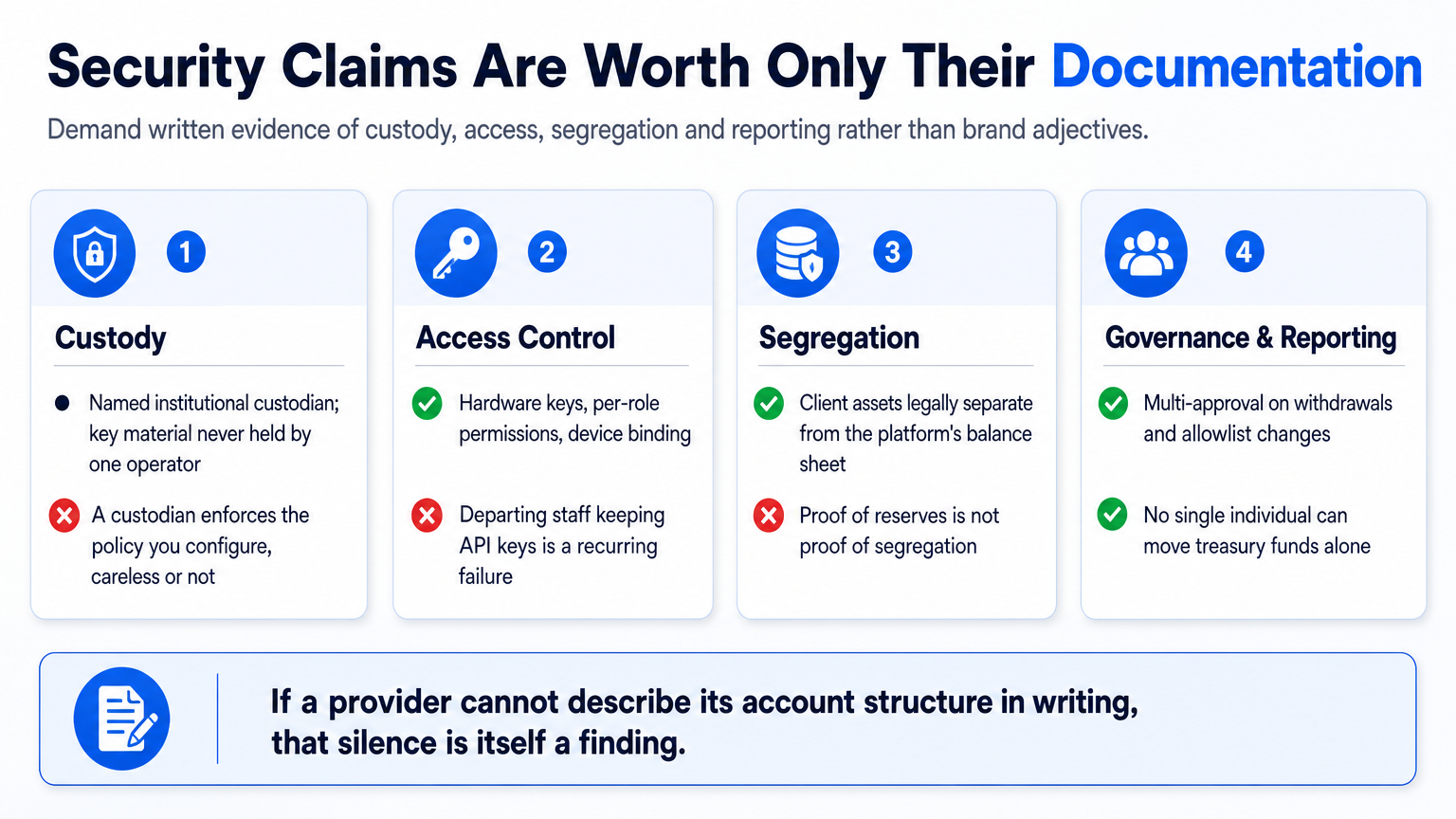
There is a genuine disagreement in this market, and it is worth adjudicating rather than glossing. Platforms — including this one — market security as a headline feature. The Binance episode shows that brand-level assurances can coexist with weak governance and opaque custody at the operating level. The sceptical reading is that security marketing is unfalsifiable and should be discounted entirely; the generous reading is that custody technology has improved substantially and providers deserve credit for it. Neither position survives contact with the evidence. The defensible middle is that security claims are worth exactly the documentation behind them, so evaluate controls as evidence, not adjectives.
Custody: Decentralized Promise, Centralized Risk
Most crypto banking is centralised custody wearing a decentralised vocabulary. When a platform holds assets for you, someone controls key material, someone approves transactions, and someone can be phished. The first question is not "is it decentralised" but who holds the keys, under what policy, and who can override that policy in an emergency.
Institutional custody providers — Fireblocks security and similar MPC-based platforms — reduce single-operator risk by splitting keys and enforcing transaction policy in software rather than in a runbook. That is a real improvement, and the institutional custody market is deepening, as Deutsche Bank's crypto custody move illustrates. But a custodian is a component, not a governance system: it enforces the policy you configure, including a careless one.
Crypto Banking Governance: Humans Are Often the Weakest Link
Corporate crypto custody fails through process, not cryptography. The recurring weaknesses in crypto banking governance are familiar from traditional finance: one administrator with unilateral withdrawal rights, allowlists changed without a second approval, departing staff who keep API keys, and emergency procedures that bypass every control because someone invoked urgency. FS-ISAC's guidance on protecting crypto assets makes the point that people and process dominate the threat model. No single individual should be able to move treasury funds alone — including the founder.
Transparency: Do You Really Know Where Your Funds Are?
In crypto banking, segregated accounts crypto ensures that client funds are legally separate in an insolvency. Proof of reserves is not proof of segregation. The questions that decide whether you get paid in an insolvency are structural: are client assets held in segregated accounts, legally separate from the platform's own balance sheet; who attests to that and how often; and does the attestation cover liabilities as well as assets? A quarterly PDF is weaker than real-time transaction visibility, exportable statements and an API your finance team can reconcile against. If a provider cannot describe its account structure in writing, that silence is itself a finding.
What security must a crypto banking platform have?
At minimum, seven control areas with evidence attached to each. Demand documentation, not adjectives.
| Control area | What to demand | Evidence to request |
|---|---|---|
| Custody | Named institutional custodian; key material never held by one operator | Provider name, architecture summary, contract terms |
| Access control | Mandatory MFA, hardware-key support, per-role permissions, device binding | Policy settings; current admin list |
| Segregation | Client assets in segregated accounts, separate from operating funds | Account structure documentation; insolvency treatment |
| Governance | Multi-approval on withdrawals and allowlist changes; documented change control | Approval matrix; sample audit log |
| Compliance | KYB, sanctions screening, transaction monitoring | Programme summary; registrations (varies by jurisdiction) |
| Reporting | Real-time balances, full history, exportable data | Statement and API sample |
| Track record | Evidence of operating DAO and Web3 treasuries | Named references; volumes (varies) |
Action Plan: Safeguarding Your Business in Crypto Banking
How can a business protect its crypto funds?
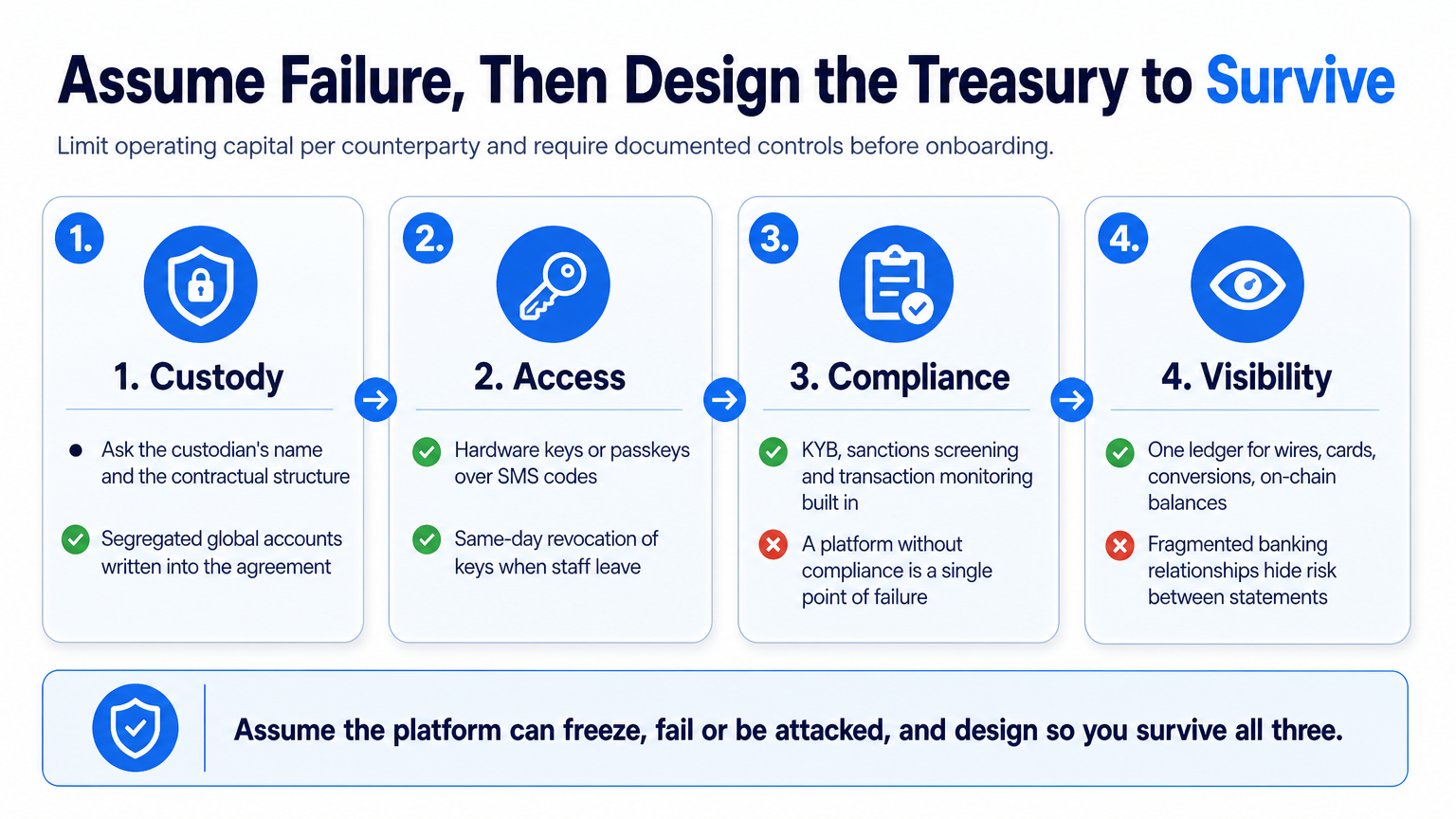
Assume the platform can freeze, fail or be attacked, and design so you survive all three: limit how much operating capital sits with any single counterparty, require documented controls before onboarding, and make sure two people — not one — stand between your treasury and an irreversible transfer. The five steps below are ordered by leverage.
1. Require Institutional-Grade Custody
Ask for the custodian's name, the contractual structure, and what happens to your assets if the platform itself fails. OneSafe, for example, secures digital assets on Fireblocks and provides segregated global accounts — exactly the kind of arrangement a buyer should have documented in the agreement rather than accepted from a marketing page.
2. Enforce Multi-Layered Security and Access Controls
Multi-factor authentication crypto is table stakes, but the type matters: hardware keys or passkeys over SMS codes, separate roles for initiating and approving payments, withdrawal allowlists, and a leavers' process that revokes API keys the same day. The threat surface is also automating, which shortens the window between a stolen credential and an attempted transfer.
3. Seek Platforms with Built-In Compliance
Know-your-business checks, sanctions screening and transaction monitoring are not bureaucratic friction; they are what keeps your account from being closed by a partner bank mid-quarter. Licensing is tightening across markets, including the pressure around Brazil's crypto banking license deadline, and a crypto fiat platform without a compliance function is a single point of failure.
4. Unify Fiat and Crypto Operations for Visibility
Fragmented banking relationships hide risk in the gaps between statements. A single interface for wires, cards, conversions and on-chain balances gives finance one ledger to reconcile — the discipline set out in our 2026 crypto treasury management playbook. Visibility is a control, not a convenience.
5. Prioritize Platforms with a Track Record Serving DAOs and Web3
Treasury experience shows up in small things: whether the platform understands multi-signature approvers, whether it can pay contributors in stablecoins and vendors in fiat from the same account, whether it can handle a token-holding entity as a client rather than a curiosity.
What should a DAO look for in a financial platform?
For a DAO banking setup, start with the legal wrapper — the entity type determines what accounts you can open and who is liable, and the labels matter more than they appear. Then require configurable roles and permissions rather than a single shared login, custody with a named institutional provider, multi-approval workflows aligned to your governance votes, exportable reporting for token holders, and a clean offboarding path when signers rotate. Multi-sig alone is not governance; roles, limits and an audit trail are. OneSafe's DAO setup — customizable roles and permissions, custody via Fireblocks, automated payment workflows — is one example of the shape to insist on, evaluated against the same criteria as any other.
What to Watch After the Hack
- Binance's formal disclosure and independent on-chain analysis of the $6.3 billion figure.
- Regulatory follow-through, particularly whether safekeeping expectations harden into examination standards.
- Custody provider standards, and whether institutional providers publish updated policy templates.
- Insurance and claims treatment for business depositors.
- Your own stakeholders: expect customers, boards and token holders to ask how your treasury is held. If part of that answer runs through a public blog, a tool such as Joyrise, which plans, writes and publishes illustrated SEO articles to your Webflow blog every day, is one way to keep a publishing cadence.
Key Takeaways
- The Times' November 2, 2026 report on the $6.3 billion Binance hack is a governance story as much as a security one, and business users should read it that way.
- Custody and payment operations sit with the same vendor in most crypto banking setups, so one incident threatens both your balance sheet and your ability to pay staff.
- Ask for segregation, approval matrices and audit trails in writing — anything a provider won't document is a control you don't have.
- DAOs need role-based permissions, multi-approval workflows and named institutional custody, not just a multi-sig wallet.
- Limit how much operating capital any single platform holds while you complete that diligence.
If you want fiat and crypto operations in one account with custody on Fireblocks and mandatory MFA from signup, you can open a OneSafe account and review the controls before you move a treasury.