Meta Description: SBI's $100M Erebor investment reshapes crypto banking. Get crypto banking news on charters, neo-banking for crypto, DAO banking and fiat-crypto platforms.
SBI’s $100M Erebor Bet: A New Crypto Banking Paradigm
November 3, 2026 – The crypto banking landscape pivoted sharply this week. On November 2, 2026, Ledger Insights reported that Japan’s SBI Holdings is investing $100 million in Erebor Bank, a U.S. nationally chartered stablecoin bank. The SBI Erebor investment signals that fully regulated, FDIC-insured crypto banking is entering the mainstream, reshaping global business banking and DAO banking.
Table of Contents
- What Just Happened: Erebor’s Charter and Stablecoin Model
- Why This Matters for Crypto Banking
- The Landscape: How Neo-Banking for Crypto Compares to Chartered Banks
- What This Means for Your Business
- What to Watch Next in Crypto Banking
- Key Takeaways
What Just Happened: Erebor’s Charter and Stablecoin Model
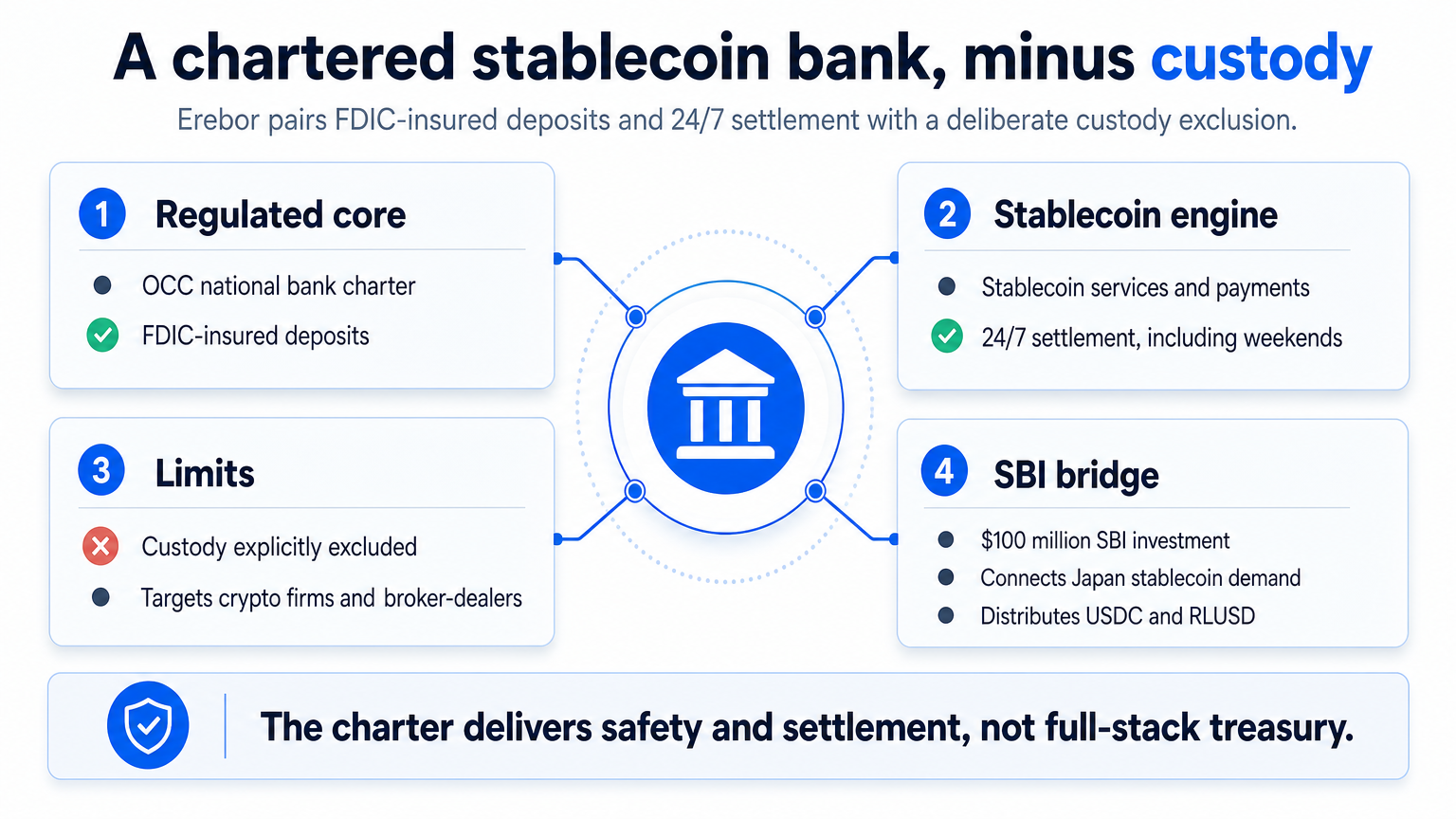
Erebor, co-founded by Palmer Luckey, opened in February 2026 with an OCC national bank charter and FDIC deposit insurance. The bank’s core mission, stated in its charter application, is to be “the most regulated entity conducting and facilitating stablecoin transactions.” The SBI funding positions Erebor as a strategic partner for U.S. market entry.
Erebor’s product lines include credit, deposits, stablecoin services, and payments. It holds crypto on its balance sheet for gas fees and wrapped stablecoin operations, accepts crypto as collateral for loans, and runs an in-house core banking system capable of 24/7 blockchain settlement—including weekends. Custody is explicitly excluded. Target clients are crypto firms, broker-dealers, and foreign companies needing dollar access. SBI, which issues Japan’s first yen stablecoin (JPYSC) and distributes USDC and RLUSD, connects Erebor to that foreign-demand pipeline.
Publicly, Erebor brands as a digital bank for AI and defense, but its charter exposes a stablecoin-first playbook: attract commercial deposits, lend against crypto, and settle on a blockchain core. The dual persona shows a chartered bank can serve traditional corporates and crypto-native firms under one federal roof.
Why This Matters for Crypto Banking
A stablecoin bank is a chartered depository institution whose primary business revolves around stablecoin transactions, reserves, and crypto-collateralized lending. Erebor’s FDIC insurance covers fiat deposits, providing regulatory safety for clients that previously relied on uninsured stablecoin issuers. This creates a direct, insured bridge between fiat and digital economies—addressing systemic risk that has long plagued crypto banking. The FDIC’s 2025 guidance already outlined a path for banks to engage in crypto; Erebor walked through it.
Erebor’s crypto bank charter sets a powerful precedent: a national bank can hold crypto, settle 24/7, and operate a stablecoin-centric model. With the OCC’s stablecoin regulation deadline looming in 2027, this early approval suggests a permissive yet supervised lane is taking shape. For businesses, a fully regulated, FDIC-insured partner that understands stablecoin operations is now tangible.
How the Charter Reshapes Global Business Banking. For the first time, an enterprise can open an account with a U.S. national bank that treats stablecoin payments as core. Erebor can hold fiat, settle stablecoins natively, and lend against crypto—all under FDIC. However, it lacks custody, multi-currency corporate cards, invoicing, and the role-based access controls DAOs need. The charter brings federal safety but not a full-stack treasury platform. That gap reshapes the competitive field: chartered stablecoin banks excel on regulatory safety, while fintech neo-banking for crypto fills operational gaps.
U.S. Bank’s launch of the USBDC stablecoin in 2026 shows legacy institutions are also entering. The landscape now spans chartered entities with insurance, fintech neo-banks offering integrated fiat-crypto platforms, and traditional banks experimenting with tokenized deposits. For finance leaders, the decision tree has grown richer.
The Landscape: How Neo-Banking for Crypto Compares to Chartered Banks
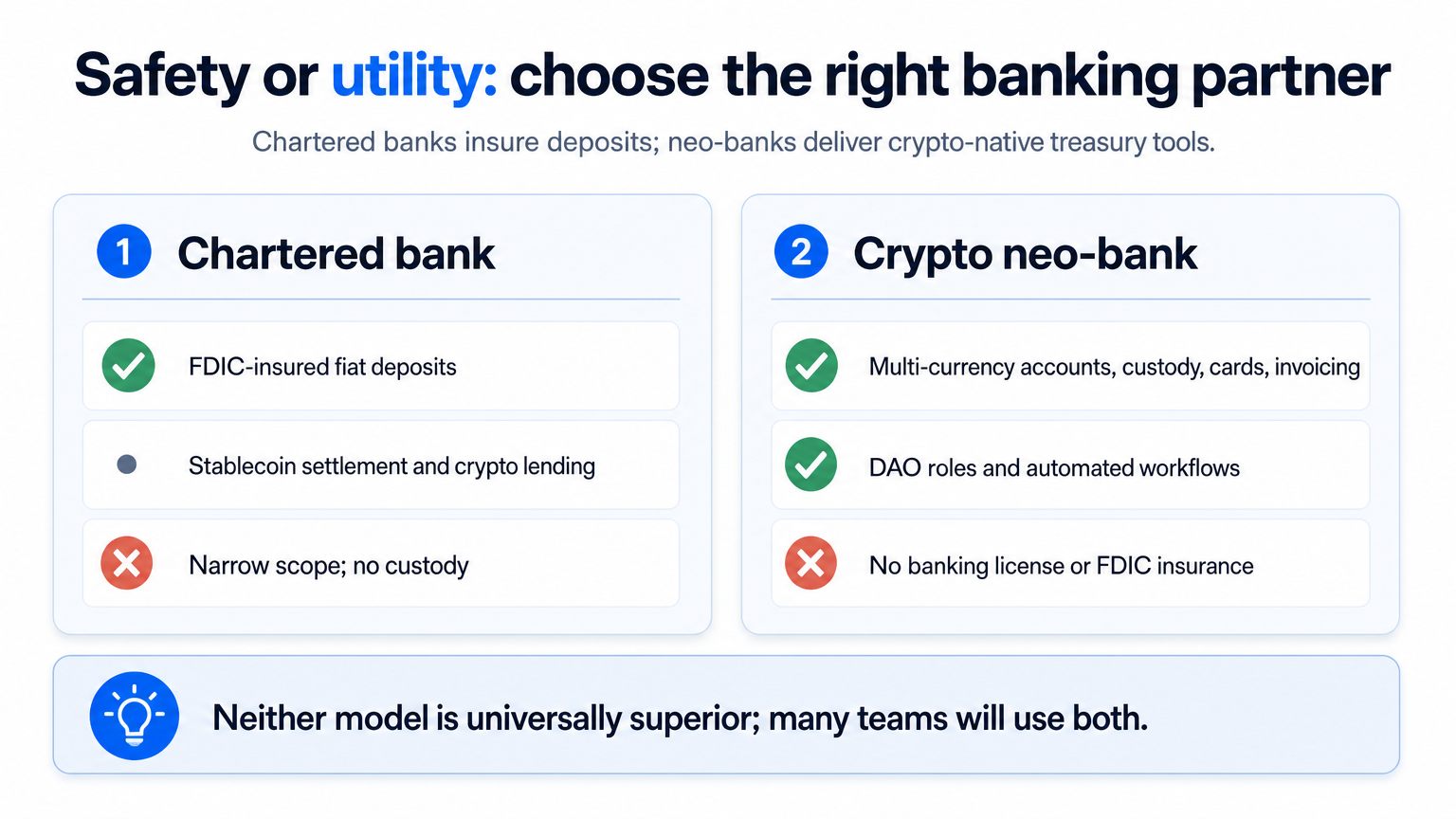
A chartered crypto bank like Erebor offers FDIC insurance but a narrow service scope: stablecoin settlement, deposit-taking, and crypto-collateralized lending. A neo-banking for crypto platform, by contrast, is a technology company that partners with banks to deliver multi-currency accounts, custody, corporate cards, invoicing, automatic FX, and DAO governance tools—without holding a banking license. Neither is universally superior; the right choice depends on whether safety or utility matters more for a specific treasury function.
DAO banking demands more than a deposit box. DAOs need customizable roles that mirror multi-signature governance, secure on-chain custody, and automated payment workflows to pay contributors in fiat or stablecoins. Erebor, without custody and designed for conventional corporate structures, can’t meet these needs yet. Platforms built for crypto-native organizations, like OneSafe, offer crypto treasury management with Fireblocks custody, segregated accounts, and programmable permissions. For a global startup converting between USD, EUR, and USDC in minutes, an integrated fiat and crypto platform trumps a safety-first chartered bank.
What This Means for Your Business
Should you choose a chartered crypto bank or a neo-bank?
Your answer hinges on FDIC insurance needs, operational complexity, and how deeply stablecoins are embedded in your treasury. The table below compares the two.
| Factor | Chartered Stablecoin Bank (e.g., Erebor) | Neo-Bank Platform (OneSafe example) |
|---|---|---|
| Regulatory status | Nationally chartered bank, FDIC insured | Fintech company; banking via partners; no FDIC insurance, but digital assets secured via Fireblocks |
| Fiat & crypto handling | Direct fiat deposits, stablecoin services, crypto‑collateralized lending; no custody | Multi-currency fiat accounts, crypto on/off‑ramp, full custody, corporate cards, invoicing, FX |
| DAO suitability | Not designed for DAO governance; standard corporate account structure | Customizable roles, permissions, automated payment workflows for DAOs |
| Onboarding | Likely traditional bank due diligence; can take weeks | Fully digital, typically completed in under a week |
| Geographic reach | US‑based, correspondent banking for foreign clients | Global availability except OFAC‑sanctioned countries |
| Ideal for | Entities needing FDIC insurance for large fiat reserves and a direct bank relationship | Startups, DAOs, and global teams that need seamless fiat‑crypto operations and speed |
If your business requires FDIC insurance for large fiat deposits, a chartered stablecoin bank is compelling. If you need comprehensive cross‑border treasury, crypto‑native operations, and DAO support, a neo-bank like OneSafe is more practical. Many organizations will eventually use both—a chartered bank for core deposit safety and a neo-bank for day‑to‑day global payments.
What the SBI Erebor Investment Means for DAOs and Startups
The SBI backing signals institutional faith in the chartered stablecoin model. For DAOs, Erebor’s current limitations mean hybrid platforms still dominate. The investment should prompt every DAO to ask: Does our current banking partner offer the regulatory gravity institutional money now demands? If not, evaluate providers that bridge both worlds while monitoring how Erebor evolves.
How OneSafe Delivers the Hybrid Model Today
OneSafe already processes over $800 million in volume for 1,000+ businesses, offering a unified fiat and crypto platform with free USDC deposits/withdrawals, virtual cards, and Fireblocks custody. Its DAO-specific tools—customizable roles, automated workflows, segregated accounts—fill the gaps that a chartered stablecoin bank like Erebor leaves. The platform shows that fintech orchestration with licensed partner banks can deliver speed, global reach, and crypto-native capabilities without waiting for a charter to build every feature.
Future‑Proof Your Crypto Banking Relationships
- Map your banking stack across fiat and crypto accounts to spot redundancies and integration gaps.
- Define your FDIC insurance need. For idle fiat reserves, a chartered stablecoin bank matters; for operational crypto, custody security may suffice.
- Audit DAO-specific requirements. If you rely on multi‑sig governance and automated stablecoin payouts, insist on a partner with customizable permissions and on‑chain workflows.
- Test a hybrid approach. Park idle reserves in a chartered bank, use a neo-bank for global payments and crypto conversion. Ensure wire or stablecoin interoperability between them.
- Verify security. Demand state‑of‑the‑art custody (e.g., Fireblocks), mandatory MFA, and clear regulatory stances, especially after incidents like the Binance hack.
- Track regulatory shifts. Follow OCC announcements, FDIC updates, and international pilots such as the HKMA tokenized settlement pilot and Brazil’s license deadline.
What to Watch Next in Crypto Banking
Will Other Regulators Follow? The OCC’s Erebor charter is a bellwether. The FDIC’s crypto engagement process, Hong Kong’s tokenized settlement pilot, and Brazil’s impending framework suggest a wave of stablecoin-friendly charters. SBI’s integration into Japan’s stablecoin ecosystem could pressure Japanese authorities to create a similar path, bringing yen‑backed stablecoin banks into the conversation.
The Stablecoin Bank Race. With Erebor’s $100 million infusion and U.S. Bank’s USBDC, the race to own the regulated stablecoin banking layer is accelerating. Staying on top of crypto banking news is critical. Tools like Joyrise plan, write and publish illustrated SEO articles to your Webflow blog every day, helping teams track developments without adding noise.
Key Takeaways
- The SBI-Erebor deal brings an FDIC-insured chartered stablecoin bank to market, validating the model for crypto banking.
- A chartered crypto bank excels at deposit safety but leaves operational gaps; neo-banking platforms deliver integrated fiat-crypto features and DAO tools.
- Businesses should choose based on FDIC insurance needs and operational demands, often benefiting from a hybrid chartered-bank-and-neobank stack.
- The OCC charter precedent will likely spur regulators globally, accelerating a stablecoin bank race that reshapes business crypto banking this year.
Ready to unify your fiat and crypto treasury with a platform built for global teams? Open an account with OneSafe today.