Description: A practical guide for businesses defining crypto banks, how they work, spectrum from chartered to neobanks, and recent 2026 developments.
What Is a Crypto Bank? A Practical Guide for Businesses
If your business handles both fiat and digital assets, “What is a crypto bank?” isn’t just a buzzword. A crypto bank is any institution or platform offering custody, trading, lending, and fiat-crypto bridges. Regulation and safety vary enormously: some are chartered banks, others uninsured trusts, and many are fintechs that aren’t banks at all.
That spectrum creates confusion. This guide clarifies what a crypto bank means for your business in 2026—covering how they work, the options, recent headlines, and practical answers, without hype.
Table of Contents
- How Do Crypto Banks Work?
- The Spectrum of Crypto Banking: Not All Are Banks
- Key Differences: Crypto Banks vs. Traditional Banks
- How to Choose a Crypto Banking Partner
- What Recent Headlines Mean for Crypto Banking
- Common Questions About Crypto Banking
- Key Takeaways
How Do Crypto Banks Work?
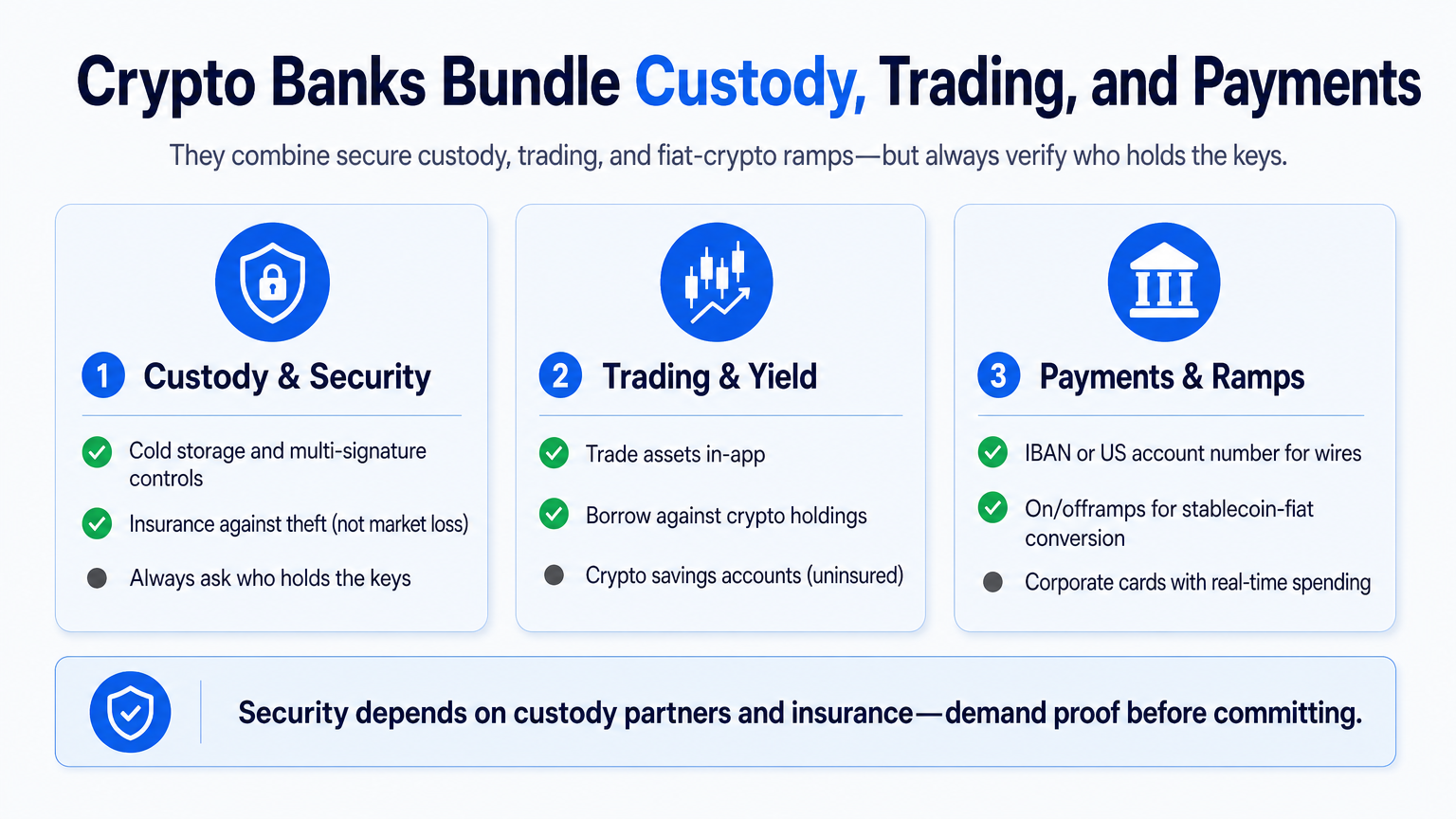
Crypto banks bundle storage, movement, trading, and sometimes yield services for digital and fiat currencies.
- Custody and security: Reputable providers use cold storage, multi-signature controls, and insurance (usually against theft, not market loss). OneSafe, for instance, secures digital assets through Fireblocks. Always ask who holds the keys—it determines your counterparty risk.
- Trading, lending, yield: Platforms may let you trade assets in-app, borrow against crypto holdings, or earn interest via “crypto savings accounts.” The College Investor (September 25, 2026) notes these yield products remain uninsured and carry credit risk.
- Payments and ramps: You typically get an IBAN or US account number for wires, ACH, and SWIFT, plus on/off-ramps to convert between stablecoins and fiat. Some issue corporate cards that spend from fiat or crypto balances with real-time conversion.
The Spectrum of Crypto Banking: Not All Are Banks
Chartered crypto banks like Anchorage Digital hold national or state charters, custody digital assets, and their fiat deposits are FDIC insured. Crypto balances are not insured, and you still need to verify specific protections.
Uninsured trust banks are exemplified by Block’s Builders Bank & Trust, announced September 29, 2026 (Yahoo Finance). It’s a limited-purpose OCC-chartered trust with no FDIC coverage. You gain regulatory oversight but no government backstop on any deposits.
Crypto neobanking platforms like OneSafe are fintechs—not banks. They layer crypto wallets, fiat accounts (held at partner banks), cards, and payments into one dashboard. Fiat at partner banks may be insured; crypto is not. The speed and unified experience suit many Web3 businesses, but you must understand the partner structure.
Crypto savings/earning accounts lend your assets for yield. They typically lack a banking charter, and total loss is possible if the platform or its borrowers fail.
Key Differences: Crypto Banks vs. Traditional Banks
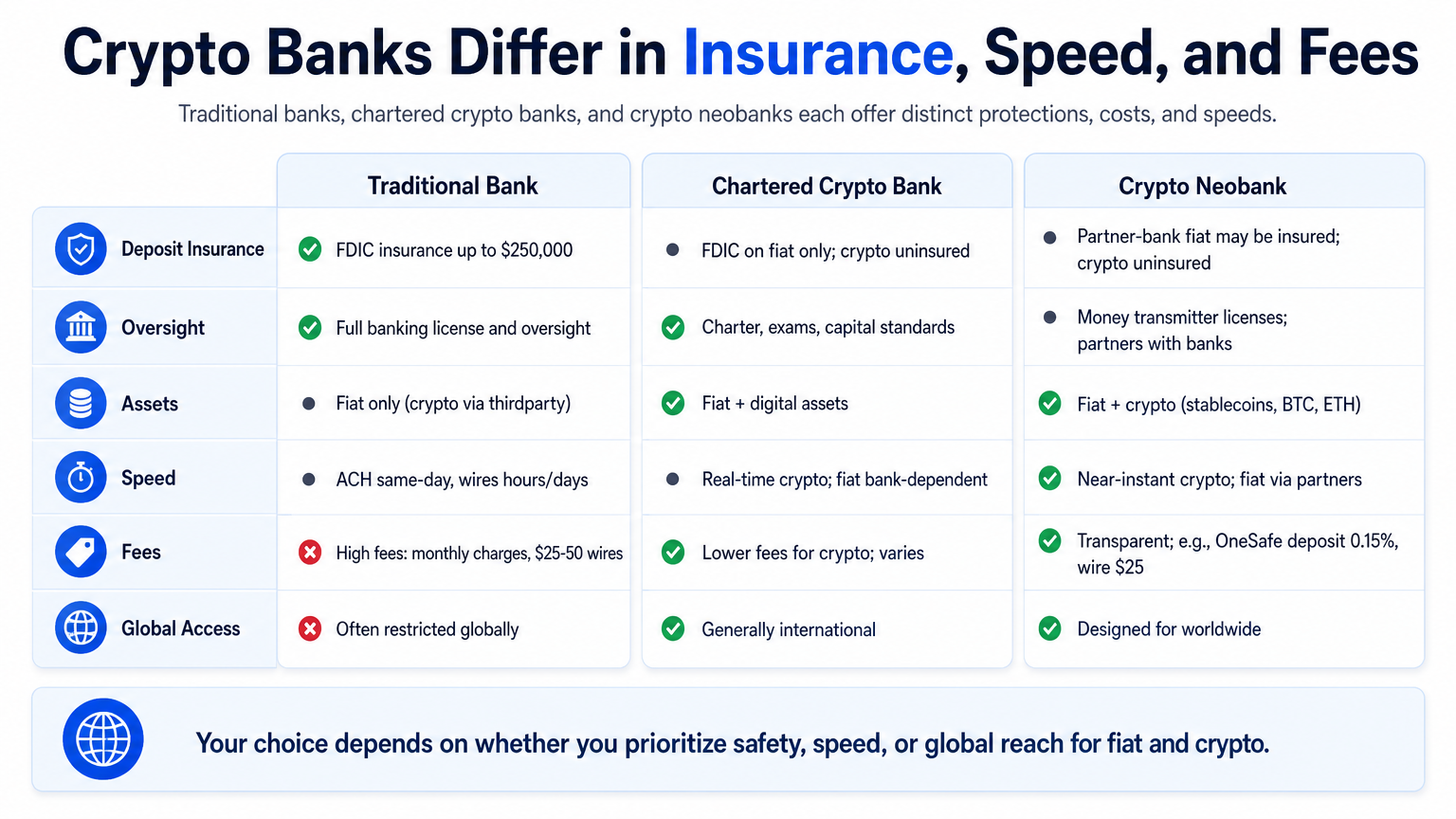
| Category | Traditional Bank | Chartered Crypto Bank | Crypto Neobank (Platform) |
|---|---|---|---|
| Deposit Insurance | FDIC up to $250,000 | FDIC on fiat only; crypto uninsured | Partner-bank fiat may be insured; crypto uninsured |
| Oversight | Full banking license | Charter, exams, capital standards | Money transmitter licenses; partners with banks |
| Assets | Fiat only (crypto via third-party) | Fiat + digital assets | Fiat + crypto (stablecoins, BTC, ETH, etc.) |
| Speed | ACH same-day, wires hours/days | Real-time crypto; fiat still bank-dependent | Near-instant crypto; fiat via partners |
| Fees | Monthly, wires $25–50, FX markups | Lower for crypto; varies | Transparent; e.g., OneSafe fiat deposit 0.15%, wire $25 (2026) |
| Global Access | Often restricted | Generally international | Designed for worldwide, sanctions-permitting |
How to Choose a Crypto Banking Partner
Security model: Know who holds the private keys. A chartered bank may self-custody under regulation; a neobank should use a recognized custodian like Fireblocks. Ask for proof of segregation and insurance.
Real-world costs: Model your expected monthly volume: subscription, deposit/withdrawal fees, wire/SWIFT charges, FX markup. For a business doing $50,000 in fiat wires and $20,000 in USDC off-ramping, a neobank could save thousands annually over a traditional bank.
Onboarding speed: Best-in-class platforms aim for days, not weeks. You’ll typically need incorporation documents, director IDs, EIN, and proof of operations. OneSafe’s digital onboarding often completes within a week.
Integration: Does the platform sync with your accounting software, support batch payments, and provide corporate cards? A wallet-only “blockchain bank” won’t suffice for real operations.
Checklist summary:
- Verify charter/license and where fiat deposits are held; confirm any insurance.
- Examine the custody partner, insurance, and proof-of-reserves.
- Run your monthly volume through their fee schedule.
- Test onboarding speed and documentation requirements.
- Check payment rails (ACH, wire, SWIFT, on/off-ramps, cards) and integration capabilities.
What Recent Headlines Mean for Crypto Banking
Block’s uninsured trust bank
Block’s Builders Bank & Trust (Yahoo Finance, September 29, 2026) shows even large tech firms are choosing a model without FDIC coverage. A charter doesn’t guarantee insured deposits; always ask explicitly what protection your fiat funds carry.
Tether account seizures
On September 25, 2026 (Futurism), the DOJ seized accounts linked to Tether. This underscores that operational freezes can lock your access, even with major crypto firms. Diversify providers and keep essential working capital in insured accounts.
Crypto savings accounts
The College Investor’s September 25, 2026 review highlights how platforms pay interest by lending your assets. These products are uninsured, lack liquidity guarantees, and carry credit risk. Treat them as yield enhancement for idle treasury that you can afford to lose—not an operating cash buffer.
Common Questions About Crypto Banking
What is a crypto bank?
It’s a broad term for institutions or platforms that let you hold, send, and convert crypto alongside fiat. It includes chartered banks, uninsured trusts, and fintech neobanks. For a business, it’s any provider that unifies digital and traditional money operations.
How does a crypto bank work?
It combines custody technology, banking rails, and software. You deposit fiat and crypto; the platform holds them directly or via partners. You then pay, exchange, and sometimes earn yield, with each transaction tapping blockchain and traditional payment networks.
Is a crypto bank safe?
Safety hinges on deposit insurance (crypto is never government-insured), custody practices, regulatory oversight, and the institution’s health. A chartered crypto bank undergoes audits and capital requirements, but even it can fail. A neobank using a reputable custodian and insured partner banks can be secure for daily operations, but crypto holdings still carry no government guarantee. The Bank for International Settlements’ 2023 report on crypto and financial stability reinforces the need for thorough due diligence.
What types of transactions can I make with a crypto bank?
You can send and receive domestic/international wires, ACH transfers, bill payments, instant crypto-to-fiat conversions (on/off-ramp), crypto wallet transfers, and issue virtual or physical corporate cards. Some platforms also support stablecoin transactions and automated batch payouts for payroll or suppliers.
How do I open a crypto bank account for my business?
- Choose a provider using the checklist above.
- Submit an online application with business documents and director IDs.
- Pass KYC/KYB verifications (possibly including a video call).
- Fund via fiat wire or crypto deposit.
- Configure team permissions and accounting integrations. Many neobanks let you start an application in 10 minutes and be fully operational within a week.
What are the fees for crypto banking services?
Traditional banks may charge $40–$60 per wire and 2–3% FX markup. OneSafe’s 2026 fee schedule shows 0.15% on fiat deposits, $25 per wire withdrawal, $10 wire deposit, free USDC deposits/withdrawals, and a 3% FX fee on card foreign transactions. Always model your expected activity on a full fee schedule.
How are crypto banks regulated?
Regulation varies by entity type. In the U.S., chartered banks are regulated by the OCC or states and follow FDIC rules. The FDIC clarified in April 2025 the process for banks to engage in crypto activities, but no blanket framework exists. Uninsured trust banks are also OCC-supervised. Fintech platforms operate under money transmitter laws and partner with chartered banks. The E.U. is implementing MiCA to standardize rules. (See our guide on ESMA’s MiCA demands.)
What’s the difference between a licensed crypto bank and a neobanking platform like OneSafe?
A licensed crypto bank holds a charter and can take deposits and issue loans directly, though crypto remains uninsured. A neobank is a tech layer that bundles partner-bank fiat accounts, crypto custody, and payments. OneSafe provides the interface and infrastructure; underlying fiat sits with a regulated bank.
Can a DAO use a crypto bank?
Yes. DAOs often need fiat ramps for contributors and vendors. A platform like OneSafe supports DAOs with customizable permissions, multi-sig transactions, and unified stablecoin/fiat management. Read our Web3 account guide for more.
How do the Block and Tether news affect my choice of a crypto banking partner?
These events highlight the importance of regulatory structure and legal risk. Block’s uninsured trust shows even large players may skip deposit insurance; Tether’s seizure shows assets can be frozen. Keep essential working capital in insured fiat accounts, verify your crypto custodian’s independence, and diversify providers.
Key Takeaways
- A “crypto bank” could be a chartered bank, an uninsured trust, or a neobank—know what you’re using.
- FDIC insurance rarely covers crypto; always segregate critical fiat in insured accounts.
- Security depends on custody partners and oversight—demand proof of segregation and insurance.
- Model your transaction profile against fees; wire and FX costs can eclipse subscription fees.
- Recent events underscore that operational resilience and legal clarity matter as much as technology.