
Stablecoin regulation shifted from a compliance abstraction to a treasury-operating concern on September 29, 2026. As CryptoRank reported that day, the Federal Reserve's stablecoin proposal would impose a general two-business-day redemption limit on issuers it supervises, even while $76 billion in stablecoins remains blocked. For founders, finance leads, and DAO treasury managers, the practical question is not whether the rule passes—it is how to keep payroll and vendor payments moving when your working capital is a stablecoin.
Table of Contents
- What just happened: the Fed's two-day stablecoin payout rule
- Why the 2-day payout cap matters for founders and finance leads
- Stablecoin regulation background in plain English
- What changes for your payment stack—and what doesn't yet
- Recommended actions now, before a final rule
- What to watch next and open questions
- Key Takeaways
What just happened: the Fed's two-day stablecoin payout rule
The September 29 proposal and its one-sentence core
The development, as reported by CryptoRank on September 29, 2026, is that the Federal Reserve's stablecoin proposal would put a general two-business-day limit on redemption by issuers it supervises. The core: if adopted as proposed, a covered issuer would have to complete a redemption request within two business days of a valid request, at least as a regulatory ceiling. That two-day clock applies to requests the issuer must process—it doesn't specify how weekends, holidays, or cutoff times affect the count. The proposal is not final as of September 30, 2026.
The two-day provision follows a broader Federal Reserve rulemaking push. Reuters reported on September 24, 2026 that the Federal Reserve had proposed new stablecoin rules; the September 29 item isolates the redemption-payout piece that matters most to treasury teams.
The $76B blocked figure that complicates the headline
The same CryptoRank report notes that $76 billion in stablecoins remains blocked despite the proposed payout guarantee. That figure matters even if your own funds are not frozen today, because it shows the gap between a proposed redemption standard and the reality of funds that are currently not moving. A proposed two-day payout rule is a future compliance obligation, not an order to unfreeze existing balances. Funds already stuck in paused redemption queues, insolvency proceedings, or custodial controls do not become liquid because a regulator publishes a proposal. The stablecoin payout rule's practical effect depends on where your funds sit at the moment the request is made.
Reported facts vs. analysis: how to read the development
Reported fact: the Fed proposal would impose a general two-business-day redemption limit on supervised issuers, and $76 billion in stablecoins remains blocked.
Analysis: the headline word "guarantees" overstates the immediate effect. A proposed cap sets a compliance floor for the future; it does not release blocked funds, does not bind non-supervised issuers immediately, and does not eliminate bank cutoff times or platform processing time. Treat the two-business-day number as a ceiling, not a promise of same-day cash.
Why the 2-day payout cap matters for founders and finance leads
Liquidity planning when your working capital is a stablecoin
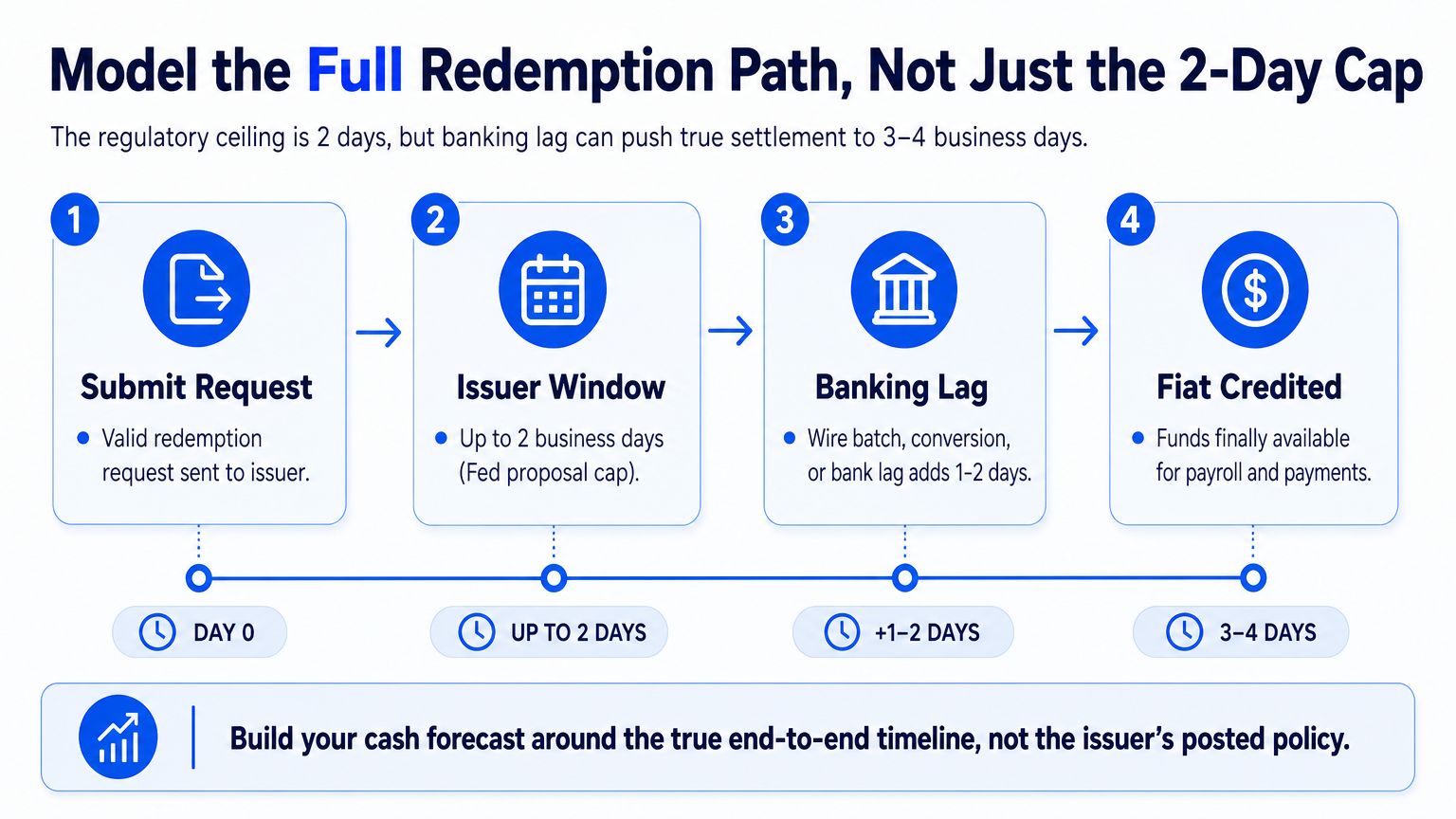
Businesses hold stablecoins for speed and 24/7 settlement, but a stablecoin balance is still one step away from fiat when payroll or rent comes due. The proposed two-business-day redemption rule reduces the worst-case issuer delay, but it does not remove the intermediate steps: your request to the issuer, the issuer's processing, and the banking or platform leg that converts fiat into your local account.
The key metric to watch is your USDC redemption timeline end to end, not just the issuer's published payout policy. If the issuer takes two business days and your banking partner adds wire batch times, the true timeline can stretch to three or four business days. Finance leads should model that full path, not the regulatory ceiling. For treasury teams already managing real-time settlement expectations, Crypto Treasury Management: Oracle Joins SWIFT's 24/7 Blockchain Push covers a similar operational shift: faster rails change the cash forecast, not just the settlement timestamp.
Payroll, vendor payments, and DAO treasury exposure
Payroll is the sharpest exposure. A missed payroll has legal and retention costs that are not recoverable by pointing at an issuer's slow redemption. Vendor payments have their own deadlines: net-30 invoices, contractor invoices, and software subscriptions do not pause while a redemption clears. The risks include timing mismatch, forced FX conversion at a bad rate, and counterparty spillover. If your payroll run depends on converting stablecoins to fiat and the redemption lands late, you may have to draw on a credit line, delay payments, or sell other assets. Vendor payments can trigger late fees, damaged supplier terms, or reputation cost.
DAO treasury stablecoins add governance risk. If a large redemption or conversion requires a multi-signature vote that takes days to assemble, the two-business-day issuer window is already half consumed before the request is even submitted. The $76B blocked figure is the systemic version of this: funds that are nominally redeemable but operationally unavailable when a treasury needs them.
Stablecoin regulation background in plain English
What stablecoins are and why redemption speed became a regulatory issue
Stablecoins are digital tokens pegged to fiat or other assets, used mainly for payments, trading settlement, and cross-border transfers. Redemption speed became a regulatory issue because redeemability is the peg's anchor: if holders cannot redeem at par promptly, the token can depeg. The Federal Reserve's two-day proposal is a direct response to that risk—it tries to make the promise of "one-to-one" concrete in time, not just in price.
How the US and global regulators currently treat issuers
US regulation is split. Issuers may face state money-transmitter requirements and, increasingly, federal frameworks. The Congressional Research Service overview of the GENIUS Act describes a federal structure for payment stablecoin issuers; the SEC's stablecoin regulatory framework catalogues the overlapping securities, banking, and payments questions. Global treatment varies, with the European Parliament's stablecoins brief outlining the EU's issuer-focused approach under MiCA.
The core for business readers: issuer obligations, not user obligations. Most proposals impose reserve, redemption, disclosure, and audit requirements on issuers, not on companies that hold or move stablecoins.
How are stablecoins regulated in the US?
The US regime remains layered. States license money transmitters; federal agencies address bank involvement, securities status, and payment-system risk. Commentary splits on how comprehensive this is: Brookings-style analysis describes oversight as still state-first and incomplete, while Morgan Lewis client guidance presents the GENIUS Act as a practical federal framework. State obligations do not disappear when a federal GENIUS Act stablecoins framework appears, and the Federal Reserve's redemption proposal shows federal standards can arrive as rulemaking in parallel with legislation. Businesses tracking the federal layer should also watch Stablecoin Regulation: Treasury's New Certification Rule, which covers the certification piece of the federal roadmap.
How are stablecoins regulated abroad?
The EU's MiCA regime applies issuer-only obligations to significant stablecoins, with stricter reserve and redemption rules for systemic tokens. Other jurisdictions vary, from licensing regimes to lighter-touch fintech frameworks. The practical point is the same: the compliance burden sits with issuers, but the redemption speed that follows from those rules affects every business user downstream. For a fuller global map, the Paxos guide on how stablecoins are regulated covers the major regimes.
What changes for your payment stack—and what doesn't yet
Issuer obligations vs. your business obligations
The Fed's proposal does not make you a regulated issuer. It does not require your company to hold reserves, file monthly attestations, or register as a money transmitter just because you hold USDC for payroll. Your exposure is indirect: the issuer's compliance speed becomes your liquidity speed. For a non-issuer, stablecoin regulation changes your counterparty assumptions more than your filing obligations. The proposed two-business-day redemption rule may shorten the worst-case wait at covered issuers, but it does not remove the need for a fiat buffer, a documented conversion path, and clear approval authority.
What does not change yet: you still need a fiat account for payroll, vendor payments, and tax. A stablecoin balance does not become a fiat balance because an issuer redeems faster. Your compliance burden is still around controls, record-keeping, and crypto business compliance basics—not issuer-level reserve management.
Where a fiat/crypto platform removes redemption bottlenecks
The Fed's two-business-day ceiling addresses one leg of the chain. The other leg is conversion. Platforms that support crypto to fiat conversion inside a single operating account remove the handoff time between an on-chain balance and a wire-ready fiat balance. OneSafe, a financial technology company that provides accounts through partner banks rather than banking itself, supports instant crypto-to-fiat conversions and free USDC deposits and withdrawals. That can compress the last mile after a redemption: instead of moving funds from a wallet to an exchange to a bank, treasury teams can hold, convert, and pay from one interface. For more on the mechanics, see Can I withdraw money from blockchain to my bank account?
Recommended actions now, before a final rule
Audit redemption terms, buffers, and conversion paths
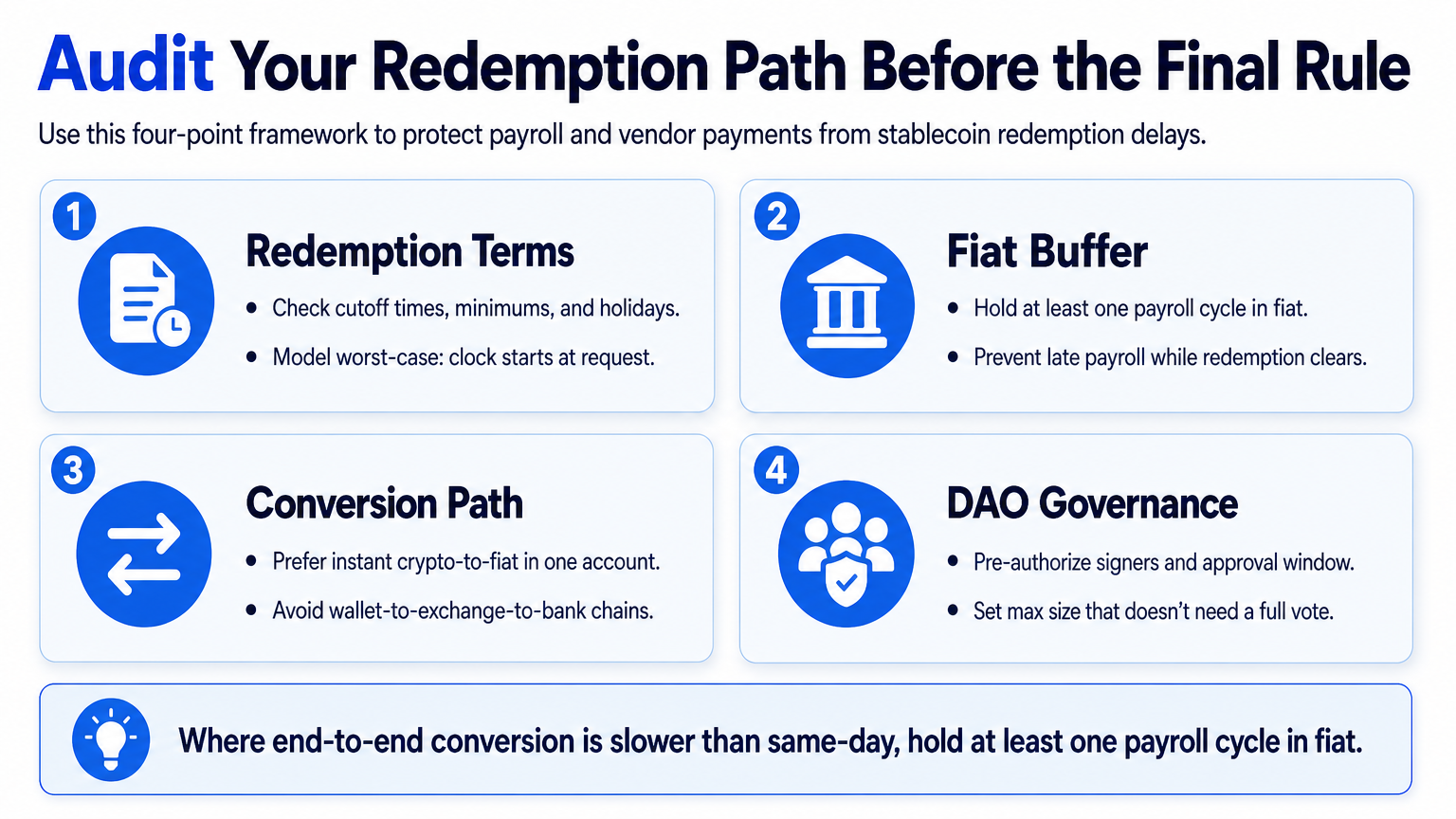
Use this framework before the proposal becomes final:
| Area | What to review | Decision rule | Why now |
|---|---|---|---|
| Issuer redemption terms | Published request cutoff, minimums, and bank holidays | Confirm requests land before cutoff; model worst case | The two-business-day clock starts at request |
| Fiat buffer | Days of payroll and vendor spend in fiat | Hold at least one payroll cycle in fiat where conversion lags | Avoid a late payroll while redemption clears |
| Conversion path | Whether your platform supports instant crypto-to-fiat conversion | Prefer a single-account path over wallet-to-exchange-to-bank | Redemption speed is the floor, not the whole line |
| DAO approval | Who can approve a large conversion or redemption | Pre-authorize signers and a time-bound approval window | Governance delay can outrun a two-day payout window |
The decision rule to remember is simple: where your end-to-end conversion path is slower than same-day, hold at least one payroll cycle in fiat.
Governance steps for DAO treasuries
DAO treasuries need an approval path that can execute faster than the redemption clock. That means pre-authorizing treasury signers, setting a maximum conversion size that does not require a full governance vote, and documenting the fallback fiat account before a delay occurs. OneSafe's DAO controls allow customizable roles and permissions so the treasury can pre-approve who may convert or pay, which reduces the risk that a governance vote turns a two-business-day redemption into a week-long payroll delay. For broader DAO operating context, see What Is a Web3 Account? A Guide for Modern Businesses.
How can DAOs and crypto businesses reduce stablecoin redemption exposure?
The shortest answer is to shorten your conversion path, not to rely on the issuer's payout rule. Keep a fiat buffer for fixed obligations, pre-authorize redemption or conversion decisions, and choose banking infrastructure that supports instant crypto-to-fiat conversion and local wires. A proposed two-business-day redemption ceiling helps, but it is not a substitute for operational liquidity planning.
What to watch next and open questions
The open questions are practical. Which issuers count as "supervised" under the final rule? How does the two-business-day clock interact with weekends, holidays, and bank settlement windows? Will the Federal Reserve's rulemaking align with the GENIUS Act proposals in Congress, or will state money-transmitter regimes remain the real enforcement layer?
Watch the comment period and final rule language. Also watch whether stablecoin payment rails continue to formalize alongside regulation; the Citi-Coinbase Deal: Next Step in Stablecoin Regulation tracks the banking integration side of the same trend. The only safe assumption as of September 30, 2026 is that redemption timelines will keep getting regulatory attention, and treasury teams should build buffers now rather than after a final rule.
Key Takeaways
- The Fed's September 29 proposal would impose a two-business-day redemption limit on supervised stablecoin issuers, but the $76 billion blocked figure shows a proposal is not a payout guarantee.
- For non-issuer businesses, the rule changes counterparty liquidity assumptions more than filing obligations; your exposure is timing, not registration.
- Finance leads should hold at least one payroll cycle in fiat wherever the end-to-end USDC redemption timeline is slower than same-day.
- DAOs should pre-authorize conversion signers and shorten the crypto-to-fiat conversion path so governance delay does not outrun the two-day window.
- Watch the final rule language and GENIUS Act alignment before changing treasury policy further.
Ready to bring fiat and crypto treasury operations into one account? Sign up for OneSafe to test your redemption-to-payment workflow.