On October 22, 2026, the crypto banking story worth tracking is not another trading app fee cut. CryptoTicker reported that The Clearing House selected Quant on September 24, 2026 as the technology partner for its bank network’s tokenised deposits initiative, with a staged plan running into Q2 2027 and the first stage already complete. The distinction matters for founders and finance leads: most crypto banking pages describe where to hold crypto and USD, not whether the settlement rails underneath are changing.
Table of Contents
- What just happened: Quant and The Clearing House target tokenized deposits
- Why it matters now for founders and finance leads
- The background you need to follow the story
- Concrete implications and recommended actions
- What to watch next and open questions
- Direct answers to seven questions
- Key Takeaways
What just happened: Quant and The Clearing House target tokenized deposits
The dated development
On October 22, 2026, CryptoTicker reported that Quant supplies the technology for The Clearing House bank network’s tokenized deposits initiative, with a staged plan running into Q2 2027 and the first stage complete. That is infrastructure news, not a product launch.
The September 24, 2026 selection and the Q2 2027 timeline
The Clearing House chose Quant on September 24, 2026. The reported goal, per CryptoTicker, is “proven technology that can scale” by Q2 2027. The Clearing House Quant timeline spans a multi-quarter build, not an immediately available settlement rail. Confirmed: the partnership and target date. Not confirmed: which banks will pilot it first, jurisdictions covered, or regulatory approvals remaining.
What ‘first stage complete’ means and what remains open
The report does not specify what the completed first stage included. Treat it as progress on technology or program structure—not regulatory approval, live settlement, or open access for non-bank businesses. Open items include pilot bank participation, technical testing, legal sign-off, and the report’s open question about Europe. The first stage is complete, but the settlement rail is not live.
Why it matters now for founders and finance leads
What the SERP misses: crypto banking pages stop at custody, trading, and onboarding
Most crypto banking ranking pages are short product copy: they describe a place to manage crypto and USD, emphasize simple onboarding, and headline low or zero trading fees. The FDIC page adds the regulatory process for banks engaging in crypto-related activity. What those pages miss is the Quant and The Clearing House settlement timeline, real all-in cost structures, KYB requirements, and how digital assets are actually custodied. That gap is the operational reality for a global business or DAO.
The practical impact: institutional settlement rails could change fiat-crypto workflows for global businesses and DAOs
If tokenized deposits become usable bank money on a shared ledger, institutional crypto settlement could reduce intermediaries between fiat and crypto legs. A global business or DAO currently moves between bank wires, FX, and stablecoin payments to pay contractors, vendors, or contributors. Tokenized deposits would be a bank-liability alternative—not a replacement for stablecoin rails, but a different counterparty risk profile. The direction matters because stablecoin payments already show fintechs beating banks on cost in some cross-border corridors, and a bank-native tokenized rail would add another option.
Why waiting for 2027 is not a treasury plan
You cannot hold a tokenized deposit today. Payroll, invoicing, vendor payments, and DAO treasury management still need to clear now. Waiting for Q2 2027 means continuing with fragmented bank relationships or holding more crypto than a treasury policy may allow, so the practical move is to tighten the fiat-crypto bridge you already use.
The background you need to follow the story
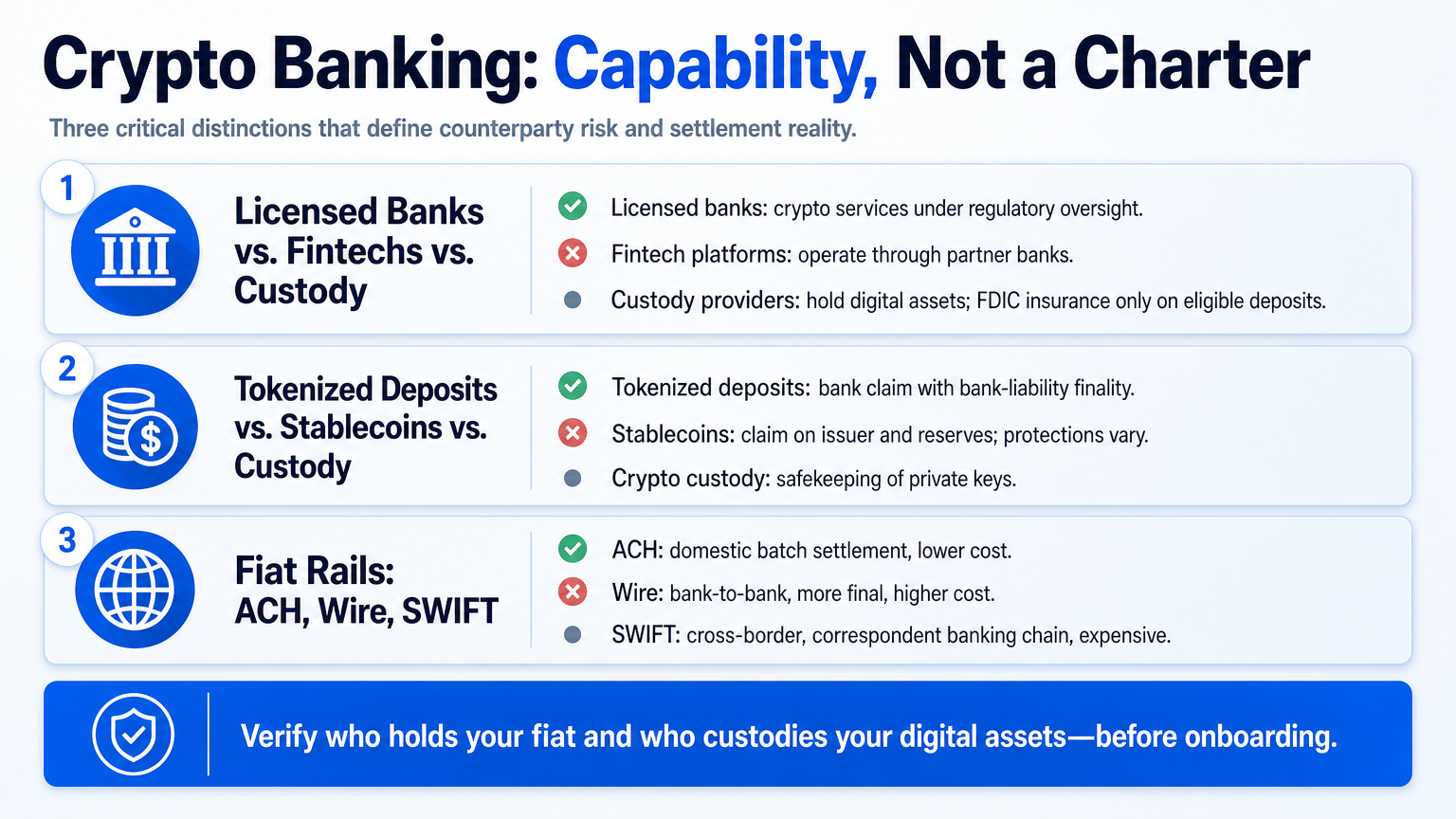
Crypto banking is not a bank charter: licensed banks vs fintech platforms vs partner-bank custody
FV Bank and Anchorage Digital may present themselves as bank or bank-grade crypto platforms. The FDIC page describes a regulatory process for banks engaging in crypto activity. OneSafe states it is a financial technology company, not a bank. These are not equivalent, and NerdWallet’s crypto banking explainer reflects the broad, account-like way the term is used. The safest reading: crypto banking is a capability, not a charter. Licensed banks can offer crypto services under oversight; fintech platforms work through partner banks; custody providers hold digital assets. FDIC insurance applies only to eligible deposits at insured banks, not automatically to a fintech interface and not to crypto assets.
Tokenized deposits vs stablecoins vs crypto custody: why the distinction matters for settlement and counterparty risk
Tokenized deposits are digital representations of deposit claims on a bank. Stablecoins are claims on an issuer and its reserves. Crypto custody is the safekeeping of private keys. Brookings distinguishes payment stablecoins from tokenized bank deposits by who owes the holder and under what regulatory regime. Nacha explains why the distinction matters for U.S. payments. The counterparty risk differs: a tokenized deposit claim is against a regulated bank, while a stablecoin claim is against an issuer that may or may not have bank-grade reserve protections. Stablecoin rules are still tightening, including the OCC’s 2-day redemption rule.
Current fiat rails: ACH, wire, SWIFT, and where tokenized deposits fit
ACH is domestic batch settlement. Wire transfers are bank-to-bank and more final, but more expensive. SWIFT moves cross-border through correspondent banks, adding intermediaries and fees. Tokenized deposits would fit as programmable bank money—closer to a wire-level bank liability but with digital-asset settlement characteristics. Oliver Wyman has described deposit tokens as a foundation for stable digital money, but the operational reality today remains ACH, wire, SWIFT, and stablecoin rails.
Concrete implications and recommended actions
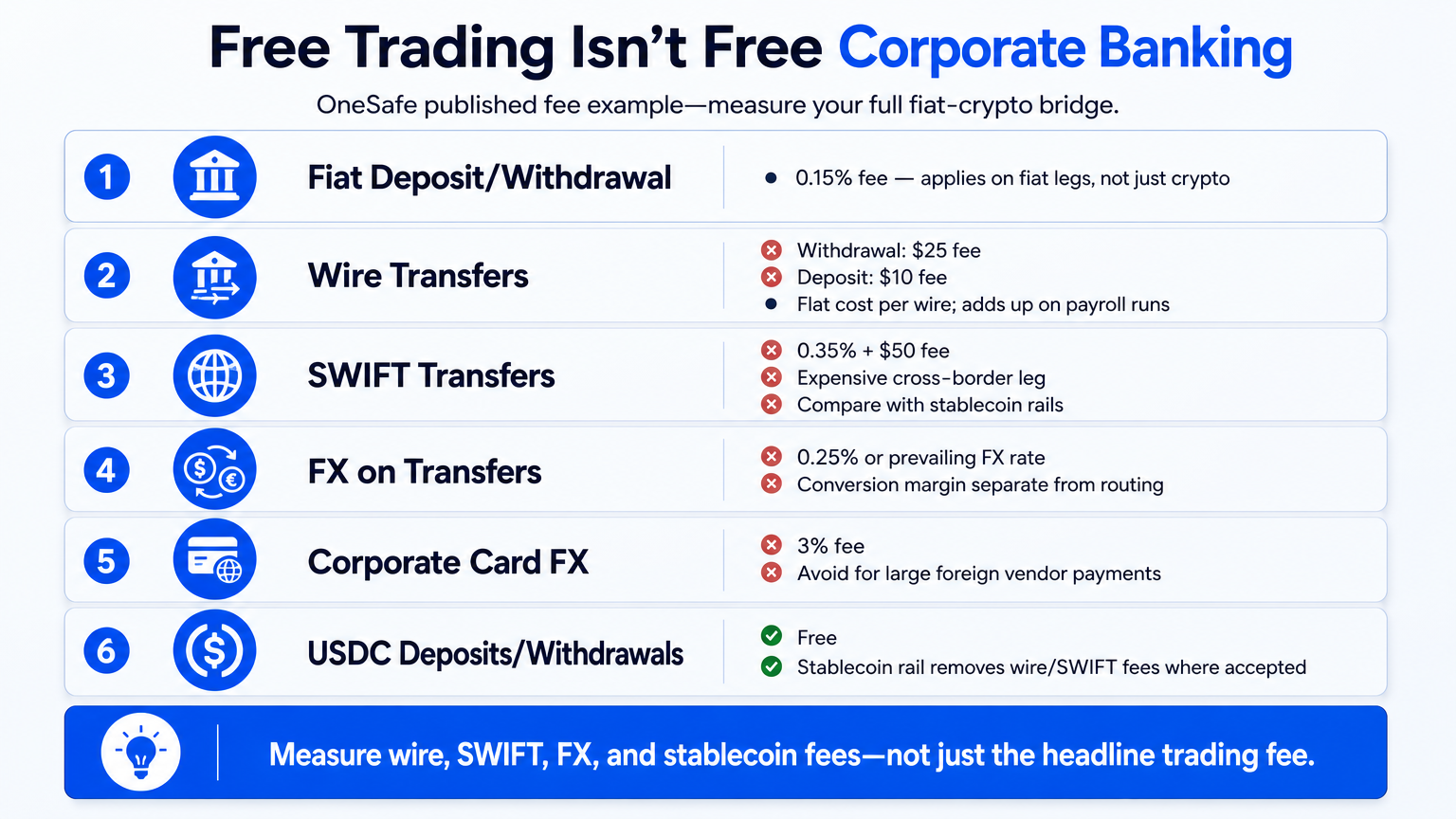
Audit your current fiat-crypto bridge for speed, fees, and counterparty risk
Use a simple four-point check:
- Map every leg: fiat in, conversion, crypto out, vendor or payroll payout.
- For each leg, identify who holds funds between settlement steps and for how long.
- Separate routing cost from conversion cost and from custody cost.
- Confirm finality: when is the payment actually irreversible?
Who holds the asset between settlement legs is the risk question.
Compare all-in costs—wire, SWIFT, FX, and stablecoin rails—not marketing headlines
Current advertises zero fees on crypto trades, but free trading is not free corporate banking—zero trading fees is not zero treasury cost. One published fee schedule from a fiat-crypto platform, OneSafe, shows the difference.
| Cost item | Published example: OneSafe fee schedule | What to check |
|---|---|---|
| Fiat deposit / withdrawal | 0.15% fee | Applied on fiat legs, not just crypto |
| Wire withdrawal / deposit | $25 / $10 | Flat cost per wire; adds up on payroll and vendor runs |
| SWIFT deposit / withdrawal | 0.35% + $50 | Expensive cross-border leg; compare with stablecoin rails |
| FX on transfers | 0.25% or prevailing FX rate | Conversion margin separate from routing |
| Corporate card FX | 3% | Avoid for large foreign vendor payments if lower-cost rails exist |
| USDC crypto deposits / withdrawals | Free | Stablecoin rail can remove wire/SWIFT fees where counterparties accept USDC |
Fees vary by platform, but the comparison method holds: measure the full fiat-crypto bridge, not the headline trading fee.
Prepare KYB documents and map your geographic footprint now
Onboarding for a business crypto banking platform is not instant. OneSafe’s verified material states that onboarding is fully digital and typically completed within a week, but it requires business formation papers and a government-issued photo ID—plus an EIN for U.S. companies—under robust KYB standards. Geographic restrictions also bind: the platform is available worldwide except in OFAC-sanctioned countries and certain U.S. states. Some ranking pages imply broad global access; the operational reality is narrower. Verify permitted jurisdictions before you design a treasury stack.
Use a single fiat-crypto workspace for payroll, invoicing, vendor payments, and DAO treasury while institutional rails mature
Until tokenized deposits are live, business crypto banking means consolidating fragmented bank relationships into one platform. For DAOs and global businesses, the operational capabilities that matter today are multi-currency accounts, ACH and wire, corporate cards with spend limits, FX, crypto on/off ramps, invoicing, payroll, and role-based permissions for DAO treasury management. A fiat-crypto platform such as OneSafe provides those workflows through partner banks and Fireblocks custody; it is not a bank charter, but it can reduce the number of accounts and intermediaries a team operates.
What to watch next and open questions
Milestones between now and Q2 2027: testing, pilot banks, and geographic scope
The next concrete signals to watch are named pilot banks, technical testing milestones, and any European scope clarification. The CryptoTicker report already flags uncertainty about what arrives in Europe. Regulatory approvals will also matter, particularly for U.S. bank participation after the OCC yield rule debate.
Open questions: interoperability with ACH and stablecoins, non-bank access, and outstanding regulatory approvals
Three open questions matter most. First, will tokenized deposits interoperate with existing ACH and wire rails, or become a parallel settlement system? Second, will non-bank fintechs and DAOs have direct access, or only through chartered institutions? Third, which regulators must approve each live use? CSBS has already issued guidance on tokenized deposits, signaling that U.S. state regulators are watching blockchain banking infrastructure closely.
Direct answers to seven questions
What just happened with Quant and The Clearing House?
The Clearing House selected Quant on September 24, 2026, as technology partner for its tokenized deposits initiative. CryptoTicker reported it on October 22, 2026, with a staged plan into Q2 2027 and the first stage complete.
What is crypto banking in 2026?
In 2026, crypto banking is a capability layer—accounts, custody, on/off ramps, and payments—delivered by chartered banks, fintech platforms, or partner-bank models. It is not a single regulatory status or an FDIC-insurance guarantee.
Is a crypto bank the same as a licensed bank, and are deposits FDIC insured?
No. A crypto bank may be a licensed bank, but many crypto banking platforms are fintechs using partner banks. FDIC insurance depends on where funds are actually held and the account type. Crypto assets are not FDIC insured. Do not infer deposit insurance from “crypto bank” branding.
What are tokenized deposits, and why do they matter?
Tokenized deposits are digital representations of bank deposit claims. They matter because they could combine bank-liability finality with programmable settlement. They are not live for U.S. treasury use from this timeline yet.
What should global businesses and DAOs do while institutional rails are still being built?
Audit the current fiat-crypto bridge, compare all-in costs across wire, SWIFT, FX, and stablecoins, prepare KYB documents, verify jurisdiction restrictions, and consolidate fiat and crypto operations into a single workspace.
What are the real fees and onboarding requirements for a fiat-crypto platform?
Fees vary by platform. One published example: fiat deposit/withdrawal 0.15%; wire withdrawal $25, wire deposit $10; SWIFT 0.35% + $50; FX 0.25% or prevailing FX rate; corporate card FX 3%; USDC deposits and withdrawals free. Onboarding requires business formation papers, a government-issued photo ID, and an EIN for U.S. companies; KYB is typically completed within a week.
Which crypto banking capabilities can replace fragmented bank relationships today?
Multi-currency USD, EUR, and CAD accounts; ACH and wire transfers; corporate cards with spend limits; FX; crypto on/off ramps; invoicing; payroll; and DAO-specific roles and custody. These capabilities do not replace a bank charter, but they can replace operational fragmentation across multiple banks and crypto rails.
Key Takeaways
- The Clearing House Quant timeline is real infrastructure progress, but tokenized deposits are not a live treasury rail today.
- Crypto banking is a capability, not a charter or FDIC guarantee; verify who holds fiat and who custodies digital assets.
- Free crypto trading is not free corporate banking—compare wire, SWIFT, FX, and stablecoin fees on total all-in cost.
- KYB and jurisdiction restrictions are binding constraints; prepare business formation papers, photo ID, and EIN for U.S. firms now.
- Until institutional rails mature, a fiat-crypto platform with ACH, wire, cards, FX, and DAO workflows can consolidate fragmented bank relationships.
For a single workspace for your fiat and crypto operations, open an account with OneSafe.