Table of Contents
- What just happened: Tether's Peso bet expands stablecoin payments in Latin America
- Why it matters: merchant stablecoin adoption meets local settlement
- Background: stablecoin payments and the acceptance-settlement gap
- Concrete actions: cost math, account setup, and DAO implications
- What to watch next: scaling USDT payments Latin America-wide
- FAQ: Quick answers on stablecoin payments and the Peso deal
What just happened: Tether's Peso bet expands stablecoin payments in Latin America

On October 21, 2026, Tether led a pre-seed funding round for Peso, a Bolivian fintech building infrastructure for stablecoin payments across four Latin American markets. The investment, reported by CoinDesk, funds expansion in Bolivia, Brazil, Colombia, and Argentina. Peso already runs live infrastructure: USDT payments via QR codes, point-of-sale systems, and virtual accounts linked to Bolivia’s ACH network. The fintech also powers USDT transactions for Yango’s food delivery in Bolivia—a concrete demonstration of merchant stablecoin adoption in a daily consumer service.
Why it matters: merchant stablecoin adoption meets local settlement
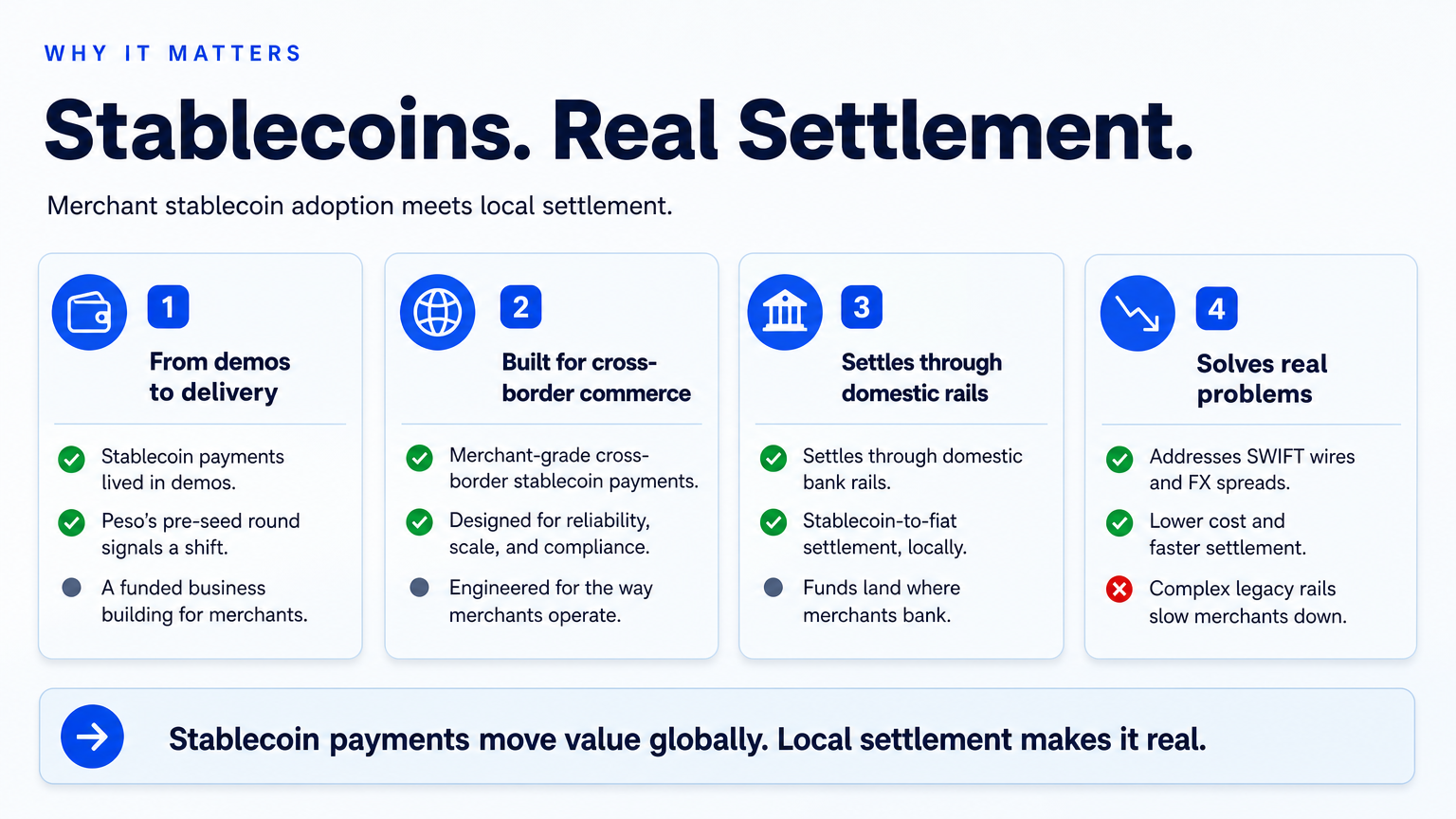
For years, stablecoin payments lived in demos. Peso’s pre-seed round signals a shift: a funded business building merchant-grade cross-border stablecoin payments that settle through domestic bank rails. In markets where SWIFT wires and FX spreads hurt, stablecoin-to-fiat settlement that feeds directly into a local ACH system cuts both cost and time.
For global businesses managing payables in the region, this is a treasury signal. The model doesn’t require every vendor to hold USDT. Instead, it pairs a stablecoin transfer leg with fiat to crypto conversion (or crypto to fiat) through a local banking partner. The Peso integration proves that merchant stablecoin adoption can happen before enterprise features like chargebacks mature—the market moves where the alternatives are worse.
Background: stablecoin payments and the acceptance-settlement gap
A stablecoin like USDT maintains a peg to the U.S. dollar. Payments move on blockchain rails, settle in minutes, and reduce cross-border costs. The IMF notes that stablecoins can improve speed, cost, and reach, but they require careful handling of custody and conversion.
Crucially, stablecoin payments involve two distinct functions. Merchant acceptance lets a customer pay with stablecoins at checkout. Treasury settlement lets a business pay suppliers by converting stablecoins to local fiat via domestic rails. Peso does both in Bolivia, but the settlement piece is where global businesses and DAOs unlock value. A company paying a Brazilian vendor doesn’t need a POS terminal; it needs business stablecoin accounts that hold USDT, convert to BRL, and settle through Pix or local ACH.
Concrete actions: cost math, account setup, and DAO implications
Run the cost numbers: USDT rails vs. SWIFT
| Payment Rail | Cost for $5,000 Cross-Border | Settlement Time |
|---|---|---|
| SWIFT Wire | ~$67.50 + intermediary fees | 2–5 days |
| Domestic Wire (US) | $25 + FX spread | Same day–2 days |
| USDT on-chain + fiat conversion | Minutes + local settlement window | |
| USDT only (no conversion) | ~$1 | Minutes |
For typical cross-border stablecoin payments that require fiat on the other end, the conversion leg adds cost, but still cuts SWIFT expenses by 60–70%. The BIS cost comparison confirms stablecoin rails consistently undercut bank wires.
Set up business stablecoin accounts with one unified interface
Businesses that need to pay Latin American vendors should use a platform that bundles stablecoin custody, fiat to crypto conversion (or vice versa), and multi-currency fiat accounts. OneSafe provides fiat accounts, ACH, wires, and on-chain USDT support—allowing a single account to receive USDT, convert to USD or local fiat, and pay out through domestic rails. This eliminates the manual hop between an exchange and a bank, collapsing treasury settlement into one dashboard.
For DAOs, the same setup works with permissioned roles. A working group can execute USDT-to-fiat payouts while the multi-sig controls treasury allocation. That links governance, custody, and daily settlement without fragmenting accounts.
What to watch next: scaling USDT payments Latin America-wide
Peso’s expansion targets four countries. The live Bolivia stack demonstrates the model; Brazil and Argentina are much larger markets with their own instant payment systems (Pix, local transfers). Adapting the ACH-linked virtual accounts to a Pix bridge would be a different technical lift. Monitor Peso announcements through 2027 for any USDT-to-Pix integration—a development that would turn the Brazil corridor into a major cross-border stablecoin payments highway.
Open questions remain: chargebacks, refunds, and dispute processes are absent on-chain. Stripe’s stablecoin docs confirm that refunds and disputes aren’t supported. For consumer-facing merchant stablecoin adoption, an off-chain refund policy is mandatory before launch.
FAQ: Quick answers on stablecoin payments and the Peso deal
Which stablecoin is used in the Peso expansion?
Tether (USDT). The October 21, 2026 announcement specifies USDT for QR code, POS, virtual account, and Yango integration. No specific blockchain is named.
Which countries does the Peso expansion affect?
Bolivia (live), plus upcoming expansion in Brazil, Colombia, and Argentina.
How do stablecoin payment fees compare?
On-chain USDT transfers cost pennies. Adding fiat conversion brings costs to $8–$13 for a $5,000 payment—far below SWIFT’s $67+.
How does a business receive and convert USDT?
Deposit USDT into a business stablecoin account, convert to fiat on the same platform, then pay out via ACH, wire, or local rail.
Are there chargebacks?
No. Blockchain transactions are final. Disputes require an off-chain process.
What should a business do now?
- Separate merchant acceptance from treasury settlement evaluations.
- Model costs on your highest-volume cross-border stablecoin payments corridor.
- Set up a unified fiat and stablecoin account (like OneSafe) to collapse custody, conversion, and payouts.
- Track Peso’s Brazil/Argentina progress; a USDT-to-Pix bridge would reshape LatAm payables.
- For consumer use cases, design an off-chain refund process upfront.
Open a business stablecoin account with fiat and crypto settlement in one place: get started with OneSafe.