Crypto payroll has moved from a niche experiment to a quiet, behind‑the‑scenes reality—largely invisible to the employees who receive it. An October 21, 2026, interview with Fireblocks VP of Embedded Wallets Itai Turbahn confirmed what many in payments infrastructure already knew: non‑crypto companies are already paying people on stablecoin rails, often without the recipient ever seeing a blockchain address.
Table of Contents
- What Just Happened: Fireblocks Reveals the Hidden Crypto Payroll Wave
- Why This Matters Now: Crypto Payroll Isn’t a Niche Anymore
- The Background Every Founder Needs: How Crypto Payroll Works Today
- Legality, Tax, and Compliance: Where Crypto Payroll Stands in 2026
- Concrete Actions: How to Evaluate and Adopt Crypto Payroll for Your Business
- What to Watch Next: The Future of Payroll Is Multi‑Rail
- Key Takeaways
What Just Happened: Fireblocks Reveals the Hidden Crypto Payroll Wave
The October 21 revelation: non‑crypto firms are already paying via stablecoins
In an Unchained Premium episode published October 21, 2026, Itai Turbahn disclosed that close to 100% of his recent conversations are with non‑crypto companies exploring embedded wallet tech (Unchained Crypto, October 21, 2026). Legacy remittance firms, payroll processors, and global employment platforms are quietly replacing correspondent‑banking rails with stablecoin settlement.
Western Union, Papaya Global, and the 10‑second contractor payment to Argentina
Turbahn detailed a Cash App transfer landing in a Western Union wallet over stablecoins, and Papaya Global paying a contractor in Argentina in 10 seconds. The end user never touches a wallet or token—embedded wallet infrastructure abstracts the entire crypto layer.
Why USDC in the U.S. and USDT on Tron dominate South America
The interview mapped regional stablecoin splits for payroll. US companies lean toward USDC, while Latin American corridors run on USDT, especially on Tron and BNB Chain. USDC’s regulatory posture suits U.S. corporate flows, while USDT’s low fees and liquidity make it the settlement layer in South America.
What just happened to make crypto payroll mainstream?
Mainstreaming didn’t require consumer awareness. Infrastructure matured: a payroll provider plugs into a platform like Fireblocks payroll, embeds a wallet, and routes stablecoins with finality in seconds—the worker sees cash in their local account. This is operating at scale today. Crypto payroll 2026 isn’t a future scenario; it’s here.
Why This Matters Now: Crypto Payroll Isn’t a Niche Anymore
The death of volatility concerns: stablecoins make price swings irrelevant
The earliest objection—volatility—is solved when payments settle in dollar‑pegged stablecoins. An employer pays an agreed fiat value; the worker receives stablecoins that can be held or instantly converted. The risk profile equals holding a money‑market‑fund token, not a speculative asset.
Invisible crypto: why your team might already be paid on a blockchain
The Fireblocks insight shows crypto payroll is an invisible infrastructure layer. If your global payroll provider adopted stablecoin rails, the remittance leg already travels over USDC or USDT without changing the payee’s experience. That’s true mainstreaming—embedded so deeply it’s no longer a talking point.
How do stablecoins reduce risk in crypto payroll?
Stablecoins address the two CFO‑blockers: price volatility and custody complexity. Pegging to fiat eliminates the need to mark‑to‑market payroll holdings. Combined with multi‑party computation (MPC) key management (as Fireblocks offers), private keys are sharded across parties, never existing in one place, drastically cutting theft and fraud risk.
The Background Every Founder Needs: How Crypto Payroll Works Today

The traditional model: employer buys crypto, employee receives it
Historically, companies bought crypto on an exchange, transferred it to a wallet, and sent it to employees’ addresses. This brought tax, accounting, and operational headaches.
Advantages: speed, cost, global reach for remote teams
Crypto payroll benefits include bypassing correspondent banks, cutting wire fees, and settling in minutes. For teams in unstable currencies or capital controls, receiving stablecoins provides immediate dollar liquidity. BIS research confirms fintech‑driven stablecoin rails undercut traditional cross‑border costs by an order of magnitude (Stablecoin payments: BIS says fintechs beat banks on cost).
Disadvantages: regulatory complexity, accounting friction—and why they’re fading
Old disadvantages—uncertain tax treatment, manual record‑keeping, piecemeal KYC—are fading as crypto payroll platforms embed compliance natively. Today’s platforms combine fiat banking with crypto rails, auto‑calculate FMV at payment time, generate employer reports, and handle withholding in fiat. A remaining challenge: some jurisdictions lack clear guidance, but the trend is toward treating stablecoin wages like foreign‑currency compensation.
| Advantages | Disadvantages |
|---|---|
| Near‑instant settlement (10 seconds cross‑border) | Regulatory fragmentation varies by country |
| Dramatically lower costs than SWIFT | Accounting for FMV requires robust tooling |
| Dollar‑denominated liquidity for high‑inflation economies | Not all platforms offer equal compliance depth |
| Invisible embedded wallets remove user education | Multi‑rail backend must handle fiat on/off‑ramps seamlessly |
| Stablecoins eliminate volatility as a payment rail | Adoption requires internal policy updates and training |
Legality, Tax, and Compliance: Where Crypto Payroll Stands in 2026
Is it legal to pay wages in crypto?
In most major economies, yes—with conditions. The U.S., UK, EU, and several Asian jurisdictions allow crypto wages if minimum‑wage laws, reporting, and tax withholding are met. Some countries like Argentina embrace it for global contractors; others restrict it. The momentum is toward permissibility with stablecoins.
How is crypto taxed?
Tax authorities treat crypto wages as ordinary income. The employer determines FMV at payment and reports on the employee’s tax form. In the U.S., the IRS applies standard withholding and FICA obligations (Thomson Reuters, “Stablecoin Payroll Gains Momentum, but IRS Rules Pose Compliance Challenges”). Employees may face capital‑gains tax if they later sell at a gain; for 1:1 stablecoins, the gain is zero, simplifying the process.
How do companies account for crypto payroll?
Employers record the compensation expense at USD‑equivalent FMV on the pay date. Instead of debiting a bank account, they debit a stablecoin wallet. A crypto‑specific sub‑ledger timestamps and logs the fiat value. Modern platforms integrate this sub‑ledger with the general ledger, automating journal entries. A unified fiat‑and‑crypto platform like OneSafe crypto payroll, with multi‑currency accounts, conversions, and accounting integration, provides a single source of truth without manual spreadsheets.
Do crypto payroll platforms require KYC?
Yes. The business provides formation documents, ID for beneficial owners, and EIN (U.S. entities). Employee identity verification meets AML obligations. OneSafe, for example, enforces KYB (onboarding within days) and requires MFA. Custody rests on Fireblocks’ MPC, splitting private key shares so no single party moves funds unilaterally, making compliant global payroll crypto feasible at scale.
Concrete Actions: How to Evaluate and Adopt Crypto Payroll for Your Business
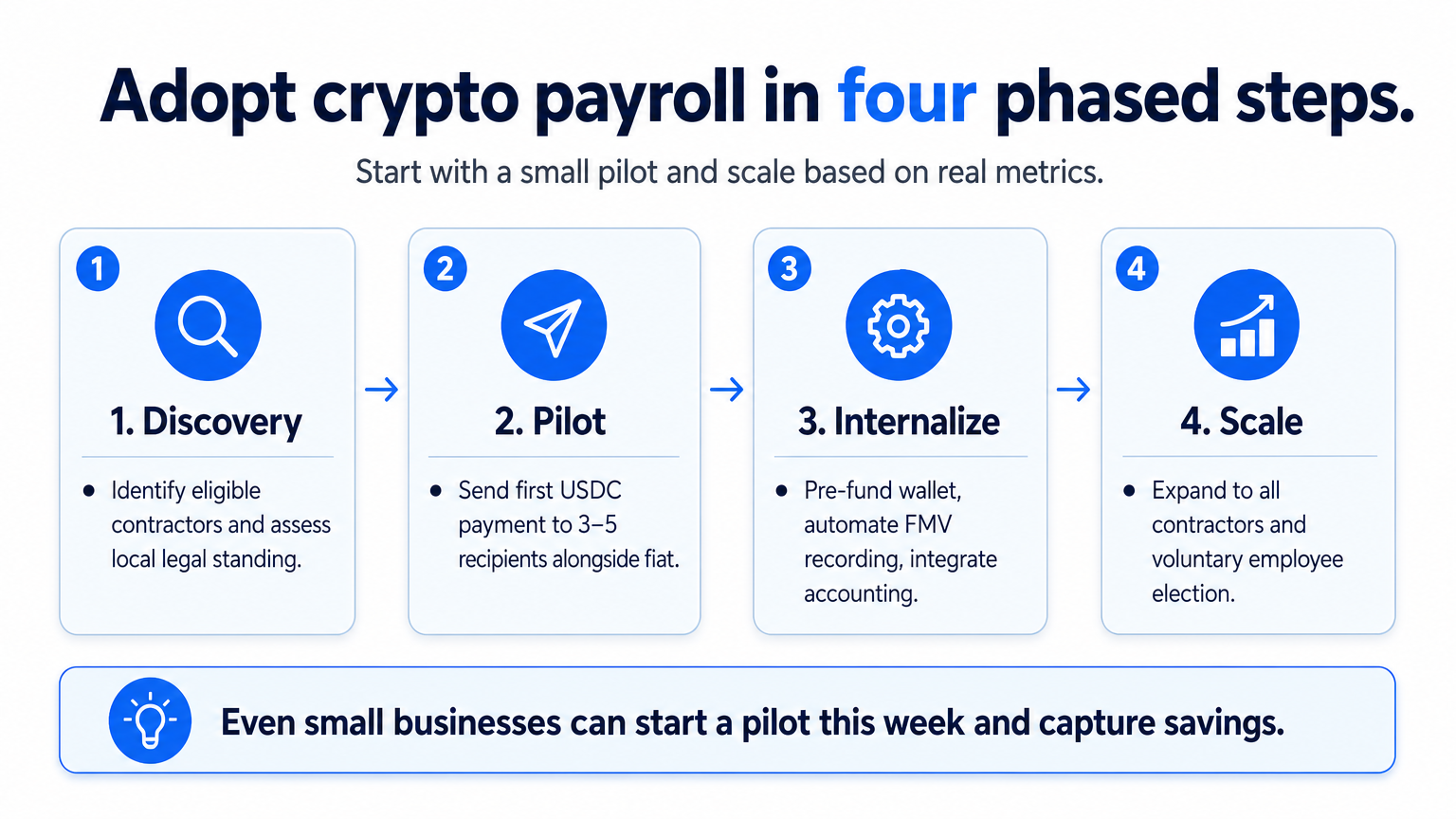
The Fireblocks insight makes the question practical: how to test stablecoin rails without disrupting the payroll stack.
Step 1: Identify team segments that benefit
Highest‑return segments:
- International contractors facing slow, expensive SWIFT and high FX fees.
- Remote workers in high‑inflation jurisdictions where stablecoins give dollar access.
- Crypto‑native talent wanting on‑chain compensation for treasury or DeFi.
Step 2: Choose a unified fiat‑and‑crypto platform, not a crypto‑only add‑on
A separate crypto wallet creates fragmentation. Look for a platform that integrates:
- MPC‑based custody (Fireblocks is the standard, as in the Fiserv, Fireblocks, and the Future of Crypto Banking partnership).
- Fiat on/off‑ramps in one interface.
- Automated accounting capturing FMV and syncing with your ledger.
- DAO‑friendly controls if needed.
Step 3: Start hybrid—pay a portion in stablecoins and expand
Begin with a small, opt‑in pilot: offer 10–20% of compensation in USDC, gauge employee experience, accounting workflow, tax gaps. Then expand eligible population and percentage. This mirrors how Mural, which raised $15 million in September 2026 to scale stablecoin payroll, structures enterprise adoption (Crypto Payroll: What Mural’s $15M Raise Means Now).
| Phase | Action | Key Metrics |
|---|---|---|
| Discovery | Identify eligible contractors/employees; assess local legal standing | Number of eligible payees, jurisdictional restrictions |
| Pilot | Send first USDC payment to 3–5 recipients alongside fiat run | Time‑to‑settle vs. wire, FX savings, satisfaction |
| Internalize | Pre‑fund wallet, automate FMV recording, integrate accounting | Reconciliation errors, audit readiness |
| Scale | Expand to all contractors, voluntary employee‑elected portion | Payroll cost reduction, global talent retention |
Can small businesses use crypto payroll?
Yes. Platforms have removed high‑minimum barriers. Open a business account holding fiat and USDC, onboard in days, send a test payment to a freelancer that week. Pick a provider not treating crypto as a premium add‑on. Small businesses using international freelancers—a startup with a developer in Argentina—gain the highest relative savings from eliminating bank fees and FX markups. So pay employees in crypto becomes accessible even for lean teams.
What to Watch Next: The Future of Payroll Is Multi‑Rail
More non‑crypto companies will quietly adopt stablecoin rails
Turbahn’s 100%-non‑crypto pipeline signals an inflection point. Every major payroll and remittance provider is evaluating embedded wallets. Consumers will see “instant” options running on stablecoins; finance teams will model payroll as multi‑rail by default.
Embedded wallets will become a standard B2B feature
As cloud payroll became default, embedded crypto wallets will become commodity B2B features. Tether’s LatAm push and USDT dominance on Tron for payroll corridors suggest multi‑stablecoin and chain‑agnostic wallets are the future.
Open questions: regulation, bank integration, and accounting standards
Three unresolved items:
- Regulatory coherence: While the UK’s FCA drafted new DeFi AML guidance and the OCC set a 2‑day redemption rule, global payroll‑specific settlement standards are pending. Monitor MiCA and U.S. state‑level licensing.
- Bank integration: Traditional banks are slowly warming to holding stablecoin reserves, but on‑/off‑ramps remain friction‑prone in some jurisdictions.
- Accounting standards: FASB and IASB haven’t classified stablecoin‑denominated payroll liabilities (cash equivalents, monetary instruments, or other), impacting balance‑sheet treatment.
Key Takeaways
- Crypto payroll is operational at major non‑crypto firms using invisible stablecoin rails.
- Stablecoins eliminate volatility; MPC‑based custody (Fireblocks) provides institutional security.
- A compliant rollout is possible now with a unified fiat‑and‑crypto platform that includes KYC, FMV tracking, and accounting integration.
- Start small: pay a portion of freelancer invoices in USDC, then expand.
- The next horizon is multi‑rail payroll: fiat, stablecoin, and CBDC paths from a single interface.
Open a globally capable business account bridging fiat and crypto seamlessly—sign up for OneSafe and begin your first stablecoin payroll pilot this week.