Uber’s HSBC tokenized buy signals a new era for crypto banking
Uber acquired tokenized money market funds through HSBC tokenized deposit service on November 2, 2026, pushing corporate crypto banking into live treasury operations. The purchase, reported by Cryptonews.net, used the Canton network for Delivery-versus-Payment (DvP) settlement, proving tokenized deposits can generate yield outside market hours. That continuous yield capability immediately redefines what a corporate treasury expects.
The transaction placed treasury into tokenized money market funds via HSBC’s new service. Fireblocks, the custody infrastructure used, highlighted the DvP settlement on Canton, ensuring atomic transfer of deposit and fund shares—no overnight risk. A previous analysis of Uber’s tokenization pilot showed how this digitizes the final mile of liquidity for a global corporation.
Table of Contents
- Why it matters now for corporate crypto banking
- The backdrop: tokenized deposits vs. stablecoins and ETFs
- The bridge between fiat and crypto for your business
- What founders and finance leads should do now
- What to watch next
- Key Takeaways
- Sources
Why it matters now for corporate crypto banking
Uber’s move signals that always-on liquidity is no longer theoretical. A publicly traded company now demonstrates tokenized deposits can slot into real cash management without overhauling controls. Corporate crypto banking isn’t just bitcoin on a balance sheet; it’s reprogramming cash management so every dollar earns, settles, and moves continuously.
Traditional treasury suffers dead zones: ACH, wire, and money market fund transactions halt outside banking hours. Uber’s use of a crypto banking infrastructure erases those gaps, sweeping excess cash into yield-bearing instruments at any hour and pulling it back when payments are due. This shift from batch processing to real-time value movement directly improves working capital efficiency.
The structural advantage—continuous liquidity, programmable treasury, onchain settlement—is exactly what mid-market companies, Web3 startups, and DAOs need, often with far less operational margin. However, they can’t wait for top-tier bank pilots. They need a Web3 business banking solution that delivers the same end result today. Many can replicate continuous-liquidity outcomes by consolidating fiat and crypto on a unified platform that treats both as natively programmable. A crypto-fiat conversion platform that offers instant swaps, multi-currency accounts, and on-ramps to stablecoin yield eliminates fragmented banking relationships. Platforms like OneSafe, which has processed over $800 million from 1,000+ businesses across 30+ countries, provide segregated global accounts, stablecoin payments, and Fireblocks custody—closing the weekend yield gap without a bank’s hours. This Web3 business banking approach gives DAOs customizable permissions, automated payroll, and a crypto treasury management layer independent of banker availability.
The backdrop: tokenized deposits vs. stablecoins and ETFs
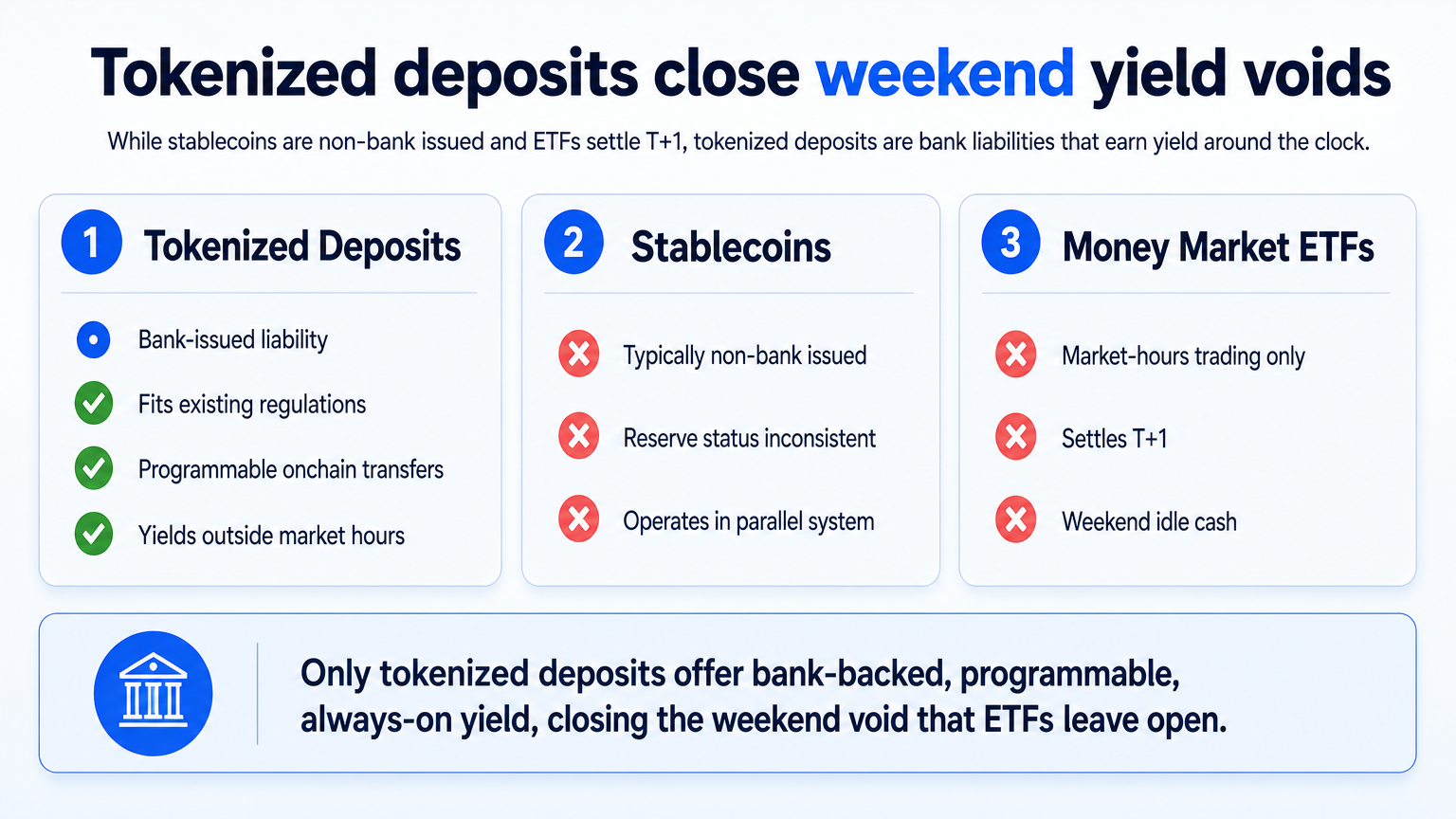
Tokenized deposits are bank liabilities on a blockchain, distinct from stablecoins, which are typically non-bank issued and vary in reserve status. As clear.bank explains in its primer on tokenised deposits, tokenized deposits retain the issuing bank’s credit risk and can fit existing regulatory frameworks, unlike stablecoins in a parallel system. Money market ETFs, by contrast, trade during market hours and settle T+1, leaving the same weekend void that tokenized deposits fill.
Tokenized deposits function as the onchain leg of a dual fiat-crypto rail, letting corporate treasuries hold a digital claim on a regulated bank while executing programmable transfers, automated sweeps, and smart-contract conditions. Because the deposit is onchain, it can interact with DeFi protocols for yield and settle instantly alongside other tokenized assets. HSBC’s Canton-based service demonstrates the institutional version; the broader market now needs approaches for entities without a direct banking pipeline.
The bridge between fiat and crypto for your business
Not every business can launch a tokenized deposit facility, but any can restructure treasury for always-on advantages by adopting a platform that natively bridges fiat and crypto. A unified stack typically includes multi-currency fiat accounts, instant conversion rails, corporate cards with spend controls, and automated payment workflows. OneSafe, for instance, provides segregated global accounts, ACH and wire transfers, bill payments, and instant crypto-to-fiat conversions through a single interface. Its DAO banking features include customizable permissions, automated payroll, and Fireblocks custody, meeting onchain organizations’ needs for both fiat payments and crypto treasury management without bank-side gatekeeping.
What separates a true crypto banking platform from a traditional bank’s crypto add-on?
A traditional bank’s crypto add-on is a custodial window bolted onto a fiat account, with settlement bound by core banking hours and manual reconciliation between separate ledgers. A true crypto banking platform treats fiat and digital assets as first-class citizens on the same infrastructure: real-time settlement for both, a single dashboard for EUR, USD, and USDC, programmatic controls across assets, and integration with accounting and payroll. Security and compliance are built in uniformly. In essence, a crypto-fiat conversion platform that doesn’t force a choice between bank and exchange is the backbone of a modern treasury.
What founders and finance leads should do now
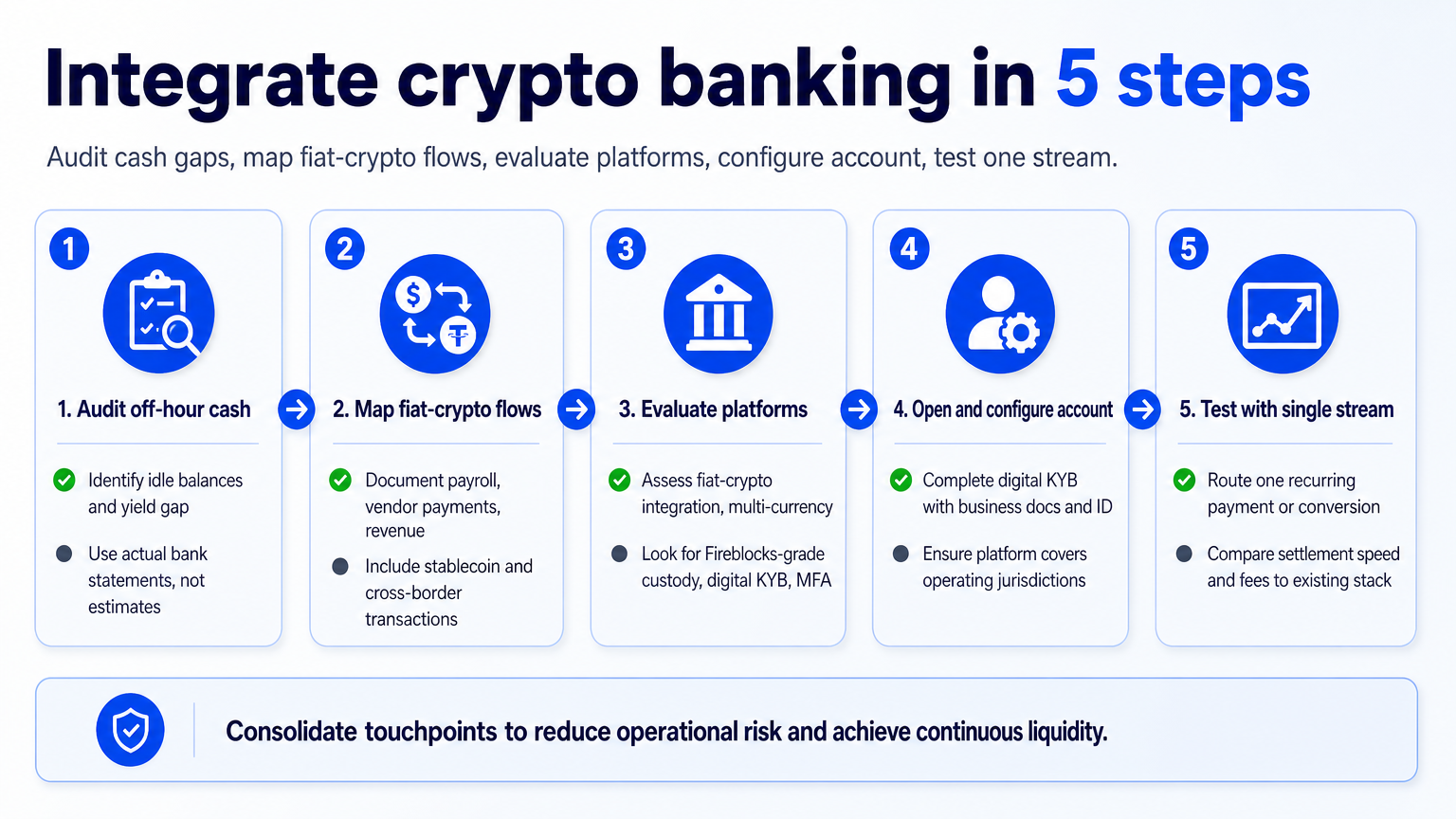
Start by auditing for off-hour yield gaps: map every window when cash sits idle—weekends, holidays, past cut-off times. Calculate foregone yield on average daily balances. Even a modest treasury finds that off-hour yield loss adds material drag. Tokenized deposits or a crypto banking platform with instant sweep capability can close that gap.
Next, list all fiat-crypto touchpoints: paying contractors in USDC, converting crypto revenue to fiat for payroll, settling invoices across currencies. A common pattern is three or four separate accounts—a bank, an exchange, a stablecoin issuer, a card provider—each with its own reconciliation headache. Converge them onto one platform supporting ACH, domestic and international wires, crypto on/off-ramp, and stablecoin payments. That consolidation reduces operational risk and makes continuous liquidity practical.
What steps should a finance lead take to integrate crypto banking into existing workflows?
A phased sequence brings immediate gains:
| Step | Action | Typical timeline | Key considerations |
|---|---|---|---|
| 1. Audit off-hour cash | Identify idle balances and yield gap | 1–2 days | Use actual bank statements, not estimates |
| 2. Map fiat-crypto flows | Document all touchpoints (payroll, vendor payments, revenue) | 1–3 days | Include stablecoin and cross-border transactions |
| 3. Evaluate platforms | Assess features: fiat-crypto integration, multi-currency, onboarding speed, DAO governance if needed | varies | Look for digital KYB, Fireblocks-grade custody, MFA |
| 4. Open and configure account | Complete digital KYB with business formation docs and ID | ~5–7 days (OneSafe) | Ensure platform supports all operating jurisdictions |
| 5. Test with a single stream | Route one recurring payment or conversion; verify reporting | 1 week | Compare settlement speed and fees to existing stack |
Real benchmarks: fiat deposit/withdrawal fee as low as 0.15%, wire withdrawals $25, SWIFT 0.35% + $50, USDC crypto deposits/withdrawals free (representative of modern platform pricing). Corporate card FX fees typically run 3%.
What security and compliance requirements apply to a hybrid fiat-crypto business account?
A hybrid account must meet overlapping standards:
- KYB: Verified business docs, government IDs, EIN before activity.
- Asset segregation: Fiat in segregated bank accounts; digital assets in institutional custody (e.g., Fireblocks MPC).
- Authentication: MFA mandatory; customizable roles prevent single points of control.
- Transaction monitoring: Onchain and offchain real-time sanctions screening (OFAC) and suspicious activity detection.
- Data encryption: At rest and in transit, with penetration testing and audit trails.
Funds with a non-bank fintech are not FDIC insured; deposit protection applies only to fiat at the underlying bank, and digital assets carry market risk. Clear disclosure of this is itself a compliance requirement.
What to watch next
Guidance from the Conference of State Bank Supervisors already emphasizes that tokenized deposits must fit the bank regulatory perimeter. The Uber transaction gives regulators a tangible, low-risk use case—treasury liquidity management—which could accelerate tailored rules. Yet fragmentation remains, with different jurisdictions treating tokenized deposits as securities, deposits, or digital assets, complicating cross-border operations. Clarity will likely come first for institutional participants, leaving startups and DAOs in a gray zone for a while.
Large institutions are building. JPMorgan’s Kinexys deposit token framework describes how deposit tokens could settle across a shared ledger, but commercial availability for mid-market clients is at least 18–24 months away, with fees likely mirroring existing treasury management costs. The near-term advantage belongs to businesses already operating a unified fiat-crypto platform.
Key Takeaways
- Uber’s November 2026 tokenized money market purchase via HSBC proves corporate crypto banking delivers continuous yield outside market hours, shifting cash management to real time.
- Tokenized deposits are bank-backed, onchain claims distinct from stablecoins, fitting regulatory frameworks while enabling programmable treasury operations.
- DAOs and global startups can replicate always-on liquidity today by consolidating fiat and crypto on a unified, compliant platform with instant conversion and multi-currency accounts.
- Finance leads should audit off-hour cash gaps, consolidate fiat-crypto touchpoints onto one platform meeting KYB and security standards.
- Regulatory progress on tokenized deposits will accelerate for large corporates but lag for smaller entities, making a proactive crypto banking strategy a near-term competitive lever.
To bring always-on liquidity to your treasury without waiting for institutional gatekeepers, open a OneSafe account and integrate fiat and crypto operations on a single, compliant platform.
Meanwhile, for crypto banking businesses building thought leadership, Joyrise writes and publishes illustrated SEO articles to your Webflow blog every day — read your first article before you pay.
Sources