Table of Contents
- title: "21 Banks Issuing Stablecoins Reshapes Stablecoin Regulation" meta_description: "The 21-bank stablecoin consortium reshapes stablecoin regulation. Explore GENIUS Act, crypto compliance for businesses, cross-border payments regulation, and the digital dollar consortium."
- The Bank-Led Stablecoin Pivot: What Just Happened
- Stablecoin Regulation in 2026: A Fractured Global Map
- Why Bank-Issued Stablecoins Change the Calculus for Businesses
- How Platforms Bridge the Old and New Before Regulation Settles
- Moves Global Businesses Should Make Now
- Open Questions and What Comes Next
- Foreign Stablecoin Issuers — Can They Access US Markets?
- How Are Stablecoins Regulated in the US?
- How Are Stablecoins Regulated Abroad?
- How Are Stablecoins Used?
- What Is a ‘Payment Stablecoin’?
- Key Takeaways
title: "21 Banks Issuing Stablecoins Reshapes Stablecoin Regulation" meta_description: "The 21-bank stablecoin consortium reshapes stablecoin regulation. Explore GENIUS Act, crypto compliance for businesses, cross-border payments regulation, and the digital dollar consortium."
21 Banks Issuing Stablecoins Reshapes Stablecoin Regulation
The stablecoin regulation landscape just shifted. On September 1, 2026, 21 global financial institutions—including Goldman Sachs, Bank of America, Citi, and Deutsche Bank—announced plans to form an issuing corporation in the second half of this year and launch a dollar-denominated stablecoin in the first half of 2027, with euro and G7-currency coins to follow. The consortium, originally 10 members in October 2025, has more than doubled in size, drawing participants from North America, Europe, Asia, the Middle East, and Africa. The announcement was published by 아시아경제 on September 4, 2026 (source).
This is a coordinated issuance vehicle backed by the balance sheets and compliance infrastructures of institutions holding trillions in deposits. The digital dollar consortium, as the group is being called, immediately raises the question of how stablecoin regulation will accommodate bank-issued tokens alongside fintech-native ones.
The Bank-Led Stablecoin Pivot: What Just Happened
The consortium will form in H2 2026 and roll out a dollar stablecoin in H1 2027, followed by euro and G7-currency tokens. Built on public blockchain infrastructure, per earlier reporting (source), these are bearer instruments designed to move across wallets—like USDC or USDT, but with an issuer class that holds federal deposit insurance and central bank master accounts. This is not a permissioned interbank token.
Korea Excluded: How Regulatory Delay Froze a Market Out
No Korean financial institution joined. Korea's Digital Asset Basic Act has stalled for a year, leaving domestic banks without a legal framework to issue or custody stablecoins. While banks from Asia participated—one each from the region's major hubs—Korea's absence is a direct consequence of legislative paralysis.
Korea had run an active stablecoin payments pilot for B2B transactions, proving demand. But the stablecoin consortium Korea missed now forces domestic businesses to likely transact in foreign-issued dollar or euro stablecoins with no won-denominated equivalent.
Stablecoin Regulation in 2026: A Fractured Global Map
US: GENIUS Act and the Dual-Path Framework
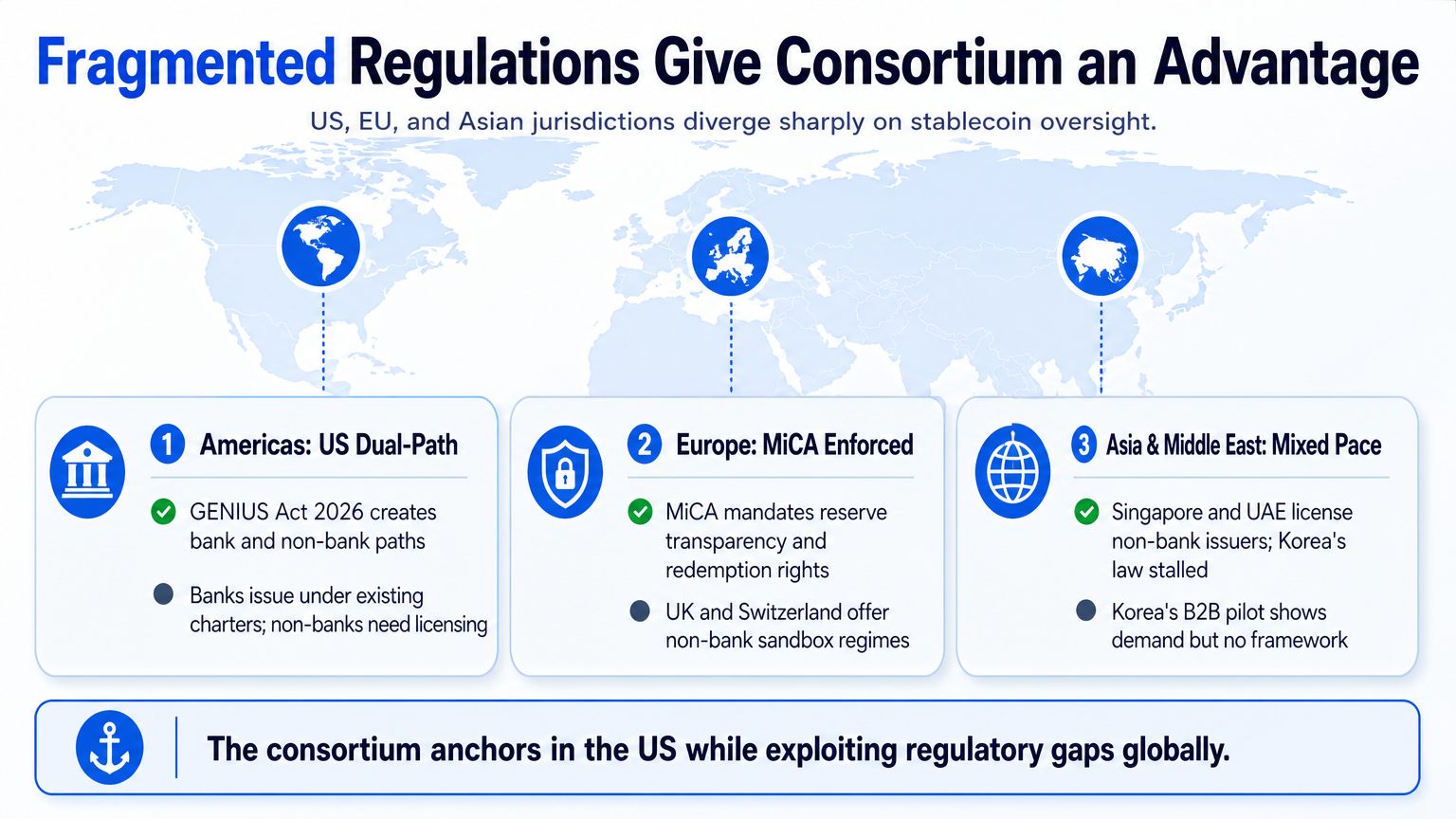
The GENIUS Act 2026 creates a dual federal-state framework for payment stablecoin issuers. Banks issue under existing charters; non-bank issuers need state licensing or federal oversight depending on scale. The Act distinguishes bank-issued stablecoins from fintech ones, and the 21-bank consortium provides an immediate test case. A Federal Reserve note from December 2025 analyzed bank intermediation of stablecoin deposits and flagged disintermediation risks (source). That analysis now reads as operational reality.
EU and Asia: MiCA Enforcement vs. Sandbox Hesitancy
The EU’s MiCA stablecoin requirements mandate reserve transparency, redemption rights, and prudential safeguards—standards the consortium can meet more easily than a startup. MiCA enforcement began in mid‑2025. Singapore and Switzerland license non‑bank issuers through sandbox regimes, while Korea hesitates. The UK has opened a framework for non‑bank issuers, and the UAE is actively attracting stablecoin business with clear rules. The consortium exploits this fragmentation by anchoring in the US while distributing globally.
Why Bank-Issued Stablecoins Change the Calculus for Businesses

From Fintech Nimbleness to Bank-Branch Distribution
Fintech stablecoins grew by serving crypto-native users and then expanding through platforms. Bank‑issued stablecoins arrive through existing corporate banking relationships, treasury contracts, and institutional custody. A CFO who never touched a crypto exchange may receive a stablecoin settlement option from their existing bank—a distribution advantage fintech issuers can’t match without banking partners.
Compliance Layers Tighten: Cross-Border Payments Regulation Meets Crypto Compliance
Bank‑issued stablecoins carry full KYC, AML, sanctions screening, and transaction monitoring at the custodian or protocol layer. This creates a tiered compliance reality: bank‑issued tokens offer clearer redemption rights but tighter oversight; fintech‑issued tokens remain more flexible but face uncertainty if the GENIUS Act’s non‑bank path narrows. For cross‑border payments regulation, this divergence matters—businesses must plan for a world where bank‑issued stablecoins become the default for institutional settlement, squeezing fintech alternatives into narrower lanes.
Crypto compliance for businesses becomes more complex as firms hold both types. A unified compliance umbrella under one KYC perimeter becomes essential.
The DAO and Web3 Treasury Problem
A DAO treasury holds stablecoins for operational liquidity and native tokens for governance. A bank‑issued stablecoin requiring institutional onboarding, corporate resolutions, and board authorization introduces friction that DAO governance may struggle to meet. DAO treasury management diverges from corporate treasury: corporations can open a multi‑currency account and access both; DAOs need a service layer that abstracts the complexity.
| Stablecoin Type | Issuer Class | Redemption Rights | Compliance Burden | DAO Accessibility |
|---|---|---|---|---|
| Fintech-issued (e.g., USDC) | Non‑bank (licensed) | Contractual, reserve‑backed | Moderate | High |
| Bank-issued (consortium coin) | Chartered bank | Regulatory, deposit‑adjacent | High | Low‑moderate |
| Algorithmic/DeFi | Protocol | Market‑dependent | Low | High |
How Platforms Bridge the Old and New Before Regulation Settles
Multi‑Currency Accounts That Treat USDC Like USD
Global businesses today operate a mix of fiat and crypto. A US startup invoicing in USDC, paying contractors in EUR, and holding reserves in both needs a unified account that handles fiat rails and stablecoin on‑off‑ramps. A platform like OneSafe provides multi‑currency balances, free USDC deposit/withdrawal, ACH, wire, and virtual cards under one digital onboarding. That unified compliance wrapper solves the immediate treasury problem while stablecoin regulation hardens.
On/Off‑Ramps Are No Longer Optional
As more stablecoin types enter circulation, the stablecoin on‑ramp off‑ramp becomes a core treasury function. A business receiving a bank‑issued dollar stablecoin must convert it to fiat or another stablecoin for payments. Without embedded on/off‑ramps, that requires an exchange account, custody transfer, and manual reconciliation. With them, the flow is: receive on‑chain, convert in‑platform, pay via wire—all inside the same KYC perimeter.
Moves Global Businesses Should Make Now
Map stablecoin exposure by issuer type and jurisdiction. Categorize every balance as fintech, bank, or algorithmic, and document the redemption mechanism, reserve location, and freeze/clawback triggers.
Unify fiat and crypto accounts under one KYC umbrella. Separate banking relationships multiply compliance surfaces and reconciliation errors. A platform handling both under one framework reduces those risks. For DAOs, customizable roles and permissions let multisig signers authorize on‑chain moves while an ops team handles fiat payables.
Watch Korea’s next legislative session. If the Digital Asset Basic Act passes, Korean banks will move fast—they already piloted B2B stablecoin infrastructure. If it stalls, expect more jurisdictions to see the same pattern: demand without a framework, leaving domestic businesses reliant on foreign‑issued stablecoins.
Open Questions and What Comes Next
Will Non‑Bank Stablecoin Issuers Survive the GENIUS Act?
Survival depends on the licensing path. The consortium’s emergence may pressure lawmakers to raise capital and reserve requirements, narrowing the non‑bank channel. Large, well‑capitalized fintech issuers like Circle and Paxos are best positioned; smaller or offshore issuers without US licensing may be locked out unless they partner with chartered banks—and the consortium makes that partnership less attractive.
Can a Bank Consortium Deliver the Speed and Cost Savings Fintech‑First Stablecoins Promised?
Settlement speed will match other on‑chain stablecoins because they settle on public chains. But cost is uncertain. Banks carry overhead from wire fees and compliance; if transaction fees are higher, the consortium may win on regulatory comfort but lose adoption in high‑volume, low‑margin use cases. The Stablecoin Payments vs. Tokenized Deposits distinction becomes critical here (analysis).
Foreign Stablecoin Issuers — Can They Access US Markets?
Foreign stablecoin issuers can access US markets only if they comply with the GENIUS Act’s licensing requirements—obtaining a federal or state charter, meeting reserve and redemption standards, and subjecting themselves to US oversight. Without that, a foreign‑issued dollar stablecoin cannot be offered legally to US persons. The consortium’s structure, anchored in the US, sidesteps this problem. Fintech‑focused issuers without similar coordination may find on/off‑ramp infrastructure the critical bottleneck; if a foreign stablecoin cannot connect to US fiat rails easily, businesses will gravitate toward tokens that can.
When Will G20 Coordination Replace Fragmentation?
Not in 2027. The consortium creates a de facto standard before a de jure one. The Financial Stability Board has issued recommendations, but they are non‑binding. Until a G20 framework mandates interoperability and reserve standards globally, fragmentation will persist. The consortium’s euro and G7 plans may accelerate coordination in those blocs, but a global standard remains years away.
How Are Stablecoins Regulated in the US?
Under the GENIUS Act 2026, banks issue under existing charters; non‑bank payment stablecoin issuers must obtain a federal or state license, with larger issuers directed toward federal supervision. Reserves must be high‑quality liquid assets, and redemption rights must be clear, with regular attestations.
How Are Stablecoins Regulated Abroad?
The EU enforces MiCA’s reserve transparency and authorization requirements. Singapore and Switzerland license non‑bank issuers under sandbox regimes. Korea’s stalled law leaves its market without a framework, while the UAE proactively licenses stablecoin operations.
How Are Stablecoins Used?
Businesses use stablecoins for cross‑border payments, contractor payouts, and treasury transfers—bypassing correspondent banking delays. DAOs use them for liquidity, grants, and governance payouts. The consortium will likely target institutional settlement, trade finance, and corporate treasury.
What Is a ‘Payment Stablecoin’?
A payment stablecoin is a digital token pegged to a fiat currency (typically the dollar) and designed for payments, not speculation. The GENIUS Act defines it separately from algorithmic or yield‑bearing tokens, requiring 1:1 backing with high‑quality liquid assets.
Key Takeaways
- The 21‑bank stablecoin consortium, H1 2027, shifts issuance from fintech to bank‑anchored—recalibrating risk, distribution, and regulation.
- Korea’s exclusion from the stablecoin consortium, caused by legislative stall, signals how regulatory delay blocks market access—a pattern to watch.
- Businesses must map each stablecoin balance by issuer type and jurisdiction because bank‑issued tokens carry different redemption rights and compliance loads.
- Unified fiat and crypto accounts under one KYC umbrella are a treasury necessity as the issuer landscape fragments.
- The GENIUS Act’s non‑bank path remains viable but is narrowing; prepare for bank‑issued stablecoins becoming the settlement default.
To manage both fiat and crypto treasury from a single dashboard as the stablecoin landscape fragments, open a free OneSafe account and onboard in under a week.