Stablecoin regulation in the UAE pulled ahead in 2026 with clear rules and a dual-track dollar-dirham model, says an Arthur D. Little analyst. On September 1, 2026, Arthur D. Little analyst Mohammad Nikkar told Coin Edition, in a piece carried by Cryptonews.net, that the UAE has pulled ahead of most jurisdictions by offering something rare: clear rules before the market forced them, plus a deliberate plan to run dollar and dirham stablecoins side by side.
For global businesses managing fiat and crypto payments, that distinction matters more than headlines suggest. It turns a compliance question into an operating decision.
Table of Contents
- What Just Happened: UAE Pulls Ahead in Stablecoin Regulation
- Why It Matters for Global Businesses Right Now
- The Background: How We Got to a World Fighting Over Stablecoins
- Concrete Implications for Your Business Operations
- What to Watch Next and Open Questions
- Key Takeaways
What Just Happened: UAE Pulls Ahead in Stablecoin Regulation
The September 2026 Arthur D. Little Analysis
On September 1, 2026, Arthur D. Little analyst Mohammad Nikkar told Coin Edition that the UAE is becoming a leader in the stablecoin market because it combines three things: clear regulations, institutional support, and a plan to use both dollar- and dirham-backed stablecoins. The report, carried by Cryptonews.net, frames the UAE’s move as a deliberate strategy rather than a reaction to private-sector pressure.
Nikkar’s core point is that the UAE is taking a different approach from many other countries. Instead of making dollar stablecoins and local-currency stablecoins compete, the UAE sees them as serving different purposes. That distinction runs through the entire UAE stablecoin framework.
A Dual-Track Model: Dollar and Dirham Stablecoins Work Side by Side
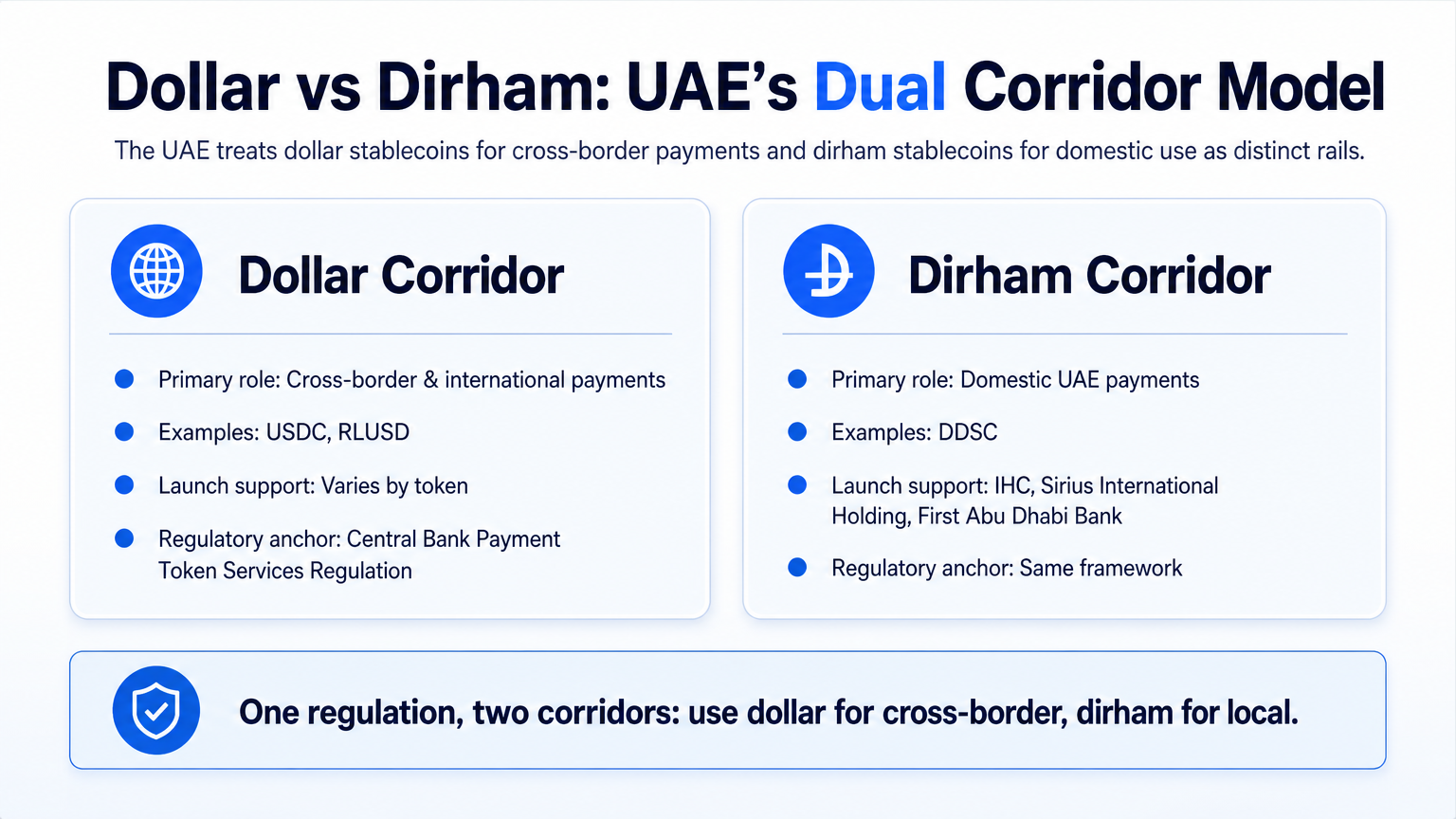
The UAE’s system separates two corridors. Dollar-backed stablecoins such as USDC and RLUSD handle international payments, while dirham-backed stablecoins can be used for payments within the UAE. This is not a two-horse race; it is a division of labor.
The decision rule for operators is straightforward: use dollar stablecoins for any cross-border leg; use dirham stablecoins only where both counterparties are inside the UAE.
| Dimension | Dollar stablecoin corridor | Dirham stablecoin corridor |
|---|---|---|
| Primary role | International and cross-border payments | Domestic UAE payments |
| Examples named in reporting | USDC, RLUSD | DDSC |
| Launch support | Varies by token | IHC, Sirius International Holding, First Abu Dhabi Bank |
| Regulatory anchor | Central Bank Payment Token Services Regulation, June 2024 framework | Same |
The UAE introduced its Central Bank framework for fiat-backed tokens in June 2024, which gave companies clear rules before the market became more developed. The Central Bank’s Payment Token Services Regulation now anchors that framework.
Why It Matters for Global Businesses Right Now
The End of Guesswork: Clear Rules Reduce Operating Risk
Most jurisdictions spent years arguing about stablecoin labels while issuers and users operated in gray zones. The UAE’s early rulemaking, laid out from June 2024, removed a large part of that uncertainty. For a business deciding where to base a stablecoin treasury or payments operation, predictability is a cost advantage.
This is not just about issuers. Stablecoin compliance 2026 increasingly affects treasury teams, CFOs, and payments leads who must know whether a token is legally usable in a given corridor. The UAE’s explicit approval path for fiat-backed payment tokens gives those teams something they rarely get elsewhere: a stablecoin issuer requirements checklist they can point to.
Institutional Backing Creates a Viable Payments Rail
The dirham stablecoin launch that Nikkar cited did not come from a small crypto startup. As reported on September 1, 2026 by Cryptonews.net, the launch of DDSC involved IHC, Sirius International Holding, and First Abu Dhabi Bank. That combination matters because it gives the local-currency stablecoin a bank-grade anchor from day one.
For a global operator, institutional participation is a signal that the rail can support settlement, liquidity, and counterparty risk management at a scale that retail-first experiments cannot. It is also the reason the UAE model feels more like a payments policy than a crypto marketing campaign.
The Background: How We Got to a World Fighting Over Stablecoins
A Quick Primer on Stablecoins and Their Regulatory Problem
What are stablecoins?
Stablecoins are digital assets pegged to a stable reference asset, most often the US dollar. Their regulatory problem is that they sit between payments, securities, and banking law without fitting cleanly into any one category. Reserve backing, redemption rights, and transparency are the recurring concerns. For a deeper look at how they compare with tokenized deposits, see Stablecoin Payments vs. Tokenized Deposits: The Real Story.
How are stablecoins used by businesses?
Businesses use stablecoins for cross-border stablecoin payments, treasury management, and 24/7 settlement outside banking hours. In practice, this means paying an overseas supplier in USDC while keeping a fiat account for payroll and tax. The efficiency gain is real, but it only holds where the regulatory treatment is clear enough to make the token a safe payment asset.
The US Takes a Swing with the GENIUS Act
How are stablecoins regulated in the US?
The GENIUS Act stablecoin framework, the main US federal proposal in 2026, categorizes payment stablecoins and creates federal and state issuer paths. Reserves, redemption rights, and disclosure remain central. The SEC staff’s stablecoin regulatory framework names the same core issues. The US approach is still being built, which means dollar stablecoin regulation in the US remains a patchwork of state money transmission rules and federal proposals rather than a single clean rulebook.
How the UAE’s Approach Differs—and Why That Matters
How are stablecoins regulated abroad?
Any stablecoin regulation global comparison in 2026 has to accept that most jurisdictions remain fragmented. Some markets, like the UK, have shifted toward an innovation-led mandate; see UK Stablecoin Regulation Shift: What It Means for Businesses. Asia’s hubs are also experimenting, as covered in Stablecoin Payments: Asia’s Hubs Lead the Way. What most jurisdictions lack is the UAE’s ability to say clearly which token is for what use.
What is the UAE's approach to stablecoin regulation?
The UAE stablecoin framework treats payment tokens as regulated payment infrastructure, not as an asset class to be debated. The June 2024 Central Bank framework for fiat-backed tokens sets out stablecoin issuer requirements under the Payment Token Services Regulation. Elliptic’s summary of the UAE Central Bank’s registration plan and Ripple’s analysis of the UAE’s blueprint both highlight the same point: the UAE created a registration path early, then let the market populate it.
Concrete Implications for Your Business Operations
Reassessing Your Banking Partners and Jurisdictions
If your company moves funds between the UAE and other markets, the 2026 question is no longer “should we use stablecoins?” but “which corridor do we use them in?” That has consequences for banking partners. A bank that will not touch stablecoin business payments creates a forced workaround; a bank or platform that can hold both fiat and stablecoin balances removes it.
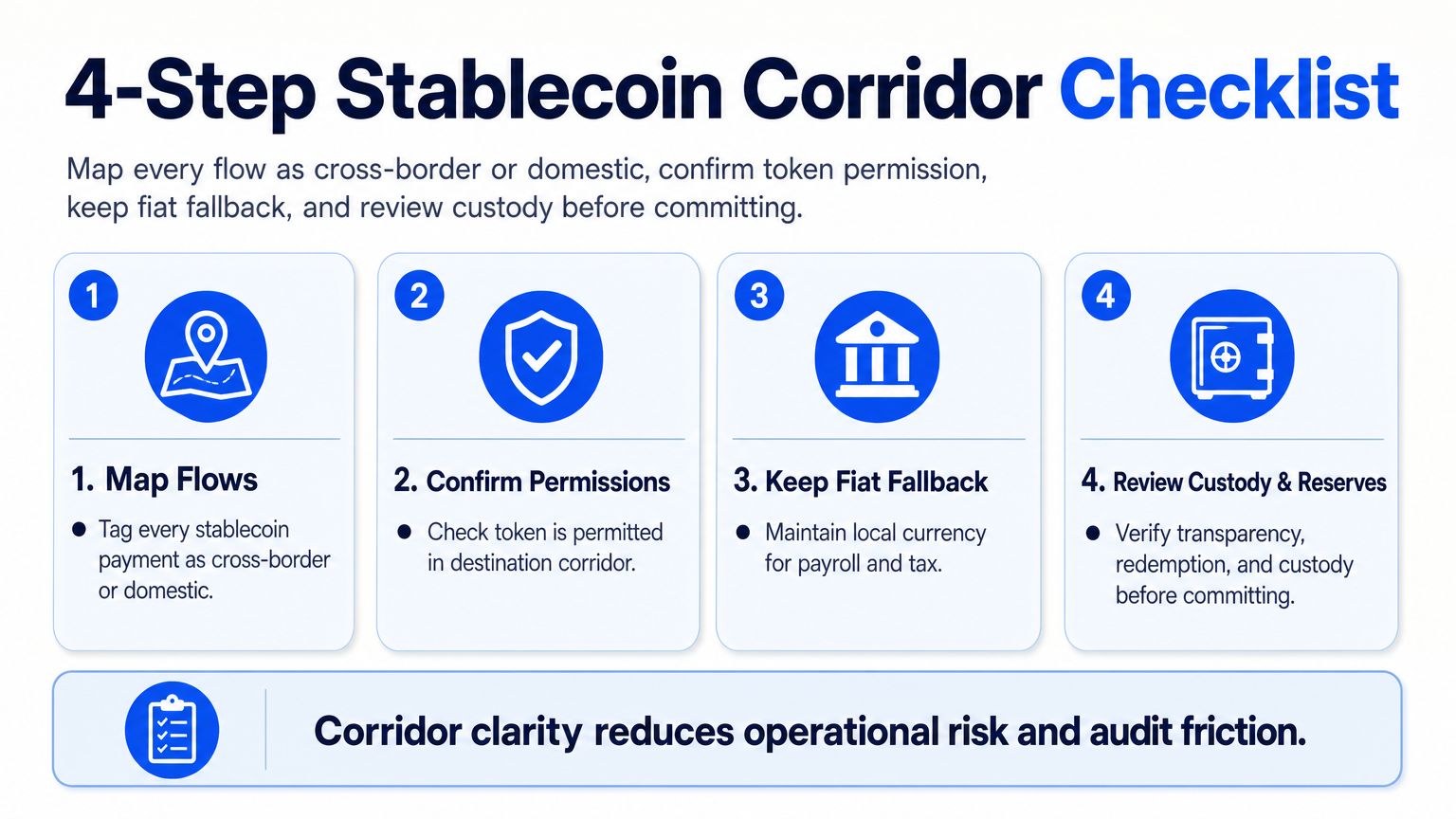
A practical operator checklist looks like this:
- Map every stablecoin flow as cross-border or domestic.
- Confirm the token is permitted in the destination corridor.
- Keep a fiat fallback in the local currency for payroll and tax.
- Review custody, redemption, and reserve transparency before committing balance-sheet assets.
Dollar Stablecoins for Global Payments, Dirham for Local—What That Looks Like in Practice
Suppose a company has a UAE entity, pays suppliers in Asia, and pays local contractors in dirhams. Under the UAE model, the cross-border flow runs through a dollar stablecoin such as USDC or RLUSD. The local flow, where both parties are inside the UAE, can run through a dirham stablecoin. That split avoids force-fitting one token into both jobs.
It also means the treasury team can optimize exchange risk differently: dollar exposure stays in the dollar corridor, and dirham exposure stays local. Stablecoin business payments become easier to audit because the corridor choice is visible. For a comparison of B2B pilots in another market, see Stablecoin Payments for B2B: Inside Korea’s New Pilot.
How Platforms Like OneSafe Operationalize Multi-Currency Stablecoin Management
How can businesses manage stablecoin payments in multiple currencies?
Businesses need a single ledger that can hold fiat currencies and stablecoin balances without forcing an artificial choice between the two. The practical solution is a platform that supports segregated multi-currency accounts, stablecoin deposit and withdrawal rails, and fiat on/off-ramps in the same interface. Reconciliation and reporting should follow the same corridor logic as the UAE model: cross-border stablecoins for external legs, local fiat or local stablecoin for domestic legs.
What does a neobank like OneSafe do to support stablecoin transactions compliantly?
OneSafe is a financial technology company, not a bank; its banking services come through partners. The platform supports fiat and cryptocurrency transactions, including ACH, domestic and international wire transfers, bill payments, instant crypto-to-fiat conversions, and multi-currency accounts in USD, EUR, and CAD. Crypto deposits and withdrawals in USDC are free, and digital assets are held through Fireblocks custody with mandatory multi-factor authentication. For global businesses, that means neobank stablecoin management without requiring a bank charter internally. The broader neobank model is explained in What Is a Neobank? A Guide for Businesses & Crypto.
What to Watch Next and Open Questions
Will Other Countries Copy the UAE Model?
The UAE’s dual-track design is easier to admire than to replicate. It requires a central bank willing to legislate before a crisis, a local currency with enough domestic payment volume, and institutions willing to anchor a local stablecoin at launch. The UK and Asian hubs are moving, but few have put the dollar and local-currency rails into a single coherent framework. The next 12 to 18 months will show whether the UAE’s clarity becomes a regional standard or stays an outlier.
The Interoperability Problem No One Has Solved
Even with clear regulation, no jurisdiction has solved interoperability across multiple stablecoins, chains, and settlement systems. A UAE operator may hold USDC on one network, RLUSD on another, and a dirham token on a third. Without a consolidated platform, that becomes three reconciliations instead of one. The tokenized deposit conversation adds another layer; see Stablecoin Payments vs. Tokenized Deposits: The Real Story for the distinction.
When Does Stablecoin Regulation Start to Bite for Non-Issuers?
Most current rules target issuers, but non-issuers will not stay outside the perimeter forever. Travel-rule compliance, wallet identity verification, and transaction monitoring are already creeping into user-facing requirements in some markets. Ape Law’s stablecoin regulatory compliance checklist frames the issuer side, but the same categories—custody, redemption, transparency—will eventually shape corporate user obligations too. The open question is when, not whether.
Key Takeaways
- The UAE’s September 1, 2026 Arthur D. Little report confirms that its stablecoin lead rests on early rules, institutional backing, and a dollar-versus-dirham corridor split.
- The operating rule is clear: use dollar stablecoins for cross-border legs and dirham stablecoins for domestic UAE payments.
- Stablecoin compliance 2026 is becoming a treasury decision, not just a legal one, because corridor choice determines settlement speed, FX exposure, and counterparty risk.
- Businesses should map their stablecoin flows now, confirm token permissibility in each jurisdiction, and keep a fiat fallback for payroll and tax.
- A platform that combines multi-currency fiat accounts with compliant stablecoin rails removes most of the operational overhead without requiring a bank charter internally.
If you want a single interface for multi-currency fiat and stablecoin flows under the new UAE-style corridor reality, open a OneSafe account.