Crypto Treasury Management Shift as US Drops Mixer Rules
The landscape of crypto treasury management entered a new chapter on October 5, 2026. The U.S. Treasury Department’s Financial Crimes Enforcement Network (FinCEN) withdrew two proposals that had hung over digital asset operations for years: the 2023 mixing rule and the 2020 self-hosted wallet reporting rule. For treasury managers at startups and DAOs, the move immediately reduces the compliance overhead that had been looming and reopens the door to privacy-preserving tools once feared off-limits.
Table of Contents
- What is crypto treasury management?
- What Just Happened: The Treasury’s Withdrawal of Mixer & Wallet Rules
- How does the Treasury’s withdrawal affect crypto treasury management?
- The Background: A Brief History of the Regulatory Push
- What are the new compliance requirements after the rule reversal?
- Concrete Implications for Your Treasury Operations
- Recommended Actions for Treasury Managers Today
- How should DAO treasuries respond to the self-hosted wallet rule change?
- What risks remain in crypto treasury management post-rule withdrawal?
- What to Watch Next: Open Questions and the Road Ahead
- What’s next for crypto treasury regulation?
- Key Takeaways
What is crypto treasury management?
Crypto treasury management covers the policies and tools a business or DAO uses to steward digital assets—custody, liquidity, payments, risk, and regulatory reporting. Resources like the Cobo enterprise guide and Breezing’s 2026 treasury management overview explain the operational mechanics, but the regulatory dimension has always been the hardest piece to manage. That’s why FinCEN’s latest action matters.
What Just Happened: The Treasury’s Withdrawal of Mixer & Wallet Rules
According to BigGo Finance on October 5, 2026, FinCEN withdrew a 2023 rule that would have designated international crypto mixing as a primary money laundering concern under Section 311 of the USA PATRIOT Act, and a 2020 proposal to extend reporting requirements to transactions involving unhosted (self-hosted) wallets. Neither rule had been finalized, so existing Bank Secrecy Act (BSA) obligations remain unchanged. (BigGo Finance)
The decision aligns with a broader policy shift that started with the President’s Working Group on Digital Asset Markets’ 2025 report and the earlier withdrawal of Tornado Cash sanctions. Regulators are now distinguishing lawful financial privacy from illicit concealment, rather than treating privacy-enhancing tools as inherently suspect.
How does the Treasury’s withdrawal affect crypto treasury management?
The withdrawal removes two specters. The self-hosted wallet rule would have forced financial institutions to collect counterparty information even for routine transfers to company cold wallets, making self-custody far more cumbersome. The mixing rule could have blacklisted any transaction touching a mixer, even for legitimate uses like commercial confidentiality or payroll privacy.
Now, crypto treasury management 2026 can recalibrate. Compliance teams no longer need to build systems for rules that never materialized. Instead, they focus on existing BSA requirements with a risk-based approach that acknowledges legitimate privacy tools.
The Background: A Brief History of the Regulatory Push
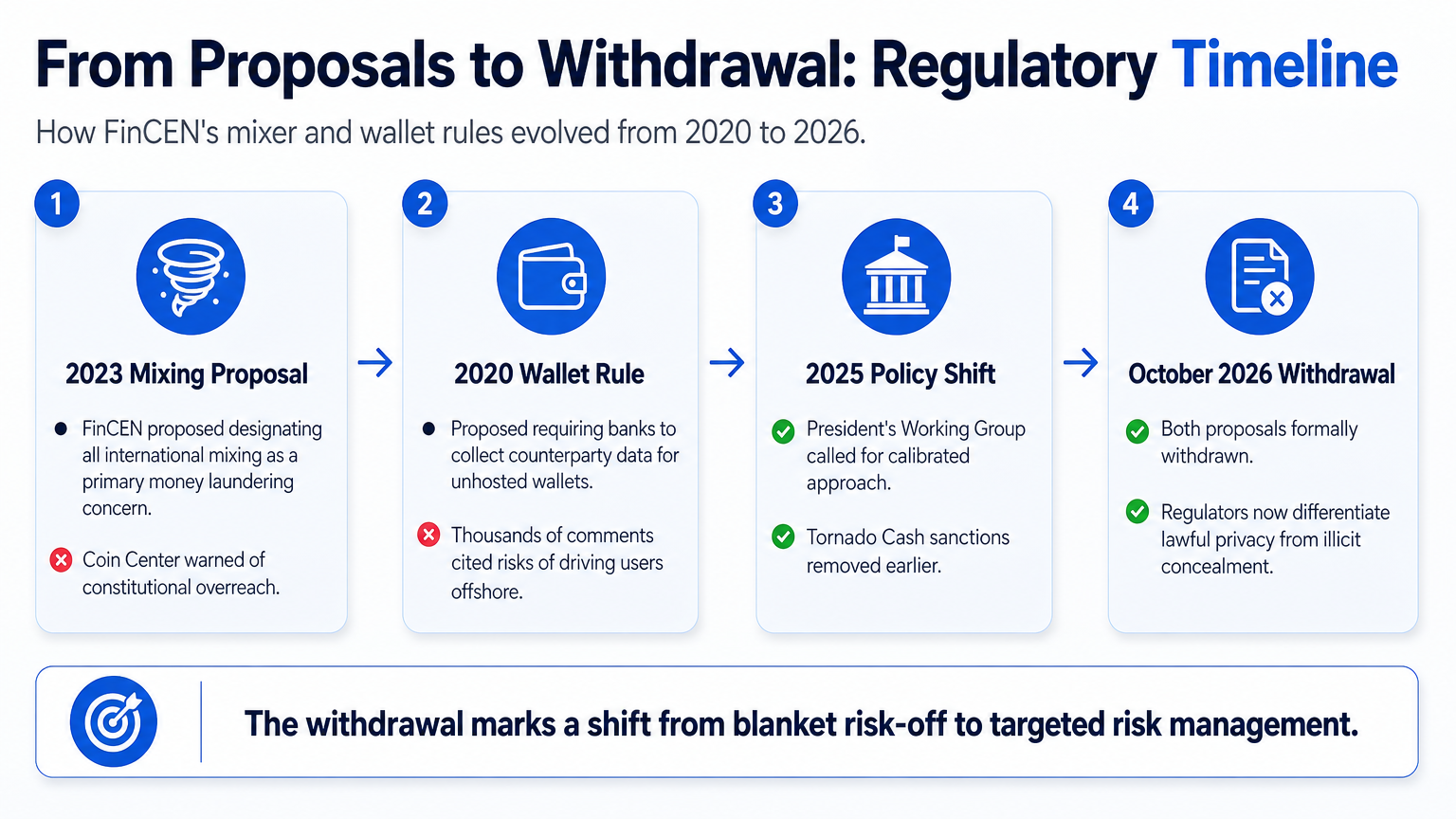
2023 mixing proposal: FinCEN proposed designating all international mixing as a primary money laundering concern, requiring U.S. financial institutions to sever ties with mixing activity. Coin Center argued the broad language would violate constitutional protections and chill innovation.
2020 self-hosted wallet rule: FinCEN proposed requiring banks and MSBs to collect counterparty information on transactions above thresholds involving unhosted wallets. Thousands of comments warned it would push users toward opaque offshore venues. The proposal languished until now.
Broader policy shift: The 2025 President’s Working Group called for a more calibrated approach. The withdrawal of mixer and wallet rules, following Tornado Cash sanctions removal, reflects a move from blanket risk-off to targeted risk management. (See Crypto Banking’s New Split: Production vs. Pilots for context.)
What are the new compliance requirements after the rule reversal?
No new federal requirements. Existing BSA obligations—transaction monitoring, suspicious activity reporting, sanctions screening—remain the baseline. The withdrawal means treasury managers can stop treating every mixer transaction as inherently high-risk or demanding KYC on every self-hosted wallet. Instead, adopt a risk-based posture that differentiates legitimate privacy from money laundering.
Concrete Implications for Your Treasury Operations
Compliance burden eases: Companies can dial back on-chain analytics configured to flag all mixer usage as suspicious. Monitoring remains essential, but mixer exposure shifts from automatic escalation to context-dependent review.
Self-custody strategies: The removal of the wallet rule removes a major disincentive to cold storage. Businesses can reevaluate self-custody’s security and cost benefits. For DAOs, on-chain treasury logic is core to governance—Crypto Treasury Management: Lessons from Compound’s Vote illustrates careful self-custody aligned with decentralized governance.
Privacy tools: Mixers and other privacy tech gain breathing room. Treasury managers can integrate a privacy layer for legitimate purposes if they document the business rationale. The key is internal records that satisfy a regulator.
Reporting adjustments: Risk matrices can reclassify mixer interaction from automatic high-risk to a factor evaluated alongside other red flags. BSA still requires reporting suspicious activity; mixer usage remains relevant but no longer decisive alone.
Recommended Actions for Treasury Managers Today
Reassess wallet infrastructure: Review your custody architecture. If you moved toward custodial solutions to avoid potential reporting rules, consider whether a hybrid or self-custodied setup now offers a better risk‑reward profile. Platforms like OneSafe provide secure, permissioned custody that balances control and compliance.
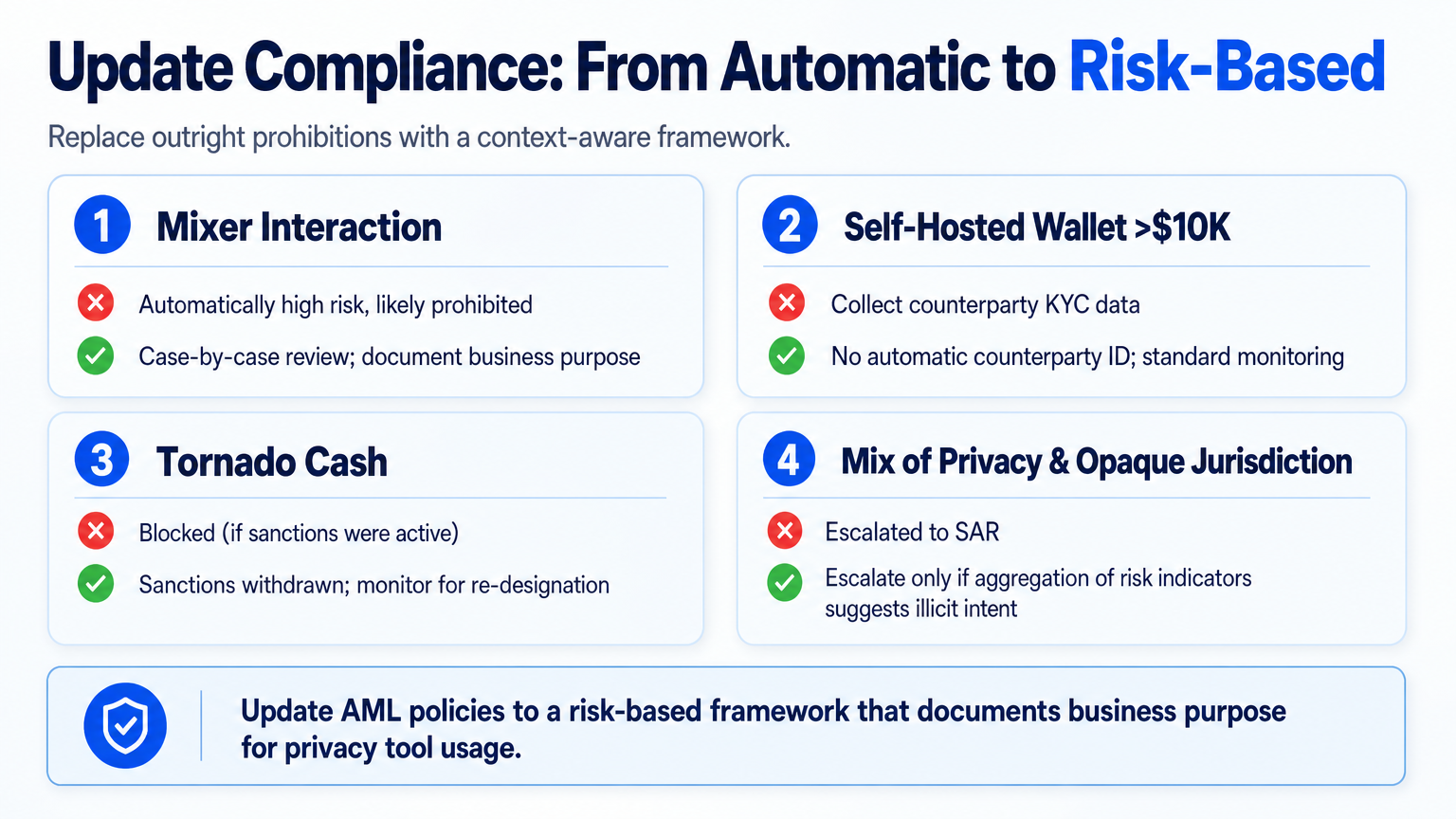
Update internal compliance policies: Refresh AML policies and crypto treasury best practices. Replace outright prohibitions on mixer or self-hosted wallet interactions with a risk-based framework:
| Risk Factor | Old Approach (Pre-Withdrawal) | New Approach (Post-October 2026) |
|---|---|---|
| Mixer interaction | Automatically high risk, likely prohibited | Case-by-case review; document business purpose |
| Self-hosted wallet above $10,000 | Collect counterparty KYC data | No automatic counterparty identification required; apply standard transaction monitoring |
| Tornado Cash or similar OFAC-listed entities | Blocked (if sanctions were active) | Sanctions withdrawn; monitor for future re-designations |
| Transaction with mix of privacy and opaque jurisdiction factors | Escalated to SAR | Escalate only if aggregation of risk indicators suggests illicit intent |
Monitor jurisdictional nuances: Federal withdrawal doesn’t override state requirements (e.g., New York’s BitLicense) or international rules like the EU’s MiCA, which tightens self-custody and privacy reporting. Maintain a unified but flexible compliance playbook.
How should DAO treasuries respond to the self-hosted wallet rule change?
DAOs, which rely on self-custodied multisigs, benefit the most. No imminent federal mandate means on-chain payments won’t trigger burdensome counterparty identification. Still, maintain transparent transaction records, enforce spending limits with role-based permissions, and document any mixer interactions. Digital asset treasury operations can now operate with the tools of decentralized governance without fearing reporting mandates.
What risks remain in crypto treasury management post-rule withdrawal?
The withdrawal reduces but doesn’t eliminate risk. State regulators (e.g., New York) could still act against mixer use that violates local money transmitter laws. International jurisdictions may criminalize mixers outright. A future administration could reintroduce similar rules, so avoid building workflows on an assumption of permanence. Reputational risk remains: banking partners and payment processors may still derisk mixer-affiliated entities. (For context on banking access, see What the ICBA Lawsuit Means for Crypto Banking.)
What to Watch Next: Open Questions and the Road Ahead
State-level actions: New York’s DFS hasn’t commented; a split regime between federal leniency and state severity could emerge. California is another wildcard.
Congressional action: Legislation could codify or reverse the current direction, but no bill is imminent. Watch for digital asset market structure hearings.
International alignment: The EU’s MiCA and upcoming AML package will impose stricter self-custody reporting, forcing multinational treasuries to maintain separate compliance playbooks. The divergence may spur innovation in zero-knowledge proof-based compliance tools.
What’s next for crypto treasury regulation?
The 2026 withdrawals mark an inflection point, not an endpoint. The Treasury’s action signals more deliberate, less reactive rulemaking. Treasury managers can expect a period of relative federal calm to embed best practices without a moving target. However, international divergence and state-level activism guarantee uneven regulatory changes. The smart move is to build a compliance architecture flexible enough to adapt—relying on transparent, auditable processes that satisfy today’s regulators and quickly absorb tomorrow’s rules.
Key Takeaways
- FinCEN’s withdrawal of the 2023 mixing rule and 2020 self-hosted wallet reporting proposal eliminates two major compliance overhangs for crypto treasury management.
- No new federal requirements replace them; existing BSA obligations remain. Compliance teams can now adopt a risk-based stance toward mixers and self-custody.
- DAOs and startups can safely re-embrace self-custody and evaluated privacy tools, provided they document legitimate business purposes and monitor for other risk indicators.
- Risks persist at state and international levels, so tailor policies to a fragmenting global landscape.
- Use this window of regulatory clarity to update internal policies, reassess wallet infrastructure, and build flexibility into compliance frameworks.
Get started with a financial platform built for the realities of crypto treasury management today—explore OneSafe’s unified fiat and crypto accounts.